Your Organic Traffic Just Dropped 58%. Google Isn't Sorry.
Google AI Overviews cut position-1 CTR by 58%. Here's why ranks stopped meaning traffic, and the 4-part GEO system that gets you cited in AI answers.
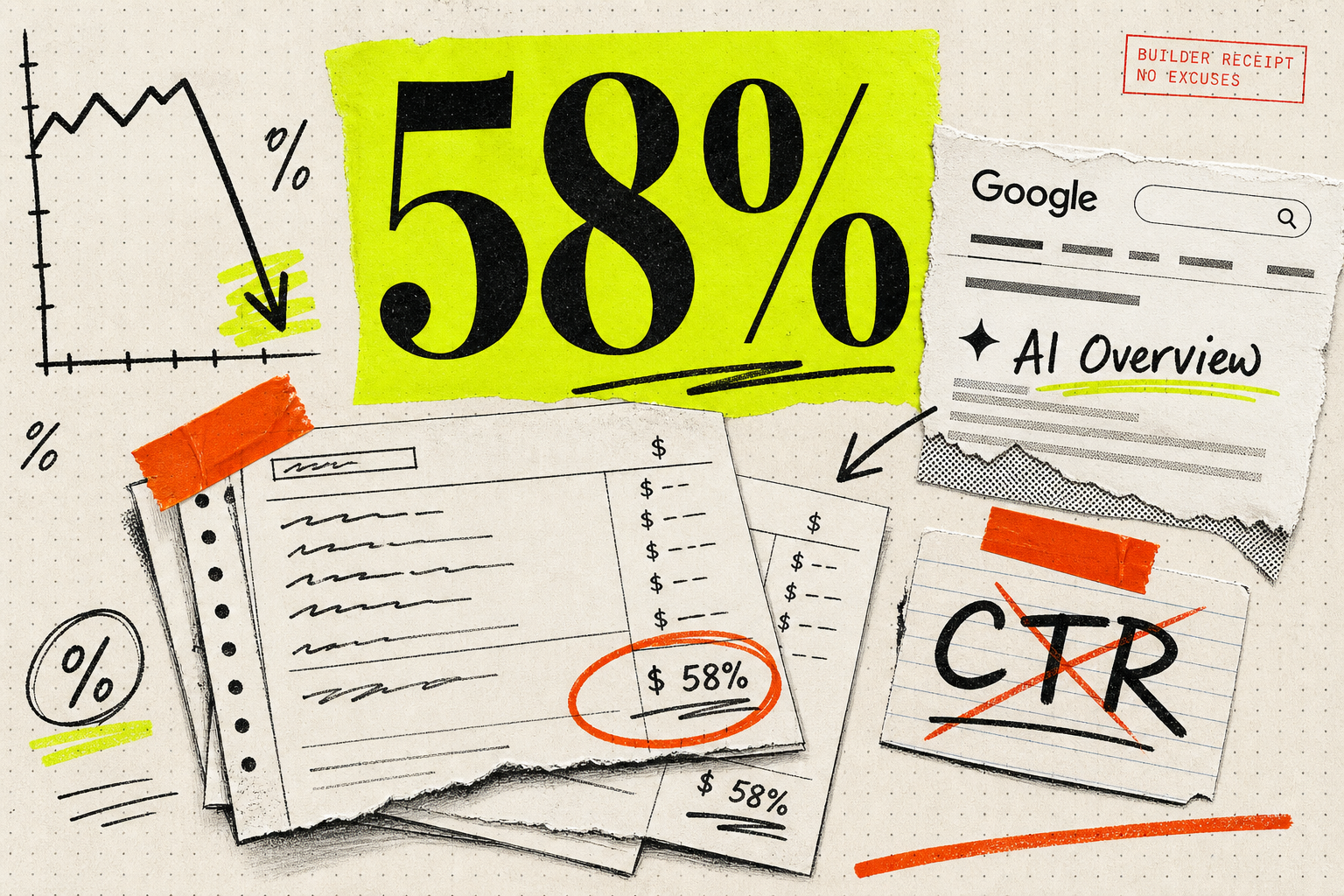
Your position-1 ranking used to mean traffic. Now it means Google reads your page, summarizes it above the fold, and sends 58% fewer clicks your way[1]. Same rank. Half the visitors. No warning email.
If your organic funnel is quietly bleeding this quarter and nobody on your team can explain it — that's what happened. And nobody's coming to fix it for you.
Here's what's actually going on, why the "just make better content" advice is useless now, and the 4-part system I build for operators who want to show up when their buyers ask an AI a question.
The three numbers you need to sit with
One: Ahrefs studied 300,000 keywords and found position-1 CTR drops 58% when an AI Overview appears[1]. Seer Interactive puts the range at 49-65%[1]. Same story, different data set.
Two: 68% of Google searches in early 2026 ended without a single click to any website — up from 58.5% in 2024[2]. The user got their answer in the results page. You never existed.
Three: Gartner forecasted traditional search volume drops 25% by 2026 as AI absorbs query share[3]. That forecast is now real — publishers and enterprise sites are reporting exactly that decline.
Your SEO agency isn't lying to you. Your rankings are the same. The rankings just don't do what they used to do.
Why "make better content" is the wrong answer
Every SEO thread on X right now says the fix is "publish more, publish deeper, add E-E-A-T." That advice was correct in 2022. In 2026 it's a treadmill that pays out less every month.
The truth is uglier: Google isn't the only search engine anymore. And for high-intent B2B queries — the kind that turn into a $30K deal — ChatGPT and Perplexity are eating share fast.
ChatGPT referral traffic to publishers grew 9.9x in 19 months, and it accounts for 92.4% of all AI-driven referrals[4]. Between September 2024 and March 2026, ChatGPT web visits grew 84% and mobile users 156%. Gemini web traffic went up 9x. App users up over 1,100%[5].
Here's the interesting bit: those AI referrals convert at 11.4% versus 5.3% for organic traffic across global ecommerce[6]. And they view nearly twice as many pages and spend twice as long on site as regular visitors[4].
Fewer visitors. Better visitors. When was the last time your SEO deck mentioned that trade?
What actually changed under the hood
Google search, ChatGPT, Perplexity, Claude — they all now do the same thing at query time. They read the top ~15 pages, extract claims and citations, synthesize an answer, and cite (or don't) the sources they leaned on.
You're not trying to rank a page anymore. You're trying to be the source an AI cites when it writes the answer.
This has a name now: Generative Engine Optimization, or GEO. It's covered in Search Engine Land as of February 2026 as "no longer optional"[7]. And unlike traditional SEO, the winning tactics are measurable and specific.
A well-cited academic study on GEO tested tactics across thousands of queries. Three moves that measurably boost citation rates in AI answers[8]:
- Adding direct quotes: +27.8% citation lift
- Adding statistics: +25.9%
- Adding source citations: +24.9%
Not "write better." Not "add EEAT." Concrete edits. Quotable claims. Numbers. Footnoted sources. Written for a machine that's reading 15 pages in parallel and picking the ones that make its answer sound credible.
The 4-part GEO system I'd build if I were you
If I were auditing a $5M professional services firm today whose leads have gone quiet, this is the system I'd install. Four parts. All measurable. Runs on your existing tech.
1. Answer-shaped content
Stop writing 2,500-word "ultimate guides" that bury the answer at scroll depth 60%. Start writing pages that answer one buyer question in the first 100 words, with a direct quotable claim, backed by a number and a source.
Rewrite your top 20 pages to look like this: The question in the H1. The answer in the first paragraph. Supporting evidence in the next three. This is the format AI engines lift from. It's also the format that converts human skimmers.
2. Off-page GEO (your Wikipedia and Reddit game)
Generative engines lean on a small pool of trusted sources: Wikipedia, Reddit, YouTube transcripts, G2, Capterra, top publications[9]. If your brand shows up on those, you show up in AI answers even when your site isn't cited directly.
Concrete moves — none of which most operators are doing:
- Claim your Wikipedia entity if you're above the notability bar. If not, seed the citations that will eventually get you there.
- Get listed and reviewed on the top review sites in your category (G2 for SaaS, Capterra for tools, industry-specific directories otherwise).
- Contribute real answers to the top 3 subreddits in your category. Not spam. Actual expertise, over months.
- Pitch to the publications generative engines cite frequently. Search Engine Land, TechCrunch, industry trade press — not "AI content farms."
3. Track your AI visibility (not just your rank)
You already track Google rank. You probably don't track: does your brand appear when a buyer prompts ChatGPT with "best [your category] tools"?
Tools exist for this now — Profound, Otterly AI, SEOcrawl AI — they run category prompts against ChatGPT, Gemini, and Perplexity and tell you your citation share[10]. If you can't afford one yet, do it manually: pick 10 category prompts. Run them monthly. Track when you appear and how you're described.
Almost nobody is doing this yet. That's your opportunity. In 18 months everyone will be. Get the data now while the field is empty.
4. Structure for the crawlers you don't see
GPTBot, ClaudeBot, PerplexityBot, GoogleOther — they're all crawling you right now. Check your server logs. Most operators have never looked.
- Serve clean HTML (not just JS-rendered content) — AI bots handle JS badly.
- Add schema markup for FAQ, HowTo, Product, Article.
- Put author bios with real credentials on every post. E-E-A-T signals still matter, and AI models weight them.
- Don't block AI crawlers in robots.txt unless you have a licensing deal in place. Blocking is losing.
What this looks like 90 days in
Here's what a real GEO rollout does in a quarter, for a small-team operator:
- Weeks 1-2: Audit which of your existing top-20 pages are already being cited by ChatGPT. Baseline your visibility.
- Weeks 3-6: Rewrite those top 20 pages in the answer-first format. Add pull quotes, stats, and source citations to every page.
- Weeks 7-10: Off-page push. Reddit answers, G2/Capterra listings, one guest post in a publication AI engines cite.
- Weeks 11-13: Measure. Check citation rate. Check AI referral traffic in GA4. Check whether your name comes up when a buyer prompts ChatGPT with your category.
You will not 10x your traffic. You'll do something more useful: you'll be visible to the 68% of searchers who never click, and you'll capture referral traffic that converts at 2x organic rates.
Meanwhile the operator across the street is still asking his agency why his ranks are the same but his form fills are down 40%. His agency will tell him to publish more blog posts.
The uncomfortable part
Most agencies aren't going to walk you through GEO because their whole model is billing you for content. GEO is less content, better content, and off-page work most agencies don't know how to do.
If you want this built for your business — the audit, the answer-first rewrite of your top pages, the off-page playbook, the tracking dashboard so you can actually see whether it's working — that's what the free audit call is for. 30 minutes. I'll tell you what your version would look like and what it would take to run it. No pitch.
Your rank is fine. Your funnel isn't. That's a GEO problem.
-
Update: AI Overviews Reduce Clicks by 58%↩
Ahrefs' study of 300,000 keywords found position-1 CTR drops 58% when AI Overviews are present.
-
In 2026, Less than One Third of Google Searches Still Send a Click↩
68% of US Google searches ended without a click in early 2026, up from 58.5% in 2024 (SparkToro + Datos study).
-
AI SEO Statistics 2026↩
Gartner forecasted a 25% drop in traditional search volume by 2026; publishers are now reporting it.
-
250+ AI SEO Statistics for 2026↩
AI referral traffic grew 9.9x in 19 months and ChatGPT accounts for 92.4% of it (Similarweb data).
-
200+ AI SEO Statistics↩
ChatGPT web visits grew 84% and mobile users 156% between Sept 2024 and March 2026; Gemini traffic grew 9x.
-
AI Search Referral Traffic Statistics 2026↩
AI referrals convert at 11.4% vs 5.3% for organic across global ecommerce (Similarweb via ALM Corp).
-
Mastering generative engine optimization in 2026↩
GEO — being the source AI engines cite — is called 'no longer optional' as of Feb 2026.
-
GEO Strategy: Build Authority in Generative AI 2026↩
GEO academic study: adding quotes (+27.8%), statistics (+25.9%), and citations (+24.9%) measurably boost AI citation rates.
-
GEO Complete Guide for 2026↩
Generative engines lean on a small pool of trusted sources (Wikipedia, Reddit, G2, YouTube transcripts) — off-page GEO drives citations.
-
10 Proven Ways to Rank Your Business on ChatGPT in 2026↩
Tools like Profound, Otterly AI, and SE Ranking track brand mention frequency across ChatGPT, Gemini, and Perplexity.
Ready to build your own AI system?
Book a Free Audit Call →Keep Reading
Buyers Shortlist You In ChatGPT Before You Know They Exist
51% of B2B buyers start vendor research inside an AI chatbot. If you're not in the model's shortlist, your funnel already ended. Here's the fix.
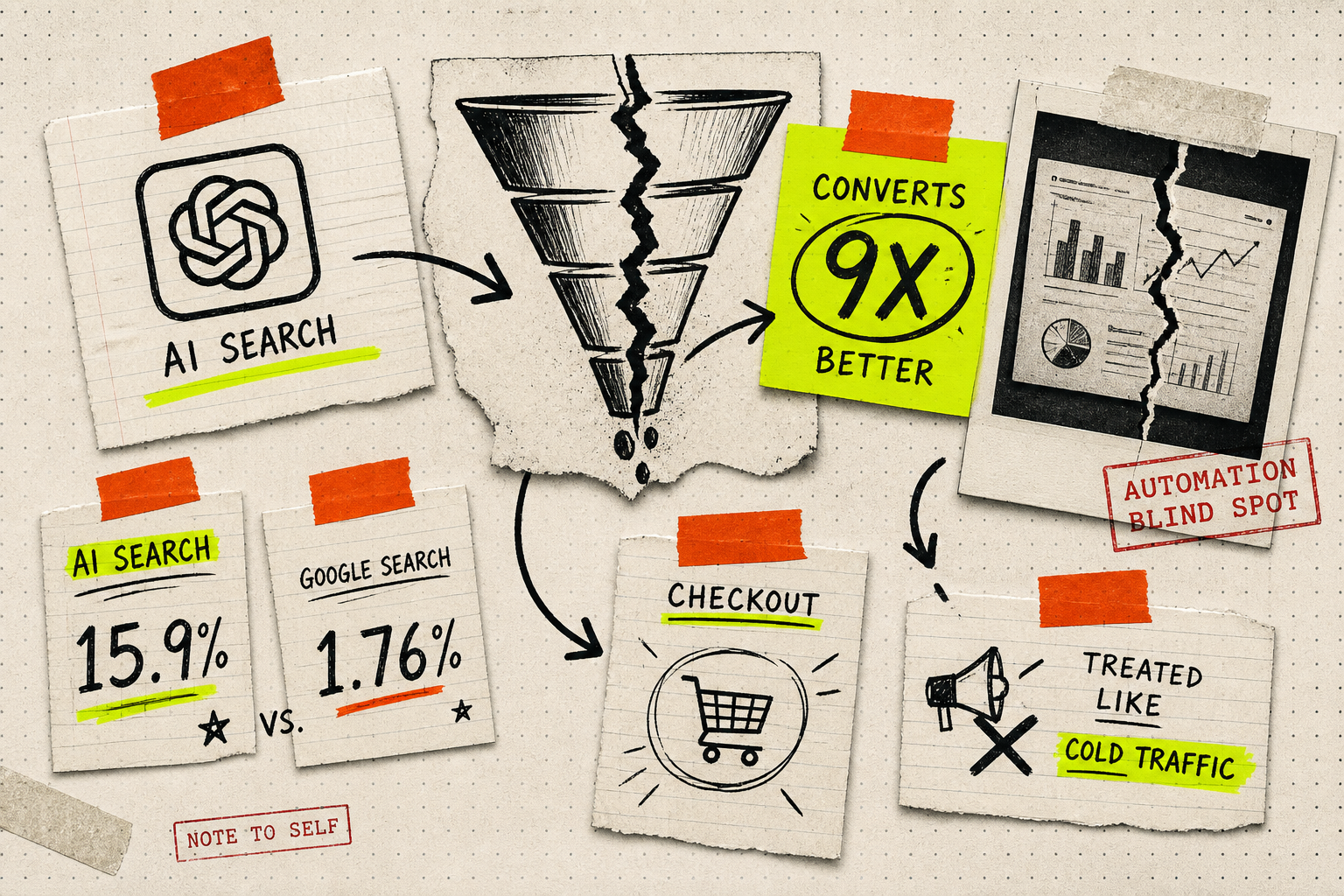
AI Search Broke Your Funnel. Your Automation Doesn't Know Yet.
ChatGPT traffic converts at 15.9%. Google at 1.76%. Your marketing automation is treating both the same — and burning your best leads.
Your Business Is Invisible In ChatGPT. Here's Why.
Your customers are asking ChatGPT for a plumber, a Shopify agency, a bookkeeper — and your business isn't in the answer. Here's why, and the 4-part fix.