Your Business Is Invisible In ChatGPT. Here's Why.
Your customers are asking ChatGPT for a plumber, a Shopify agency, a bookkeeper — and your business isn't in the answer. Here's why, and the 4-part fix.
Your customers are asking ChatGPT for a plumber, a Shopify agency, a bookkeeper — and your business isn't in the answer. Not because your SEO is broken. Because AI doesn't read like Google does.
Here's what's actually happening and the 4-part fix I'd build if it were my business.
The math has already flipped
ChatGPT hit 900 million weekly active users by February 2026[1]. Referral traffic from ChatGPT jumped 36.7% in May 2026 alone across a 101,574-site panel[2]. And it converts: Similarweb clocks ChatGPT referral traffic at a 7.1% conversion rate — second only to paid search at 7.8%, and ahead of Google organic, direct, social, and email[3].
The volume is still small — most sites get 0.1–0.5% of their traffic from ChatGPT today[4]. But that's the wrong number to fixate on. The right number is 5x. AI referral visits hit 1.13 billion in the first half of 2026, up 357% year-over-year, and convert at roughly 5x the rate of Google clicks[5].
Meanwhile Google is quietly bleeding your top-of-funnel traffic. Non-branded informational queries are down 15–30% across content sites since AI Overviews rolled out[6]. If your business gets found because someone Googles "how do I fix X" and lands on your blog — that pipeline is already smaller than it was 12 months ago.
The buyers didn't disappear. They're just asking a different box.
Why your SEO isn't translating
Old SEO optimized for one query → ten blue links. AI search optimizes for one query → one paragraph, stitched together from anywhere between 3 and 20 sources via retrieval-augmented generation (RAG)[7].
The engines don't agree on which sources. Discovered Labs analyzed thousands of AI responses and found:
- ChatGPT cites Wikipedia in 47.9% of responses — it wants consensus, structured, high-authority pages[8].
- Perplexity cites Reddit 46.7% of the time — it wants real people talking in real threads[8].
- Google AI Overviews overlap 54% with the traditional organic top-10 — closest to old SEO[8].
- Claude wants technical depth and precision — it barely touches Reddit and rewards actual documentation[8].
Same customer question, four totally different recipes for who gets cited. This is why the "just write good SEO content" advice is failing. Good SEO content is one input to one of four engines. And the biggest one — ChatGPT — doesn't rank you the way Google does.
What actually gets you cited
Princeton, Georgia Tech, IIT Delhi and the Allen Institute published the peer-reviewed GEO paper at KDD 2024 — 10,000 queries across 10 generative engines. Their finding: three specific content moves lift AI citations by up to 40%[9]:
- Add statistics. Not adjectives. Numbers with sources. "Cut costs 32%" beats "significantly reduced costs."
- Add citations. Quote and link named third-party sources inline. The AI trusts pages that already trust other pages.
- Add quotations. Direct quotes from authorities on the topic — even short ones — raise citation odds materially.
Layer on what the platform-specific studies show. Konabayev's analysis of 52 citation studies found sites with 350K+ referring domains are 5x more likely to be cited by ChatGPT than sites with 200[10]. Direct-answer paragraphs in the first 2–3 sentences double-to-triple citation odds. Yext's own study across ChatGPT, Perplexity, Gemini and Claude concluded the single most-cited content type — over half of all citations — is verified, structured data[11].
Translation: The AI is choosing pages that give it clean, factual, cite-able chunks it can lift into an answer. If your homepage says "We help businesses grow with AI-powered solutions," you're invisible. There's nothing to lift.
The 4-part fix I'd build
If a $2M–$20M business hired me tomorrow to get found in AI answers, here's the stack — in order.
1. A "one-paragraph answer" for every buyer query
Take your top 20 sales-conversation questions. For each one, write a 40–80 word direct answer at the top of the corresponding page. Not marketing prose. The literal answer, with a number in it. "Our average install takes 6 weeks." "We charge $8K–$15K depending on X." "Our client win-back rate is 34%."
That's the paragraph the AI lifts. If you don't write it, you don't get cited.
2. Real numbers in every claim
Every page gets audited for weasel words — "leading," "world-class," "dramatically" — and every one gets replaced with a stat + source. Even better if the stat is your own operating data. AI models weight verifiable specificity[11]. Vague pages don't get cited; specific ones do.
3. Structured data + a machine-readable "about" page
Schema.org markup on every service page. Organization schema on your homepage. A /about page written in the third person that reads like a Wikipedia entry — because ChatGPT's #1 citation source is Wikipedia[8]. Include: what you do, who you serve, when you started, where you're located, named leadership, verifiable outside references (press mentions, podcast appearances, review platforms).
4. Third-party mentions across ChatGPT's + Perplexity's preferred sources
You will not get cited by ChatGPT and Perplexity purely from your own site. You need the mentions to exist elsewhere. That means:
- Wikipedia-adjacent references — trade publications, industry associations, .edu partnerships, a G2/Capterra/Clutch profile filled out completely. ChatGPT triangulates authority from these[12].
- Reddit presence — one honest, non-spammy account, participating in real subreddits where your buyers live. Perplexity's 46.7% Reddit citation rate isn't optional to work around[8]. Ignore Reddit and Perplexity ignores you.
- YouTube presence — because Perplexity also leans on YouTube as a citation source[12]. Even one 8-minute explainer video per quarter, transcript included, changes your surface area.
None of these are exotic. They're just cheap enough that most business owners haven't done them yet.
What most agencies are selling instead
The rush to sell "GEO services" is on. Most of what I'm seeing on LinkedIn is old SEO with new labels — same keyword research, same backlink outreach, same $3K/mo retainer, now with "AI" in the deck. It doesn't work because the underlying content moves are different. Backlinks matter less. Being quotable matters more. A page with 6 stats and 4 named sources will outrank a page with 60 backlinks in an AI answer — because the AI is grading the paragraph, not the domain.
If someone's selling you a GEO retainer without showing you their citation-monitoring dashboard, without changing your on-page content structure, and without touching your Reddit or Wikipedia surface — they're selling you a rebrand of what they were selling last year.
The window is closing
The playbook above is public. The paper is public. The citation studies are public. In 12 months this will be table stakes, not an edge. The businesses that show up in ChatGPT's answer for "best [your category] in [your city]" in July 2027 are the ones doing the work in July 2026.
If you want this built instead of building it yourself, that's what I do. Book a 30-minute audit and I'll tell you exactly which of your buyer queries you're invisible on, which platforms you're missing, and what the fix looks like for your specific stack.
-
AI Search Statistics 2025-2026: 55+ Data Points on GEO, Buyer Behavior, and Citation Rates↩
ChatGPT reached 900 million weekly active users by February 2026 (OpenAI-sourced).
-
Referral Traffic from ChatGPT Hit an All-Time High in May 2026↩
Analysis of 101,574 websites showed ChatGPT referral traffic jumped 36.7% in May 2026.
-
Gen AI Stats 2026: AI Visibility Trends, Data & Insights↩
ChatGPT referral traffic converts at 7.1% — second only to paid search at 7.8%.
-
ChatGPT Referral Traffic: Data, Analysis & 2026 Projections↩
Average website sees 0.1–0.5% of traffic from ChatGPT in late 2026 despite doubling YoY.
-
AI Search Market 2026: Key Figures & Market Share Stats↩
AI referral visits reached 1.13 billion in H1 2026, up 357% YoY, with 5x higher conversion than Google.
-
AI Search Engine Statistics 2026: Market Share Data↩
Non-branded informational Google queries are down 15–30% across content sites since AI Overviews.
-
7 Tips to Get Cited by LLMs like ChatGPT, Perplexity and Google's AI Answers↩
AI search engines use retrieval-augmented generation (RAG) — assembling one answer from 3–20 sources.
-
AI Citation Patterns: How ChatGPT, Claude, and Perplexity Choose Sources↩
ChatGPT cites Wikipedia 47.9%; Perplexity Reddit 46.7%; Google AI Overviews overlap 54% with organic top-10.
-
GEO: Generative Engine Optimization (KDD 2024)↩
Peer-reviewed study across 10 generative engines showing GEO tactics lift citations up to 40%.
-
AI Search Statistics 2026: 52 Stats on ChatGPT & AI Mode↩
Sites with 350K+ referring domains are 5x more likely to be cited by ChatGPT than sites with 200.
-
How ChatGPT, Perplexity, Gemini, and Claude Actually Decide What to Cite↩
Verified, structured data accounts for over half of all AI citations across the four leading engines.
-
How AI Search Engines Choose Sources and Citations↩
ChatGPT Search cites Wikipedia, Perplexity cites YouTube, AI Mode cites Google — 7 engines, 7 editorial identities.
Ready to build your own AI system?
Book a Free Audit Call →Keep Reading
Buyers Shortlist You In ChatGPT Before You Know They Exist
51% of B2B buyers start vendor research inside an AI chatbot. If you're not in the model's shortlist, your funnel already ended. Here's the fix.
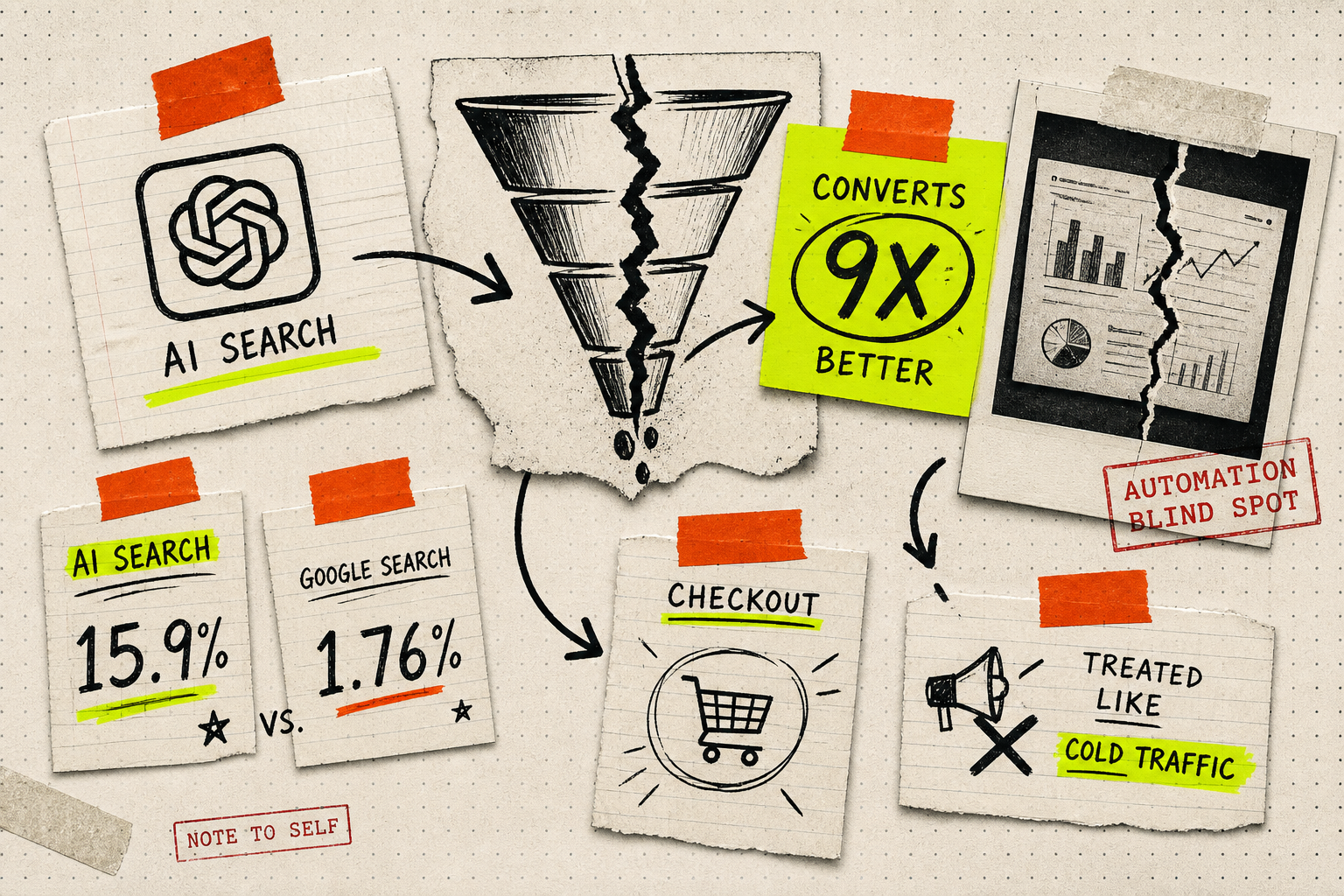
AI Search Broke Your Funnel. Your Automation Doesn't Know Yet.
ChatGPT traffic converts at 15.9%. Google at 1.76%. Your marketing automation is treating both the same — and burning your best leads.
Your Organic Traffic Just Dropped 58%. Google Isn't Sorry.
Google AI Overviews cut position-1 CTR by 58%. Here's why ranks stopped meaning traffic, and the 4-part GEO system that gets you cited in AI answers.