AI Search Broke Your Funnel. Your Automation Doesn't Know Yet.
ChatGPT traffic converts at 15.9%. Google at 1.76%. Your marketing automation is treating both the same — and burning your best leads.
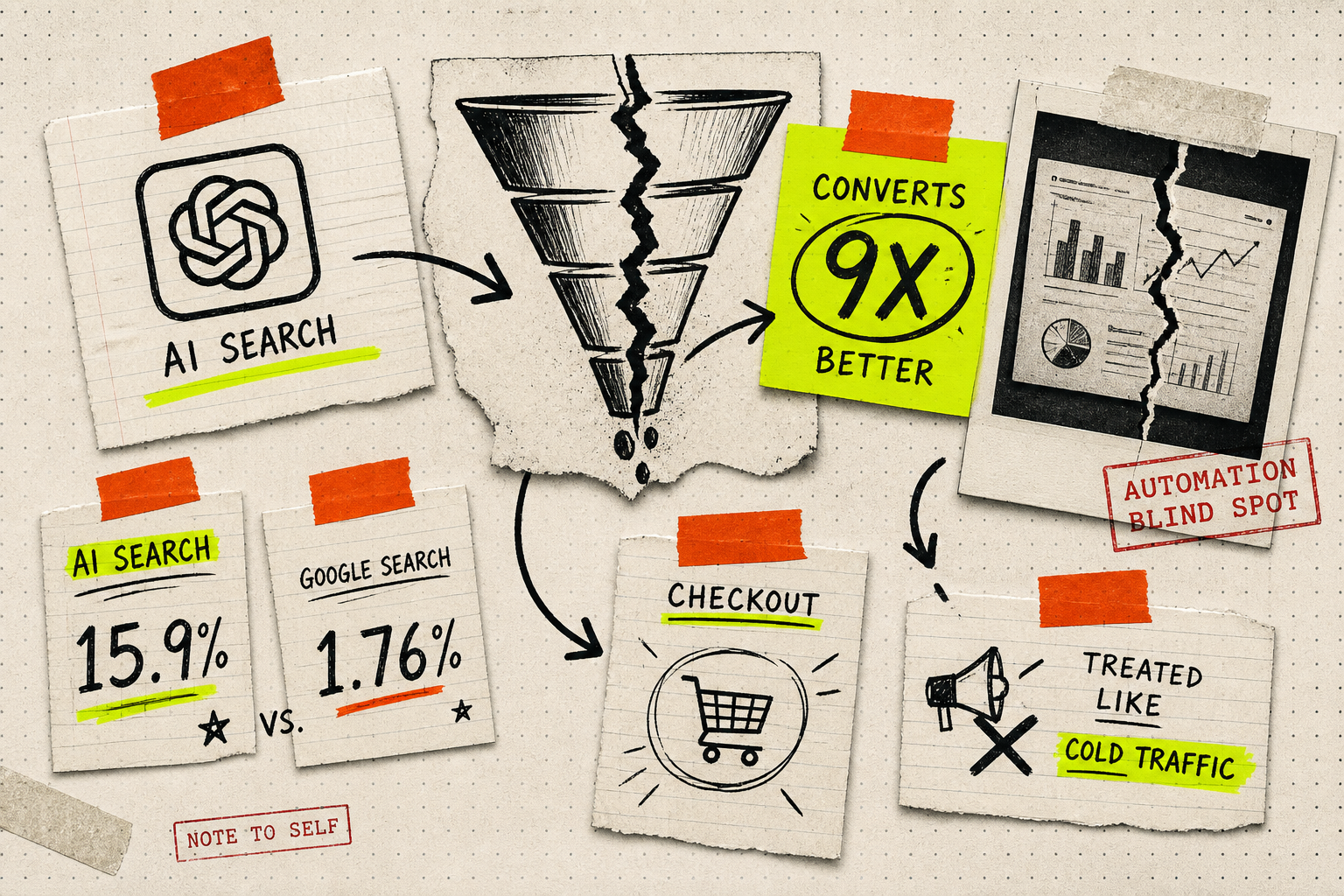
ChatGPT sends you a visitor and they convert at 15.9%. Google sends you one and they convert at 1.76%. That's a 9x gap[1]. And your marketing automation stack — the one you pay $2K–$8K a month for — is scoring both of them the same way.
That's the story of Q2 2026 in one paragraph. Everyone's talking about AI search "breaking marketing" like it's a headline. It's not a headline. It's an already-happened change in what a click is worth, and almost no operator I talk to has recalibrated the plumbing behind the click.
Here's what actually broke, and what I'd fix first.
The funnel model was built for cold clicks
Every marketing automation platform you've heard of — HubSpot, Marketo, ActiveCampaign, Klaviyo, Customer.io — was designed around one assumption: traffic arrives cold. Someone Googles a keyword, lands on a blog post, reads for 22 seconds, gets a popup, maybe hands over an email in exchange for a PDF. Then you drip-nurture them for 14–90 days until they're "sales-ready."
The whole edifice — lead scoring, MQL/SQL definitions, nurture cadences, attribution windows — assumes the buyer needs to be educated into readiness. That's why the median B2B nurture campaign has seven touches before a sales handoff.
Now look at where AI search traffic sits in that model. Seer Interactive's benchmark study on a B2B client found ChatGPT referral sessions converted at 15.9% — roughly 4.4x the organic average, and 9x Google's 1.76% baseline[1]. Similarweb's clickstream panel across April–May 2026 pegged ChatGPT referral conversion at 7.1%, second only to paid search at 7.8% — ahead of direct, organic, social, email, and display[2].
Different studies, different methodologies, same directional truth: AI-search traffic converts 4–5x organic[3].
Why? Because by the time someone clicks through from ChatGPT or Perplexity to your site, the AI has already done the education. It answered "which AI marketing tool integrates with Shopify Plus," compared four options, and told the user why yours won. The user isn't at the top of the funnel. They're at the bottom. They came to buy.
Your automation stack doesn't know that
Here's the mechanical problem. Your marketing automation sees a visitor arrive from chatgpt.com. It doesn't know that visitor was pre-qualified by a 4-minute conversation with an LLM that essentially wrote them a recommendation. So it does what it always does:
- Fires an exit-intent popup offering a lead magnet
- Tags them as "top of funnel" if they don't convert on the first visit
- Enrolls them in a 6-week "nurture" sequence to teach them things they already know
- Applies the same lead score as a random Google organic visitor
- Times any sales outreach for two weeks later, because that's what the playbook says
Every one of those moves is calibrated for cold intent. Applied to warm intent, they burn the lead. The buyer came ready to convert; you told them to download an ebook.
Meanwhile, most GA4 setups are still mis-attributing AI referrals as direct traffic because ChatGPT strips the referrer for a majority of clicks — you're not even seeing where the good stuff is coming from[4].
The macro number that matters
The AI search category — search plus generative — is projected to hit $182B in 2026. That's not the story. The story is that a Q2 2026 Cloudflare Radar snapshot showed the AI bots — ClaudeBot (13.87%), Meta-ExternalAgent (12.70%), GPTBot (10.23%) — collectively pulling roughly a third of measured bot requests, second only to Googlebot at 27.49%[5]. The AI systems are indexing the web to answer buyer queries without ever sending the click. The clicks that do come through are the ones where the AI ran out of information and needed to point at a real page.
Translation: fewer clicks, hotter clicks. And "hotter" means the whole nurture-and-score playbook is wrong shape.
What I'd actually fix
Four moves, in order. These aren't theoretical — they're what I'd wire up on a Monday.
1. Segment AI-search traffic on arrival
Before anything else, tag the source. In GA4, set up a UTM-independent segment: any session where the landing page has ?ref=chatgpt, ?utm_source=chatgpt.com, or the referrer contains chatgpt.com, perplexity.ai, claude.ai, or gemini.google.com. In your automation platform (HubSpot / Klaviyo / whatever), pass that segment as a contact property the first time you get an email. That property is now the most valuable signal in your CRM. Don't lose it.
2. Kill the top-of-funnel treatment for AI referrals
If a visitor arrives from an AI source and converts on any form — trial, demo, contact — skip the nurture. Skip the "welcome series." Route them straight to sales with a note: arrived from ChatGPT, treat as sales-qualified. Empirically, ChatGPT referrals also show longer session durations and lower bounce rates than organic[6]. These are engaged buyers. Treat them like buyers.
3. Give sales the AI-conversation context
The biggest miss I see: your salesperson doesn't know why the buyer chose you. The AI already told them. Your intake form should ask one question — "What made you reach out today?" — and route the answer straight into the deal record. Some of those answers will literally quote ChatGPT recommendations. That's your positioning, delivered back to you as ground truth. Use it in the discovery call.
4. Optimize for AI citation, not organic ranking
The old SEO playbook — target a keyword, build a page, get backlinks — is downstream of the wrong question. The new question is: what does ChatGPT say when someone asks about our category? If your site isn't cited, the 15.9% conversion event never happens. Rank tracking for AI Overviews and ChatGPT citations is still crude, but tools like Profound, Peec AI, and Otterly exist for exactly this. Even a manual monthly check — "ask ChatGPT the 20 buyer queries we care about, log which sites it cites" — beats flying blind.
Why most operators won't do this
Because the automation stack you already own is lock-in. It reports on itself. Its dashboards optimize for the wrong KPIs — email opens, form fills, MQL volume. It looks healthy while your best traffic is being wasted. The AI-referral segment is small in absolute numbers (Similarweb shows AI referrals at under 1% of tracked traffic in most panels) — which is exactly why it flies under the review radar. But it converts 4–9x, which means it's already a meaningful chunk of your pipeline you're mis-handling.
Sixty-one percent of marketers surveyed by HubSpot in 2026 said marketing is going through its biggest disruption in 20 years[7]. That's the softest possible framing. The hard version: the automation industry got fat selling you infrastructure for a funnel that no longer exists in its old shape. Nobody's rebuilding it from the inside. You have to.
The move
If your marketing automation reports don't segment "arrived-from-AI" from everything else — that's the whole problem in one number. Fix that this week. Everything else in this post is downstream of that one segment existing.
If you want a second pair of eyes on your stack — where the AI traffic is hiding, what's mis-routed, what to kill — that's what the audit call is for. 30 minutes, no pitch, you walk out with a punch list. Book it at zerocam.studio.
-
Case Study: 6 Learnings About How Traffic from ChatGPT Converts↩
ChatGPT referrals converted at 15.9% vs Google organic at 1.76% (9x gap) on a B2B client site.
-
Gen AI Stats 2026: AI Visibility Trends, Data & Insights↩
ChatGPT referral traffic converts at 7.1%, second only to paid search at 7.8% (Apr-May 2026 clickstream panel).
-
Why AI Search Traffic Converts at 4–5x: What the Data Actually Shows↩
Multiple independent 2025-2026 studies show AI-search traffic converts at 4-5x organic search.
-
ChatGPT vs Google Traffic: Conversion Rate Truth (2026)↩
ChatGPT strips referrer data on most clicks, causing GA4 to mis-attribute AI traffic as direct.
-
AI in Marketing Statistics 2026: 35 Stats on Adoption, ROI and Trust↩
Q2 2026 Cloudflare Radar: Googlebot 27.49%, ClaudeBot 13.87%, Meta-ExternalAgent 12.70%, GPTBot 10.23% of measured bot requests.
-
AI Referral Traffic vs Organic Search: Conversion Rates and Performance Compared↩
ChatGPT referral visitors show longer session durations and lower bounce rates than organic search.
-
2026 State of Marketing Report↩
61% of marketers say marketing is going through its biggest disruption in 20 years due to AI.
Ready to build your own AI system?
Book a Free Audit Call →Keep Reading
Buyers Shortlist You In ChatGPT Before You Know They Exist
51% of B2B buyers start vendor research inside an AI chatbot. If you're not in the model's shortlist, your funnel already ended. Here's the fix.
Your Business Is Invisible In ChatGPT. Here's Why.
Your customers are asking ChatGPT for a plumber, a Shopify agency, a bookkeeper — and your business isn't in the answer. Here's why, and the 4-part fix.
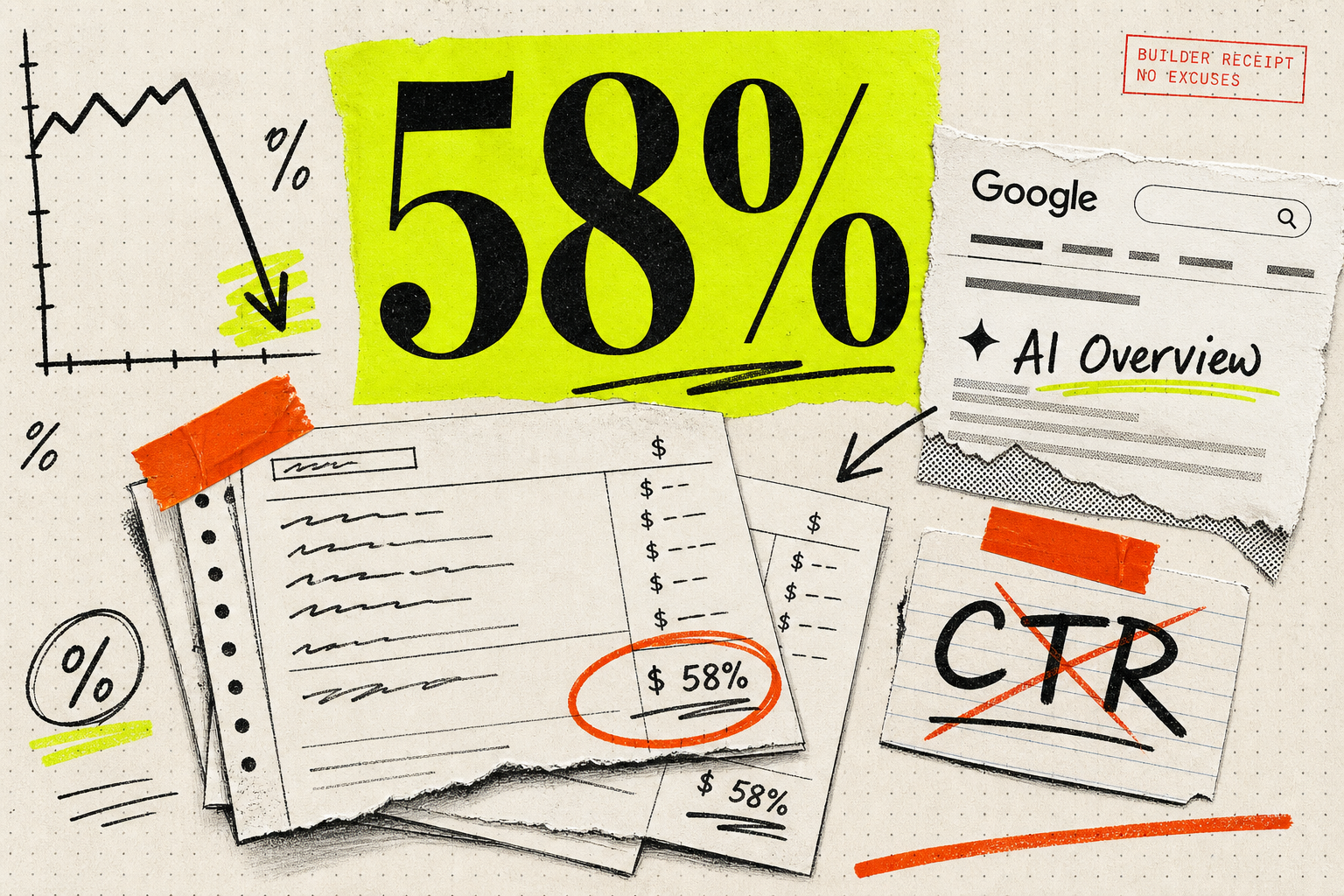
Your Organic Traffic Just Dropped 58%. Google Isn't Sorry.
Google AI Overviews cut position-1 CTR by 58%. Here's why ranks stopped meaning traffic, and the 4-part GEO system that gets you cited in AI answers.