Buyers Shortlist You In ChatGPT Before You Know They Exist
51% of B2B buyers start vendor research inside an AI chatbot. If you're not in the model's shortlist, your funnel already ended. Here's the fix.
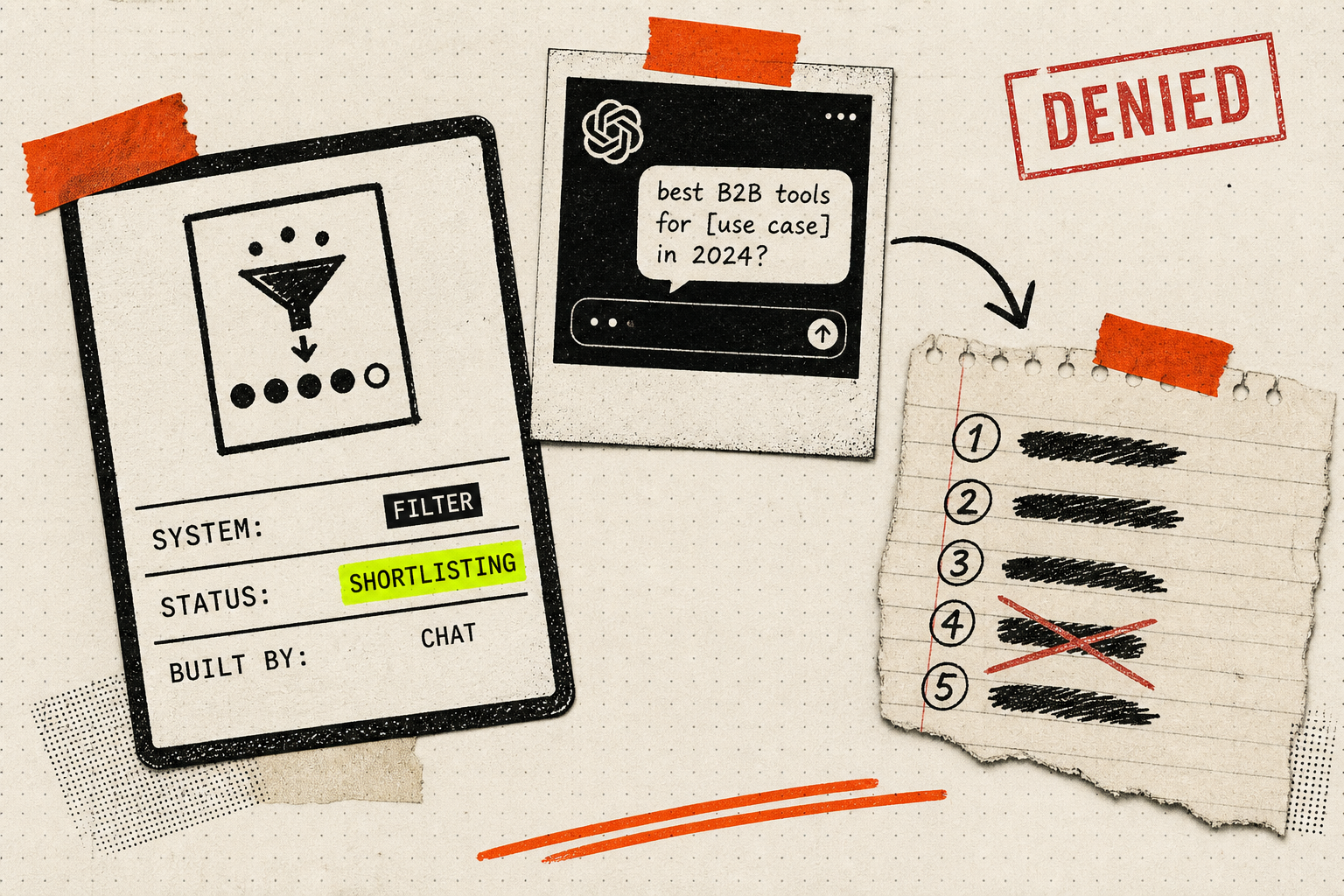
Your next customer probably already made their shortlist. You weren't on it. Nothing hit your CRM. No form fill. No demo request. They typed a question into ChatGPT, got five vendor names back, and picked three to actually contact. If your name didn't show up in that first answer, the buying process ended for you before it started — and you have no idea it happened.
That's not a hot take. G2 surveyed 1,076 B2B software buyers in March 2026: 51% now start their vendor research with an AI chatbot instead of Google — up from 29% a year earlier. Eight in ten have sourced software recommendations from tools like ChatGPT or Google AI Mode in the past two years[1]. Position Digital pulled the same signal from a wider aggregate: 92% of B2B software buyers said AI influenced their vendor shortlist, with 45% saying it had a significant impact[2]. Forrester's 2026 read: 94% of B2B buyers used generative AI or conversational search during their buying process[3].
The buying committee didn't disappear. The pre-buying committee — the "who do we even talk to" filter — did.
The mechanic that broke your funnel
Here's what actually happens now, and why the classic playbook doesn't catch it.
A director at a $10M brand needs help with cold outbound. Three years ago she'd Google "best cold email agencies," open six tabs, read reviews on G2, ask her network on LinkedIn. You had a chance to show up in ten different surfaces. Today she opens ChatGPT and types: "Which agencies build AI cold outreach systems for mid-market DTC brands? Give me five with pricing and honest tradeoffs." Twelve seconds later she has a table with names, positioning, and rough price bands.
She didn't click a single link. She never hit your homepage. She never triggered your retargeting pixel. The MarketScale summary of the shift is blunt: "vendors that do not appear in the AI-generated initial shortlist are unlikely to be considered at all, and most of that filtering happens before any direct buyer engagement"[4]. Or as AirOps CEO Alex Halliday put it in G2's 2026 Buyer Behavior Report: "The first version of a buyer's shortlist is increasingly being assembled by AI before that buyer ever lands on your site or talks to Sales"[5].
That's the funnel collapse. The old top-of-funnel — SEO traffic, ad clicks, LinkedIn views — now happens inside a model you don't own.
Why your current stack won't fix this
Most operators I talk to hear this and immediately reach for the familiar levers. None of them work here.
More SEO content won't fix it. ChatGPT and Perplexity don't rank pages the way Google does. They synthesize. A 2,000-word listicle that ranks #4 on Google might get zero mentions inside an LLM answer if the model doesn't find it authoritative, structured, or cited elsewhere. Google's own AI Overviews now cannibalize the exact clicks the article was built for.
More LinkedIn posts won't fix it either — and now they're actively working against you. LinkedIn changed its algorithm on May 20, 2026 to suppress low-quality AI-generated posts and automation-driven comments. Content flagged as AI slop isn't removed; it's just capped to your immediate network, killing reach[6]. So the "post daily to build authority" playbook is now trained to punish exactly the volume you'd generate to keep up.
Paid ads still work — for the shortlist you already made. They don't get you into the shortlist. ChatGPT doesn't run your Meta ads. Perplexity doesn't index your Google Ads landing page. The pre-filter is upstream of the paid layer.
The category has a name now: Generative Engine Optimization (GEO) — the practice of getting your business surfaced in AI answers instead of AI pages. It's not SEO in a new hat. The signals are different, the surface area is different, and the reward function is different[7]. It's mostly ignored by mid-market operators because it feels abstract. It isn't. It's the buying moment.
What actually gets you into the shortlist
The good news: LLMs are lazy in a specific way, and that laziness is exploitable. They pull from a smaller set of trusted, well-structured sources than Google does. Which means a mid-market business can punch well above its weight if it plays the game the models actually reward.
Four things move the needle. I've watched all four work.
1. Get cited in outlets the models already trust. MarketScale's reporting on the GEO shift is explicit that a placement in a tier-1 outlet "does double duty: it reaches human readers and it feeds the training and retrieval signals that determine whether a vendor surfaces when a buyer types a purchase query into an AI assistant"[8]. That means one earned mention in TechCrunch, Inc., or your vertical's most-cited publication is worth more than 30 self-published blog posts. PR firms are already re-tooling around this. Most operators haven't caught up.
2. Build a fact-dense, LLM-legible site. LLMs don't like ambiguity. They like sentences that state what you do, who you do it for, what it costs, and what the tradeoffs are — in plain text, without marketing fog. If your homepage opens with "We empower next-generation growth," the model has nothing to grab. If it opens with "I build AI cold outreach systems for $2M–$20M DTC brands, priced from $8K," the model has five things to cite.
3. Publish opinionated content on real questions. LLMs synthesize consensus but often surface distinct takes when the consensus is weak. If you write a post that stakes out a specific position — "most AI SDR tools are wrappers, here's what to actually build" — with real numbers and receipts, you become the source cited when a buyer asks the model about that exact tradeoff. Neutral content is invisible. Strong content is quotable.
4. Own a query, not a keyword. SEO targeted keywords. GEO targets questions a buyer actually asks the model. "Best AI marketing tool" is a keyword. "Which AI cold email tool works for a 6-person sales team without triggering spam filters" is a query. The second is what buyers type. The second is where the shortlist is decided.
Test yourself. Open a fresh ChatGPT tab (log out first — personalization pollutes the test). Type the exact question a buyer would ask to find you. Do you show up in the top 5? Do you show up at all? If not, that's your top-of-funnel gap. It's not that you don't have leads. It's that you never had a chance at them.
The 30-day version of the fix
If you want to actually move on this before Q4, here's the compressed playbook:
- Week 1: Run 20 buyer queries in ChatGPT, Perplexity, and Google AI Mode. Log who shows up. That's your competitor set inside the model, which is different from your competitor set on Google.
- Week 2: Rewrite your homepage and top 3 service pages in plain, fact-dense language. Kill the fog. Add specific numbers, prices, tradeoffs, ICPs.
- Week 3: Publish one opinionated piece per week that answers a real buyer question you saw the LLM handle poorly. Cite real sources. Make it worth quoting.
- Week 4: Pitch two tier-1 or vertical-tier-1 outlets on a story only you can tell. One placement is worth more than a month of LinkedIn.
Re-run the queries in 30 days. Watch what moved.
Gartner is already forecasting the next inflection: by 2030, 75% of B2B buyers will prefer sales experiences that prioritize human interaction over AI[9]. The pendulum will swing back. But between now and then, the AI-driven shortlist is the funnel gate. Miss it and the human interaction never happens.
If you want this built for your business — the query audit, the content system, the outlet pitches, all wired to the buyer questions that actually matter for your category — that's the audit call. Thirty minutes, no pitch. You'll leave with the queries you're missing and a rough plan to show up in them.
-
New G2 Research: AI Is Reshaping How B2B Software Deals Are Won and Lost↩
51% of B2B software buyers now start research with an AI chatbot; 8 in 10 have sourced recs from ChatGPT or Google AI Mode in the last two years.
-
100+ AI SEO Statistics and Insights for 2026↩
92% of B2B software buyers said AI influenced their vendor shortlist; 45% said the impact was significant.
-
The State of AI Search in 2026: 150+ Statistics↩
Forrester finds 94% of B2B buyers used generative AI or conversational search during their buying process in 2025.
-
AI is collapsing the B2B buying cycle before vendors ever see a lead↩
Most vendor shortlisting now happens inside AI answers before any direct buyer engagement.
-
How Demand Gen Teams Spot and Close Competitive Gaps Before Deals Slip Away↩
AirOps CEO Alex Halliday: buyer shortlists are increasingly assembled by AI before the buyer visits your site or talks to sales.
-
LinkedIn Is Suppressing AI Slop: What That Means for You↩
LinkedIn's May 20, 2026 algorithm changes suppress low-quality AI-generated posts and automation.
-
GEO, AEO, and SEO in 2026: The enterprise guide to AI visibility↩
Defines GEO (Generative Engine Optimization) as the practice of building visibility inside AI answers, distinct from classic SEO.
-
B2B tech PR firms are racing to build GEO practices as AI search reshapes how buyers discover vendors↩
Tier-1 outlet placements feed the retrieval signals that determine whether a vendor surfaces in AI assistants.
-
B2B buying journey 2026: the self-serve buyer↩
Cites Gartner's 2026 read: 45% of B2B buyers used AI in a recent purchase; 67% prefer a rep-free digital journey; the 75%-prefer-human 2030 forecast.
Ready to build your own AI system?
Book a Free Audit Call →Keep Reading
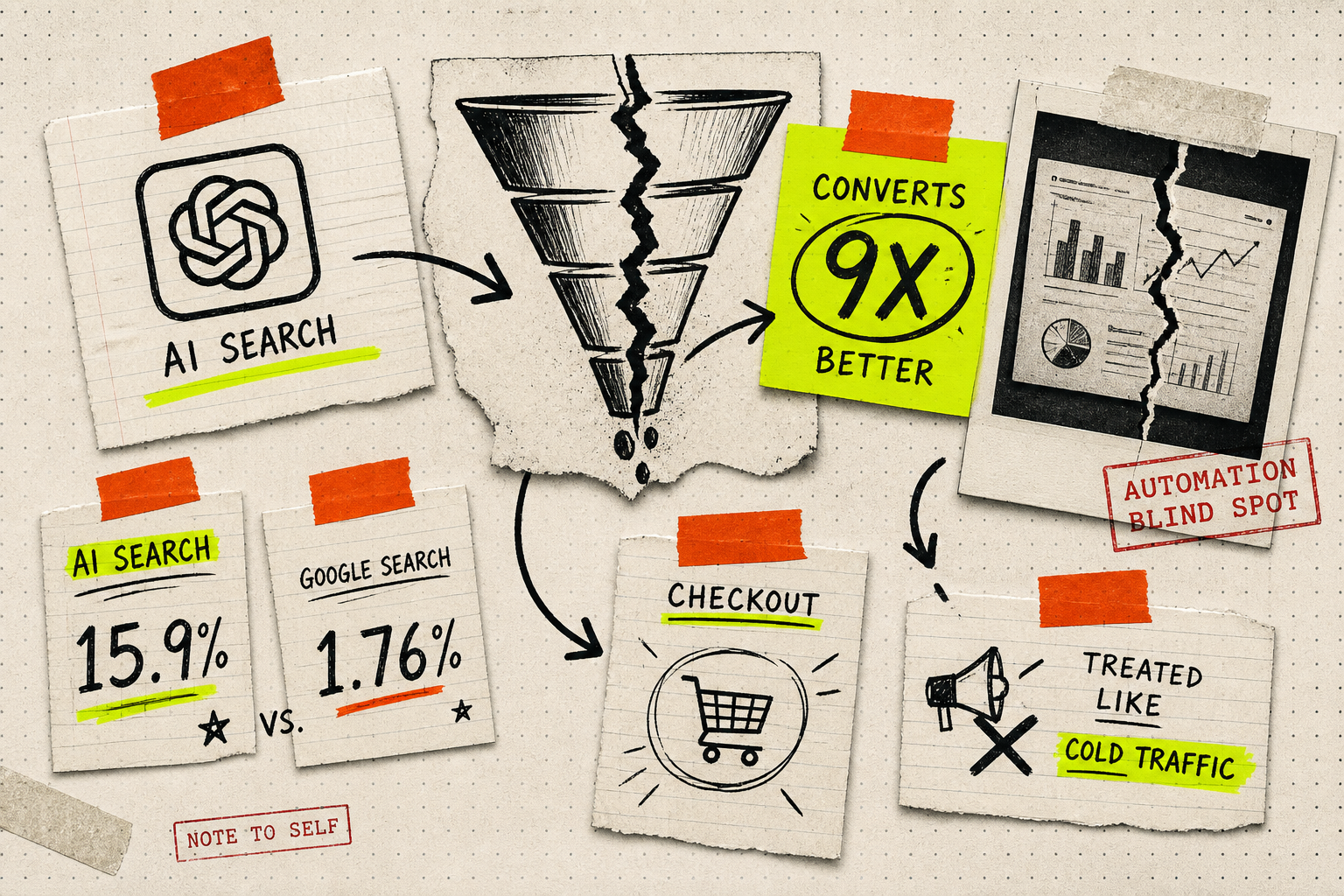
AI Search Broke Your Funnel. Your Automation Doesn't Know Yet.
ChatGPT traffic converts at 15.9%. Google at 1.76%. Your marketing automation is treating both the same — and burning your best leads.
Your Business Is Invisible In ChatGPT. Here's Why.
Your customers are asking ChatGPT for a plumber, a Shopify agency, a bookkeeper — and your business isn't in the answer. Here's why, and the 4-part fix.
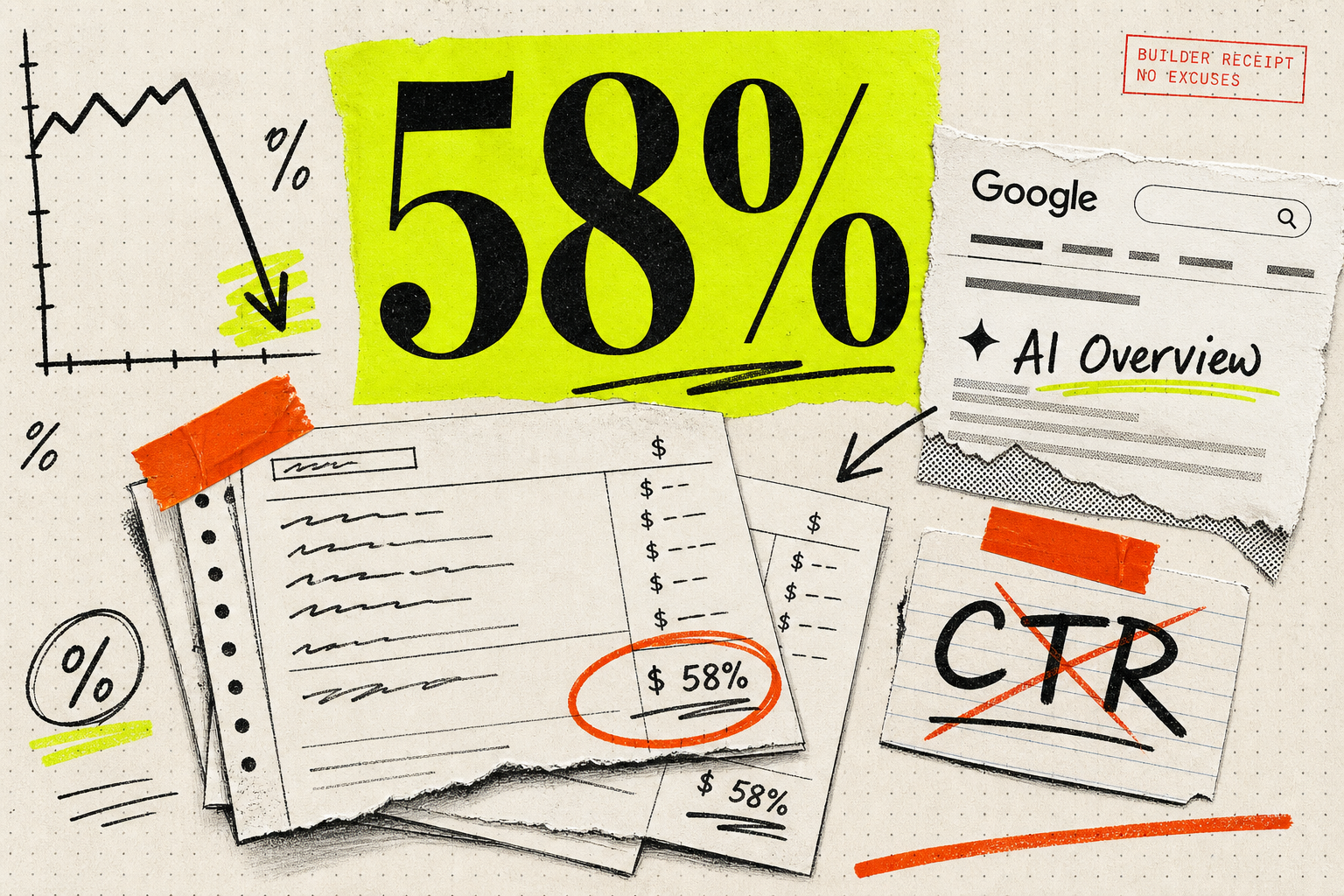
Your Organic Traffic Just Dropped 58%. Google Isn't Sorry.
Google AI Overviews cut position-1 CTR by 58%. Here's why ranks stopped meaning traffic, and the 4-part GEO system that gets you cited in AI answers.