Your $150K Content Team Is A Claude Skill Now
A $150K in-house content team is a 2019 answer. Here's the 4-Skill Claude stack — topic-scout, voice-draft, pre-publish-check, distribute — that ships daily for $200/mo.
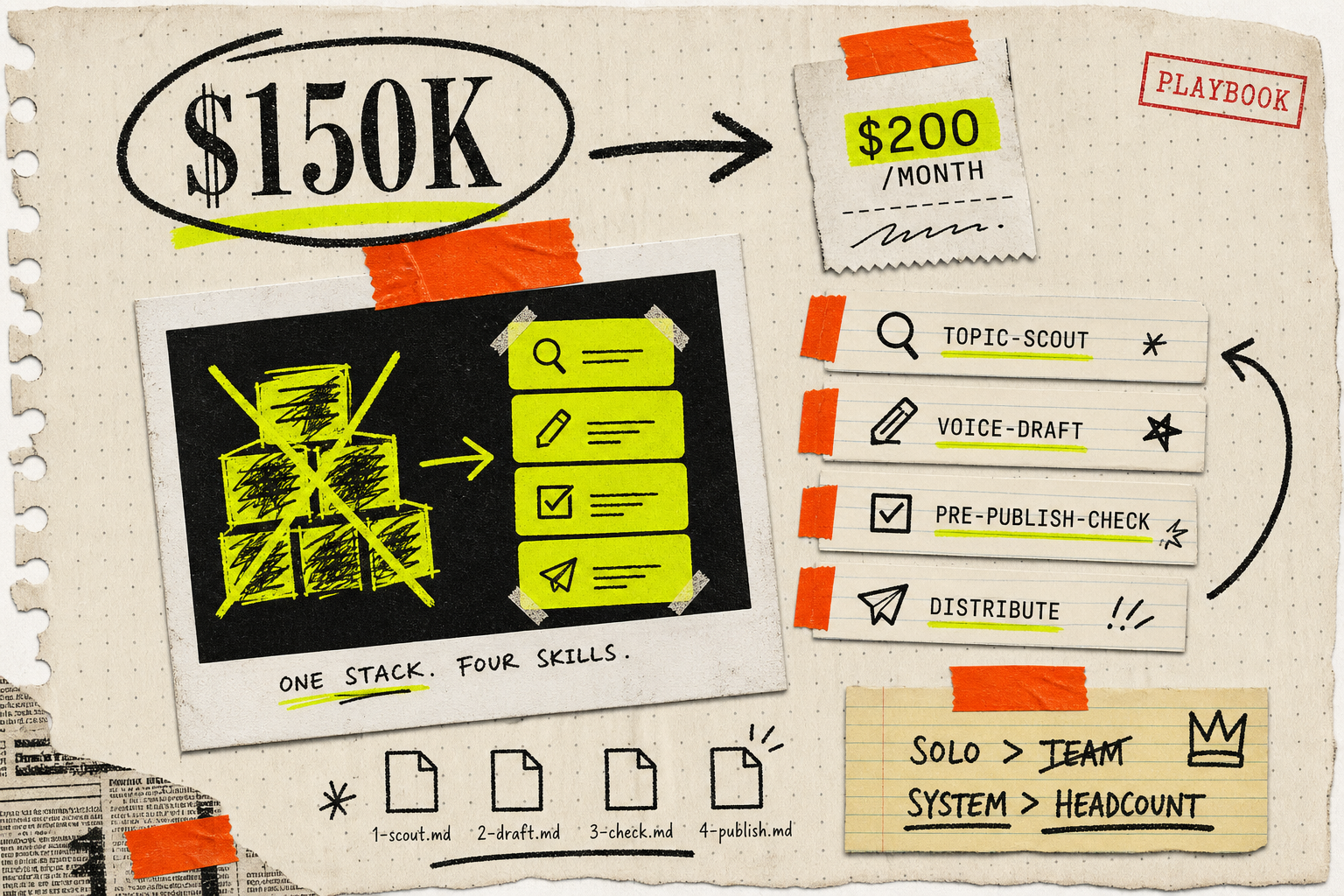
A small in-house content team — one strategist, one writer, one designer — runs about $150,000 to $250,000 a year in salary alone, before benefits, tools, or the manager tax[1]. Add an agency retainer on top for "strategy," and the mid-market operator I keep meeting is spending $200K+ a year to publish four blog posts a month.
You don't need that team anymore. You need four Claude Skills and about $200 a month.
I'll show you the stack.
What a Skill actually is (and isn't)
Anthropic published the Agent Skills specification as an open standard on December 18, 2025[2][3]. A Skill is just a folder — a markdown file that tells Claude how to do a specific job, plus any templates, scripts, or reference docs it needs. Claude loads the folder only when the task is relevant. That's it.
It's not a plugin. It's not an agent. It's a habit you install into the model.
The open-standard part matters. It means the same Skill folder runs in Claude, in any model that adopts the spec, and — importantly — in your own systems via the SDK[4]. You're not building for one vendor's roadmap.
That's the primitive. Now the stack.
The 4-Skill content stack
Every content team has the same four jobs — strategy, drafting, editing, distribution. Here's what each one looks like as a Skill, and what it replaces.
Skill 1 — topic-scout
Replaces: the strategist doing Google Trends and competitor analysis on a Monday.
What it does: pulls signals from Google Search Console, YouTube's Data API, and a handful of RSS feeds, cross-references them against your ICP, and dumps a ranked brief of five topics worth writing about. Runs on a cron. You review in ten minutes over coffee.
Every input above is free API access. The Skill is 40 lines of markdown plus one Python file that hits the APIs. Total cost: your time to write it once, then the token cost of the weekly run — under $5.
Skill 2 — voice-draft
Replaces: the $70K writer.
What it does: takes the picked topic + the outline the strategist Skill produced, drafts a 1,200-word post in your locked voice. The Skill folder contains a VOICE.md with every rule you've ever handed a writer — hard-no phrases, house style, hook structure, CTA voice. Claude reads it every time.
The nuance most people miss: the voice folder needs to include bad examples, not just good ones. A specific banned-phrase list beats a vague "write with a strong hook" every time. Anthropic's own docs push this — Skills work best when they encode judgment, not just steps[2].
Token cost per draft: roughly $0.30 on Sonnet. A month of daily drafts is under $10.
Skill 3 — pre-publish-check
Replaces: the editor.
What it does: runs the draft through a fixed checklist before it ships. Client references? Fabricated stats? Hard-no phrases? Word count in range? Cited sources with real URLs? All pass/fail, all deterministic.
This one's the reason the whole stack works. Most operators who "tried Claude for content" got mediocre output because they skipped this step. A checklist Skill catches 90% of what a human editor would catch, without the ego. And it runs in 8 seconds.
Fiddler AI's 2026 analysis puts agent failure rates at 70-95% in production[5] — most of that failure is judgment slipping between steps. A hard-coded gate closes the gap.
Skill 4 — distribute
Replaces: the social manager's Monday.
What it does: takes the published post, generates a LinkedIn caption (hook + three insights + CTA, no hashtags), a Twitter thread, and an Instagram carousel outline. Different formats, same voice. Pushes to whatever scheduler you use — Buffer, Later, your own n8n flow.
The LinkedIn caption alone is worth building. Native LinkedIn posts get 3-8x the reach of link posts, and a 2,000-character caption written for LinkedIn — not copy-pasted from the blog — is what separates 200 impressions from 20,000.
Token cost per distribution run: roughly $0.20. Call it $6 a month.
The math
Four Skills. Roughly $25 a month in tokens if you're publishing daily. Add the Claude Team plan at $25/user/month[6] and a Vercel/hosting bill, and you're at $200 all-in for a system that publishes five posts a week, distributes them to three platforms, and never ships a draft with agency filler phrases in it.
The same output, done by humans, runs $200K a year. That's 1,000x cheaper. Even if you cut the human comparison in half and say "no, my team was $75K, not $150K" — you're still at 375x.
I don't say that to be cute. I say it because most operators I talk to are stuck in a 2019 mental model where "content" means "hire someone." The primitive shifted. The old math no longer maps.
Where this breaks
Two places. Both fixable.
One: voice drift. If you don't feed the voice-draft Skill your actual writing — five or six real pieces you like — it will regress to Claude's default "helpful assistant" voice. Which sounds like every AI blog on the internet. Fix: paste your best work into the Skill folder. Update quarterly.
Two: original reporting. Skills can pull public sources, but they can't interview your customer or sit in on a support call. If your content strategy leans on original insight — case studies, interviews, proprietary data — you still need a human for the inputs. Skills just handle the output.
That's actually the right division. Pay a human $500 to interview a customer for 45 minutes. Let the Skills turn that transcript into a 1,200-word post, a LinkedIn thread, and a carousel. The human does the thing only a human can do. The Skills do the thing that got expensive by accident.
How to start this week
Don't build all four at once. Build pre-publish-check first.
Take your last five blog drafts. Write down every reason you sent them back. That's your checklist. Turn it into a SKILL.md file. Run it on your next draft before you publish. That's your Monday.
Next week, build voice-draft. Feed it the five drafts you liked and the five you rejected. See what it writes.
By week three you've replaced $6,000 of monthly content spend with a folder of markdown files and a Claude subscription. You'll know it works because the drafts stop needing your fingerprints on every paragraph.
If you'd rather not spend three weekends on this, that's what the audit call is for. I've built this exact stack for the studio's own publishing engine — five posts a week, one operator, no writers on payroll. 30 minutes, no pitch. I'll tell you exactly what your version looks like.
-
How Much Does Content Marketing Cost? [2026 Pricing Guide]↩
In-house content team salaries total $150K-$250K/yr for a strategist, writer, and designer.
-
Skills: Custom instructions Claude can call on demand↩
Anthropic's Skills product doc — Skills work best when they encode judgment as instructions Claude loads on demand.
-
Agent Skills: Anthropic's Next Bid to Define AI Standards↩
Anthropic launched Agent Skills as an open standard on December 18, 2025.
-
awesome-claude-code-and-skills↩
Public catalog of Skills following the Agent Skills open standard published Dec 2025 — evidence of ecosystem portability.
-
Why do 70-95% of AI agent projects fail in production?↩
AI agents fail 70-95% of the time in production without deterministic gates.
-
How to Use Claude AI for Business: The Complete 2026 Guide↩
Claude Team plan is $25/user/month, the entry point for small ops to run Skills.
Ready to build your own AI system?
Book a Free Audit Call →Keep Reading
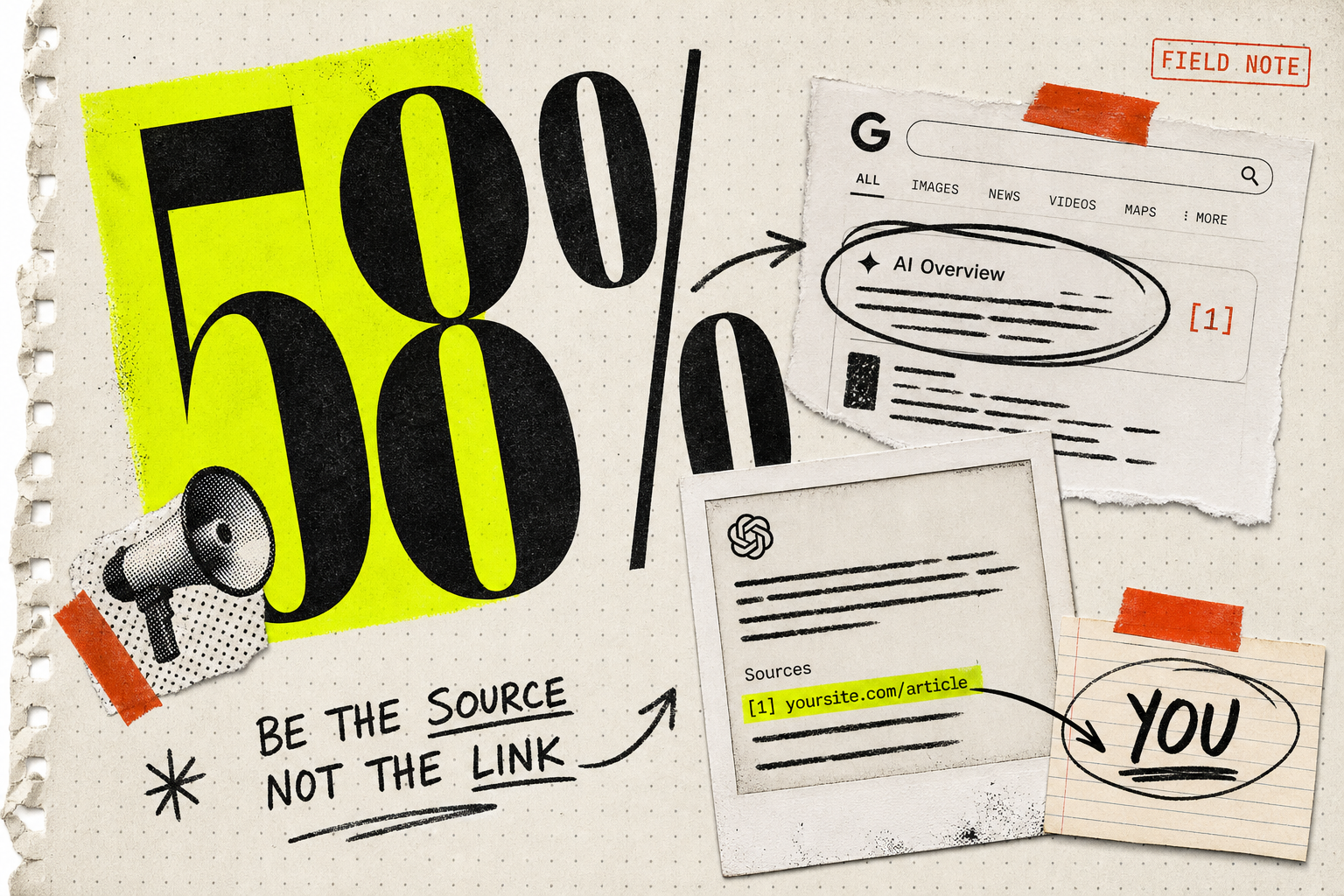
How To Get Cited By ChatGPT And Google AI Overviews
Position-one Google clicks are down 58% because of AI Overviews. The new game is getting cited by ChatGPT and Perplexity. Here's the 5-part playbook.
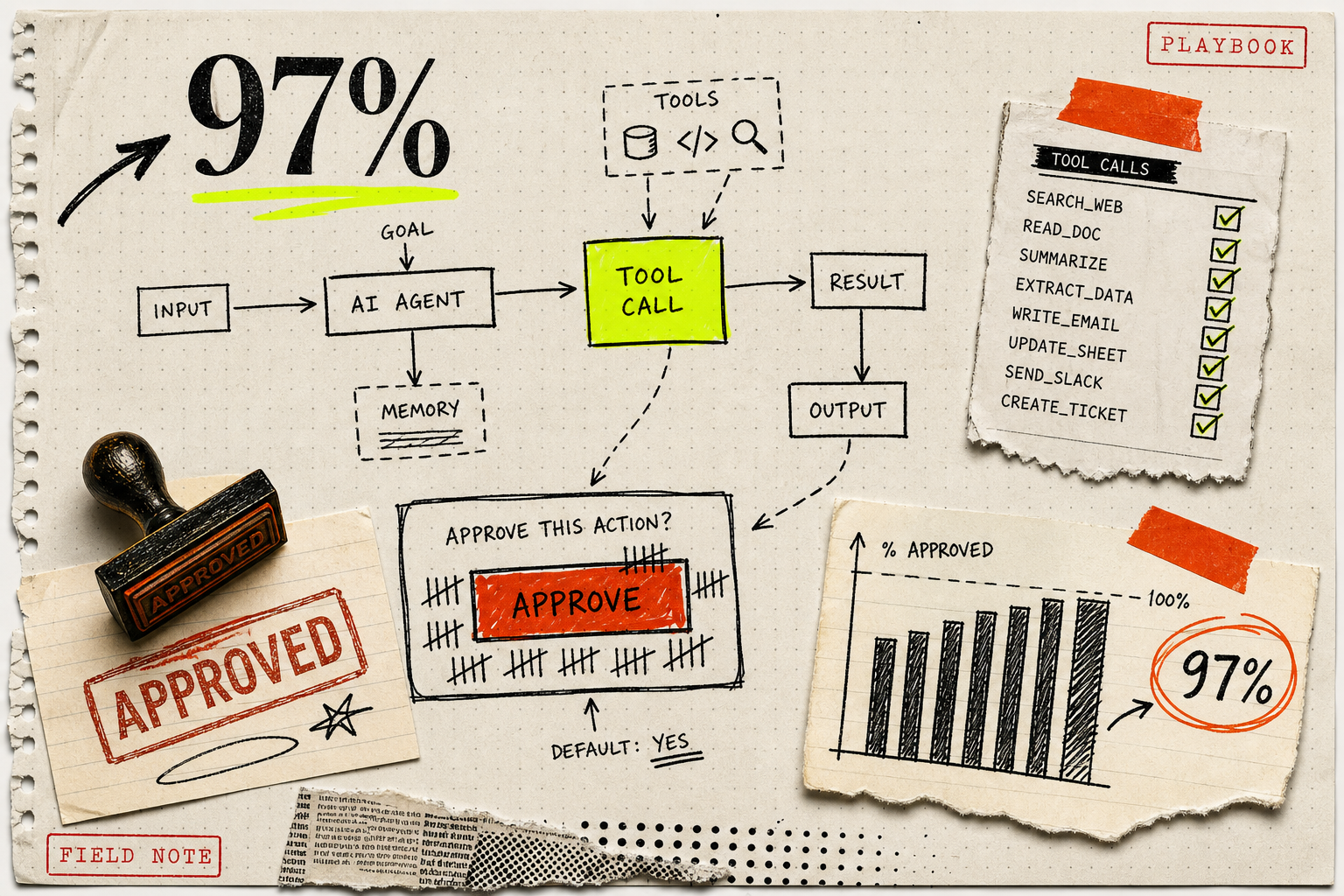
Your Humans Approve 97% Of What The AI Does. That's Not Oversight.
Anthropic just measured it: developers approve 97% of the permission prompts AI agents ask them. Here's how to build oversight that actually works.
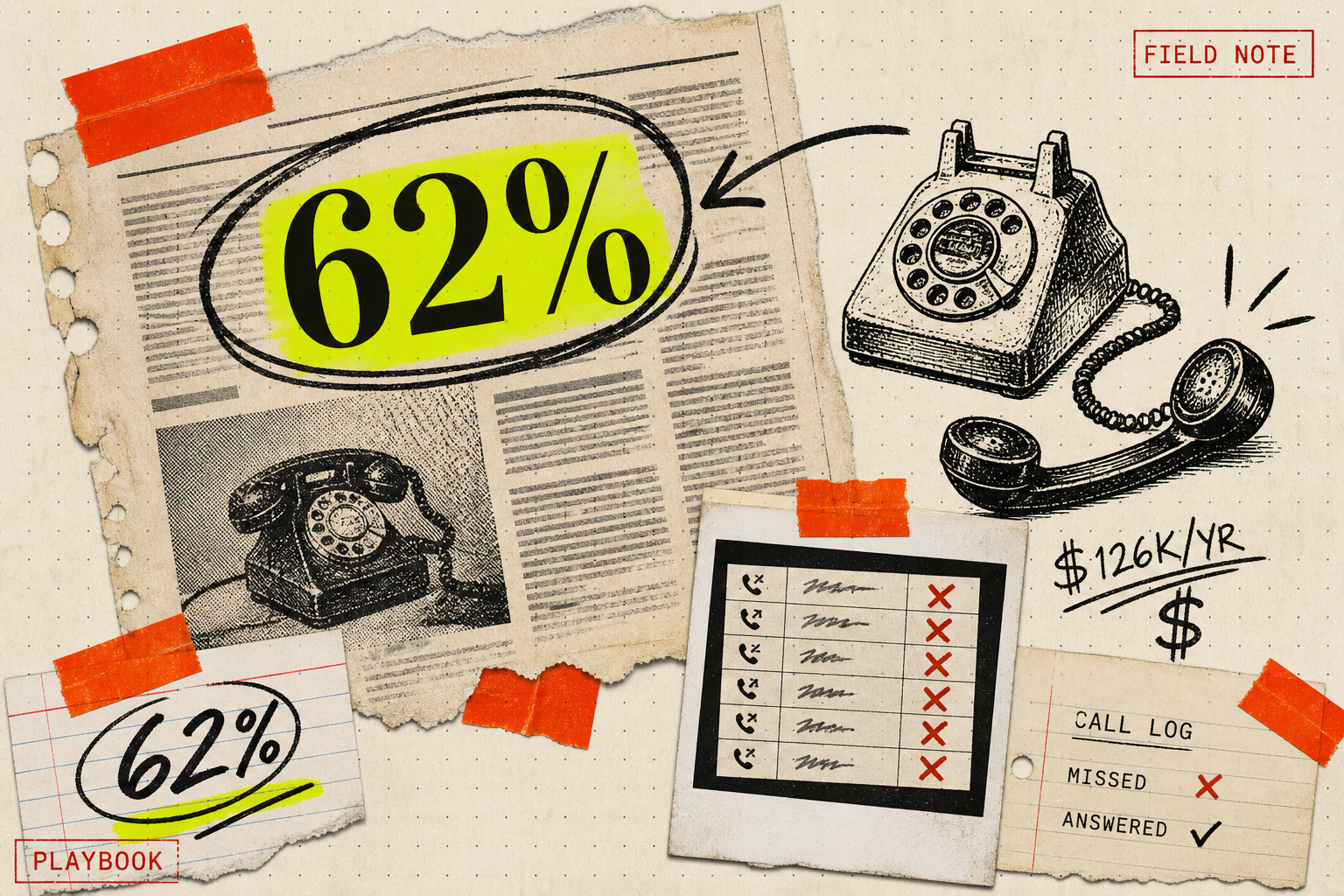
Your Business Misses 62% Of Its Phone Calls. Here's The Fix.
Small businesses miss 62% of inbound calls — a $126K/year leak on average. Here's the AI voice receptionist stack that plugs it, with real costs and a rollout plan.