The Cheapest Meta Lead Is The Worst Meta Lead
Meta's algorithm finds the cheap lead because that's what you told it to. Why 2026's lowest CPL is usually the worst-converting one — and how to fix it.
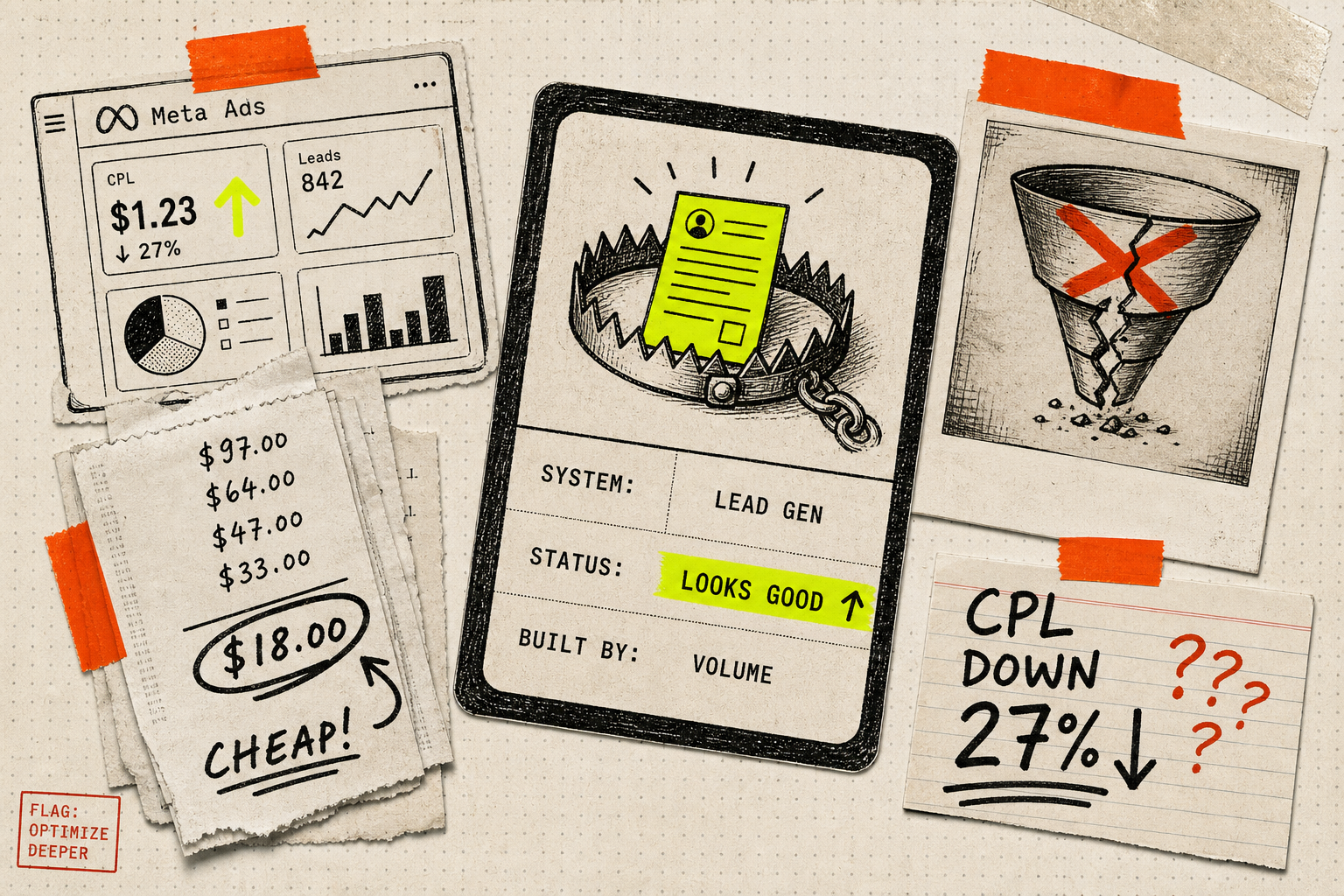
Your Meta Ads dashboard says you're crushing it. Cost per lead is down 27% quarter over quarter. Your agency sent a screenshot with green arrows. Everyone's happy — except your sales team, which is quietly closing fewer of those leads than they did six months ago.
This is the trap most operators are walking into in 2026. Meta's own engineers have been telling advertisers the same thing for two years now: optimize for the cheap lead and the algorithm will hand you garbage at scale[1]. The platform changed. Most playbooks didn't.
The thing nobody wants to admit about Lead Ads
Meta Lead Ads are easy to run and easy to misread. A user taps your ad, an Instant Form auto-fills their name and email from their profile, and you get a row in a spreadsheet. The friction is basically zero, which is exactly the problem.
Zero friction means zero qualification signal. You're paying for someone who tapped a button — not someone who decided they want what you sell. Meta processed over a billion Instant Forms in 2023 and the volume has only grown since[2]. A "$15 CPL" looks great in the dashboard. It also frequently means a 1-2% sales conversion rate downstream, because half those leads forgot they filled out the form by the time you called.
The benchmarks confirm it. Across industries, B2B and high-ticket Meta lead campaigns now average around $67.50 per qualified lead in 2026 — and direct-sales CPA hits $155 in lead-gen verticals[3]. The gap between "cheap raw lead" and "lead that actually closes" is the entire game.
Why the algorithm rewards low intent if you let it
Here's the part most marketers miss. Meta's optimizer doesn't know what you mean by "lead." It only knows what event you told it to optimize for.
If you optimize for Lead (form submit), the algorithm finds people who submit forms. That's not a typo. There's a population of users on Facebook and Instagram who tap lead form CTAs reflexively — for sweepstakes, freebies, mild curiosity, whatever — and the bidder finds them, because they're cheap and they convert on the event you defined. You trained the model to find them. It did its job.
You did not train it to find people who buy.
What actually changed in 2026
Three things, all related, all under-discussed:
1. Andromeda flipped the optimization stack. Meta's new ad retrieval system selects ads first based on creative and predicted outcomes, then ranks them. Over-segmented account structures with 10–20 ad sets per campaign starve the model of the data pool it needs to optimize[1]. Simpler structures with one broad ad set and many creatives now consistently outperform clever audience splits.
2. First-party data became the only real signal. Browser-based pixel tracking is mostly noise post-iOS-17. Conversions API (CAPI) with deduplicated server-side events is no longer a nice-to-have — it's the substrate Meta's algorithm runs on. Accounts with strong Event Match Quality see lower CPA volatility and faster recovery after budget changes; the ones still on pixel-only are flying blind[1].
3. Value-based optimization quietly became table stakes. Meta added value-based Lookalike Audiences and pipeline-value events long ago, but most lead-gen accounts still don't pass them. Industry benchmarks now put Advantage+ campaigns at roughly 32% lower CPA than manually structured campaigns in ecommerce and lead-gen verticals — but only when you give the model real outcome data to learn from[4].
The shift: optimize for the event that pays your bills
Here's the rule I tell operators: don't let Meta optimize for an event that doesn't actually correlate with revenue.
If your sales cycle is two weeks and a phone call, "form submit" is the wrong event. The right event is Qualified Lead or Booked Call or Closed Won — whatever line in your CRM that, when checked, means money. Pass that event back through CAPI with a value attached. Now Meta's algorithm is optimizing for the thing you actually care about, not a proxy you've been pretending matters.
This is also why every agency screenshot bragging about a $9 CPL should make you nervous, not happy. A $9 form-fill rate in a market where qualified leads cost $67 means one of two things: the campaign is targeting a population that submits forms reflexively, or the agency is reporting a vanity metric. Often both.
What I'd do this week if I ran your Meta account
Five moves, in order. None of them are clever. All of them work.
- Audit your optimization event. Open your lead-gen campaigns. What event are they optimizing for? If it's
LeadorForm Submit, you have a problem. Map your CRM to a downstream event — Qualified Lead, SQL, Booked Demo, Sale — and switch optimization there. The algorithm will scale on the new event over the next 7-14 days.
- Fix your CAPI implementation. Not partial setup. Full setup. Pass enhanced identifiers (hashed email, phone, external ID). Pass real lead-quality signals back from your CRM (qualified vs unqualified). The Event Match Quality score in Events Manager is the number you optimize against — most accounts run at 4-6 out of 10 when they should be at 8+[1].
- Consolidate your account structure. Kill the 14 ad sets. One campaign, one broad ad set, 8-15 creatives. Let Meta's model do the targeting work — that's literally what Andromeda is for. Meta's official Advantage+ Leads page says it explicitly: fewer inputs, fewer parallel campaigns, more automation[5].
- Pass values, not just events. A lead worth $20K LTV and a lead worth $200 LTV should not look identical to the algorithm. Send the pipeline value back. Use it for value-based Lookalikes. This is the single biggest unlock most lead-gen accounts haven't touched.
- Watch the May 2026 rollouts. Meta extended Purchase event audience retention to 730 days, started auto-generating Instant Forms from URLs, and added ad-level placement controls[6]. The 730-day retention change in particular silently broadens custom audiences that were intended to stay tight — check Audience Manager and re-segment if your retargeting strategy depends on recency.
The uncomfortable POV
If you're paying an agency to "optimize CPL," and your sales team's close rate has slipped, you are not winning. You are being shown the metric the algorithm is best at gaming. Lead-gen performance marketing is shifting from lead volume to lead value, and most agencies haven't updated their reporting because their pricing model assumes you won't notice[7].
The boring answer is the right one: send Meta better data, optimize for events further down the funnel, and stop celebrating cheap form-fills. You'll see CPL go up. You'll also see qualified pipeline go up faster.
That's the trade. And in 2026, it's the only trade that makes Meta lead gen work.
If your Meta account is still optimizing for the form-fill event and your CAPI implementation is partial, I can tell you in 30 minutes whether it's worth rebuilding from scratch or just rewiring. Book a free audit call at zerocam.studio — no pitch, just a teardown.
-
5 Lead Gen Shifts to Run Profitable Meta Ads in 2026↩
The cheapest lead is often the worst; Andromeda + CAPI + simpler structures define 2026 Meta lead-gen success.
-
AI Meta Ads for B2B Lead Generation Guide (2026 Strategy)↩
Meta processed over 1 billion Instant Forms in 2023; B2B form completion is 16.6% higher with AI optimization.
-
Meta Ads Benchmarks 2026: CPM, CPC, CPA & CTR by Industry↩
B2B lead-gen averages ~$67.50 per qualified lead; direct-sales hits ~$155 CPA in 2026.
-
How to Reduce CPA on Meta Ads with AI (2026 Guide)↩
Advantage+ Shopping campaigns deliver ~32% lower CPA than traditional setups by automating audience/creative/attribution.
-
Meta Advantage+ Leads Campaigns↩
Meta's official position: Advantage+ Leads requires fewer inputs and replaces multiple manually-targeted campaigns.
-
Meta Ads Updates May 2026: 6 New AI, Pixel, Creative, and Retargeting Features↩
May 2026 brought ad-level placement controls, AI-generated Instant Forms, and 730-day Purchase audience retention.
-
How AI is turning lead scoring into a decision engine↩
AI lead scoring is replacing simple rules; volume-of-noise era of marketing is over.
Ready to build your own AI system?
Book a Free Audit Call →Keep Reading
Buyers Shortlist You In ChatGPT Before You Know They Exist
51% of B2B buyers start vendor research inside an AI chatbot. If you're not in the model's shortlist, your funnel already ended. Here's the fix.
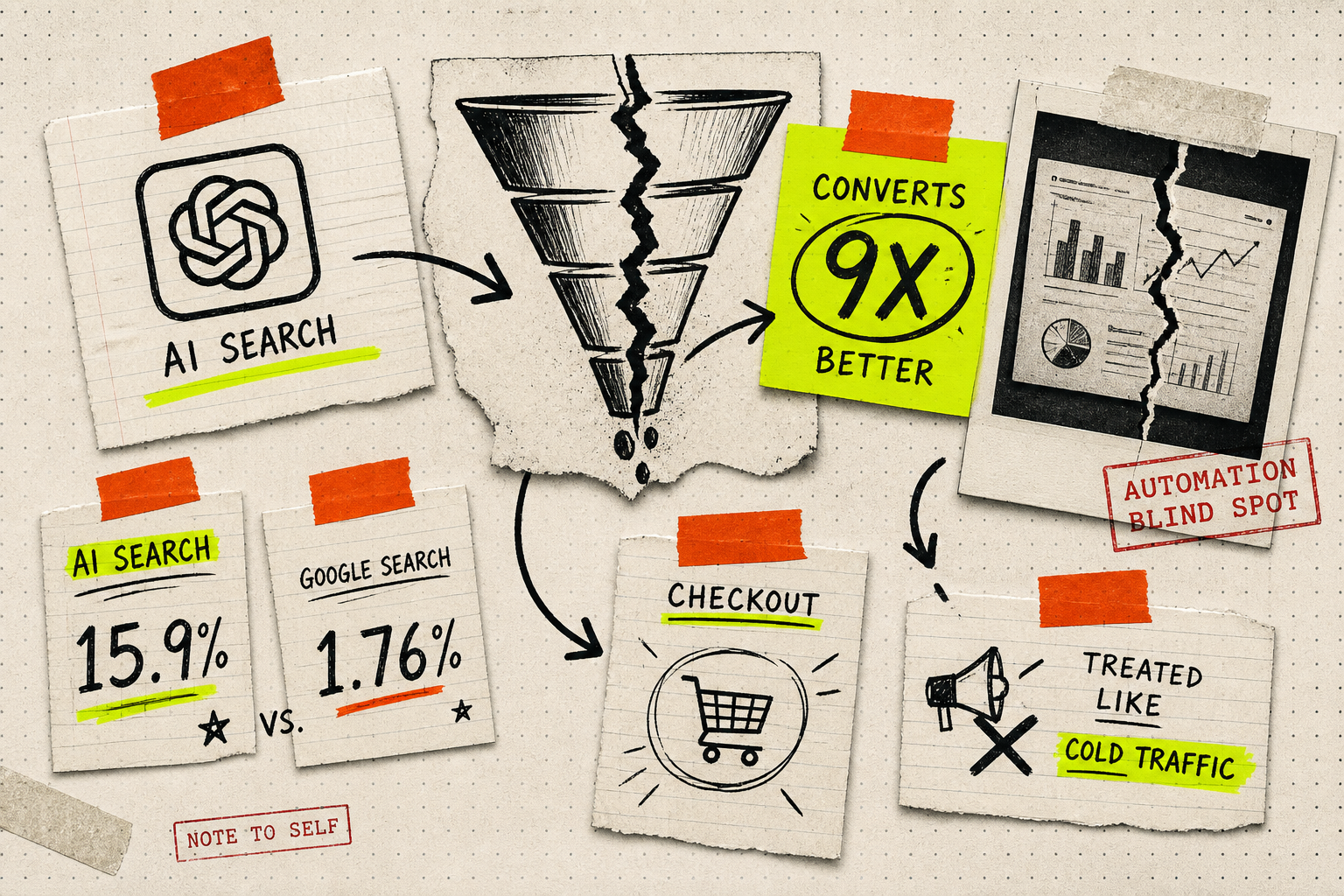
AI Search Broke Your Funnel. Your Automation Doesn't Know Yet.
ChatGPT traffic converts at 15.9%. Google at 1.76%. Your marketing automation is treating both the same — and burning your best leads.
Your Business Is Invisible In ChatGPT. Here's Why.
Your customers are asking ChatGPT for a plumber, a Shopify agency, a bookkeeper — and your business isn't in the answer. Here's why, and the 4-part fix.