Cold Email Reply Rate Is 3%. Signal-Based Outbound Is 4x That.
Cold email's average reply rate is 3.43%. Signal-based outbound hits 15-25%. The 4 layers — and the volume math you stop running.
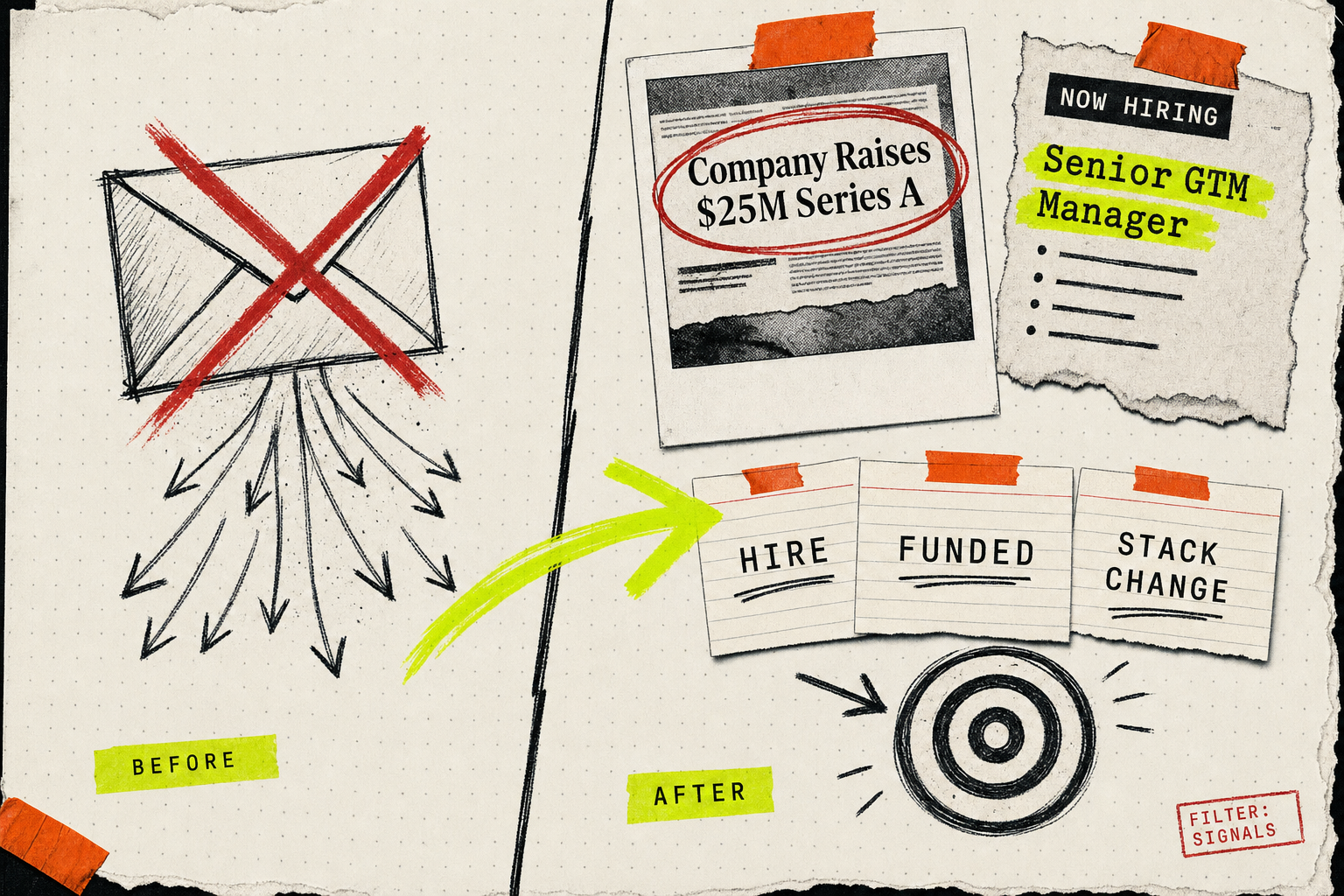
The average B2B cold email gets a 3.43% reply rate. That's Instantly's number, pulled from billions of sent emails in 2026[1]. Cleanlist's aggregated dataset puts it at 3.1%[2]. Apollo says a "well-run" campaign should land between 3% and 5%[3].
So when someone sells you on a cold email tool that promises "10x reply rates," they're promising you'll hit the 80th percentile of a market where 19 out of 20 emails get ignored[4]. Cool. Math is fun.
Here's what's actually changed: the people getting 15–25% reply rates aren't sending better cold emails. They're not sending cold emails at all. They're sending signal-based outbound — outreach triggered by a specific event at a specific company, sent within hours, referencing the event directly.
The data on that gap is now boring. Salesmotion's 2026 benchmark report puts signal-based outreach in the 15–25% response range[5]. Devcommx tracks 3–6x higher positive reply rates versus generic cold outbound[6]. Prospeo logs 2–4x higher conversion across verticals, with one dataset showing a 384% lift in meetings booked[7].
If you're an operator running a $1M–$20M business and you're still buying lists and blasting them, you're not in a "cold email isn't working anymore" problem. You're in a "cold email has stopped working for 19 out of 20 of you and you didn't change anything" problem.
What "signal-based" actually means
Drop the jargon. A signal is a thing that happened at a company in the last 7 days that says they might need what you sell right now. That's it.
The signals that actually convert are short:
- Funding round closed — they suddenly have a budget line item they didn't have last month.
- New hire in a specific role — a new VP of Marketing means a 60-day window where they're making vendor decisions.
- Job posting for a role you replace or augment — if they're hiring three SDRs, they have a $300K/year problem you can solve for $40K.
- Tech stack change — they just installed your competitor or your prerequisite tool.
- Headcount crossing a threshold — passing 50 employees means a new compliance buyer just got hired.
That's the short list. The reason it works is the same reason cold email stopped working: it's not personalization, it's timing. Apollo's own taxonomy treats trigger events as a separate layer specifically for prioritizing when to reach out — funding, leadership change, expansion announcement — not just who to reach out to[8].
A generic cold email to a marketing director gets 3% reply. The same email sent the week she got promoted into the role gets a meeting. Same email. Different week.
Why most "AI outbound" tools won't fix this for you
The current crop of AI sales tools mostly automates the wrong half of the problem. They make cold emails faster, more personalized, and more numerous. They don't change which prospects you hit or when.
Here's the symptom: if your AI outbound tool is bragging about "sending 10,000 personalized emails a day," it's solving the wrong problem. Sending 10,000 emails a day puts you over Google and Yahoo's bulk sender threshold of 5,000/day, which since November 2025 means Gmail actively rejects non-compliant senders instead of just filtering them to spam[9]. If your spam complaint rate goes above 0.3%, you're domain-toxic — Gmail's threshold for ineligibility is exactly that[10].
So now you have:
- A 3% reply rate
- A 0.3% spam-complaint ceiling you can't cross
- A 5,000/day volume cap before strict authentication kicks in
- And tools that all sell you more volume
The math doesn't fix itself by adding more zeros. It fixes itself by sending 1/100th the volume to a list 10x more likely to reply.
How I'd build a signal-based outbound stack today
I'd build this in four parts. No fancy stack — just things stitched together with intent.
Part 1: Signal source layer
Pick 3–5 signal sources, not 20. Funding announcements (Crunchbase / news scrape), job postings (LinkedIn / Google for Jobs), executive moves (LinkedIn change detection), and tech-stack changes (BuiltWith / similar). Clay positions itself as the orchestrator for this layer specifically — when a signal fires, it triggers downstream enrichment and routing[11].
Part 2: Enrichment + qualification layer
When a signal fires, enrich the account: company size, revenue band, current stack, contact info for the relevant role. Drop anything that's not in your ICP — if you sell to $5M Shopify brands and the signal fired at a Fortune 500, kill it. The point of this layer is to narrow, not to widen.
Part 3: Personalization layer
A small LLM call drafts an email that references the actual signal. Not "I saw on LinkedIn" — that's lazy. "Saw the seed round close last Tuesday — congrats on closing Greylock" works because it proves you actually noticed. Salesforge frames the entire shift as moving from volume-first to timing-first prospecting — the edge is acting on the signal before your competitors do, not finding signals nobody else has[12].
Part 4: Speed-to-send layer
This is the one most teams skip. Signal-based outbound dies if it takes 4 days to send the email. The benchmark to beat is 48 hours from signal-fire to email-sent. Anything slower and you're cold again.
Total stack cost for a $1M–$20M operator should land in $200–$600/month. Not $2K. If your stack is $2K/month and you're still getting 3% replies, you bought the wrong stack.
What you stop doing
This is the part nobody writes about. Going signal-based means:
- Smaller lists. Your weekly outbound volume drops from 2,000 to 200. That feels wrong. Do it anyway.
- No more "blast Mondays." Signals don't care about your sequence calendar. You send when the signal fires.
- Different team metrics. "Emails sent per SDR per day" is now a vanity metric. The right one is "signals acted on within 48 hours."
- Fewer tools. The Apollo + Outreach + Lemlist + Smartlead stack collapses to one signal aggregator and one sender.
The teams that quietly hit 20% reply rates aren't using a magic tool. They've just stopped trying to scale a thing that doesn't scale linearly anymore.
The honest version of the pitch
I'm not telling you cold email is dead. Plenty of people will keep hitting 3% reply rates and grinding it out. If you have a $50 LTV product and you can absorb a 0.5% meeting conversion, generic outbound still works. Volume math.
But if you're selling something with a $5K+ ACV to a $1M–$20M operator who gets 80 cold emails a week, you're not in volume math anymore. You're in trigger math. The week someone closes a Series A is the only week they'll read your email at all.
If you want this built — picking the 3 signals that matter for your ICP, wiring the stack, getting the first batch out the door in 14 days — that's what I do. Book a 30-minute audit on zerocam.studio and I'll tell you exactly what your version looks like, what it costs, and whether it's worth doing.
If the signals don't exist for your market, I'll tell you that too.
-
Cold Email Benchmark Report 2026: Reply Rates, Deliverability and Trends↩
3.43% average cold email reply rate across billions of sent emails in 2026.
-
Cold Email Response Rates: 3.1% Average (2026 Data)↩
Cleanlist's aggregated 2026 dataset puts average cold email reply rate at 3.1%.
-
What's a Good Cold Email Reply Rate in 2026?↩
Apollo positions a well-run cold email campaign at 3-5% reply rate with top performers at 8-12%.
-
B2B Cold Email Statistics 2026: Benchmarks & What Works Now↩
About 19 out of 20 cold emails get ignored; reply rates above 5% are considered good.
-
Signal-Based Outbound Metrics: What to Track in 2026↩
Signal-based outreach produces responses in the 15-25% range vs 3% for generic cold.
-
Signal-Based Selling vs Intent Data in 2026↩
Signal-based selling delivers 3-6x higher positive reply rates vs generic cold outbound.
-
Buying Signals for Outbound: 8 Signals Ranked by Impact (2026)↩
Signal-based outbound delivers 2-4x higher conversion with one dataset showing 384% lift in meetings.
-
What Signals Identify High-Fit Accounts for Outbound?↩
Apollo's signal taxonomy treats trigger events (funding, leadership change, expansion) as a prioritization layer.
-
Cold Email Guide 2026: Best Practices & Benchmarks↩
Since November 2025, Gmail actively rejects non-compliant bulk senders above 5,000/day instead of just spam-filtering.
-
Gmail & Yahoo Sender Requirements 2026: The Complete Guide↩
Spam complaint rate at or above 0.30% makes a sending domain ineligible for delivery on Gmail/Yahoo.
-
Custom Signals — Clay↩
Clay orchestrates signal-driven enrichment and routing when funding announcements or job changes fire.
-
Signal-Based Outbound: How to Find and Act on Buying Signals Before Your Competitors↩
Signal-based outbound replaces volume-first prospecting with timing-first prospecting — speed and act-first beats source novelty.
Ready to build your own AI system?
Book a Free Audit Call →Keep Reading
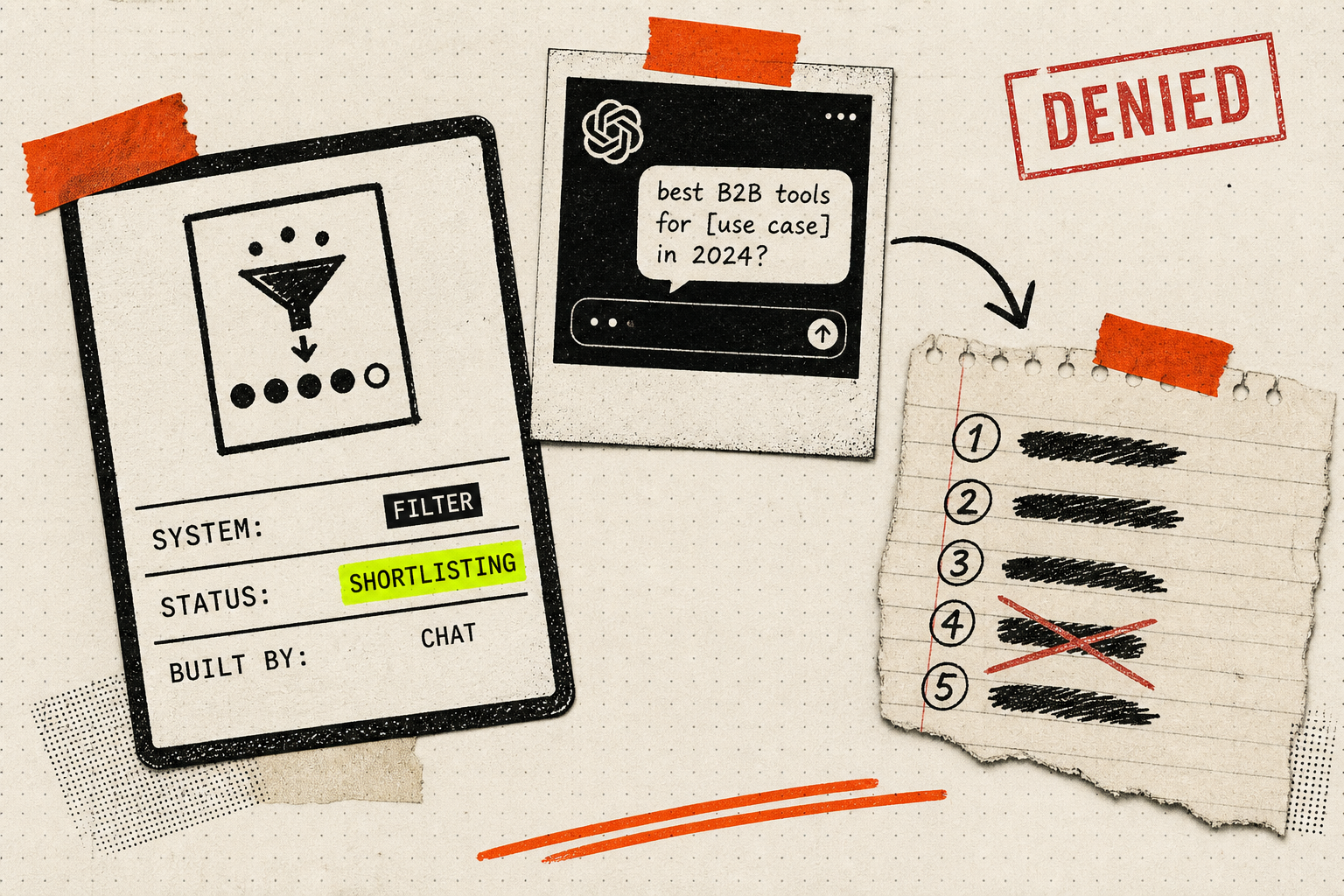
Buyers Shortlist You In ChatGPT Before You Know They Exist
51% of B2B buyers start vendor research inside an AI chatbot. If you're not in the model's shortlist, your funnel already ended. Here's the fix.
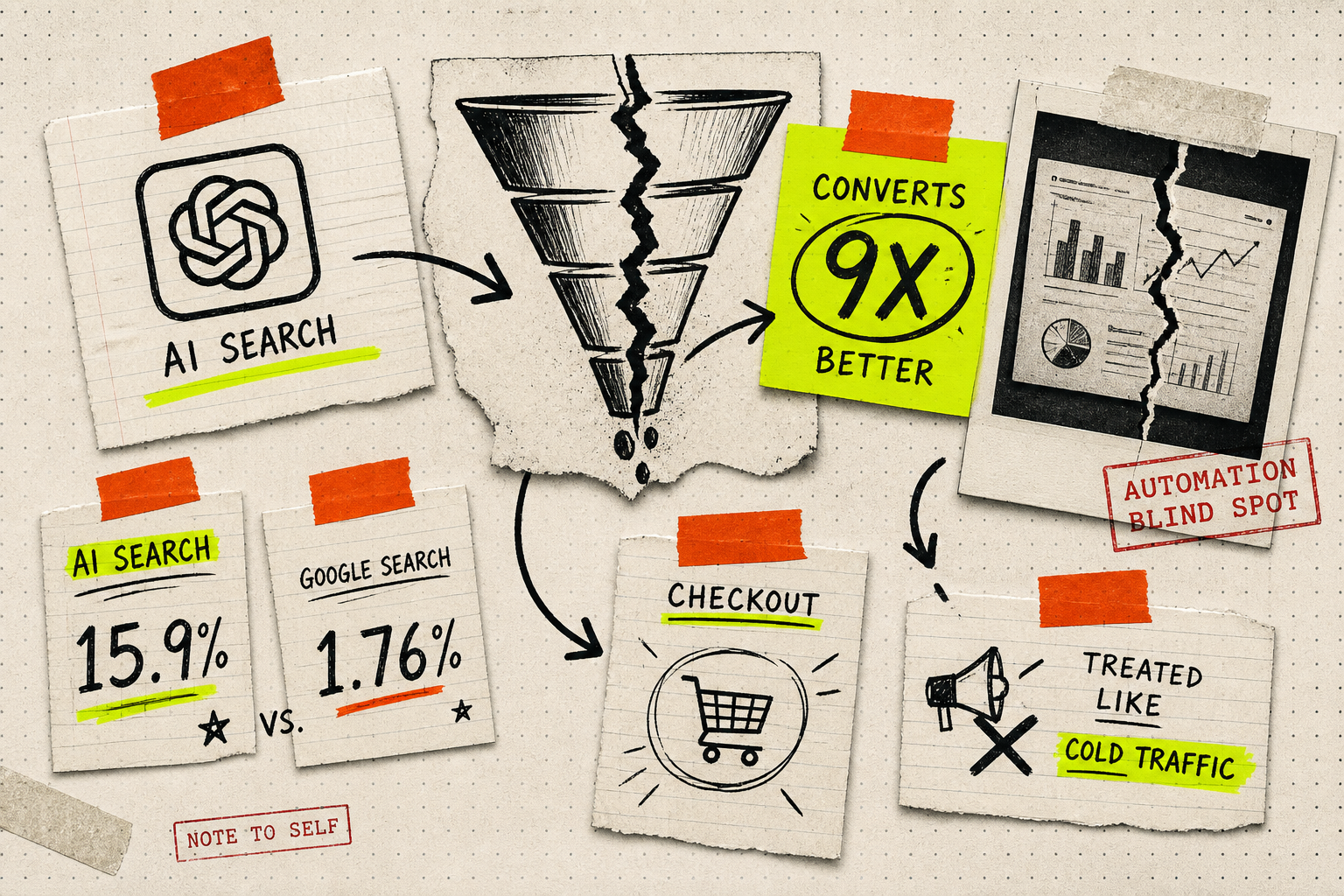
AI Search Broke Your Funnel. Your Automation Doesn't Know Yet.
ChatGPT traffic converts at 15.9%. Google at 1.76%. Your marketing automation is treating both the same — and burning your best leads.
Your Business Is Invisible In ChatGPT. Here's Why.
Your customers are asking ChatGPT for a plumber, a Shopify agency, a bookkeeper — and your business isn't in the answer. Here's why, and the 4-part fix.