AI Marketing Plans Are Free. That's Why They're Worthless.
GPT-5 will hand you a 60-page marketing plan in 43 seconds. MIT says 95% of these pilots produce zero P&L impact. Here's what a real plan looks like.
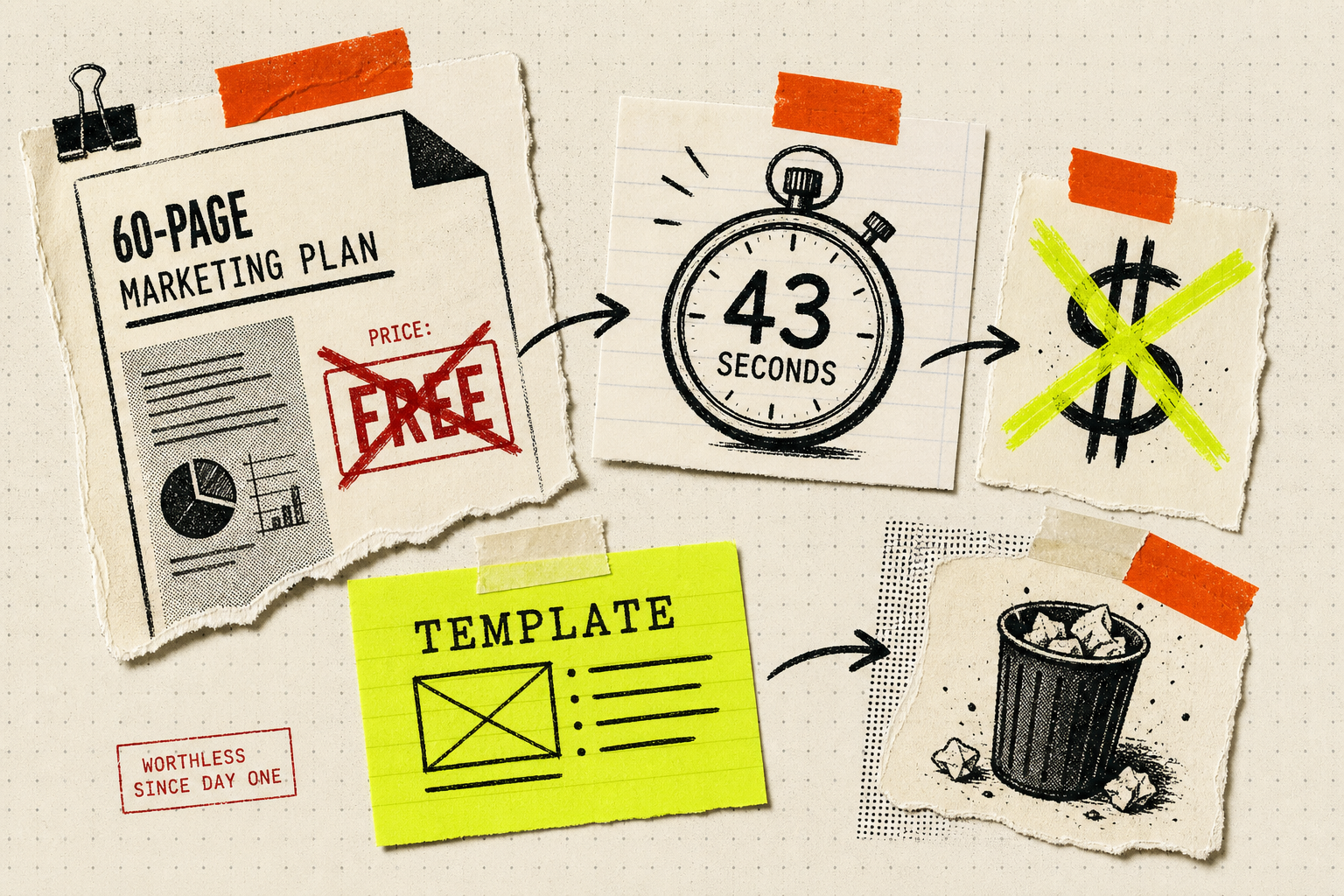
I watched a $4M home services owner paste his business into ChatGPT last week and ask for a marketing plan. It gave him one in 43 seconds. Eight channels, a content calendar, a "brand voice," three influencer tiers. He printed it. He was happy.
He's going to lose money.
Not because the plan was wrong on its face. Because it was a plan for no one — a smooth, confident, generic document assembled from every marketing blog GPT-4 ever ate. The 43 seconds it took to generate is exactly how much strategic thinking went into it: zero. And the market has now priced that at zero, for good reason.
Here's what the data says about what happens next.
Everyone is doing this. Almost none of it is working.
MIT's State of AI in Business 2025 report found that roughly 95% of enterprise generative-AI pilots deliver no measurable P&L impact[1]. Only about 5% see meaningful revenue acceleration. This isn't an "AI doesn't work" story — the same report shows the winners pulling ahead fast. It's a story about what most people are doing with these tools, which is asking them to produce output before feeding them the inputs that make output worth anything.
The failure factors are extremely well-mapped. A meta-analysis across McKinsey, HubSpot, and the Marketing AI Institute found the top blockers are knowledge gaps (71.7%), technical challenges (70%), and lack of training (67%)[2]. Notice what's missing from that list: "the AI was too dumb." The tool works. The prompt in front of it doesn't.
Meanwhile the money keeps flowing. Gartner's 2026 CMO Spend Survey shows CMOs now allocate 15.3% of marketing budgets to AI initiatives, but only 30% of organizations say they're ready to scale AI capabilities[3]. That gap — spending as if you're operating a Ferrari, executing as if you're still learning to drive — is where the money goes to die.
What "AI marketing plan" actually means
Ask GPT-5 or Claude for a marketing plan and it will produce something that reads like a decent MBA case study. Positioning statement. TAM/SAM/SOM. Channel matrix. KPIs. Content pillars. It's very well-formatted.
Here's what it can't do, and won't tell you it can't do:
- It doesn't know your margins. Every recommendation assumes you can afford it. Most cannot.
- It doesn't know your team. "Launch a podcast" is free advice when the model doesn't have to hire an editor.
- **It doesn't know your competitors' actual funnels** — just what they publish. The interesting stuff (their retargeting, their offer stack, their upsell path) is invisible to a web-scrape.
- It doesn't know what already failed. Every recommendation is presented as if you haven't already tried three of them.
Academic research has landed here too. A 2024 study in the Journal of Digital & Social Media Marketing explicitly warned that ChatGPT "falls short in understanding consumer needs and preferences" and lacks the domain expertise required for real marketing decisions[4]. The plan looks complete. Under the hood it's a confident average of everyone else's plan.
I'll say it more directly: a strategy that costs $0 and takes 43 seconds is not a moat. It's a template. Your competitor has the same template.
Why smart operators still get suckered
Because the alternative — hiring an agency to write a marketing plan — has been broken for years. $8K to $20K, six weeks, a 60-page PDF, half of which is stock photography. When ChatGPT can produce the same 60 pages in a minute, the natural reaction is: "OK, so the agency was overcharging." Which is true. But the conclusion — "so I'll just use the AI version" — is wrong. Both are worthless. One's just cheaper.
The value was never in the deliverable. The value was in the thinking. Nobody was buying a PDF. They were buying the two questions no template ever asks: what specifically has failed for you, and what do you already know that nobody else does? The AI has neither of those. Neither did most agencies.
What actually works — the shape of it
Here's the process I run when someone hands me a business that needs a real marketing plan, not a template dressed up as one:
- One hour on the P&L. Not a mission statement. Not a customer avatar. Look at where money came in last quarter, at what CAC, at what payback period. Half the "marketing plans" I see recommend channels the business's unit economics can't support. That's not a marketing problem. It's an arithmetic one.
- Interview five customers who paid full price in the last 90 days. Ask them what they almost bought instead. Ask them what they'd tell a friend. Those two answers reshape positioning more than any AI can, because they're facts, not statistical averages.
- Look at what the last 12 months of marketing spend actually returned. If you don't have attribution, that's the first thing to fix — not "launch a TikTok." A dashboard that tells you what worked is worth ten AI-generated content calendars.
- Pick two channels. Only two. Gartner projects marketing work will go from 16% AI-automated in 2026 to 36% by 2028[5]. That doubling doesn't mean "run ten channels because AI can handle it." It means the two channels you do run should each be instrumented to a level that was uneconomic five years ago.
- Ship a 90-day test. Not a year-long plan. Not a "brand voice." One offer, one channel, one measurable outcome. Then iterate on what the numbers said.
None of this requires GPT-5. All of it requires someone willing to sit with unglamorous inputs before they generate confident outputs.
Where AI actually earns its keep
I use AI constantly. Just not for strategy.
Where it pays for itself: drafting ad variants after a human has written the positioning, summarizing 40 customer interviews into themes, building the analytics dashboard, running the SQL to figure out CAC by cohort, cleaning up a landing page's copy after someone has decided what the page needs to say. In every one of those, a person made the decision and the model did the labor. That's the correct division.
The mistake is inverting it — asking the model to make the decision and do the labor. That's when you end up with the $4M home services owner and his 43-second plan. And when you end up as part of the 95% MIT was talking about.
Gartner's own data suggests the shift is quietly happening. In the same 2026 CMO study, the marketing organizations they call "AI-ready" allocate more of their budget to AI (21.3% vs. the 15.3% average) but also report average marketing budgets of 8.9% of company revenue[3]. They're not spending less. They're spending better. The AI is helping. It isn't leading.
What to do this week
If you're an operator running a $1M–$20M business, and you've been staring at an AI-generated marketing plan wondering why executing it feels off:
- Delete the plan.
- Book three hours on your calendar this week — one for the P&L, one for customer calls, one to write what you actually believe about your market on a single page.
- Then, and only then, hand any of that to the AI, and let it draft the tactics.
The template was never the constraint. Your specific, hard-won knowledge of your business was. AI can help you scale that knowledge. It can't manufacture it.
If you want the version of this built into a real 90-day system — with the P&L review, the customer interviews, the two channels, and the dashboards wired up — that's what I do. Book a 30-minute audit and I'll tell you exactly what your version would look like. No pitch, no plan-shaped PDF. Just the numbers.
-
MIT report: 95% of generative AI pilots at companies are failing↩
MIT State of AI in Business 2025 found ~95% of enterprise GenAI pilots deliver no measurable P&L impact.
-
Top Marketing AI Implementation Failure Statistics 2025↩
Top AI marketing failure factors: knowledge gaps (71.7%), technical challenges (70%), lack of training (67%).
-
Gartner 2026 CMO Spend Survey: 15.3% of Marketing Budgets to AI, but Only 30% Are Ready to Scale AI Capabilities↩
CMOs allocate 15.3% of budgets to AI but only 30% say they're ready to scale; AI-ready orgs allocate 21.3% and average 8.9% of revenue on marketing.
-
ChatGPT for Marketers: Limitations and Mitigations↩
Academic study identifying ChatGPT's inability to understand consumer needs and lack of domain marketing expertise.
-
Gartner Warns Marketing Leaders: Competence Is the AI Trap↩
Gartner: marketing leaders project AI-driven automation of marketing work to double to 36% by 2028.
Ready to build your own AI system?
Book a Free Audit Call →Keep Reading
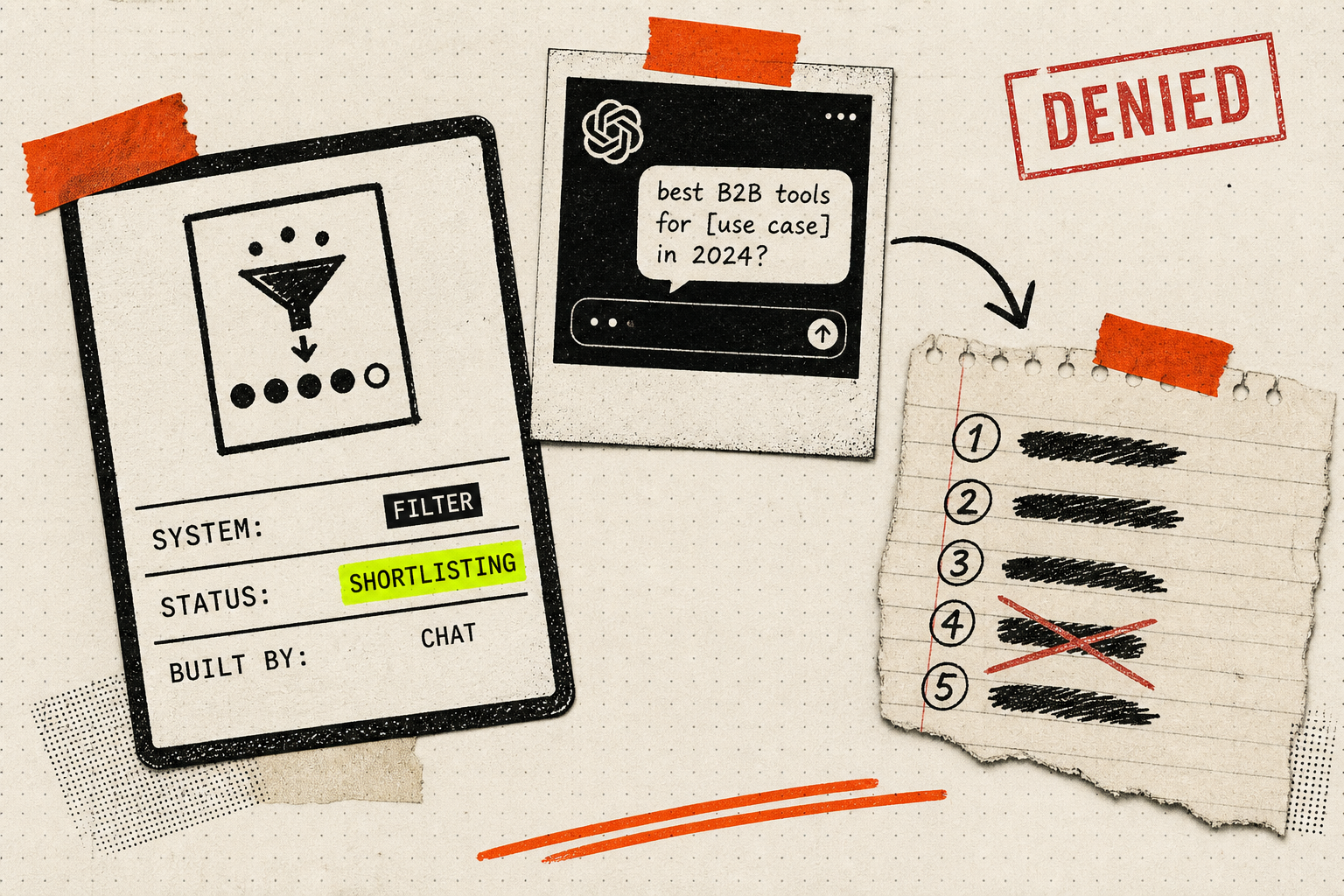
Buyers Shortlist You In ChatGPT Before You Know They Exist
51% of B2B buyers start vendor research inside an AI chatbot. If you're not in the model's shortlist, your funnel already ended. Here's the fix.
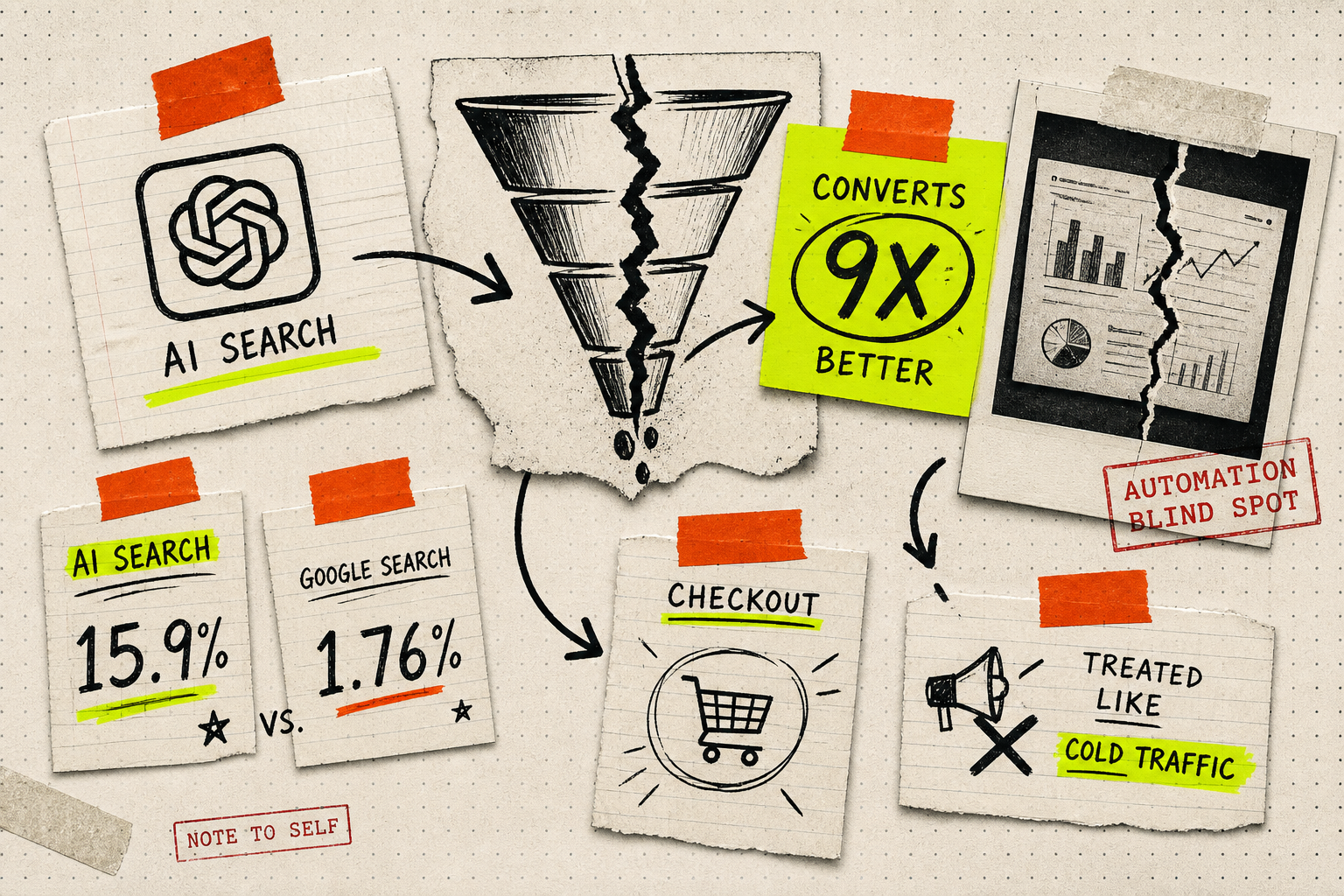
AI Search Broke Your Funnel. Your Automation Doesn't Know Yet.
ChatGPT traffic converts at 15.9%. Google at 1.76%. Your marketing automation is treating both the same — and burning your best leads.
Your Business Is Invisible In ChatGPT. Here's Why.
Your customers are asking ChatGPT for a plumber, a Shopify agency, a bookkeeper — and your business isn't in the answer. Here's why, and the 4-part fix.