HubSpot's Stock Is Down 70%. They're Repricing To Survive AI.
HubSpot's stock is down 70% and they just flipped Breeze agents to pay-per-result pricing. Here's what that means for every SaaS line item on your invoice.
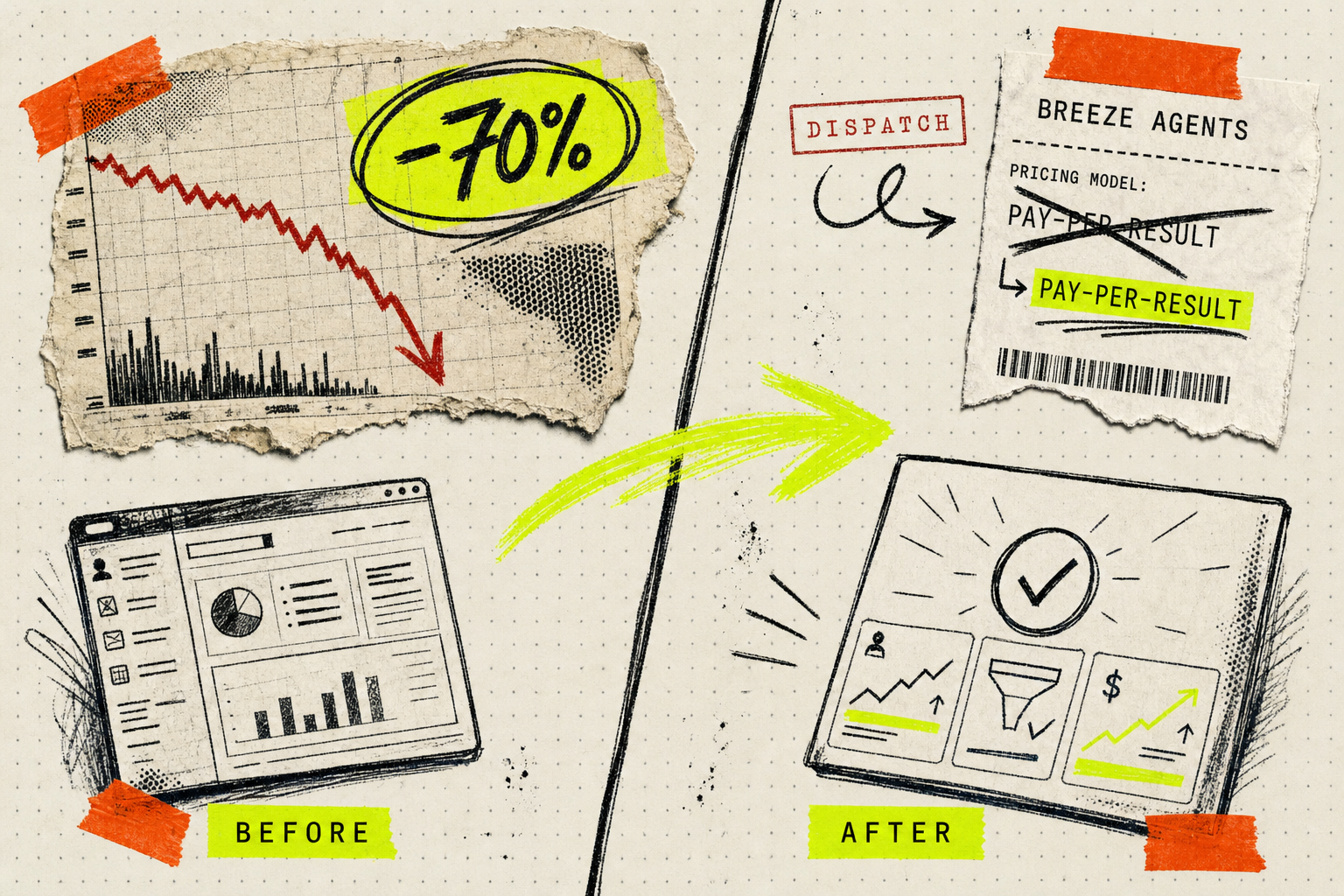
HubSpot's stock has fallen roughly 70% in 2026[1]. Revenue is still growing — 23% year-over-year in Q1, $881M in the quarter[1]. That combination should tell you something. The market isn't punishing HubSpot for missing numbers. It's punishing HubSpot for being a seat-based SaaS company at the exact moment AI agents are collapsing the value of seats.
This isn't a HubSpot story. It's a warning shot for every SaaS platform your business is currently paying for.
What actually happened
In April 2026, HubSpot flipped the pricing model on its two flagship AI agents — Breeze Customer Agent and Breeze Prospecting Agent — from per-usage to pay-per-result[2]. Customer Agent bills only on resolved tickets. Prospecting Agent bills only on completed prospecting tasks. Both come with a 28-day free trial[3].
Read the CEO quote carefully: "Customers can move faster, experiment more, and trust that their spend is tied to real results"[2]. Translation: the old pricing model — seats, tiers, per-user — is dead for AI. If HubSpot doesn't move to outcomes, someone will build a $99/mo agent that does the same job and eat their lunch.
The market is already pricing that in. HubSpot's stock fell sharply on AI-pricing and disruption news through early 2026[4]. Revenue growth decelerated from 25.4% in 2023 to 19.2% in 2025[5], and companies are quietly leaving over stacked pricing — $3,000–$7,000 mandatory onboarding fees on top of climbing subscription tiers[5]. Gartner projects 35% of point-product SaaS tools will be replaced by AI agents by 2030[6]. The software sector as a whole shed roughly $2 trillion in market cap in early 2026[6].
That's the backdrop.
Why most takes on this are wrong
The LinkedIn take is: "HubSpot is dying, self-host everything with n8n and Claude."
That's lazy and it's wrong. Look at the actual numbers. HubSpot added ~40,000 customers year-over-year to reach just under 300,000 subscribers, and margins flipped from a GAAP loss to a $27.9M operating profit in Q1[7]. The business isn't dying. It's transitioning. Fast.
The other bad take is: "outcome-based pricing is a gimmick." Also wrong. Outcome pricing is the first honest concession from a legacy SaaS company that agents don't sell like seats. When your "user" is a script that runs 24/7, the seat model breaks. HubSpot moved because the math forced them to. The rest of your stack is next.
The real question isn't whether HubSpot survives. It's: which line items on your monthly SaaS invoice are about to reprice underneath you, and which ones will just quietly disappear?
What this actually changes for a $1M–$20M operator
You have a stack. If you're running a business that size, it's usually some flavor of:
- A CRM (HubSpot, Pipedrive, or a homegrown Airtable duct-tape rig)
- An email / outreach tool
- A support / helpdesk tool
- A dashboard tool (Looker, Metabase, or worse — Excel)
- 3–8 point tools nobody remembers signing up for
Here's what's coming:
1. Support-desk seats will collapse first
Breeze's Customer Agent bills on resolved tickets. So does Intercom's Fin. So does Decagon. The moment your support seats stop scaling with your team and start scaling with resolved tickets, the incentive to add headcount vanishes. Ninety percent of "tier 1" seats are already at risk.
2. Prospecting SDR seats are next
Prospecting Agent bills on completed research tasks. AI voice agents are booking meetings roughly 3x better than SDRs in early trials[8]. If your SDR team costs $8K per rep loaded and an agent costs $0.30 per completed research task, one of these is not going to survive Q4 2026.
3. Dashboard tools are dead-tool-walking
SaaS utilization rates are projected to hit just 54% by 2026[9] — meaning almost half the seats you're paying for aren't being used. An agent that reads three tools and answers "how did yesterday go" in Slack replaces most dashboard licenses on your P&L.
4. The middle of your stack gets absorbed
Point tools (schedulers, form-builders, chat widgets) get eaten by whichever platform holds your customer data. HubSpot's argument for keeping you: "Breeze Agents operate within HubSpot's Smart CRM, giving them access to customer data"[3]. That's the moat play — own the data layer, run agents on top of it, kill everything in between.
The play — right now, this quarter
I'm not telling you to rip out HubSpot. I'm telling you to audit the invoice like it's already 2027.
Here's the actual exercise, and it takes an afternoon:
- Pull every SaaS invoice from the last 6 months. Get a real number, not a memory. Most $5M businesses are running 40–70 tools they can't name.
- Column A: What outcome does this tool produce? (Not "features." Outcomes. "Books meetings." "Resolves tickets." "Sends invoices.")
- Column B: Is that outcome measurable in a database row? If yes, an agent can bill on it — and someone will offer that in 12 months.
- Column C: What's the annual cost, all-in? Include the human hours to run it.
- Sort by column C descending. That's your kill list.
The tools that survive this exercise: ones that own unique data, ones with real integrations, ones that produce fuzzy outputs (creative work, judgment calls). The rest — the middle-layer tools that just move data around — those are dead-tool-walking. You'll be running an agent that does their job for 5% of the price by mid-2027.
The HubSpots and Salesforces will survive because they own the customer graph. The point tools stapled to them will not. That's the trade.
What I'd build instead
If I were rebuilding a $5M DTC brand's stack today, I'd keep exactly two things: the CRM (for data gravity) and the accounting tool (for legal reasons). Everything else — support, prospecting, dashboards, review handling, inventory alerts, order-status pings, refund triage — gets replaced by four or five agents wired directly to the CRM, running on outcome-priced APIs.
Total monthly cost after transition: usually 30–50% of what the business was paying before. Fewer dashboards. Fewer logins. Fewer "who owns this tool" Slack threads.
The HubSpot stock chart is just the loudest tell that this is happening. The quieter one is the invoice you haven't read yet.
If you want to run the audit above without spending your Saturday on it — that's what the free audit call is for. Thirty minutes, I'll look at your stack, tell you which three line items are about to reprice on you and which two agents you could deploy this month to get ahead of it. No pitch, no follow-up spam. Book it at zerocam.studio.
-
HubSpot defies SaaSpocalypse with strong Q1 results↩
HubSpot stock down ~70% in 2026 while Q1 revenue grew 23% YoY to $881M
-
HubSpot's Customer Agent and Prospecting Agent: Now you pay when the task is complete↩
HubSpot moved Breeze agents to pay-per-result pricing in April 2026
-
HubSpot Shifts Breeze AI Agents to Pay-per-Result Pricing↩
Both Breeze agents come with a 28-day free trial and operate within Smart CRM
-
HubSpot Announces AI Pricing Changes, Stock Falls Sharply↩
HubSpot stock fell sharply on AI pricing / disruption news in early 2026
-
Why Companies Are Quietly Leaving HubSpot in 2026↩
HubSpot revenue growth decelerated from 25.4% (2023) to 19.2% (2025); $3K-$7K onboarding fees added
-
20 Micro-SaaS Ideas for 2026 (That AI Won't Kill)↩
Gartner projects 35% of point-product SaaS replaced by AI agents by 2030; software sector shed $2T market cap in early 2026
-
HubSpot Stock Drops As Q1 Beat Collides With AI Transition Fears↩
Q1 2026: 300K subscribers, flipped from GAAP loss to $27.9M operating profit
-
HubSpot Layoffs 2026: SaaS Engineering Talent Lands Where↩
SaaS labor market context around HubSpot and AI-agent adoption in 2026
-
AI Agents vs SaaS: 2026 Business Trends↩
SaaS utilization rates projected to hit just 54% by 2026
Ready to build your own AI system?
Book a Free Audit Call →Keep Reading
Salesforce Just Named Seven Agents. Enterprise AI Still Loses 88% Of Pilots.
Salesforce shipped 7 named Agentforce agents. But 88% of enterprise AI pilots still fail to reach production. Here's the real gap operators need to fix first.

Small Businesses Using AI Are Hiring More People, Not Fewer
Gusto ran payroll on 2,262 small businesses. AI adopters grew headcount 7% faster — 10% for under-10 firms. The doom takes miss the operator story.
WhatsApp Just Made Every Reply Billable. Your Bot Bill Starts October 1.
On October 1, Meta starts charging for every WhatsApp reply — human, third-party AI, or its own. The sticker price is the boring part. Here's what it actually breaks.