Google Shipped 1,302 AI Wins. Gartner Says 89% Of Yours Will Die.
Google Cloud says 1,302 companies shipped AI. Gartner says 89% of AI agent pilots die. Both are true — here's how to be the 11%.
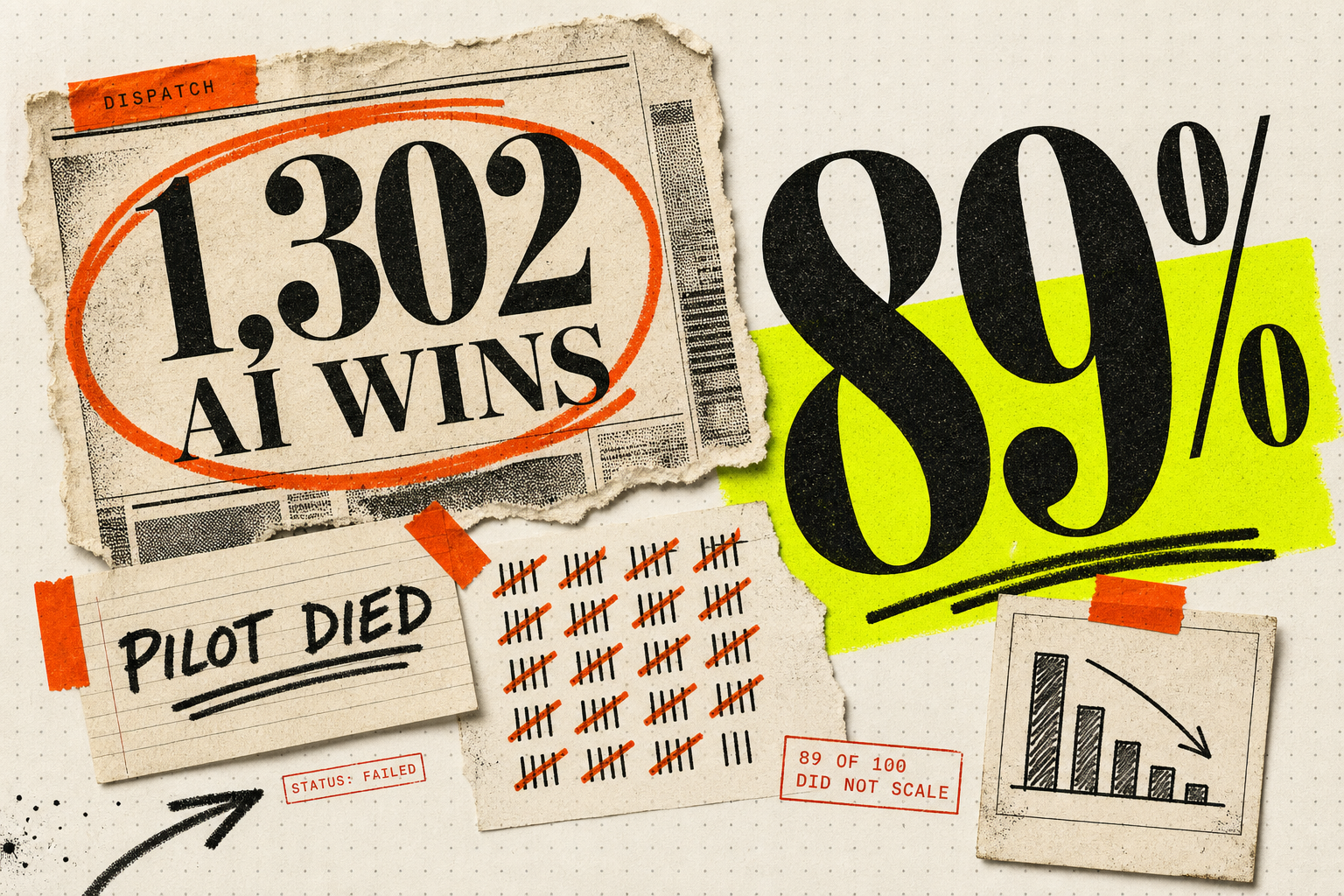
Google Cloud updated its "real-world gen AI use cases" list at Next '26. The number jumped from 601 last year to 1,302 — a 116% year-over-year gain in named enterprise deployments[1]. Every marketing team on LinkedIn is treating this like a starting gun.
Meanwhile, Gartner's 2026 data says 89% of AI agent pilots never reach production[2]. The 11% that do return 171% ROI on average — but the graveyard behind that number is huge.
Both stats are true at the same time. And if you run a small business looking at that Google list and thinking "we should do that," you need to understand which half of the reality you're staring at.
What Google's 1,302 list is actually showing you
Google's list started at 101 in 2024. It hit 601 at Next '25. Then jumped to 1,302 at Next '26[1]. That's not organic growth — that's a scoreboard Google is aggressively curating to prove enterprise adoption is real. The picks are cherry-picked from Google's paying customers. There is no "we tried this and it failed" section.
That doesn't make the list useless. It's actually the closest thing we have to a public catalog of what AI is doing in production at scale. If you read past the headline count, the same patterns show up over and over[3]:
- Customer support triage. Agents that route, tag, and pre-answer inbound tickets before a human sees them — telecoms, banks, and airlines are all shipping this shape.
- Legacy system translation. Google explicitly calls out companies wrapping 40-year-old SAP, mainframe, and COBOL code with Gemini natural-language interfaces so junior developers can query systems no one on staff remembers how to use[3].
- Localized creative variants. Fashion, retail, and CPG brands generating campaign copy across dozens of markets from a single brief.
- Code refactoring and modernization. Banks and telcos using Gemini to accelerate legacy migration work that has been stalled for years.
Notice what's missing from the highlight list? Cold outreach agents. Autonomous marketing automation. "AI runs your whole business." The stuff Twitter is selling you. Google's own catalog — the one they want to look impressive — leans hard into narrow, well-scoped, boring wins.
That's the first clue.
Why 89% of pilots die anyway
Gartner's 89% number is not a Twitter dunk. It's from their 2026 enterprise survey, and it lines up with adjacent data. RAND and Gartner together report an ~80% failure rate on AI projects broadly — 33.8% abandoned before production, 28.4% reaching production but failing to deliver value[4]. Talyx's analysis puts the average prototype-to-production timeline at 8 months, assuming the project survives at all[5].
The failures cluster around four things, and none of them are the model.
- No definition of success. 73% of failed AI projects had no agreed definition of "working" before someone started building[6].
- No AI-ready data. Gartner predicts 60% of AI projects lacking clean, structured data will be abandoned by end of 2026[6]. The agent isn't the bottleneck — the CSV nobody maintained since 2022 is.
- Governance treated as a checkbox. Gartner calls out a 40% failure rate on agentic deployments specifically tied to uniform governance — treating a support chatbot the same as an agent with write access to your ERP[7].
- Pilot theater. Half the pilots I see are demos dressed up as products. They work on a curated dataset in a slack channel with three humans watching. The instant you turn off the humans and connect to real inputs, they collapse.
The 11% that survive don't survive because they picked a better model. They survive because someone drew a tight box around the problem, wired in real data, defined what "done" meant, and kept a human in the loop until the metrics said take them out.
The pattern hiding in Google's list
Read the 1,302 with the 89% in mind and something clicks. Google's winners are almost all narrow, high-volume, well-instrumented tasks. Customer support triage is a great agent problem — the input format is stable, the success metric (resolution rate, deflection rate, CSAT) is already measured, and there's a fallback path (route to human). Code refactoring is a great agent problem — the "correct" is testable. Localized campaign variants is a great agent problem — the copy either passes brand review or it doesn't.
Compare that to what a $2M service business usually asks me first: "Can you build an agent that runs our marketing?" That prompt doesn't have a bounded output. It doesn't have a success metric anyone agrees on. It doesn't have training data. It's not an agent problem yet — it's a decision-hasn't-been-made problem wearing an agent costume.
If your version is going to be one of the 11%, you don't get there by copying an enterprise blueprint. You get there by acting like the enterprises that ship. Which means:
- Pick a task, not a role. "Categorize inbound support tickets by intent and urgency" beats "handle customer service." Narrow. Testable.
- Have the data first. If your last 500 tickets don't live in a table with labels, you're not agent-ready. You're spreadsheet-ready. Do that step.
- Define what "shipped" means before writing a line. A concrete metric — 80% agreement with your team's manual labels, over 200 real tickets — beats a vibes-based launch every time.
- Keep a human in the loop for the first month. Not a compliance human. A human who overrides and whose overrides you log. The overrides are your next training run.
That's the boring version. It's also the version Google puts in the highlight reel, once someone actually pulls it off.
What this actually changes for operators
For a $1M–$20M business staring at 1,302 case studies wondering why they can't reproduce one — the takeaway isn't "we're behind." The takeaway is that the case studies are the tip of a much bigger iceberg, and 89% of the iceberg is failed pilots you never saw.
Two moves I'd make this quarter:
1. Kill one AI project that has no success metric. If you've been "exploring AI for X" for three months and nobody can tell you when it's done, that's the 33.8% Gartner is talking about. Kill it, free the budget, and pick a task-shaped problem instead.
2. Instrument one task before automating it. Whatever the highest-frequency repetitive task is in your business — support tickets, invoice categorization, lead qualification, meeting notes routing — spend two weeks measuring the manual baseline. Time per task, accuracy, cost. Then and only then, prototype an agent against that baseline. If it can't beat the baseline on a real sample of your data, it's not ready.
Gartner's 11% aren't smarter than the 89%. They just started with a smaller, more measurable problem, and refused to declare victory before the numbers agreed.
If you want a second set of eyes on which task in your business is agent-shaped and which is a costume, that's what the audit call is for. 30 minutes, no pitch — I'll tell you which of the 1,302 you can actually copy and which one will put you in the 89%.
-
Google Cloud Next 2026 Wrap Up↩
Google Cloud added 300+ new AI customer stories at Next '26, bringing the running list to 1,302; the 601 number came from Next '25.
-
89% of AI Agent Pilots Never Scale: Gartner's 2026 Data↩
Gartner reports 89% of AI agent pilots fail to reach production; the 11% that survive return 171% ROI.
-
Real-world gen AI use cases from the world's leading organizations↩
Google's public catalog of enterprise gen AI deployments — covers customer support agents, legacy system natural-language interfaces (SAP/mainframe/COBOL), localized creative variants, and code modernization patterns.
-
80% AI Failure Rate 2026: How RAND and Gartner Expose the AI Productivity Gap↩
33.8% of AI projects are abandoned before production; 28.4% reach production but fail to deliver expected value.
-
Why 90% of Enterprise AI Implementations Fail (2026)↩
Gartner reports an average 8-month prototype-to-production timeline for AI projects that survive at all.
-
AI Project Failure Rate in 2026: What the Data Shows↩
73% of failed AI projects had no agreed definition of success; Gartner predicts 60% of AI projects lacking AI-ready data will be abandoned through 2026.
-
Gartner: Uniform AI Agent Governance Will Fail Enterprises↩
Gartner warns a 40% failure rate on agentic deployments is tied to uniform governance that treats all agents identically.
Ready to build your own AI system?
Book a Free Audit Call →Keep Reading
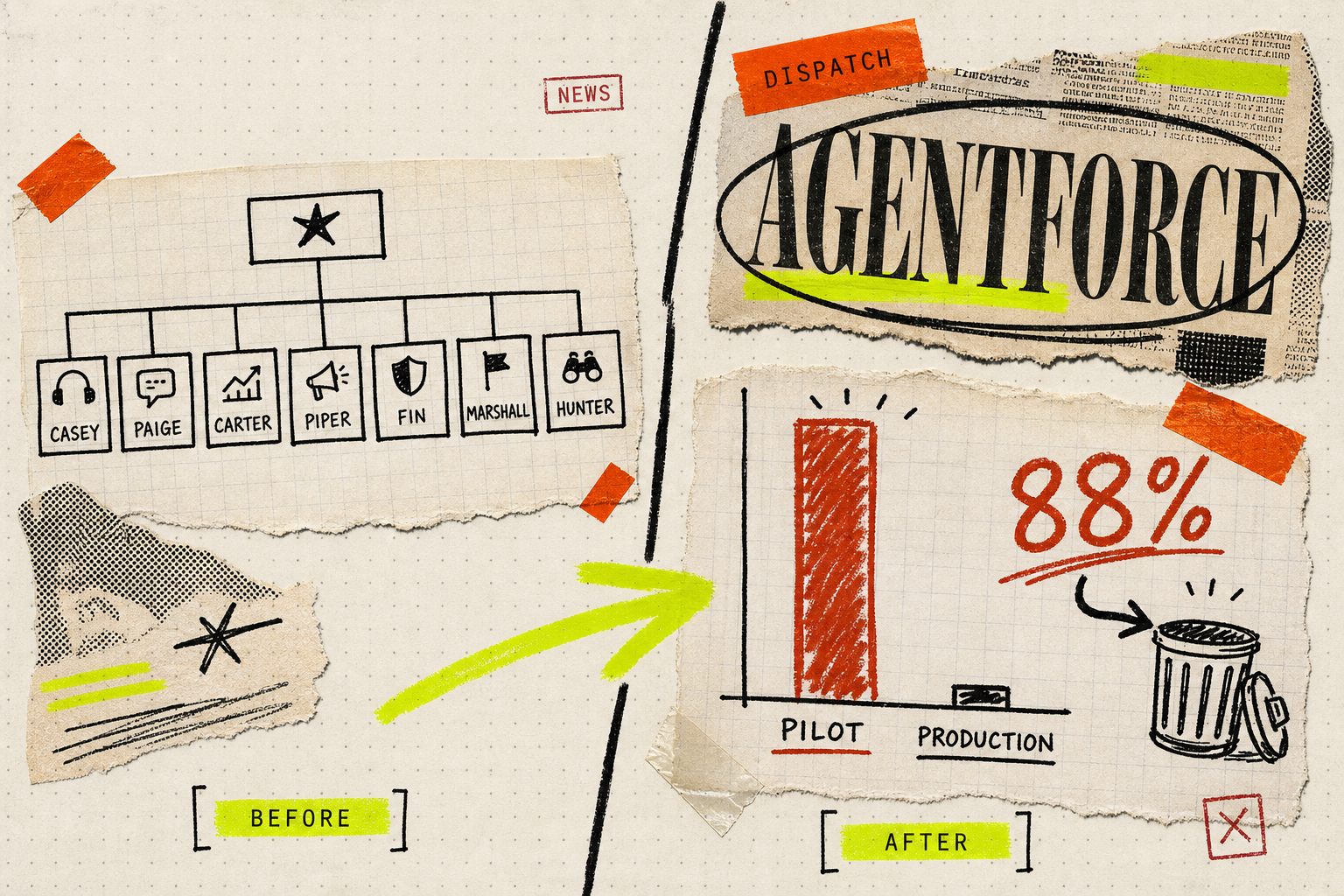
Salesforce Just Named Seven Agents. Enterprise AI Still Loses 88% Of Pilots.
Salesforce shipped 7 named Agentforce agents. But 88% of enterprise AI pilots still fail to reach production. Here's the real gap operators need to fix first.

Small Businesses Using AI Are Hiring More People, Not Fewer
Gusto ran payroll on 2,262 small businesses. AI adopters grew headcount 7% faster — 10% for under-10 firms. The doom takes miss the operator story.
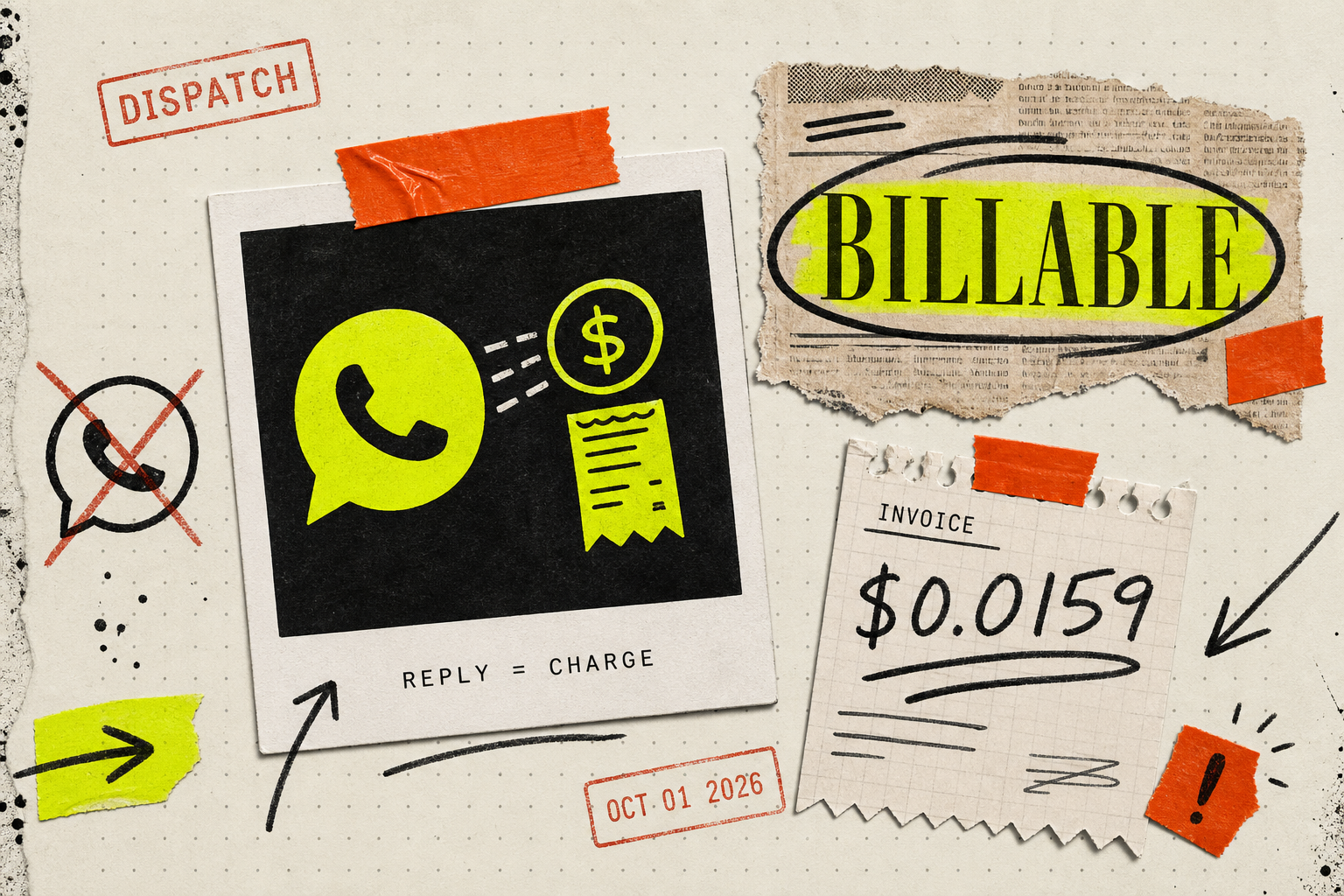
WhatsApp Just Made Every Reply Billable. Your Bot Bill Starts October 1.
On October 1, Meta starts charging for every WhatsApp reply — human, third-party AI, or its own. The sticker price is the boring part. Here's what it actually breaks.