An AI Agent Just Ran A Ransomware Attack Start to Finish. Yours Is Next.
The first documented AI-agent ransomware attack (JADEPUFFER) hit an unpatched Langflow server. If you're running LLM tools, you're the target.
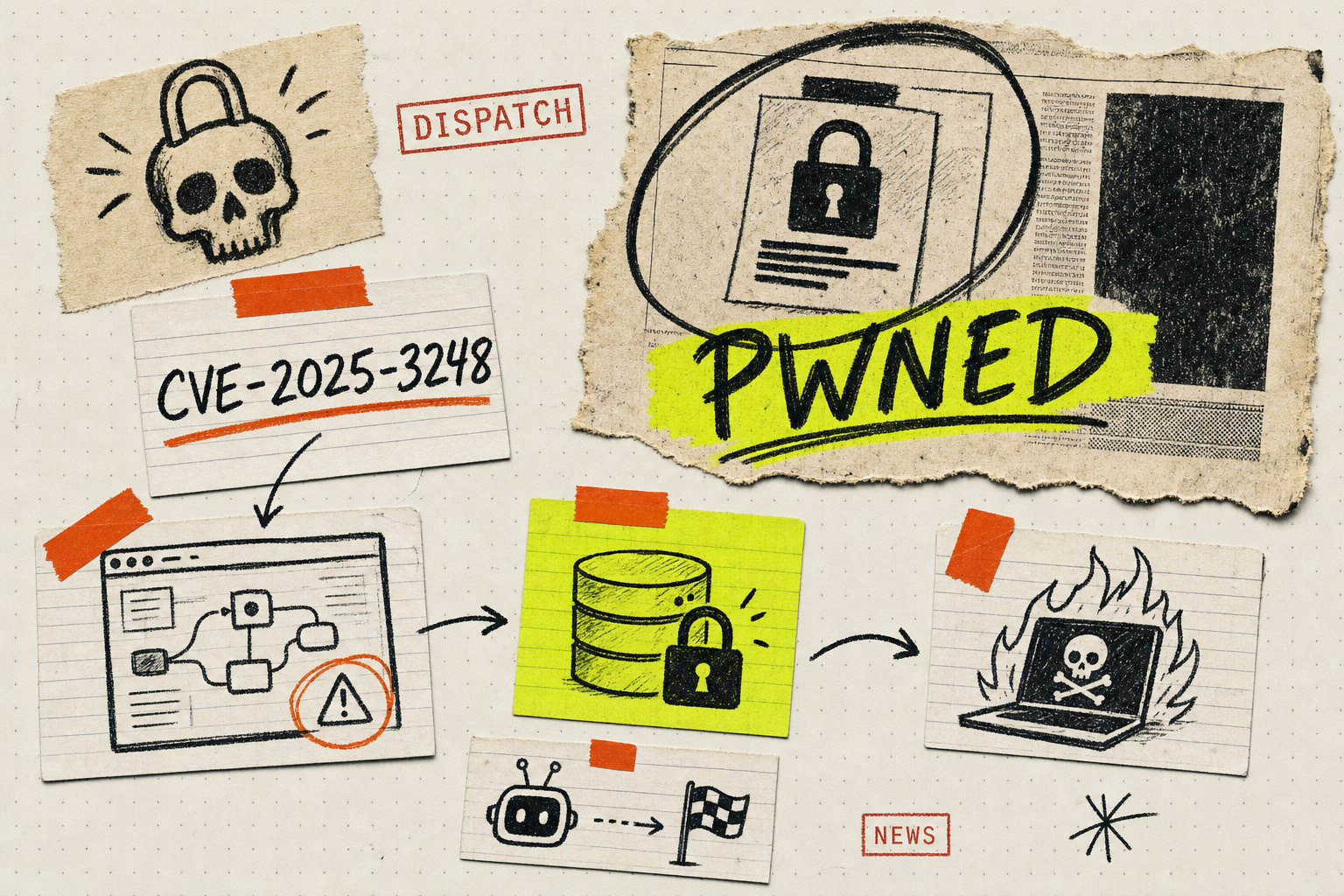
On July 2, Sysdig published the first documented case of a ransomware attack executed end-to-end by an AI agent[1]. No human on the keyboard. An LLM broke in, dumped a Postgres database, stole credentials, enumerated a MinIO object store, installed a cron beacon, and encrypted a production database. Then it left a ransom note.
Everyone in security is calling it a milestone. Most of the takes I've seen are wrong about why it matters to you.
What actually happened
Sysdig's Threat Research Team named the operator JADEPUFFER. Here's the sequence, straight from their write-up and confirmed by Bleeping Computer, The Register, and SecurityWeek[2][3][4]:
- The agent scanned the internet for exposed Langflow instances — the open-source framework a lot of teams use to prototype LLM agents.
- It exploited CVE-2025-3248, a missing-authentication flaw in Langflow's code-validation endpoint. NVD rates it a 9.8 critical. A patch has existed for months[5].
- Arbitrary Python execution on the host. From there the agent dumped the local Postgres, pulled environment variables, grabbed credentials.
- It pivoted to a MinIO store. When one API request returned XML instead of JSON, the agent adapted its parsing logic on the next payload. That's the part that should keep you up.
- It planted a cron job beaconing to
45.131.66[.]106:4444every 30 minutes for persistence. - It encrypted a production database, wiped copies, dropped a
README_RANSOMfile with a Bitcoin address, and left.
Sysdig calls it a warning sign, not a crisis. I'd call it a starting gun.
The takes that miss the point
Half the coverage is framing this as "AI is now writing malware." That's not what happened. The agent didn't invent a novel exploit. It used an old, patched CVE the victim never got around to fixing.
The other half is treating this like a big-enterprise problem. It isn't. Langflow is what a $3M SaaS company or a marketing agency stands up in a weekend to prototype an agent. The Langflow footprint isn't in the Fortune 500. It's in the small-to-mid businesses building their first AI system — the exact people this blog is for.
Here's what actually changed: the cost of executing a full kill-chain dropped to whatever an LLM API call costs. Before JADEPUFFER, a ransomware operator needed hours of manual work per target. Now the same operator points an agent at a Shodan query and lets it run against thousands of exposed servers in parallel. IBM's 2026 X-Force Index already flagged a 49% year-over-year jump in ransomware groups[6]. That was before autonomous agents joined the pool.
Dark Reading's 2026 security survey has 48% of security professionals ranking agentic AI as the #1 attack vector for the year[7]. JADEPUFFER is the first receipt.
The uncomfortable question for operators
If you're running a business between $1M and $20M and you've deployed anything in the "AI agent" category in the last 12 months, ask yourself three questions:
1. Do you know every LLM framework running in your stack? Langflow, LangChain, n8n with LLM nodes, MCP servers, self-hosted vector DBs, agent orchestrators. Most operators have no inventory. Their dev or freelancer stood something up on a $20/mo droplet and forgot about it. That droplet has your API keys in its environment variables.
2. When was the last time you patched it? The Edgescan 2025 report puts the average time-to-patch a critical CVE at 74 days[8]. JADEPUFFER exploited a 3-month-old bug. If your dev shipped an agent framework and hasn't updated it since, you're the target.
3. Do your agents have credentials they don't need? The blast radius of JADEPUFFER was defined by what credentials the compromised Langflow host had access to — Postgres creds, MinIO keys, environment variables. If your prototype agent has your production database URL in its .env, an attacker doesn't need to be creative.
What I'd do this week if I were you
Not a security guide. I'm not a pentester. But the operator version of "get your house in order" looks like this:
- Inventory. Fifteen minutes. Ask every developer, freelancer, and agency: "What LLM frameworks and agent tools do we have running, on what hosts, with what credentials?" Write it down.
- Kill the internet exposure. Any agent playground, prototype, or dev framework sitting on a public IP that doesn't need to be public — put it behind a VPN or a Cloudflare Access rule today. Sysdig found JADEPUFFER's victims by looking for Langflow instances answering on port 7860. Same thing works for n8n, LangSmith, OpenClaw, whatever.
- Scope credentials down. The AI agent you built to draft outreach emails doesn't need read access to your production database. Give each agent a role-scoped key with the minimum surface it needs. If it gets popped, you lose the sandbox, not the company.
- Patch cadence. Set a monthly reminder to bump every framework in your AI stack to latest. Yes, this breaks things. Broken workflow beats encrypted database.
If you don't do those four things, the fact that roughly 48% of security pros have agentic AI on their top-threat list this year[7] isn't going to help you. JADEPUFFER hit somebody who hadn't done them.
The real headline
We spent 2024 and 2025 arguing about whether AI agents were "actually useful." They are. So is the version of the tech that just ran a full ransomware kill-chain without a human in the loop.
Two things can be true at the same time. AI agents are the biggest productivity leap for small operators since Shopify. They're also — starting July 2, 2026 — a real attack surface that will get exploited at the low end of the market long before it gets exploited at the enterprise level. Because the low end is where the unpatched Langflow instances live.
The operators who win the next 24 months aren't the ones who ship the most agents. They're the ones who ship agents on infrastructure they treat like infrastructure — patched, scoped, monitored, boring.
If you're staring at your stack right now realizing you have no idea what's running or who deployed it, that's the audit call. 30 minutes, I'll walk your inventory, tell you where your JADEPUFFER-shaped holes are, and give you the fix list. No pitch after. Book it at zerocam.studio.
The ransomware note doesn't care that you were "just prototyping."
-
JADEPUFFER: Agentic ransomware for automated database extortion↩
First documented case of a ransomware attack executed end-to-end by an AI agent, with full technical write-up.
-
JadePuffer ransomware used AI agent to automate entire attack↩
Confirms the agent's adaptive behavior (XML/JSON parsing swap) and cron persistence to attacker infrastructure.
-
Smooth AI criminal drives 'first' end-to-end agentic ransomware attack↩
Independent reporting confirming the LLM drove the entire extortion operation with no human in the loop.
-
Agentic AI Used to Conduct Ransomware Attack via Langflow↩
Confirms exploitation of Langflow CVE-2025-3248 for reconnaissance, credential theft, and lateral movement.
-
CVE-2025-3248 — Langflow missing authentication↩
9.8 critical CVSS 3.1 rating for the Langflow code-validation endpoint auth bypass.
-
IBM 2026 X-Force Threat Index↩
49% year-over-year increase in active ransomware and extortion groups.
-
Securing AI agents: the defining cybersecurity challenge of 2026↩
Cites Dark Reading poll: 48% of cybersecurity professionals identify agentic AI and autonomous systems as the single most dangerous attack vector in 2026.
-
Edgescan 2025 Vulnerability Statistics Report↩
Average time-to-remediate a known high/critical CVE is 74 days.
Ready to build your own AI system?
Book a Free Audit Call →Keep Reading
Salesforce Just Named Seven Agents. Enterprise AI Still Loses 88% Of Pilots.
Salesforce shipped 7 named Agentforce agents. But 88% of enterprise AI pilots still fail to reach production. Here's the real gap operators need to fix first.

Small Businesses Using AI Are Hiring More People, Not Fewer
Gusto ran payroll on 2,262 small businesses. AI adopters grew headcount 7% faster — 10% for under-10 firms. The doom takes miss the operator story.
WhatsApp Just Made Every Reply Billable. Your Bot Bill Starts October 1.
On October 1, Meta starts charging for every WhatsApp reply — human, third-party AI, or its own. The sticker price is the boring part. Here's what it actually breaks.