Your AI Agent Has Amnesia. Stanford Just Fixed It.
Stanford's AutoMem paper just lifted a 32B open model to match Claude Opus 4.5 by fixing one thing: agent memory. Here's why your agent forgets.
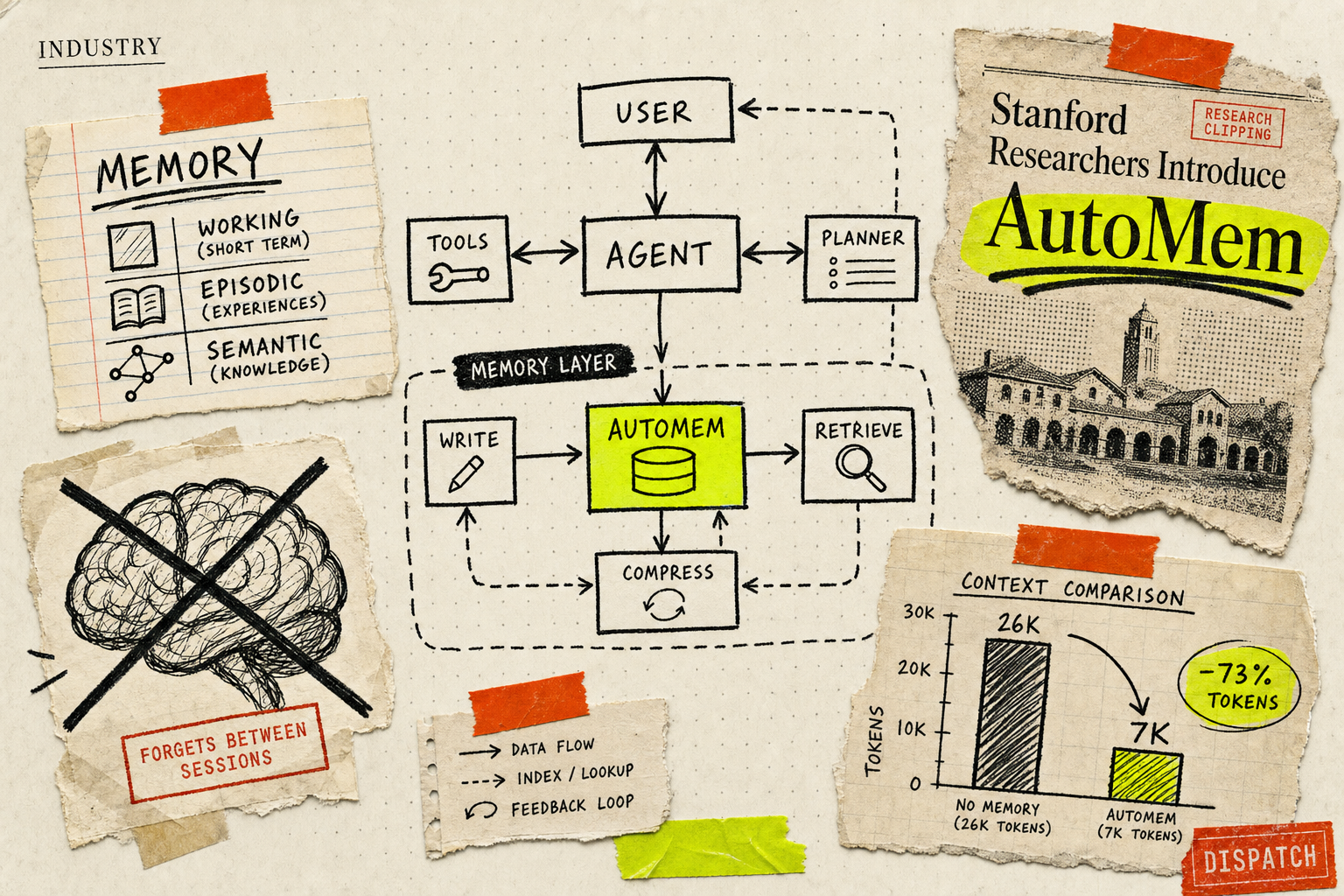
Stanford dropped a paper five days ago that lifts a 32B open model to match Claude Opus 4.5 without touching the model weights. They did it by teaching the agent one skill: how to remember. And it explains why the agent you built last quarter is quietly falling apart.
Here's what most operators still don't realize. The reason your AI agent starts brilliant on Monday and gets dumber by Thursday isn't the model. It isn't the prompt. It's memory — the thing every demo skips and every production system breaks on.
The problem nobody put on the pitch deck
Every framework you've evaluated — LangChain, CrewAI, whatever's trending on GitHub this week — treats memory as a checkbox. "Vector database plugged in. Done." Except memory is not a database. Memory is a policy: what to write down, when to forget, what to surface, and in what order.
Get that policy wrong and your agent either drowns in stale context or forgets the customer's last complaint. Get it right and a mid-sized open model beats a frontier one. That's not my claim — it's the entire finding of the AutoMem paper Stanford published on July 1[1].
The numbers, since we're an operator blog and I owe you numbers: AutoMem lifted a Qwen2.5-32B agent by 2x to 4x on hard benchmarks (Crafter, MiniHack, NetHack) — matching Claude Opus 4.5 on the same tasks — without changing a single task-action weight[2]. All of the improvement came from a better memory loop.
Why this matters for your token bill
Here's the part that lands on your invoice.
Mem0 published their 2026 benchmark report a week ago. On LoCoMo — the long-conversation memory benchmark from Snap Research[3] — a naive "just stuff everything into the context window" approach uses roughly 26,000 tokens per turn. Mem0's 2026 memory algorithm uses about 6,956 tokens per retrieval call for equivalent recall[4].
That's ~73% fewer tokens per turn. On a Claude Sonnet 4.5 agent running a few hundred conversations a day, that gap turns into thousands of dollars a month. On a customer support agent doing 50K sessions a month, it's the difference between "AI made this cheaper" and "AI made this cost more than the humans."
I've seen operators run the exact same agent on two stacks — one dumping the entire chat history into context on every call, one running a memory layer that retrieves 4-6 relevant snippets. Same model. Same prompt. The memory-layered version costs a fraction and gives better answers because the model isn't drowning in noise. That's the entire game.
The three things every operator gets wrong
I run into the same three mistakes on nearly every audit call.
One: vector DB ≠ memory. Pinecone, Weaviate, Qdrant — great databases. Not memory. Memory is decisions about what to remember, when to forget, and how to structure recall. A vector DB is one component of a memory system, not the system itself. If your team is telling you "we plugged in Pinecone, we have memory" — you don't. You have retrieval.
Two: no layered memory. A working agent needs at least three layers: working memory (this conversation), episodic memory (things that happened), and semantic memory (facts about the customer/business/domain). Most teams ship one — the vector DB — and wonder why the agent contradicts itself on turn eight.
Three: no eval loop. The mem0 report has the receipt on this too: 60+ documented statistics on memory system performance now exist in public benchmarks[5]. Your team should be running an internal eval set — 20-30 golden conversations with known-good outcomes — monthly[6]. If they aren't, you're flying blind.
What the leaderboard actually looks like
For the ones asking "which memory layer should I evaluate" — as of last week the LoCoMo leaderboard has ByteRover 2.0 at 92.2%, Mem0's 2026 algorithm at 92.5%[7], and a slate of new academic entrants like AutoMem changing the landscape monthly.
Translation for an operator: the memory layer is now the most differentiated part of the agent stack. More than the model. More than the framework. If your team is spending 80% of their agent time tuning prompts and 5% thinking about what the agent remembers, they're optimizing the wrong end.
The MCP angle everyone missed
Anthropic published something on this exact problem a few weeks back — using code execution with MCP to make agents use context more efficiently[8]. The core idea: instead of dumping every tool description into the prompt, agents load tools on demand and filter data before it reaches the model.
That's the same underlying insight as the memory papers. The context window is a scarce resource. Everything that reaches the model needs to justify its token cost.
If your team is still building agents where the system prompt is 40K tokens of "here are 200 tools you might need," you're leaving 80% of the perf on the floor. Rewrite that as MCP-mediated loading and a proper memory layer, and the same model on the same task will feel like it got smarter overnight.
The catch
None of this is free. Building a proper memory layer means:
- Picking a memory framework and evaluating on your data (not LoCoMo)
- Defining the schema: what goes in working memory vs episodic vs semantic
- Building the eval set — 20-30 golden conversations, minimum
- Instrumenting retrieval calls so you can see what the agent is pulling and when
- Rerunning the eval monthly as the model and framework change
That's 2-3 weeks of engineering time for a small agent, more for a complex one. Most teams don't budget for it because most vendors don't sell it. The demo shows the model. The production reality is 80% memory.
What to do this week
If you already have an agent in production and it's getting weirder, not smarter, over time — the failure mode is almost always memory. Run this checklist:
- Log 20 real user conversations. Read them. Count where the agent forgot something a competent human would have remembered.
- Look at your token bill by call. If your average call is >15K input tokens, you're in the "dump everything" camp. There's easy money on the table.
- Ask your team: "Show me our memory eval set." If they can't, you don't have one.
- Ask them: "What are we writing to episodic vs semantic memory?" If the answer is "everything into a vector DB" — same problem.
If you fix those four things, you'll get more improvement than any prompt-tuning session you've ever run. Guaranteed.
If your agent is expensive, forgets things, or degrades over time and you want a second set of eyes on the stack before your team spends another quarter guessing, that's the audit call. 30 minutes, no pitch — I'll tell you exactly where the memory layer is losing you money.
-
AutoMem: Automated Learning of Memory as a Cognitive Skill↩
Stanford's AutoMem paper treating memory as a learned cognitive skill; matches Claude Opus 4.5 with 32B model.
-
Stanford AutoMem lifts Qwen 32B to match Claude Opus 4.5↩
2x to 4x lift on Crafter, MiniHack, NetHack from AutoMem's memory loop.
-
LoCoMo: Evaluating Very Long-Term Conversational Memory of LLM Agents↩
Reference benchmark for long-conversation memory evaluation.
-
AI Agent Memory 2026: Progress Benchmark Report Evaluations↩
~6,956 tokens per retrieval call vs ~26,000 tokens for full-context on LoCoMo.
-
AI Memory Systems Statistics You Need to Know in 2026↩
60+ documented statistics on AI memory system performance.
-
How to Build AI Agent Memory in 2026↩
Recommendation to build a 20-30 golden-path conversation eval set and run monthly.
-
Benchmarking AI agent memory: ByteRover 2.0 Scores 92.2% on LoCoMo↩
ByteRover 2.0 at 92.2%, Mem0 2026 at 92.5% on LoCoMo leaderboard.
-
Code execution with MCP: building more efficient AI agents↩
Load tools on demand, filter data before it reaches the model, execute complex logic in one step.
Ready to build your own AI system?
Book a Free Audit Call →Keep Reading
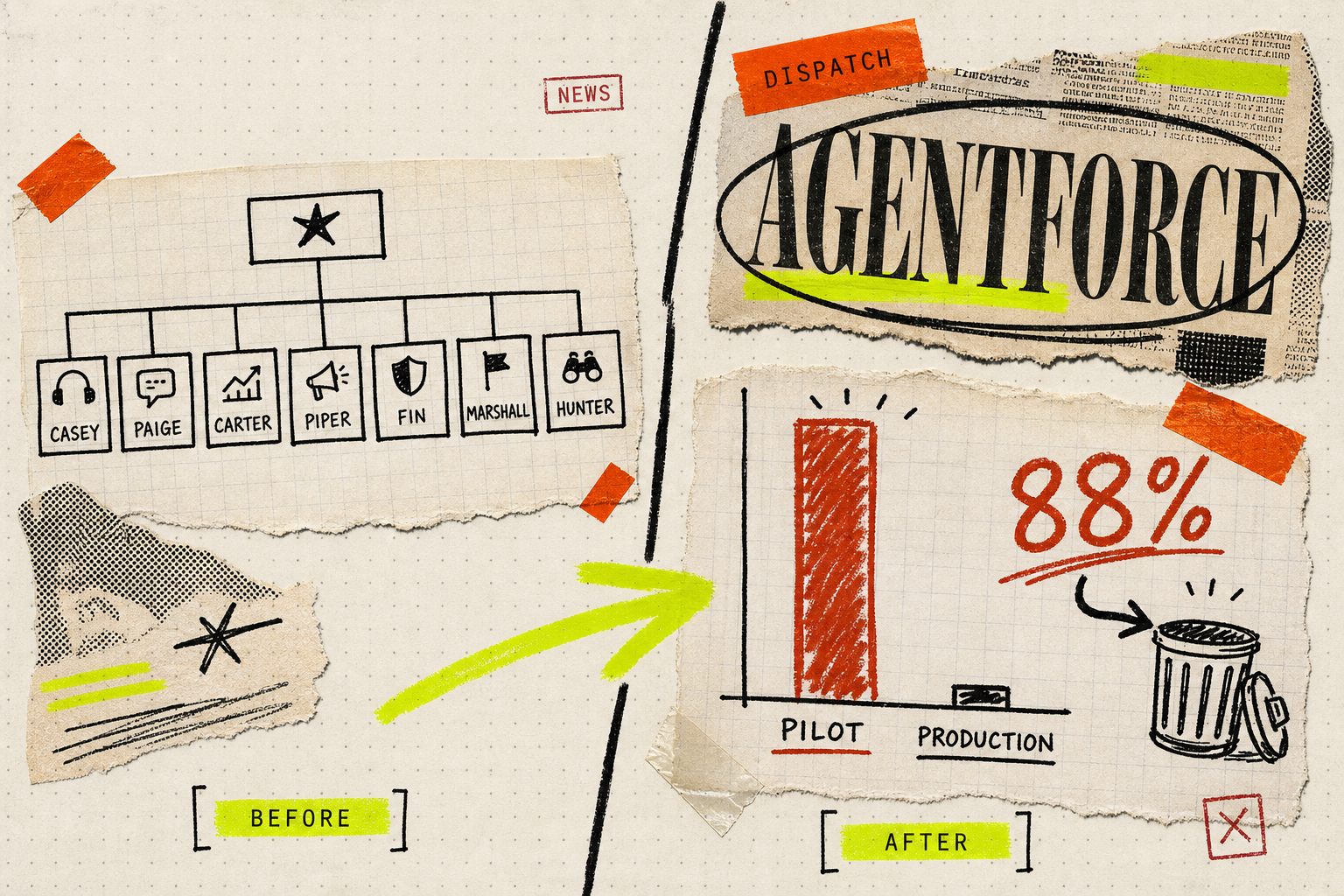
Salesforce Just Named Seven Agents. Enterprise AI Still Loses 88% Of Pilots.
Salesforce shipped 7 named Agentforce agents. But 88% of enterprise AI pilots still fail to reach production. Here's the real gap operators need to fix first.

Small Businesses Using AI Are Hiring More People, Not Fewer
Gusto ran payroll on 2,262 small businesses. AI adopters grew headcount 7% faster — 10% for under-10 firms. The doom takes miss the operator story.
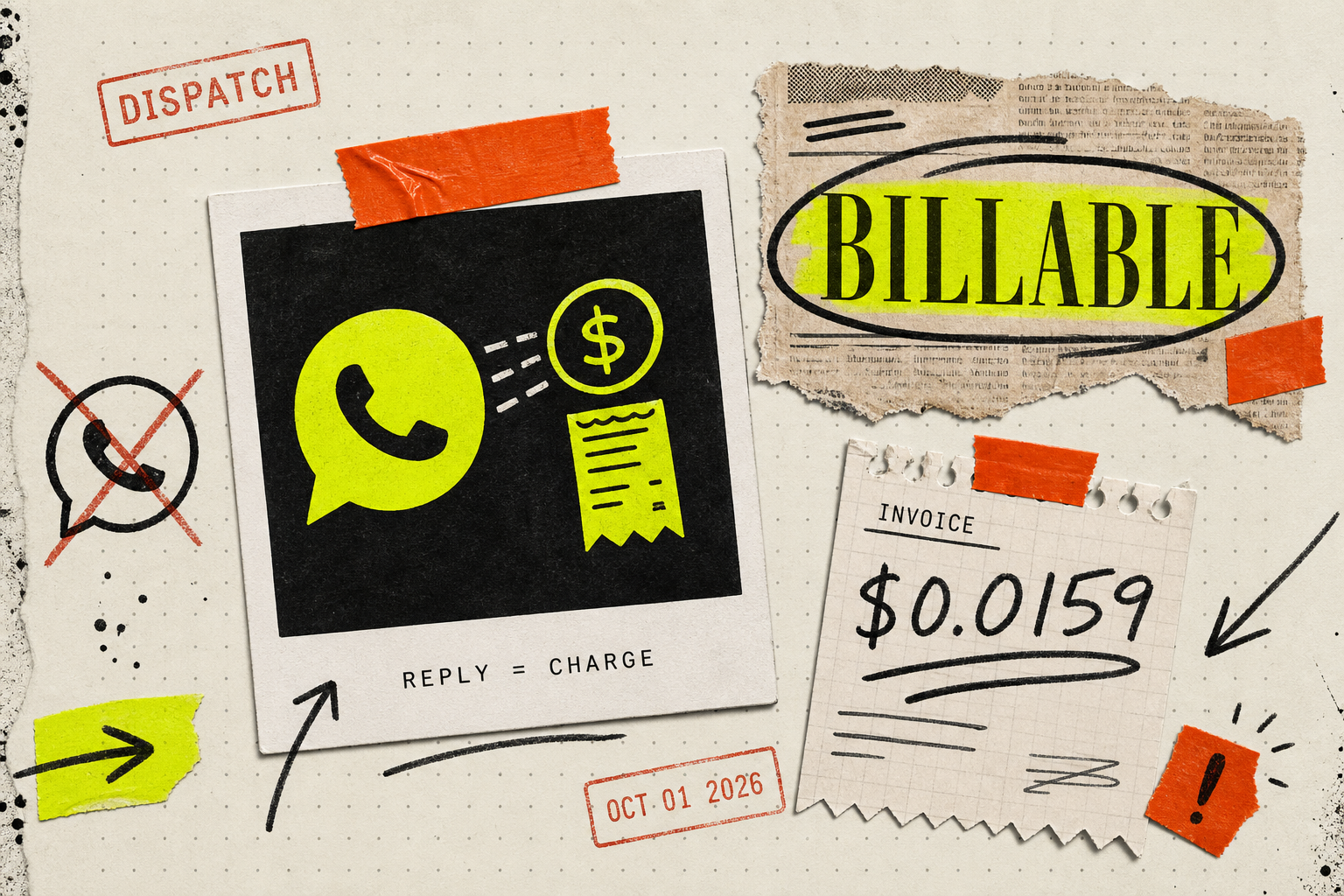
WhatsApp Just Made Every Reply Billable. Your Bot Bill Starts October 1.
On October 1, Meta starts charging for every WhatsApp reply — human, third-party AI, or its own. The sticker price is the boring part. Here's what it actually breaks.