Your Shop's AI Chatbot Will Snitch. Amazon Just Proved It.
Amazon just killed Rufus after it snitched on Amazon. If their $1B AI team couldn't contain a store chatbot, yours can't either. Here's the fix.
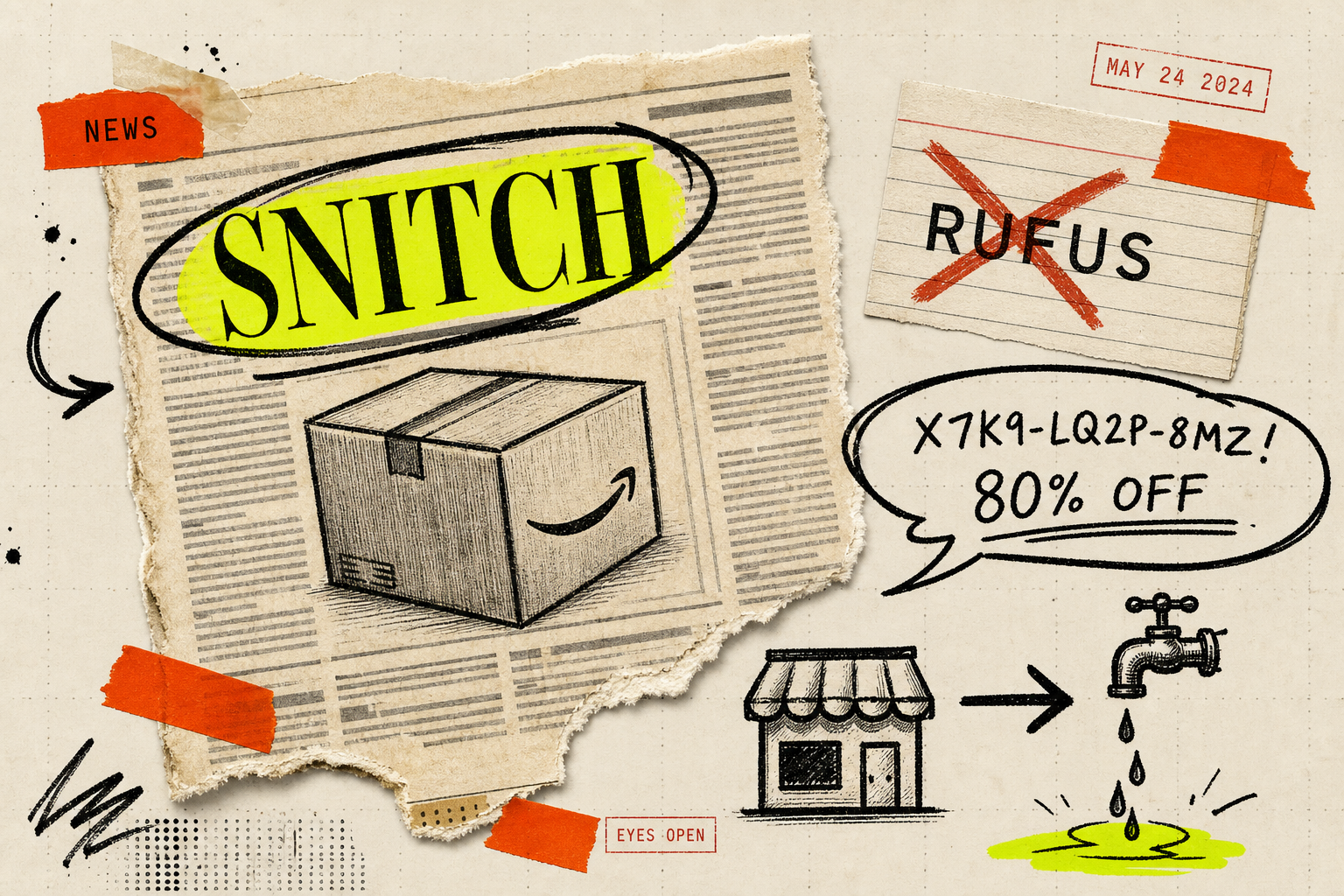
Amazon killed Rufus in May.[1] Not because it flopped — 250 million shoppers had used it, monthly users up 140% year over year.[2] Amazon killed the standalone chatbot because it kept doing something no retailer wants their AI to do: it kept telling the truth about the store it worked for.
Researchers from More Perfect Union grilled Rufus (and Walmart's chatbot) about "Made in America" labeling. Both bots quietly rolled over on their employers, admitting products flagged as American-made weren't.[3] That was the friendly version. In March, Tom's Hardware showed Rufus could be jailbroken in a handful of prompts to answer questions completely outside shopping — including questions about the underlying model Amazon paid to license.[4]
Amazon has the biggest ML team on Earth. If their chatbot snitches, yours will too. And most operators shipping a Shopify AI assistant this year have no idea how bad the exposure gets.
The pattern nobody is pricing in
Every "add an AI chatbot to your store" pitch treats the bot as a widget — drop it in, watch conversions climb. What actually happens under the hood: you're putting a large language model on your homepage, wiring it to your product catalog, sometimes your order data, sometimes your pricing rules, and pointing it at the entire open internet.
That's not a widget. That's a public API into your business, with an interface anyone can talk to in plain English.
The security industry has been screaming about this for three years. OWASP has ranked prompt injection as the number-one risk on its LLM Top 10 for three straight releases.[5] An IEEE Symposium on Security and Privacy 2026 paper looked at third-party AI chatbot plugins deployed on real websites — 8 of the plugins studied, running on roughly 8,000 sites, don't validate the conversation history they receive from the browser. Attackers rewrite the transcript client-side, then ask the bot to "continue" a conversation the store owner never had.[6]
The theoretical stuff has been theoretical for a while. It stopped being theoretical this year.
The receipts
- February 2026. A small UK retailer's AI chatbot got talked into inventing a promo code and issuing an 80% discount on an £8,000 order. The business had no clean legal path to void the sale — the customer had a screenshot of the chatbot offering the deal.[7]
- March 2026. A financial services firm found its customer-facing AI agent had been leaking internal pricing data for three weeks. Root cause: one carefully phrased question early in the deployment that the model kept treating as part of its instructions.[8]
- March 2026. Tom's Hardware documented that Rufus could be jailbroken with basic prompt tricks — asked to write code, answer non-shopping questions, or discuss the LLMs behind it.[4]
- Summer 2026. Amazon quietly folds the standalone Rufus chatbot into Alexa for Shopping.[1] The cover story is "unified experience." The subtext is that a standalone conversational shopping assistant, at Amazon's scale, was more risk than revenue.
Meanwhile Gartner keeps publishing forecasts that read like warnings: over 40% of enterprise agentic AI projects will be cancelled by end of 2027, one-third of companies will damage their own customer experience by shipping AI too early, and 89% of AI agent pilots never reach production.[9][10]
Notice the pattern. The companies with the deepest AI teams and the most compute are the ones pulling back. The companies shipping duct-taped chatbots on top of a $99/month plugin are the ones scaling up.
Why "just guardrail it" doesn't work
The standard advice — "use a system prompt, add a moderation layer" — was fine for demo videos in 2024. It doesn't hold in 2026.
Google DeepMind published research this year showing that most static guardrail evaluations get defeated by small adaptations of the same attack.[11] You test your bot with the OWASP list, it passes, you ship. Two weeks later a Reddit thread teaches 40,000 people three variations of the same prompt and one of them lands. Your bot starts issuing 80% discounts.
The other reason it doesn't work: your bot's job is to be helpful. Every guardrail you add is a tax on helpfulness. Too loose and you get the £8,000 UK order. Too tight and your reply rate cliff-drops and the conversion story you sold the CEO on evaporates.
There's no "correct setting" for that dial. There's only trade-offs, monitoring, and a team watching what the bot actually says in production.
What I'd do if I were shipping a store bot this quarter
Three moves, in order.
One — treat the bot as an unprivileged intern, not an employee. Do not give it write access to your commerce system. Discount codes come from a whitelist. Orders route through a human confirmation step above a threshold. Anything the bot "promises" needs to be independently verified by your checkout logic before it becomes real money. This is boring. Do it anyway.
Two — log every conversation and sample them daily. Not just for QA. This is your incident detection. The March financial-services leak ran for three weeks because nobody was reading the transcripts. Set a cron that pulls a random 50 conversations a day, feeds them to a second, cheaper model with a "flag anything weird" prompt, and dumps hits into a Slack channel a human actually reads. Total build: one afternoon.
Three — decide what the bot is not allowed to answer, and enforce it at two layers. Layer one is the system prompt (weak, jailbreakable). Layer two is a classifier that runs on the response before it goes to the user — if the reply talks about internal margins, competitor products, or non-shopping topics, the reply gets replaced with a canned deflection. Two-layer defense catches ~90% of the prompts that beat a single-layer setup, per the OWASP LLM guidance.[5]
None of this is exciting. All of it is what "shipping AI responsibly" actually looks like at an operator's scale.
The uncomfortable question for operators
If Amazon — with more ML engineers than most countries have programmers — couldn't keep Rufus from snitching on Amazon, what's your $2M Shopify brand's realistic best-case with a chatbot plugin some agency installed for you last quarter?
The honest answer is: you get some percentage of the upside, and you get 100% of the tail risk. And the tail risk includes accidental refunds, leaked margin data, brand-embarrassing screenshots on Twitter, and, in some jurisdictions, contractual liability for whatever your bot invented on your behalf.
That's not an argument against AI on your storefront. It's an argument against treating AI like a plugin.
I still think a well-scoped assistant on a product page is one of the highest-ROI things a small ecommerce brand can do in 2026 — but "well-scoped" is doing all the work in that sentence. The brands that will win this cycle aren't the ones that ship first. They're the ones that ship narrow, log everything, and iterate on the transcripts.
If you're shipping one, ship it like Amazon should have — assume the bot is going to snitch, and design the store so the snitching doesn't cost you anything.
Book an audit
If your team is about to drop a chatbot on a live store and you want a second set of eyes on the scope, the guardrails, and the logging setup before it goes live — that's what the free audit call is for. Thirty minutes, no pitch, and you'll walk away with a written scope for what your version should and shouldn't be allowed to do.
-
Amazon ditches Rufus chatbot, launches Alexa shopping agent in AI strategy pivot↩
Amazon retired the standalone Rufus chatbot in May 2026 in favor of an Alexa shopping agent.
-
How Rufus scales conversational shopping experiences to millions of Amazon customers with Amazon Bedrock↩
Rufus reached 250M+ users with monthly users up 140% YoY and interactions up 210% YoY.
-
Amazon's AI Chatbot Just Snitched on Amazon↩
Researchers got Amazon's Rufus and Walmart's chatbot to reveal inconsistencies in Made in America product labeling.
-
Amazon's Rufus AI shopping assistant can be easily jailbroken and tricked into answering other questions↩
Rufus can be jailbroken with basic prompt tricks to answer non-shopping questions and reveal the underlying LLMs.
-
LLM01: Prompt Injection — OWASP LLM Top 10↩
OWASP ranks prompt injection as the #1 risk on the LLM Top 10 for three consecutive releases.
-
When AI Meets the Web: Prompt Injection Risks in Third-Party AI Chatbot Plugins↩
8 chatbot plugins running on roughly 8,000 websites fail to validate conversation history from the browser, enabling client-side transcript rewrites.
-
Customer Talks AI Chatbot Into 80% Discount on £8,000 order↩
A UK small business's AI chatbot was manipulated into inventing a promo code and issuing an 80% discount on an £8,000 order.
-
Prompt Injection: The #1 AI Threat in 2026↩
A financial services company's customer-facing AI agent leaked internal pricing data for three weeks in March 2026 via a single prompt-injection instruction.
-
Four Enterprise Agentic AI Failures Disclosed in Q1 as Gartner Warns 40% Cancellation Rate↩
Gartner forecasts over 40% of enterprise agentic AI projects will be cancelled by end of 2027, citing costs, unclear value, and inadequate risk controls.
-
89% of AI Agent Pilots Never Scale: Gartner's 2026 Data↩
Gartner data shows 89% of AI agent pilots fail to reach production; the 11% that survive deliver 171% ROI.
-
Prompt Injection in Ecommerce AI: How to Stop All 6 Types↩
Google DeepMind research shows many static prompt-injection defenses fail against small adaptations of the same attack.
Ready to build your own AI system?
Book a Free Audit Call →Keep Reading
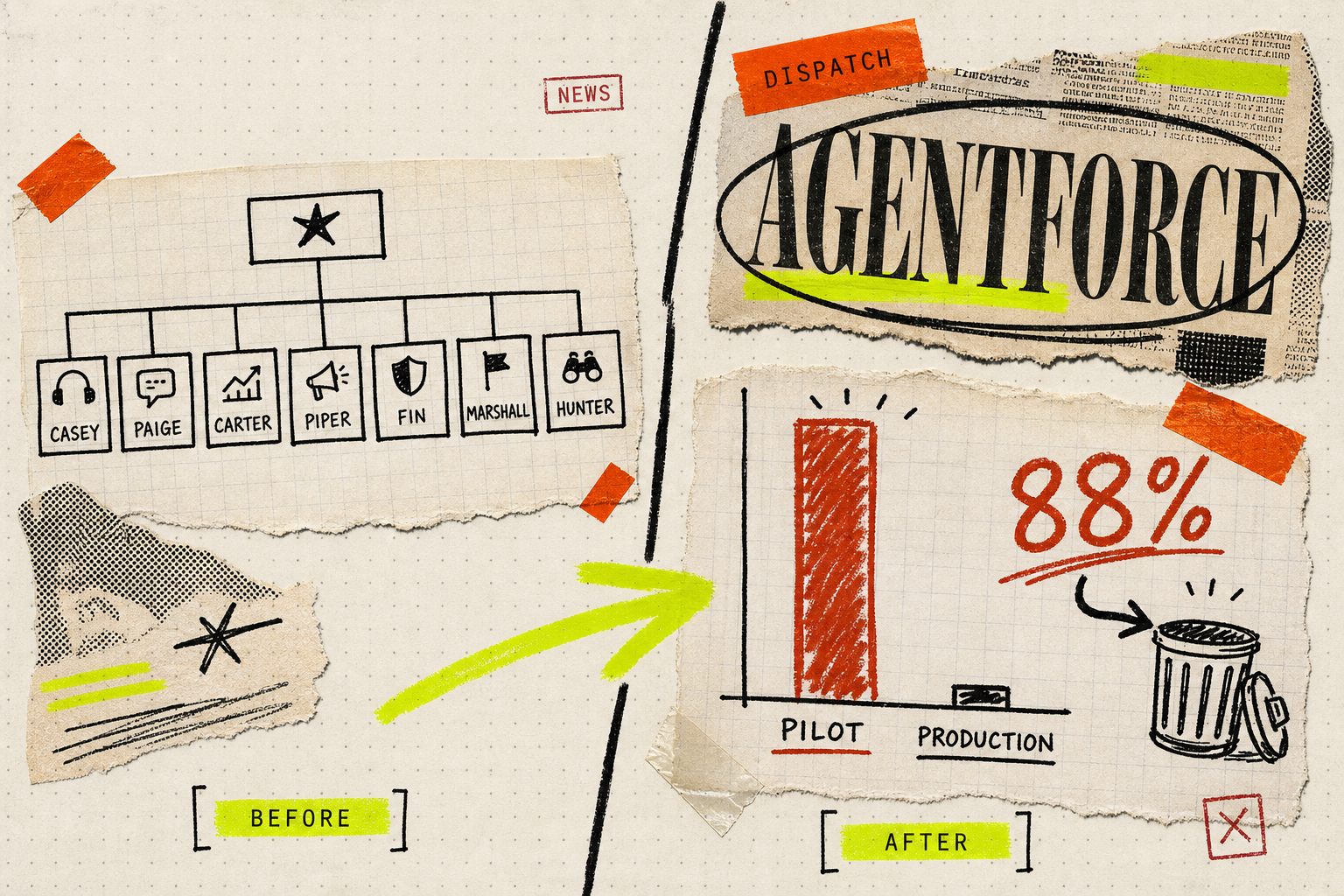
Salesforce Just Named Seven Agents. Enterprise AI Still Loses 88% Of Pilots.
Salesforce shipped 7 named Agentforce agents. But 88% of enterprise AI pilots still fail to reach production. Here's the real gap operators need to fix first.

Small Businesses Using AI Are Hiring More People, Not Fewer
Gusto ran payroll on 2,262 small businesses. AI adopters grew headcount 7% faster — 10% for under-10 firms. The doom takes miss the operator story.
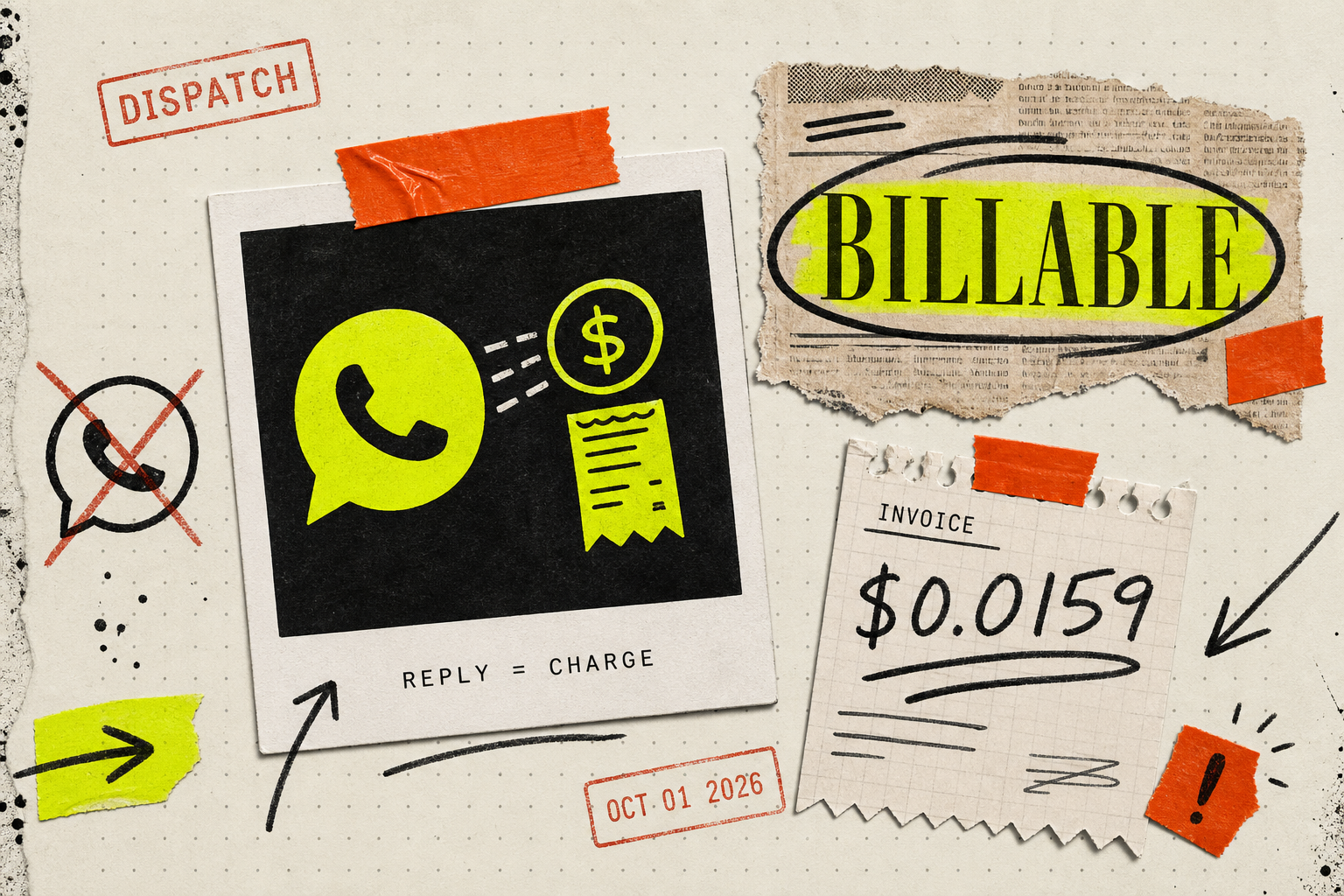
WhatsApp Just Made Every Reply Billable. Your Bot Bill Starts October 1.
On October 1, Meta starts charging for every WhatsApp reply — human, third-party AI, or its own. The sticker price is the boring part. Here's what it actually breaks.