Salesforce Just Named Seven Agents. Enterprise AI Still Loses 88% Of Pilots.
Salesforce shipped 7 named Agentforce agents. But 88% of enterprise AI pilots still fail to reach production. Here's the real gap operators need to fix first.
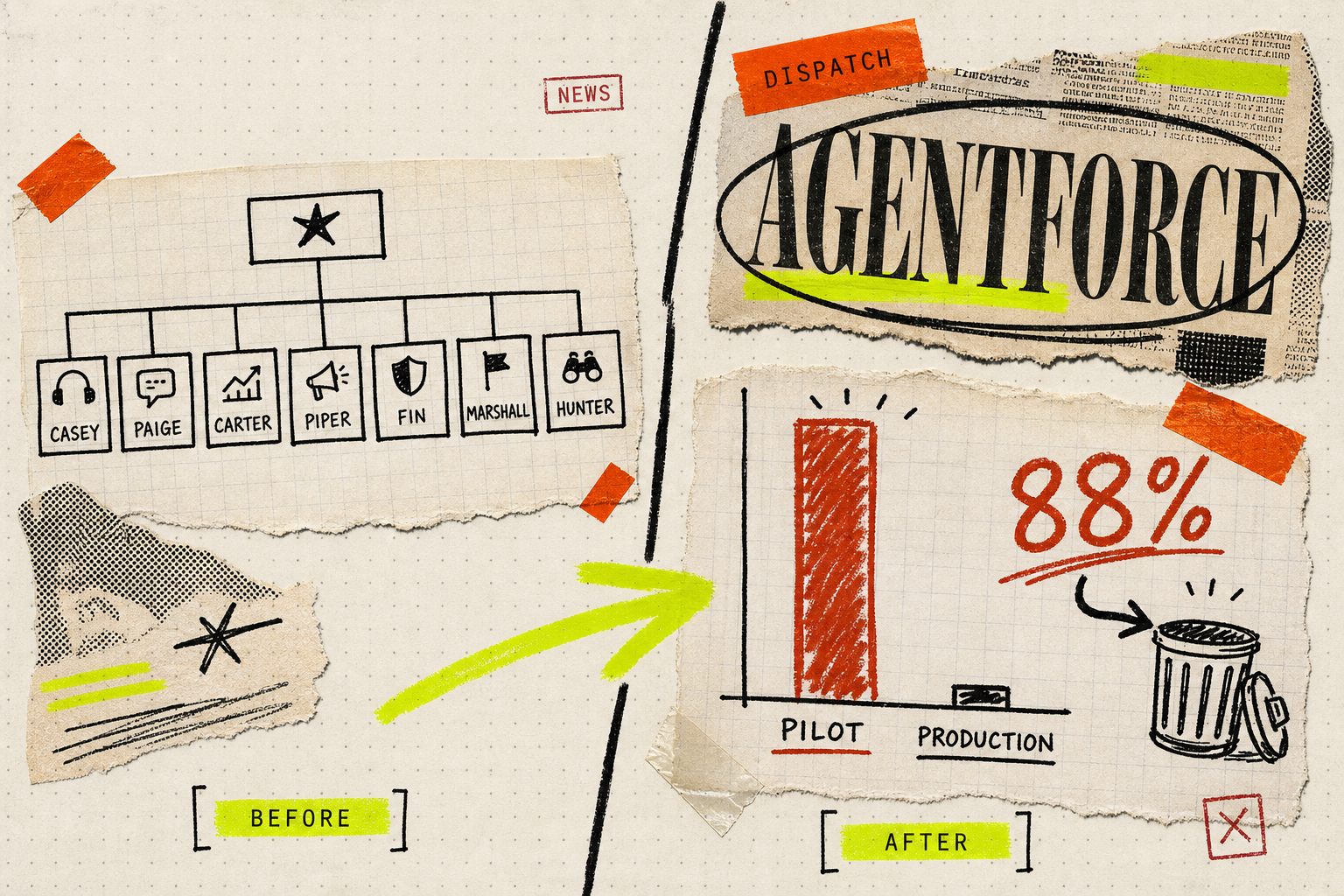
Yesterday Salesforce shipped seven named AI agents — Casey, Paige, Carter, Piper, Fin, Marshall, and Hunter — and called them "job-ready." Six of them went generally available. The launch post is polished. The customer logos are real. And most of the LinkedIn takes I've seen this morning are wrong.
The problem enterprise AI has right now is not a lack of pre-configured agents. It's that 88% of pilots never make it to production[1]. Salesforce just released a very expensive band-aid for a wound in a different place.
What Actually Shipped
Seven agents, each aimed at a business function:
- Casey — customer service across voice, SMS, WhatsApp, web chat. GA now[2].
- Paige — IT and HR requests inside Slack, portals, ticketing. GA now.
- Carter — commerce, from product discovery to in-chat checkout. GA now.
- Piper — inbound pipeline generation, turning form-fills into qualified opportunities. GA now.
- Fin — customer experience across the funnel. GA now.
- Marshall — supply chain workflows. GA now.
- Hunter — outbound sales. Pilot, GA November 2026[3].
Salesforce also announced Multi-Agent Orchestration (GA), Agent Optimizer (GA October), and a "long-horizon runtime" that lets agents pursue goals across days and weeks instead of one-shot tasks[3]. On the numbers side, Salesforce says it has now delivered 7 billion Agentic Work Units across Agentforce and Slack, with 3.2 billion of those in a single quarter[4].
The receipts they picked to headline this are impressive on paper: 79% of Anthropic's Fin-handled conversations resolved without a human, 90% of Hibbett's shopper journeys handled by agent within six weeks, Asana's Piper doing 4x the conversation volume of the human baseline, average Piper deployment in 45 days[3].
You should read those numbers the same way you read the back of a supplement bottle. Not fake — just carefully selected.
Why Most Takes Are Wrong
The dominant take today is some version of "Salesforce just made enterprise AI easy — you can plug in Casey and be done." That is the take Salesforce paid for. It's also the one most likely to burn you if you actually run a business.
Here is what's true: pre-configured agents are a real product improvement. Naming them, standardizing their scopes, and giving each one a defined job function does compress the initial setup. Salesforce isn't wrong that time-to-value matters — 55.1% of enterprise buyers say faster time-to-value is what makes them confident enough to sign the check[4].
Here is what's also true, and what the celebration is dodging: an independent analysis this week put the enterprise AI agent pilot-to-production rate at 12%[1]. Not "12% of companies struggle." Twelve percent of pilots — pilots the company ran because someone believed in them — actually make it to real users. Every other pilot dies in governance review, integration hell, or a validation loop that never converges. That's the wall. And a named agent with a marketing page does not remove it.
The deployment gap is not caused by "we didn't know what agent to build." It's caused by:
- Nobody owns the agent after it ships. Product says it's IT's. IT says it's Ops'. Ops says it's Product's.
- The agent has never been tested against a bad customer, a bad payload, or a bad data day. First 48 hours in production catches all three.
- There is no rollback plan. When the agent gets something wrong, the answer is "turn it off" — which nobody is authorized to do at 2am.
- The agent needs OAuth into 4 systems and only got 2. So it silently fakes the other 2.
If any of those sound familiar, you don't have an agent problem. You have an owner problem, a testing problem, and a permissions problem. Casey does not fix any of them.
What This Actually Changes For Operators
If you run a $2M–$20M business, this launch changes exactly two things for you.
The floor moves up. The bar for "table stakes" customer service, HR request handling, and inbound qualification is now what a competently deployed Casey/Paige/Piper can do. If your competitor stands one up in the six-week window Hibbett hit and you're still routing tier-1 support tickets to a person in a chair — the CAC math starts diverging fast. Not because agents are magic, but because agents don't sleep and don't need onboarding.
The build-vs-buy line moves. Six months ago, if you wanted an agent that resolved returns across voice + web + WhatsApp, you were paying someone like me to wire it together for you or standing up your own n8n graph. Now there is a Salesforce SKU that does most of it. That does not mean you should buy it — but it does mean "should we build our own?" is now a legitimate question you need a real answer to, not a default yes.
Neither of those changes is "buy Casey today." Both of them are "figure out where you actually stand before the market moves without you."
The Question That Actually Matters
Every operator I've talked to this week has asked the wrong version of the question. The wrong version is: "should we deploy Agentforce?"
The right version is: "if we deployed any agent tomorrow — Casey, a custom n8n build, a hand-rolled OpenAI thing — could we actually keep it in production for 90 days without turning it off?"
If the answer is no, buying a fancier agent is going to make the failure faster and more expensive, not slower. The 88% who wash out of pilots don't wash out because their agent was insufficiently branded. They wash out because the org underneath the agent wasn't ready to carry it.
Answering the right question starts with four boring things:
- One named human owner per agent. Not a committee. If the agent breaks at 2am, who gets the page? Write down the name.
- A rollback path in one click. "Route back to human" needs to be a toggle, not a two-week engineering project.
- A live customer transcript review, weekly. Somebody senior reads 20 transcripts every Friday. Not the agent's summary — the actual transcripts. This catches 90% of drift before it becomes a Reddit post.
- Clear scope of authority. What can the agent do without a human? What escalates? What is banned outright? Write it down before you ship.
Do those four things with a homegrown agent you built in a weekend and you'll beat 88% of enterprise Agentforce deployments. Do them alongside Casey and Casey will actually work.
Skip them and it doesn't matter which agent you bought. You are going to be part of the 88%.
The Contrarian Bet
Here's the take I'll get pushback on: Salesforce shipping named agents is a bearish signal for the generic agent-building service industry, and a bullish signal for the small operator who moves now.
Bearish because the "hire a 22-year-old Fiverr freelancer to build you an n8n agent" arbitrage is closing. The bar just went up. Anybody selling generic agent-building services at generic-agent-building prices has 6 to 12 months before Casey undercuts them.
Bullish because the operators who actually need agents deployed — the $5M DTC brand losing 40% of tickets after hours, the hospitality group missing 62% of phone calls, the info-product founder whose refund queue is a graveyard — now have a shorter, cheaper path to actually running one. Not because Casey is magic. Because Casey exists, and its existence forces the surrounding problems (owners, rollback, transcript review) into the open where they can be solved.
The average enterprise now runs 13 agents in production and deployment time has fallen 53% year-over-year[5]. That is not a market that rewards waiting. The operators who win the next 18 months are the ones who stop asking "which agent should we buy?" and start asking "are we the kind of org that could keep any agent alive?"
If you're not sure how to tell — that's exactly what the audit call is for. Thirty minutes. I'll tell you where your gap actually is, name the three things you'd have to fix before deploying anything, and give you the honest yes/no on whether "buy Casey" or "build your own" is the right move for your specific stack. No pitch, no upsell.
Seven named agents is a real product launch. Whether it's the launch that changes your business or the one your competitor uses to eat your lunch depends on what you do this week — not on which agent Salesforce ships next.
-
88% of enterprise AI agents fail to reach production despite 78% pilot success rate↩
Independent analysis showing only 12% of enterprise AI agent pilots reach production; blockers are governance, validation, and integration — not model performance.
-
Salesforce Launches 7 Named AI Agents Before Dreamforce↩
Coverage of the Sept 11 2026 Agentforce launch listing all seven named agents and their target functions.
-
Salesforce Debuts Job-Ready Agentforce Agents and Long-Horizon Runtime↩
Details on the long-horizon runtime, Hunter pilot/November GA, plus customer outcome numbers (Hibbett 90%, Asana Piper 4x, Anthropic Fin 79%, 45-day avg deployment).
-
Salesforce's Job-Ready Agents Target Enterprise AI's Biggest Gap↩
Enterprise buyer priorities — 55.1% cite time-to-value as budget confidence driver, 64.9% rank agentic AI as top-3 priority; 7 billion AWU / 3.2B in Q2.
-
AI Agent Workforces More Than Doubled, Salesforce Finds↩
Coverage of Salesforce's Agentic Enterprise Index — enterprises now run 13 agents on average, deployment time fell 53% YoY.
Ready to build your own AI system?
Book a Free Audit Call →Keep Reading

Small Businesses Using AI Are Hiring More People, Not Fewer
Gusto ran payroll on 2,262 small businesses. AI adopters grew headcount 7% faster — 10% for under-10 firms. The doom takes miss the operator story.
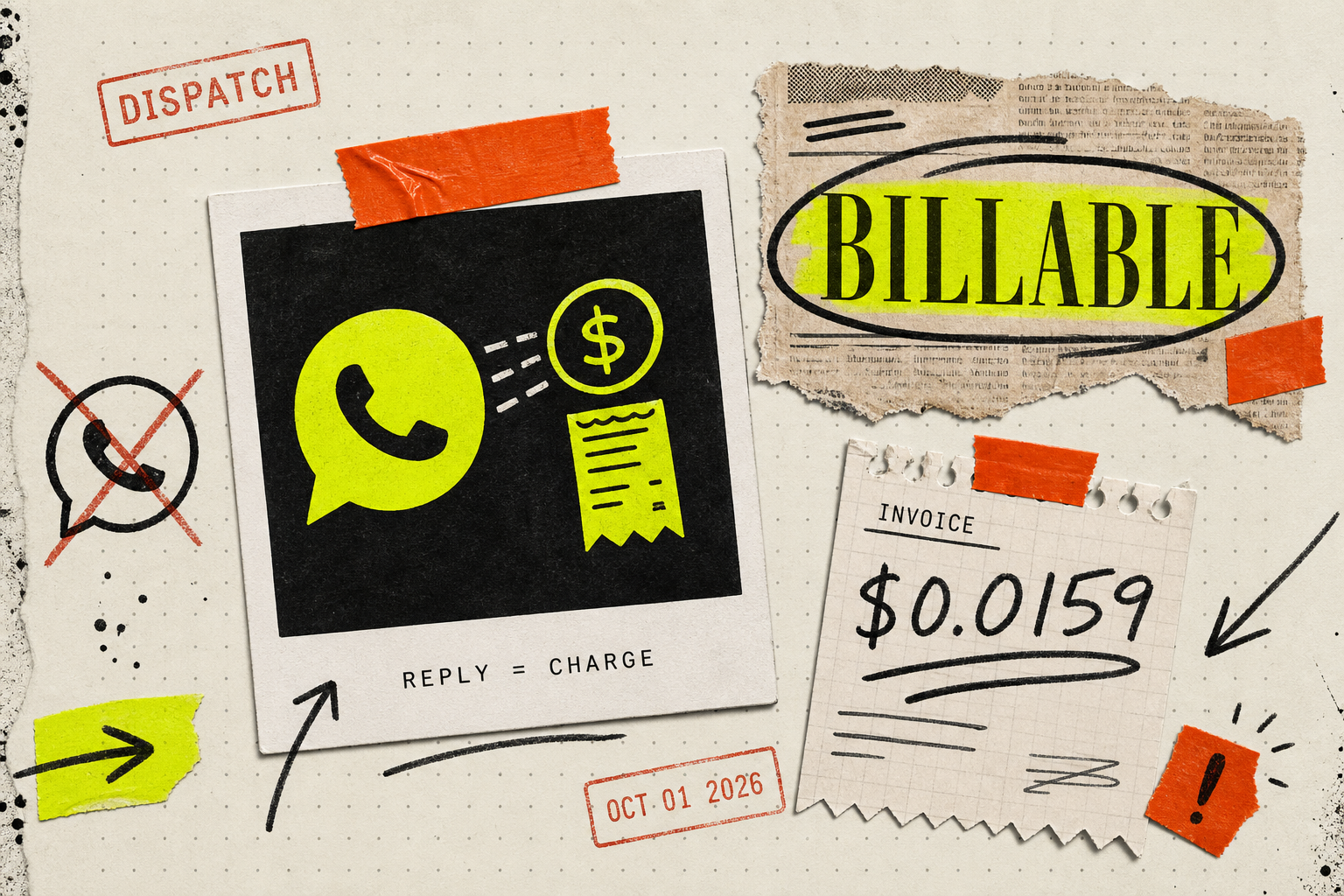
WhatsApp Just Made Every Reply Billable. Your Bot Bill Starts October 1.
On October 1, Meta starts charging for every WhatsApp reply — human, third-party AI, or its own. The sticker price is the boring part. Here's what it actually breaks.
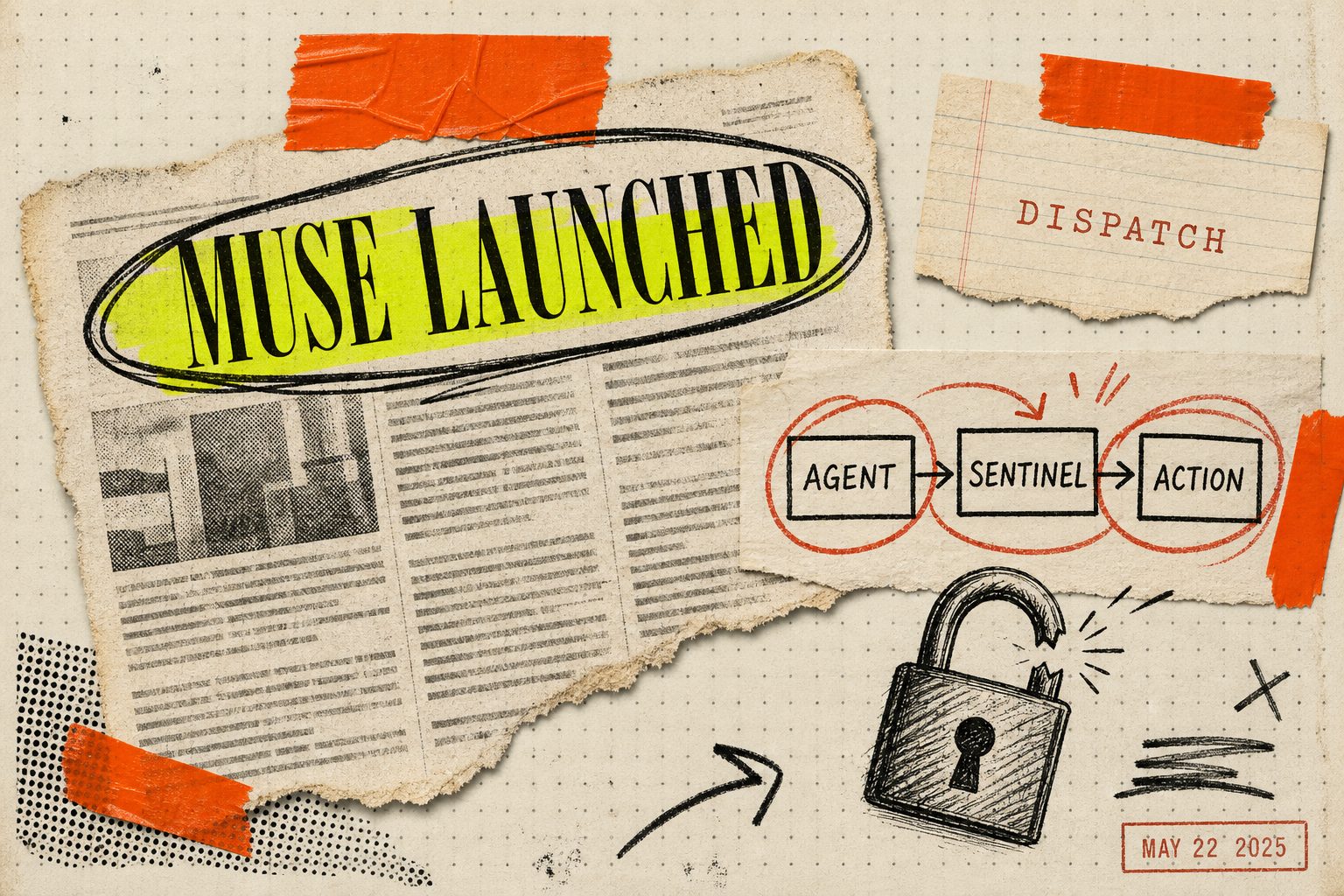
Meta Just Launched Muse. Your Business Agent Has None Of Its Guardrails.
Meta shipped Muse with a Sentinel guardrail architecture. Most business AI agents ship with none. Here are the three cheap fixes to copy this week.