Your AI Bill Is Up. Your Revenue Isn't. Do The Math.
91% of small businesses say AI boosts revenue. 95% of enterprise pilots fail to move the P&L. Here's why both are true — and how to end up in the 5%.
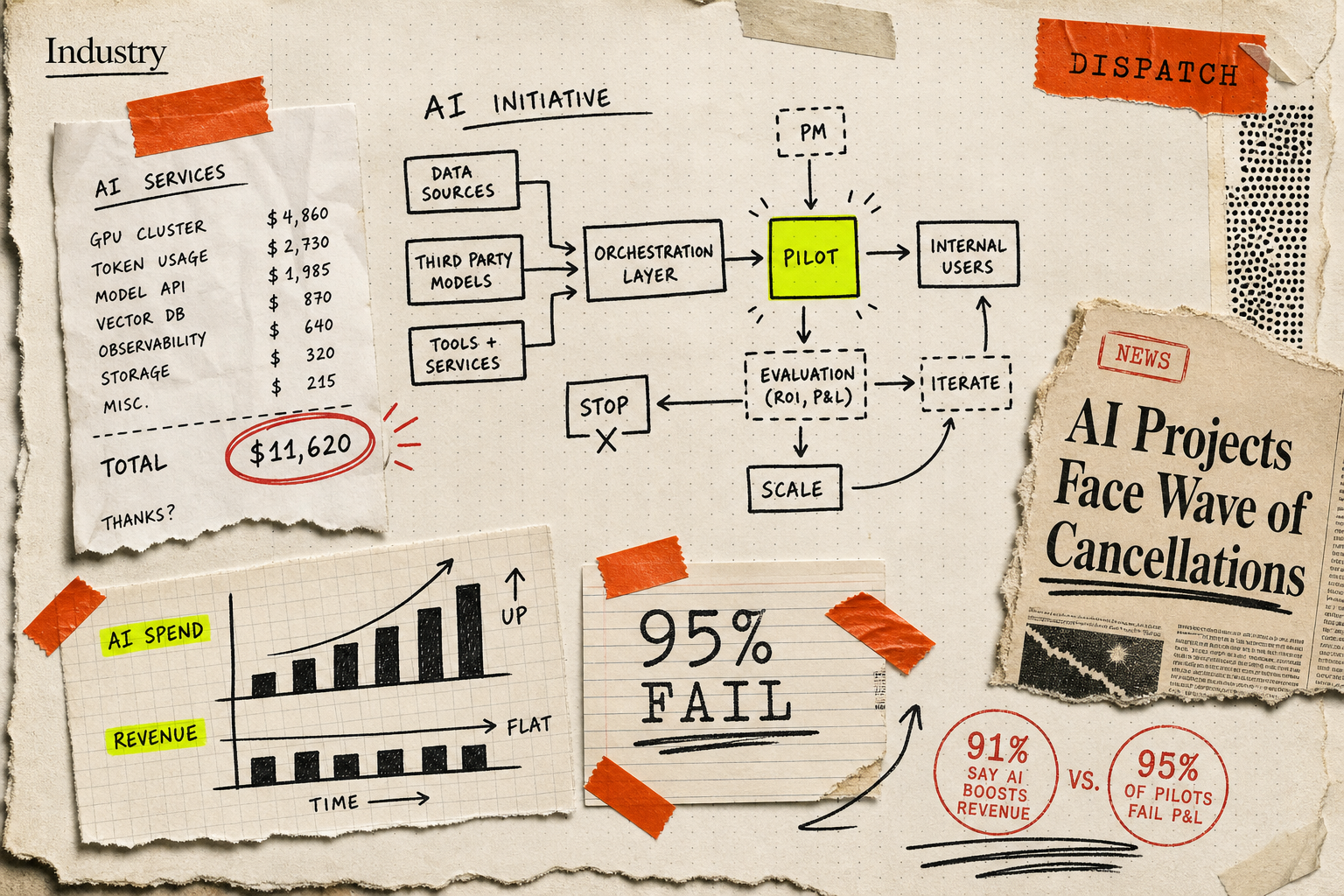
Two numbers landed on my desk this month and they don't agree with each other.
Number one: 91% of small businesses using AI say it boosted their revenue[1]. Number two: 95% of enterprise generative-AI pilots fail to move the P&L at all[2]. Gartner adds a third — over 40% of agentic AI projects will get canceled by the end of 2027 because of "escalating costs, unclear business value, or inadequate risk controls"[3].
Someone is lying to themselves. It's probably the 91%.
The self-reporting problem
The 91% number comes from a Salesforce survey. It's a self-report. Nobody who just spent 8 months and $40K rolling out an AI stack wants to sit in a survey and say "yeah, we set money on fire." So they check the "revenue increased" box, hand-wave a percentage, and move on.
MIT's NANDA group actually looked at outcomes. 150 interviews, 300+ documented deployments, real P&L data. Their finding: only about 5% of generative AI pilots produce rapid revenue acceleration[2]. The rest stall — soaking up budget, hitting no measurable target, quietly getting shelved.
That's the gap between "AI is working" (survey answer) and "AI is paying for itself" (actual accounting). If you're an operator running a $2M–$20M business, that gap is your money.
Where the bill comes from
Global spending on AI is forecast to hit $2.52 trillion in 2026 — a 44% jump year over year, per Gartner[4]. Enterprise LLM budgets are the fastest-growing slice of that number, and small businesses are pulled along by it: every SaaS you already pay for is quietly bolting AI onto its price sheet.
The token bill is the sneakiest line item in the P&L for one reason: it doesn't come as a monthly SaaS invoice you can rip up. It comes as usage, buried inside 6-7 tools you already pay for — Zapier plans that now include "AI actions," Shopify apps with per-message fees, chat widgets billed per resolved ticket, "copilots" bundled inside your CRM at $20-per-seat-per-month.
Every one of them looks reasonable on its own. Together, they're a shadow subscription your bookkeeper can't reconcile.
What actually killed the 40%
Gartner's 40% cancellation forecast is worth reading carefully because it lists the causes[3]:
- Escalating costs. Tokens got cheaper (GPT-4o input dropped from $5 to $2.50 per million tokens in October 2024[5]), but usage grew faster than the price cut. Net bill: up.
- Unclear business value. The team can't point to a specific dollar the AI moved.
- Inadequate risk controls. No governance layer, no audit trail, no rollback plan when the model does something dumb.
Not one of those is a technical problem. All three are what happens when someone bought "AI" without buying a system to deploy it, measure it, and shut it off when it stops working.
The two-column test
Here's the tool I hand operators before they commit another quarter of budget to an AI stack. It fits on a napkin.
Column A — every AI-adjacent line item in your books this quarter. LLM API, seat licenses, per-message fees, per-lead credits, "AI-enhanced" add-ons on existing SaaS, contractor time to babysit the workflow. All of it.
Column B — the specific outcome each line item produced this quarter. "Cut 12 hours of support ticket routing" (dollarize it). "Wrote 43 pieces of ad copy that ran, with ROAS attached." "Booked 6 sales calls that turned into 2 deals." A specific number, tied to a specific business event.
If Column A is bigger than Column B, you're not doing AI. You're subsidizing it. That's fine for a quarter. It's not fine for four.
The reason 95% of pilots don't move the P&L is that nobody filled out Column B. They filled out Column A and hoped.
What the winning 5% actually did
The a16z counter-analysis to the MIT paper is worth reading in full[6]. 29% of the Fortune 500 and ~19% of the Global 2000 are already paying, live customers of a leading AI startup — meaning: they signed a contract, converted a pilot, and shipped to production. That's real adoption.
Look at what those companies did differently. Every case study I've read follows the same three moves:
- Picked a single, boring workflow — invoice coding, ticket triage, ad-copy variants, contract redlines — not "AI agent for our entire business."
- Named a dollar target before starting. "Save 400 hours in AP" or "cut CAC by 15% on paid social." One number, one owner, one review date.
- Wrote a kill switch. If the AI doesn't hit the number by the review date, it gets turned off. No sunk-cost drift, no "let's give it another quarter."
The other 95% skipped step 2 and 3. They picked a shiny use case, launched, and got busy. Three months later they had a bill and no answer.
The uncomfortable question
If you're a $5M business and your AI line has been quietly climbing 15%-per-month for two quarters, you have to ask: what dollar in my P&L moved because of that? Not "we feel faster." Not "the team likes it." A specific dollar. In inventory. In pipeline. In fulfillment cost.
If you can't name the dollar, you're in the 95%. That's not a failure of AI — it's a failure of scope. Tools don't produce ROI. Systems built around one measurable job do.
What to do this week
Three moves, in order, no tools required.
- Print your last quarter's card statement. Highlight every line that's AI-adjacent. Total it. Most operators are surprised by the number.
- Next to each line, write the dollar it moved. If you can't, cross that line out and cancel it this month.
- For the lines that survive, put a 90-day review date on your calendar. If the dollar isn't bigger by then, that line goes too.
You'll probably kill 40-60% of your AI spend in an afternoon. And you'll be closer to the 5% who actually got a return than the 95% who paid for the story.
Bottom line
The 91% survey and the 95% study aren't contradictions. They're a bill and a receipt. One says you feel good about the spend. The other says nothing measurable happened. Both can be true at the same time — and both are, for most of the market right now.
If you want to actually be in the 5%, the work isn't picking a smarter model. It's picking one workflow, naming the dollar, and writing the kill switch before you sign the contract.
If your AI line has crept past 5% of revenue and you can't point to the number it moved, book a free audit call. Thirty minutes, we'll walk your Column A and Column B on the call, and you'll leave knowing exactly which lines to keep and which to cut. No pitch.
-
AI Statistics for Small Business 2026↩
91% of SMBs using AI report revenue increases (Salesforce data)
-
MIT report: 95% of generative AI pilots at companies are failing↩
95% of enterprise GenAI pilots fail to deliver measurable P&L impact per MIT NANDA study
-
Gartner Predicts Over 40% of Agentic AI Projects Will Be Canceled by End of 2027↩
40%+ of agentic AI projects canceled by 2027 due to costs, unclear value, risk controls
-
Gartner: Global AI spending to reach $2.5 trillion in 2026↩
Global AI spending forecast at $2.52 trillion in 2026, up 44% YoY per Gartner
-
GPT-4o Pricing 2026: $2.50/$10 per 1M Tokens vs GPT-4.1↩
GPT-4o input pricing cut from $5.00 to $2.50 per million tokens in October 2024
-
Where Enterprises are Actually Adopting AI↩
29% of Fortune 500 and ~19% of Global 2000 are paying, live customers of a leading AI startup
Ready to build your own AI system?
Book a Free Audit Call →Keep Reading
Salesforce Just Named Seven Agents. Enterprise AI Still Loses 88% Of Pilots.
Salesforce shipped 7 named Agentforce agents. But 88% of enterprise AI pilots still fail to reach production. Here's the real gap operators need to fix first.

Small Businesses Using AI Are Hiring More People, Not Fewer
Gusto ran payroll on 2,262 small businesses. AI adopters grew headcount 7% faster — 10% for under-10 firms. The doom takes miss the operator story.
WhatsApp Just Made Every Reply Billable. Your Bot Bill Starts October 1.
On October 1, Meta starts charging for every WhatsApp reply — human, third-party AI, or its own. The sticker price is the boring part. Here's what it actually breaks.