Give The AI CMO A Goal And A Budget. Watch It Set Your Money On Fire.
Half a dozen vendors just launched "AI CMO" platforms. Gartner says 40% of agentic AI projects will be cancelled. Here's what to build instead.
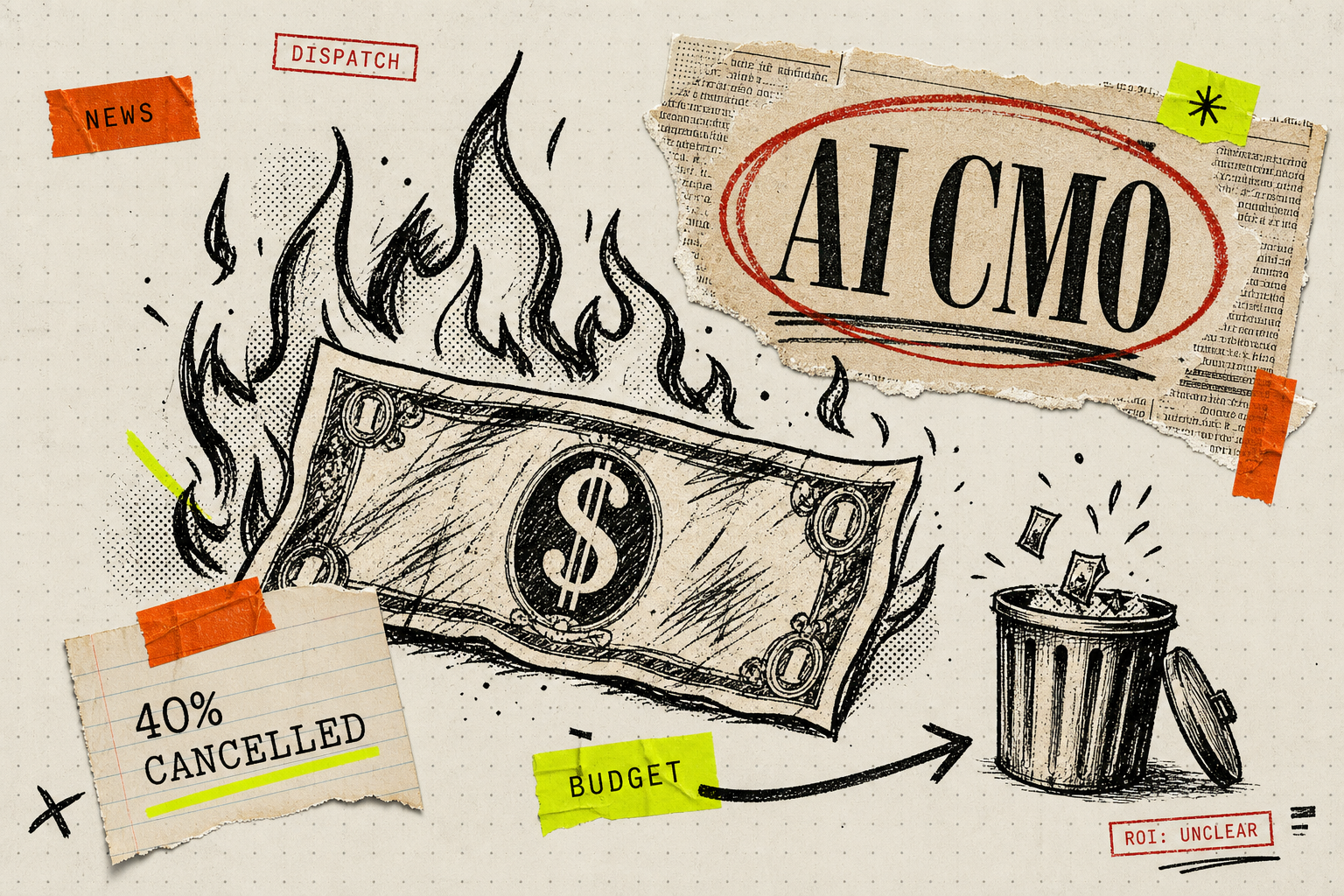
Half a dozen vendors this month launched an "AI CMO" — you set a goal, hand it a budget, and it runs your marketing while you sleep. TheAICMO.com sells it for $99/mo. Marketowl.ai claims to be "30x cheaper" than a marketing department. SearchAtlas ranked 10 of these platforms five days ago[1]. Improvado's B2B trend report says 96% of marketers now use AI and the 2026 shift is agents that "orchestrate campaigns, qualify leads, and personalize buying group touchpoints without human intervention"[2].
I keep getting asked if I'd hand a $10K/mo budget to one of these. No. And the numbers say you shouldn't either.
What the vendors are selling
The pitch is identical across every platform: goal in, budget in, campaigns out. Autonomous mode. No prompting. Set-and-forget. The AI CMO's homepage says the agent "drafts blog posts, emails, social content, and ad copy automatically" on a schedule while you're offline[3]. Marketowl positions it as "1 hour / mo" of your time to run B2B social[4]. Search Atlas is running listicles titled "Ranked by Execution Depth"[1], as if execution depth is what's holding operators back.
It isn't. What's holding you back is that most agents don't actually work in production.
The real numbers on autonomous marketing agents
Gartner told MarTech in late April that over 40% of agentic AI projects will be cancelled by end of 2027 because of governance, observability, and ROI clarity failures[5]. The consequence isn't just wasted budget — Gartner also predicts one-third of companies will actively harm customer experience by deploying AI prematurely, eroding brand trust and hurting both acquisition and retention[5].
For agents that do get deployed, the failure rate is worse. SaaSUltra's May teardown of enterprise data reports 88% of AI agent deployments report unclear or negative ROI[6]. Omnibound's compilation of 54+ agentic-marketing data points landed on the same read: the 40%+ cancellation rate isn't because the tech doesn't work — it's because most orgs deploy before solving the data layer[7].
Nine months from pilot to limited production. Twelve to eighteen months to full enterprise deployment[8]. That's not "give it a goal and a budget on Tuesday and check on Friday."
What the "AI CMO" actually is under the hood
Here's the honest version of what you're buying when you sign up for one of these platforms:
- A content generator (LLM wrapper) that writes blog posts, emails, and captions on a schedule.
- A scheduler that pushes to LinkedIn, X, Facebook, and sometimes Meta ads.
- A dashboard that reports "performance" using platform-side data (impressions, clicks, engagement rate).
- Optionally, a budget mover that shifts ad spend between campaigns based on ROAS.
None of that is a CMO. A CMO decides what business you're in, who you're selling to, and what the offer is worth. Every "AI CMO" I've dissected assumes those decisions are already made and correct. If they're wrong — and for most $1M–$20M operators, at least one of them is — the agent will spend faster and lie prettier about it.
The one piece that genuinely moves numbers is the budget mover. And even there, the honest benchmark is boring: Meta's own Advantage+ Shopping campaigns — the most-deployed autonomous-budget system in the world — deliver a 22% ROAS lift over manual on average[9], and industry benchmark tests show 32% higher ROAS with 17% lower CPA in some categories[10]. Real numbers. Not "30x cheaper than a marketing team."
Why "goal + budget" is the wrong contract
The vendor pitch assumes the interface between operator and agent is a text box and a dollar amount. That's how you get expensive failures.
A working autonomous marketing setup has four contracts, not one:
- Hard guardrails. Daily spend cap, per-campaign cap, ROAS floor, MER floor. Superscale's July playbook for AI-driven Meta ads makes this the first thing you configure — the honest filter is "if a vendor won't tell you what the agent can't do, walk away"[11].
- Phased authority. Read-only for 72 hours, then budget pacing, then creative rotation, then variant generation[11]. Not full autonomy on day one.
- A defined data layer. The agent needs unified conversion, attribution, and inventory data — not just whatever the ad platform surfaces. Omnibound's read is blunt: agents fail when orgs skip the data layer and jump to autonomy[7].
- A human escalation path. Influencers Time reported last week that the CMO role is splitting exactly because of this — one leader owns AI infrastructure and guardrails, another owns brand and creative[12]. Decisions like "can the agent reallocate budget without sign-off?" get escalated to both.
None of the $99/mo "AI CMOs" ship any of that. They ship a text box.
What I'd actually build for a $5M brand
If you run a $1M–$20M business and you want to compress your marketing team with agents, the build isn't one autonomous CMO. It's four narrow agents wired through your own data:
- Copy agent — drafts email/social/ad copy against your ICP and offer doc. Human approves before it ships.
- Budget agent — reallocates spend across existing Meta/Google campaigns inside pre-set floors. Alerts on anomaly, doesn't launch new campaigns.
- Analytics agent — pulls yesterday's numbers, compares to last week/month, writes the 3-line "what changed" summary you'd get from a good CMO on Slack.
- Research agent — mines call recordings, reviews, and support tickets for the next offer/angle. Outputs prompts, not campaigns.
Total time to build with a competent operator: two to three weekends. Total time to build by picking one of the ten AI CMOs on that SearchAtlas list: 12–18 months to "full enterprise deployment" — and then a 40% chance you cancel it anyway.
The one thing to steal from the pitch
The vendors got one thing right: your marketing does need autonomy, and you do need to hand agents a budget. Just not to a single "CMO" text box.
Hand each of those four narrow agents a clear job, hard guardrails, and observability. Make them ship a 3-line report every morning. Read it with your coffee. That's the AI marketing team you actually want — one that reports up to a human, not one that replaces the human on day one and hides the receipts behind a dashboard.
If you're staring at the AI CMO landing pages this week trying to figure out which one to sign up for, that's my answer: none of them yet. Build the narrow four. Then, in 12 months when the market shakes out and the survivors have real observability, revisit.
If you want that built instead of building it yourself, that's what the audit call is for. Thirty minutes, no pitch — I'll tell you exactly which of the four your business needs first and what a working version looks like on your stack. Book it at zerocam.studio.
-
10 Best AI CMO Platforms Ranked by Execution Depth (2026)↩
SearchAtlas ranked 10 AI CMO platforms by execution depth, published 5 days ago
-
13 B2B Marketing Trends for 2026↩
96% of marketers use AI; 2026 shift is agents that orchestrate campaigns without human intervention
-
The AI CMO — While You Run the Business, It Runs the Marketing↩
TheAICMO's homepage sells autonomous mode where the agent drafts blog posts, emails, social content, and ad copy on a schedule
-
AI marketing for B2B — 1 hour/mo↩
Marketowl claims 30x cheaper than a marketing team and 1 hour/mo of operator time
-
Gartner: 40% of agentic AI projects will fail, making humans indispensable↩
Gartner predicts 40%+ of agentic AI projects will be cancelled and one-third of companies will harm customer experience by deploying AI prematurely
-
AI Agent Statistics 2026: Adoption Rates, ROI Data, and Which Industries Are Actually Winning↩
88% of AI agent deployments report unclear or negative ROI
-
Agentic AI Marketing Statistics (2026): 54+ Data Points on Autonomous Campaigns, Adoption, and ROI↩
40%+ cancellation isn't because the tech doesn't work — it's because most orgs deploy before solving the data layer
-
89% of AI Agent Pilots Never Scale: Gartner's 2026 Data↩
6–12 months from pilot to limited production, 12–18 months to full enterprise deployment
-
Meta Ads ROAS Benchmarks by Industry (2026)↩
Advertisers using AI-driven Advantage+ campaigns report 22% increase in ROAS compared to manual efforts
-
Meta Advantage+ Setup: The 7 Settings That Decide ROAS (2026 Guide)↩
Advantage+ Sales campaigns delivered 32% higher ROAS and 17% lower CPA vs manual in benchmark tests
-
Automate Meta ads with AI agents: a 2026 playbook↩
Configure hard guardrails first; phase authority read-only → budget pacing → creative rotation → variant generation
-
CMO Role Split: Inside the AI Skills Gap in Marketing↩
CMO role is splitting — one leader owns AI infrastructure and guardrails, another owns brand and creative
Ready to build your own AI system?
Book a Free Audit Call →Keep Reading
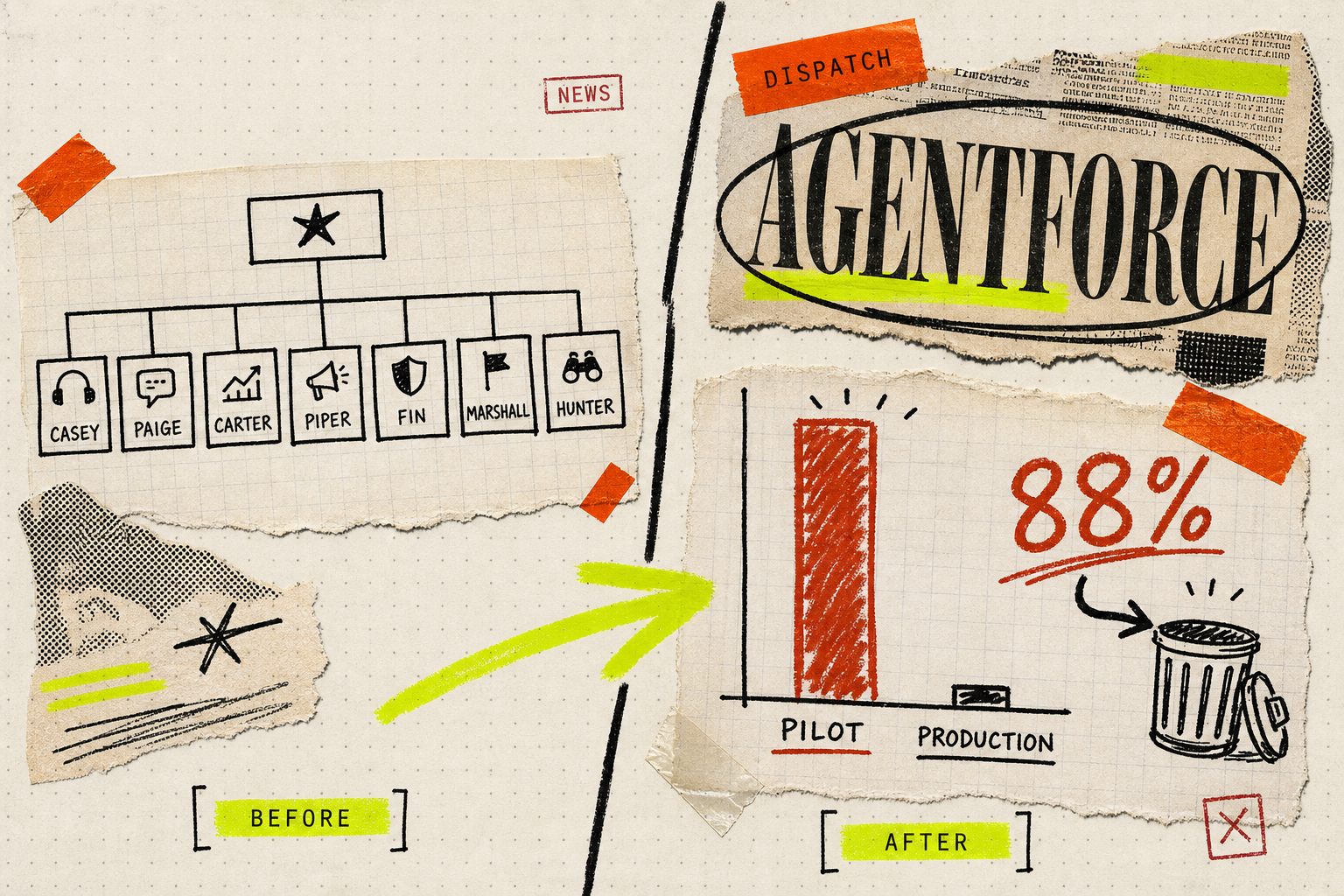
Salesforce Just Named Seven Agents. Enterprise AI Still Loses 88% Of Pilots.
Salesforce shipped 7 named Agentforce agents. But 88% of enterprise AI pilots still fail to reach production. Here's the real gap operators need to fix first.

Small Businesses Using AI Are Hiring More People, Not Fewer
Gusto ran payroll on 2,262 small businesses. AI adopters grew headcount 7% faster — 10% for under-10 firms. The doom takes miss the operator story.
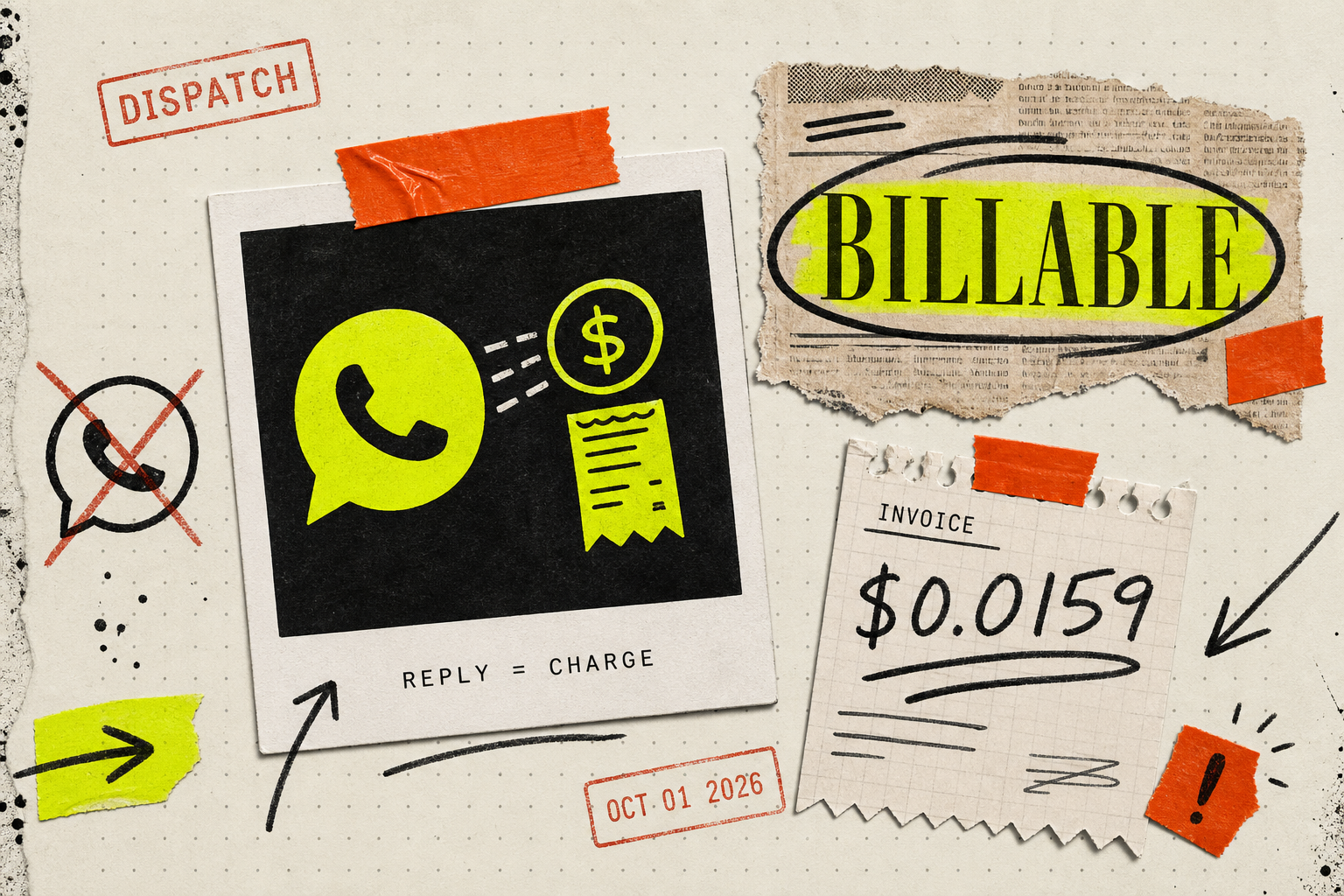
WhatsApp Just Made Every Reply Billable. Your Bot Bill Starts October 1.
On October 1, Meta starts charging for every WhatsApp reply — human, third-party AI, or its own. The sticker price is the boring part. Here's what it actually breaks.