Your AI Agent Uses 1000x More Tokens Than Chat. That's The Design.
AI agents burn 10-1000x more tokens than chatbots — not because they're broken, but because that's what agentic architectures do. Here's where the money leaks.
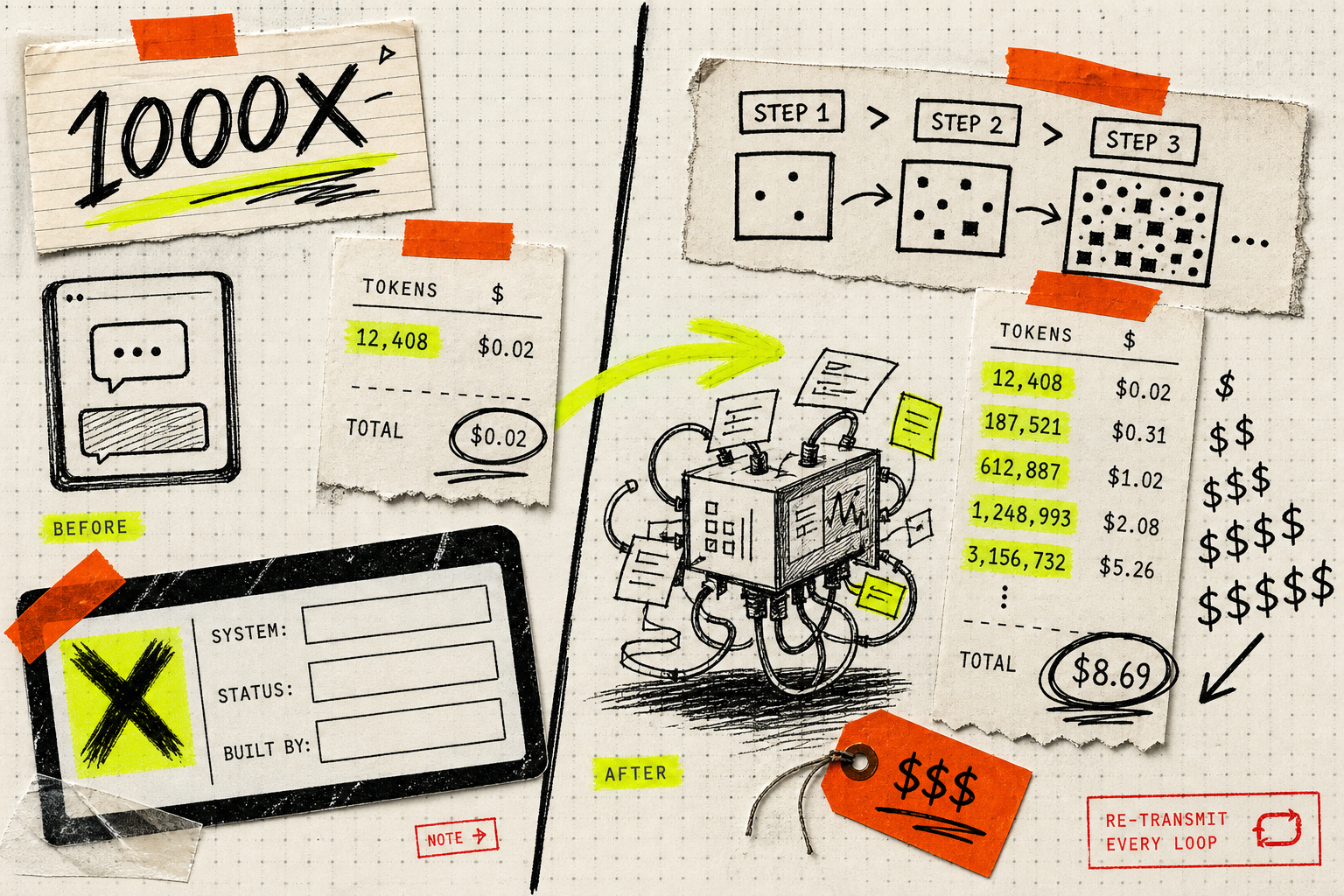
Your chatbot cost $80/month. You swapped it for an "AI agent" doing the same job. The bill came in at $2,400.
You didn't get scammed. You got physics. Stanford's Digital Economy Lab measured it on production agentic coding tasks and put a number on the delta: agents consume ~1000x more tokens than the equivalent chat task[1]. Not 10x. Not 100x. Three orders of magnitude.
Every operator I talk to right now is one invoice away from ripping their agent stack out. Before you do that, understand what you built — because the fix is architectural, not a switch to a cheaper model.
The chat-to-agent jump isn't linear
Here's the mental model most people are running with: a chatbot answers a question in one call. An agent thinks a little, calls a tool, thinks again, answers. Maybe 3–5x the tokens. Fine.
That's not what happens. That's not even close.
A typical chatbot exchange burns 200–2,000 tokens. A RAG query pulling documents into context is 2,000–12,000 tokens. A genuine agentic task — one that reasons, calls tools, checks its work, and iterates — regularly exceeds 1,000,000 tokens per completion[2].
The multiplier isn't 3–5x. Production data across 2025 and 2026 shows agentic workloads landing anywhere from 10x to 100x more expensive than the equivalent chat interaction[3], with heavy long-horizon tasks pushing well past that. Spheron's inference-cost breakdown puts the practical floor at 5–30x for well-designed agents[4]. The Stanford paper puts the ceiling on real coding agents at 1000x[1]. Pick your poison.
And here's the mistake operators are making: per-token prices are dropping. GPT and Claude API costs have fallen every quarter since 2024. So people assume their bills should drop too. The opposite happens. Consumption is growing faster than prices are falling[5]. Cheap tokens times a huge multiplier is still an expensive month.
Where the tokens actually go
I've built enough agent systems to tell you exactly where the money leaks. There are four bleeds. In order of magnitude:
1. Context re-transmission on every loop
This is the biggest one and the most invisible. When your agent takes a step — call a tool, read the result, decide the next move — it doesn't just send the new information to the model. It re-sends the entire accumulated conversation, every prior tool call, and every prior tool result. Step 1 costs X input tokens. Step 2 costs roughly 2X. Step 10 costs 10X. The cost multiplier for identical output is 10x by turn 10[2]. A 20-step task doesn't cost 20 units. It costs somewhere around 200.
2. Context pollution from tool results
Anthropic's own engineering team published this in plain English: when an agent analyzes a 10MB log file for error patterns, the entire file enters the context window even though it only needs a summary. When it fetches customer data across tables, every record accumulates in context regardless of relevance[6]. Then that pollution gets re-sent on every subsequent step (see bleed #1). Two multipliers stacking.
3. Retries and self-correction
Agents don't get things right on the first try. They try, fail, re-plan, try again. Every retry is a full context re-send. The arxiv analysis of agentic coding tasks called out that input tokens, not output tokens, drive overall cost — because retries and re-planning are almost pure input[1].
4. Multi-agent pipelines
Anytime one agent hands off to another, the receiver often gets the full conversation as context. Now you're paying the loop tax twice. This is why "manager agent orchestrating specialist agents" architectures blow up the bill so fast.
None of these are bugs. They're what "agentic" means. The agent has memory, plans, and self-corrects — and every one of those capabilities is paid for in tokens on every step.
How I actually build agents that don't bankrupt anyone
There's no clever prompt that fixes this. The fixes are structural. Here's the stack I use.
Give the agent a token budget and enforce it
Claude Code's engineering team wrote about this: they set strict upper bounds on context size during initialization, track accumulated usage actively, and enforce their own ceiling before the API returns an error[7]. This is table stakes now. Every agent I build has a max-tokens-per-task cap. When it gets hit, the agent summarizes progress, drops history, and continues on a fresh context — or bails out and asks a human. No open-ended loops.
Summarize aggressively between steps
Instead of re-sending 20 turns of raw tool output, run a cheap model to compress everything before turn 15 into a 200-token summary, then continue. You lose some fidelity. You save 80% of the input tokens. Almost always worth it.
Filter tool results at the tool, not in the context
Anthropic's guidance on writing effective tools is to build pagination, range selection, filtering, and truncation into the tool response itself[8]. If your agent needs error counts from a log file, the log-reading tool should return a small summary object, not the 10MB file. Push the filtering to the edges. The context stays small.
Cache the prefixes that repeat
Anthropic caches token prefixes that repeat between calls, and reads from cache cost a fraction of normal price. But that cache has a limited lifespan — pause for more than a few minutes and it evaporates[9]. If your agent has a stable system prompt and toolset, keep it hot. Batch requests to hit the cache. This one line-item alone typically cuts real costs by 40–70% for high-frequency agents.
Match the model to the step
Not every step needs your smartest model. Planning steps, yes. Summarization, no. Extracting a value from a tool response, no. I route 60–80% of agent steps to a cheaper model and reserve the top-tier model for the actual reasoning turns.
Do all four and a typical agent that was burning 1000x chat tokens comes down to 30–80x. Still expensive. Still an order of magnitude more than chat. But it's a bill you can build a business on, not a runaway blaze.
The framing that actually matters
Most operators are asking the wrong question. They ask "how do I make my agent cheaper?" The right question is "what is this agent worth per run?"
An agent that spends $12 on tokens to do work a $60/hour contractor would spend two hours on is a good agent. An agent that spends $0.30 on tokens to do work worth $0.10 is a bad agent — no matter how cheap. Token cost is a floor, not a ceiling.
The agents I build are ruthless about scope: one job, tightly defined, with a clear ROI per run. Not "an assistant for everything." Never "a general-purpose knowledge worker." The general-purpose agents are the ones burning $2,400 to answer what a chatbot handled for $80. They're doing 1000x more work — most of it worthless.
If you already deployed one of those and the bill came in this month, don't panic and don't rip it out. Look at the top-5 tasks by token spend. In my experience 80% of the burn comes from 20% of the workflows, and 90% of that 20% is fixable with the four techniques above. You don't need a new model. You need an audit of what your agent is actually doing between the first prompt and the final answer.
That's it. The 1000x is real. It's also mostly self-inflicted. The design is the fix.
If you want someone to look at where your agent is bleeding tokens and hand you back the four-line summary of what to actually cut — that's what the audit call is for. 30 minutes, no pitch.
-
How Do AI Agents Spend Your Money? Analyzing and Predicting Token Consumption in Agentic Coding Tasks↩
Agentic tasks consume ~1000x more tokens than code chat, driven by input tokens.
-
Token Usage Guide 2026: How Many Tokens AI Really Uses↩
Chatbot: 200-2K tokens; RAG: 2K-12K; agentic: >1M. 10x cost multiplier by turn 10.
-
The AI Agent Token Consumption Gap: Why Agentic Workloads Cost 100x More Than Chat↩
Production data shows agentic workloads costing 10-100x more than equivalent chat.
-
Agentic AI Inference Cost: Why Agents Burn 5-30x Tokens↩
Well-designed agents still cost 5-30x more than chat due to tool-call loops.
-
AI Costs 2026: Why They're Exploding & How to Cut Them↩
Consumption is growing faster than per-token prices are falling.
-
Introducing advanced tool use on the Claude Developer Platform↩
Tool results pollute context — full log files and query results accumulate regardless of relevance.
-
AI Agent Token Budget Management: How Claude Code Prevents Runaway API Costs↩
Claude Code enforces its own ceiling on accumulated tokens before hitting the API's.
-
Writing effective tools for AI agents — using AI agents↩
Tool responses should build in pagination, filtering, and truncation to protect the context window.
-
How to optimise token usage in Claude Code without burning through your subscription↩
Anthropic prefix caching cuts costs dramatically, but the cache expires after a few idle minutes.
Ready to build your own AI system?
Book a Free Audit Call →Keep Reading
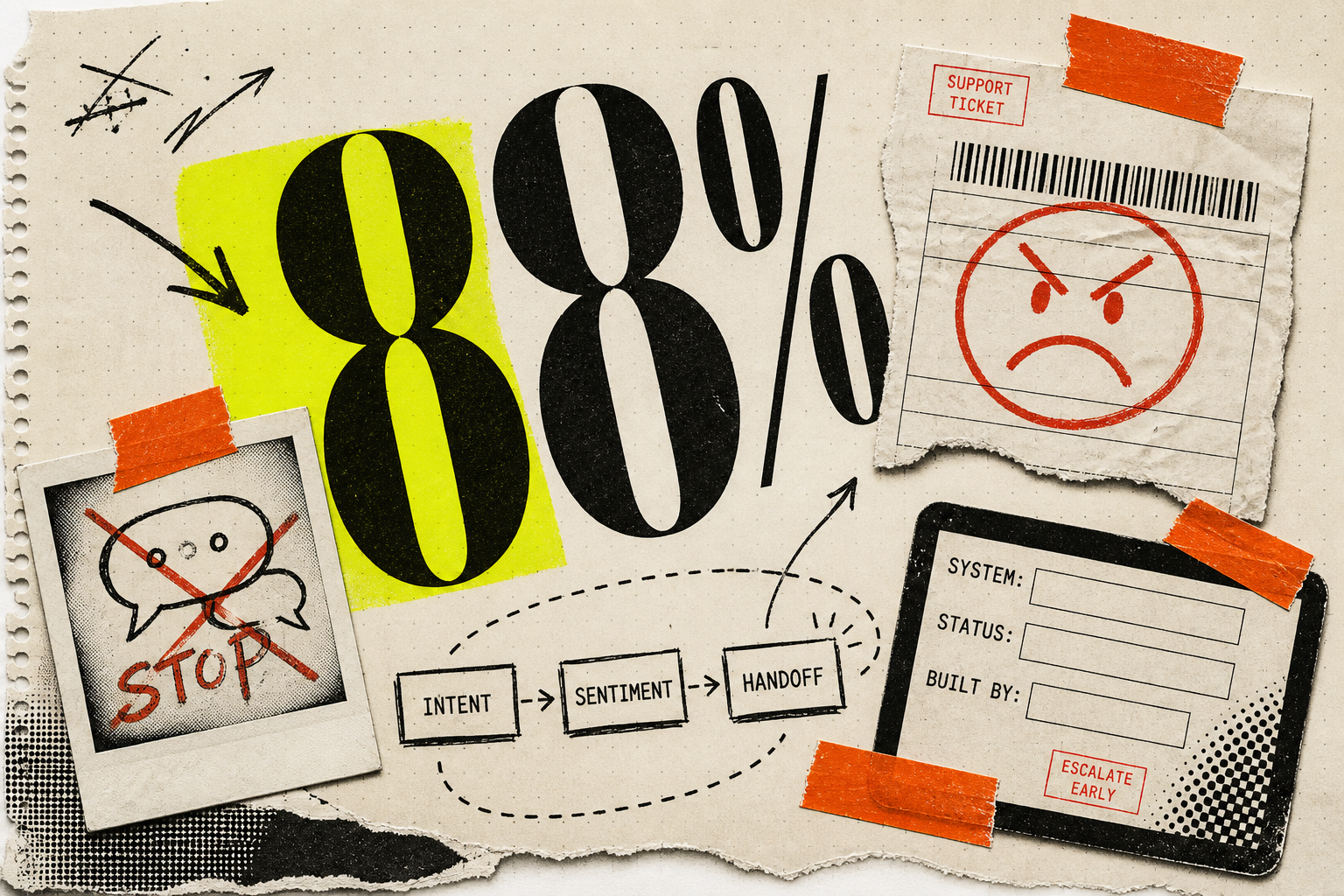
Never Put An AI Agent In Front Of An Upset Customer
AI-handled support hits 4.10/5 CSAT vs 4.30 for humans — and the gap is entirely emotional tickets. Here's the four-gate escalation design that closes it.
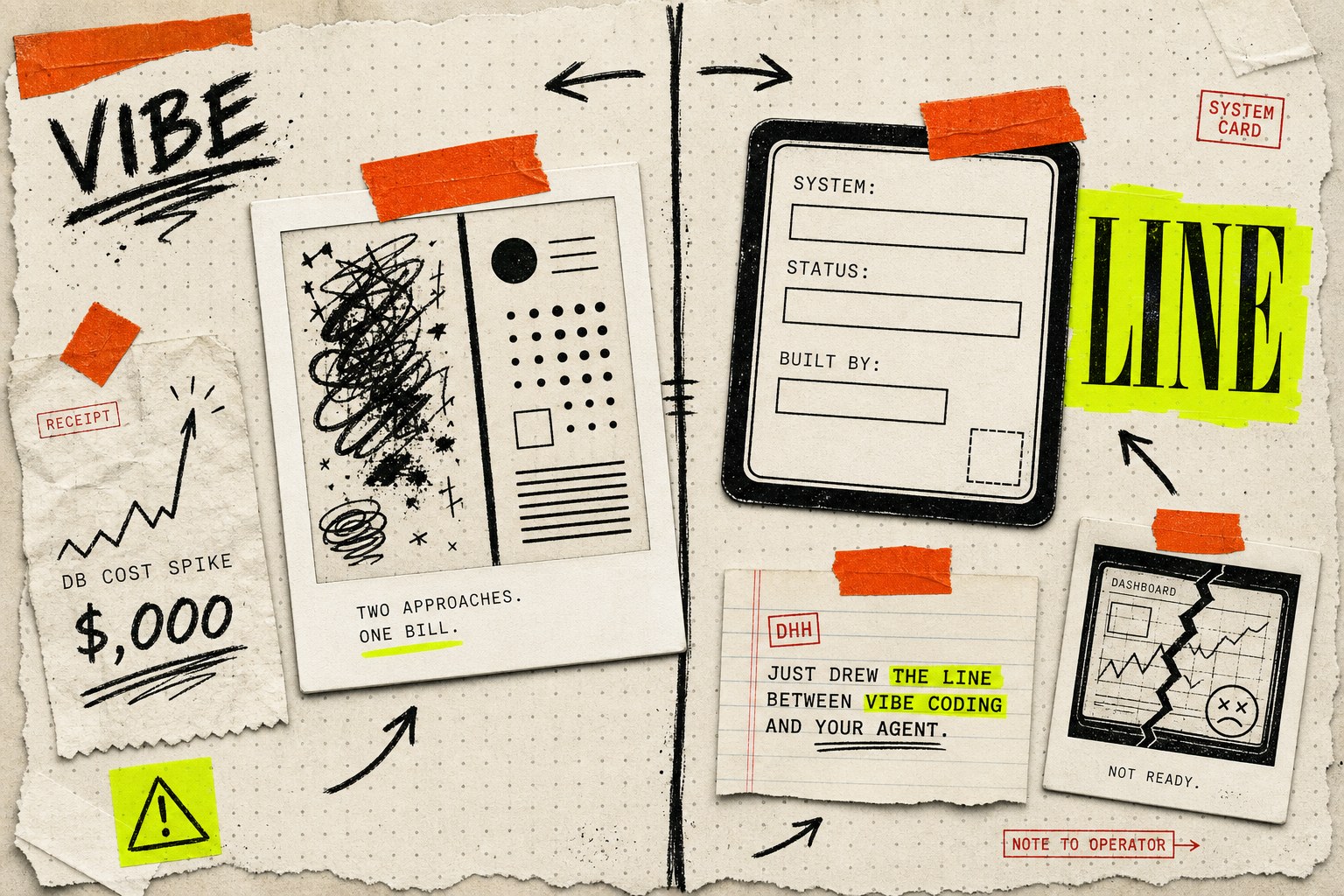
DHH Just Drew The Line Between Vibe Coding And Your Agent
DHH split vibe coding from agentic engineering on Lex Fridman. The same wedge is coming for every operator running AI agents in 2026.
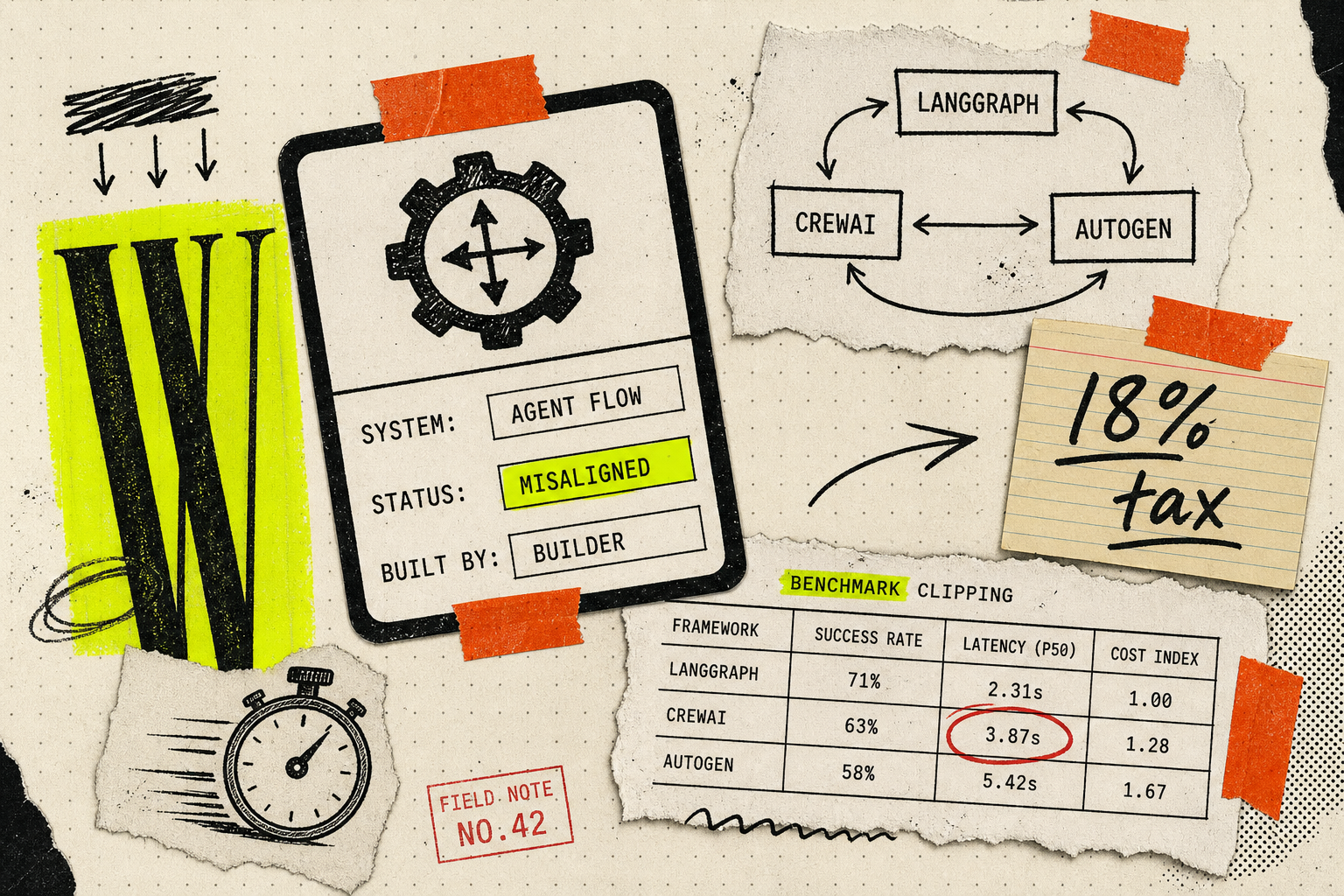
You Picked The Wrong Agent Framework. Benchmarks Say So.
You picked the framework off a listicle instead of a benchmark. Here's how LangGraph, CrewAI, AutoGen actually stack up — and the picking rule I use.