Never Put An AI Agent In Front Of An Upset Customer
AI-handled support hits 4.10/5 CSAT vs 4.30 for humans — and the gap is entirely emotional tickets. Here's the four-gate escalation design that closes it.
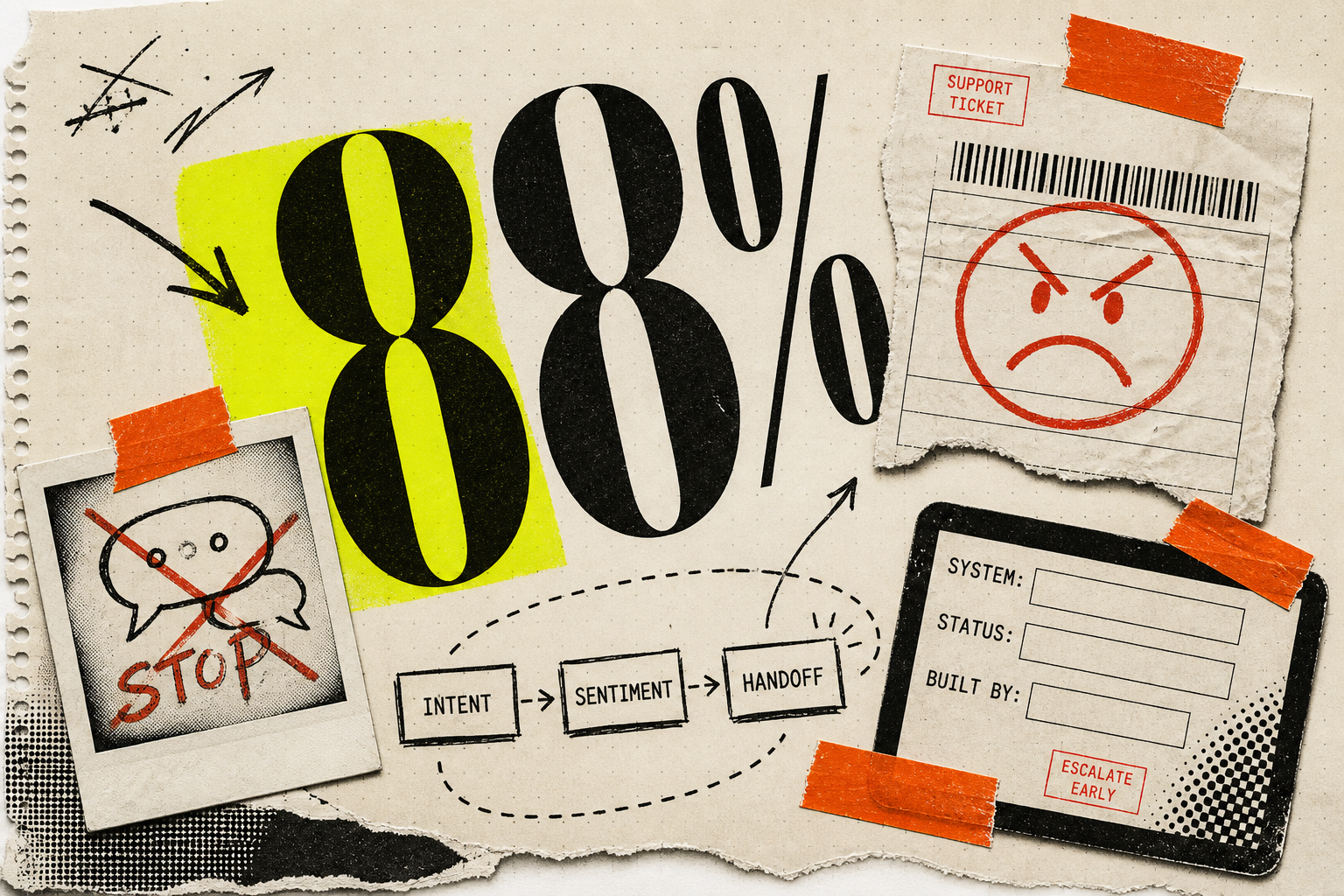
Here's a rule I write into every support-agent build: the moment a customer's tone shifts from confused to angry, the AI stops talking. Not "de-escalates." Not "empathizes." Stops. Routes to a human. Gone.
Most operators do the opposite. They spent $40K on an AI support stack, so they want the AI to handle everything — refunds, complaints, the guy whose order arrived broken. That's how you end up like Klarna: 700 agents replaced, 18 months of quietly deteriorating CSAT, then a public reversal because "lower quality customer service" was the CEO's own phrase[1].
The AI wasn't the mistake. Putting it in the wrong seat was.
The number nobody puts on the pitch deck
The 2026 Zendesk CX Trends report — 11,000+ CX leaders across 22 countries — put a hard number on it: AI-handled tickets average 4.10/5 CSAT vs 4.30/5 for humans[2]. A 0.20 gap. Sounds tiny. It isn't. That gap is entirely concentrated in one bucket: complex, emotional, refund-adjacent conversations. Refunds and password resets deflect at 70%+. Nuanced complaints "rarely break 25%"[3].
Translation: your AI is great at the easy 70%. It's actively destroying your relationship on the emotional 15%.
The hybrid number is the one worth writing on the wall. When you route emotional tickets to humans before the AI face-plants, the CSAT gap collapses to 0.05 points[3]. That's inside statistical noise. That's the whole game.
Why "the AI can handle it" is almost always wrong
Three things happen when an AI agent stays in the seat with an angry customer:
1. It hedges. LLMs are trained to be helpful and safe, so they default to "I understand your frustration and I want to help." That's the exact phrase every operator I know now hates hearing. It reads as corporate. It burns 20 seconds before saying anything real.
2. It can't actually do the thing. Most support agents in the wild have read-only access to the order system, the billing system, and the refund tool. So the AI apologizes, asks 4 clarifying questions, and then says "let me connect you with a specialist." The customer has now told their story twice. Their anger is not smaller — it's compounding.
3. Sentiment gets worse the longer AI stays. Tommaso Ricci's 2026 field guide put it best: "A customer who escalates and then gets resolved cleanly forgives the AI. A customer who escalates into a second dead end does not come back."[4] The window closes fast. Every additional AI turn after an emotional trigger measurably lowers post-resolution CSAT.
What actually works: an escalation-first design
I don't build support agents. I build escalation systems that happen to answer easy tickets first.
Here's the mental flip: the AI is not the product. The routing decision is the product. The AI is a filter that decides "can I close this one-shot, or does a human need to see it in the next 60 seconds?"
The design has four gates, all firing in the first two turns of every conversation:
Gate 1 — Intent classifier. First message runs through a small classifier (I use a lightweight LLM call, 200-token prompt, ~$0.0002 per hit). Buckets: informational, transactional, complaint, refund_dispute, security, escalation_request. Anything in the last four buckets skips the AI response entirely and goes straight to human queue with a summary. This alone kills 80% of the "AI wasted my time" complaints.
Gate 2 — Sentiment trigger. Every turn runs through sentiment scoring. Sustained anger, distress, urgency, or rapid deterioration are all documented handoff signals in the current escalation literature[5][6]. I set the threshold aggressively low: two consecutive turns of negative sentiment → hand off. Don't wait for the third apology.
Gate 3 — Explicit request. "Can I talk to a person?" is an unconditional immediate escalation. No confirmation dialog. No "let me try to help first." No exceptions[6]. Every AI agent that violates this rule loses trust in a single interaction, and it never comes back.
Gate 4 — Confidence floor. The AI has to score its own answer before sending it. Anything under a 0.6 confidence floor gets flagged for human review before the response goes out[7]. This is the one most builders skip because it feels expensive. It isn't. It's the difference between a hallucinated policy answer and a correct one.
The math on doing it this way
Take a $5M B2B SaaS with 5,000 support contacts a month at $12 fully-loaded cost per contact. Current CSAT: 72.
Option A — "AI does everything, humans review." Contact cost drops to ~$5. CSAT drops to 66. Refund rate goes up because angry customers who couldn't reach a human just charge back. Net: you saved $420K and lost more than that in churn.
Option B — Escalation-first. AI closes ~55–65% of tier-1 volume without human touch (the Builts.ai 2026 benchmark puts small-mid businesses in the 55–70% deflection band[8]). Complex/emotional 20% skips the AI entirely and routes straight to a human with a pre-written context summary. The remaining ~15% is AI-drafted, human-approved. Contact cost drops to ~$7. CSAT holds or goes up. That's the real ROI.
The delta between those two options is the whole thesis: don't optimize for AI deflection rate. Optimize for correctly-routed emotional tickets.
What this looks like in a real build
I use n8n for the orchestration layer, a small Claude Haiku call for the classifier, sentiment scoring on every turn (also Haiku, batched), and a webhook into whatever help desk the client already runs (Zendesk, Intercom, Front, or Help Scout — all have solid conversation-injection APIs). The "AI part" is maybe 15% of the build. The 85% is:
- The intent taxonomy (custom per business, not off the shelf)
- The escalation summary template (so the human agent doesn't get a raw dump)
- The sentiment threshold tuning (starts aggressive, loosens slowly with data)
- The confidence-floor prompt eval loop (weekly, forever)
- The queue routing rules (which humans see what, by priority + skill)
Every one of those is a design decision, not a product feature. That's why "we bought an AI support tool" almost never works alone. The tool is the easy part. The design is the whole thing.
The one sentence to steal
If you take one thing from this: your AI agent's job is to route, not to resolve. The moment it stops being able to route correctly — because the customer is angry, or the confidence is low, or the topic is regulated — it should shut up and get out of the way.
The Klarna reversal wasn't a story about AI failing. It was a story about a well-built AI being asked to hold a conversation it had no business holding. Every operator I talk to is one bad refund thread away from repeating that story at smaller scale.
If you want this designed for your stack — the intent classifier, the sentiment gates, the escalation summaries, tuned to your business — that's what the free audit call is for. 30 minutes. I'll tell you exactly which of your ticket categories should never see an AI and which are safe to automate today.
-
Klarna Reverses AI Layoffs: Why Replacing 700 Failed↩
Klarna reversed its all-AI support stance after 18 months of CSAT deterioration
-
Zendesk CX Trends 2026↩
AI-handled tickets average 4.10/5 CSAT vs 4.30/5 for humans across 11,000+ CX leaders in 22 countries
-
Customer Service AI Agent Statistics 2026: 120+ Data Points↩
Refunds/password resets deflect at 70%+, nuanced complaints rarely break 25%, hybrid escalation closes the gap to 0.05 points
-
AI for Customer Service: Costs, Deflection and Rollout — 2026 Guide↩
Customers forgive AI on clean escalations but not on second dead-ends; sentiment worsens with more AI turns
-
AI Agent Human Handoff: Escalation Guide for 2026↩
Sustained anger, distress, urgency, and rapid deterioration are the documented sentiment triggers for escalation
-
AI Agent Escalation: How to Design Seamless Handoffs↩
Three unconditional escalation triggers: explicit human request, sentiment-detected frustration, low confidence
-
How to set up an AI agent that escalates to a human when unsure↩
0.6 baseline confidence threshold; sentiment-triggered escalation on detected frustration
-
AI Customer Service in 2026: What Works and What Doesn't↩
AI reliably deflects 55-70% of tier-1 support volume for small-mid businesses
Ready to build your own AI system?
Book a Free Audit Call →Keep Reading
DHH Just Drew The Line Between Vibe Coding And Your Agent
DHH split vibe coding from agentic engineering on Lex Fridman. The same wedge is coming for every operator running AI agents in 2026.
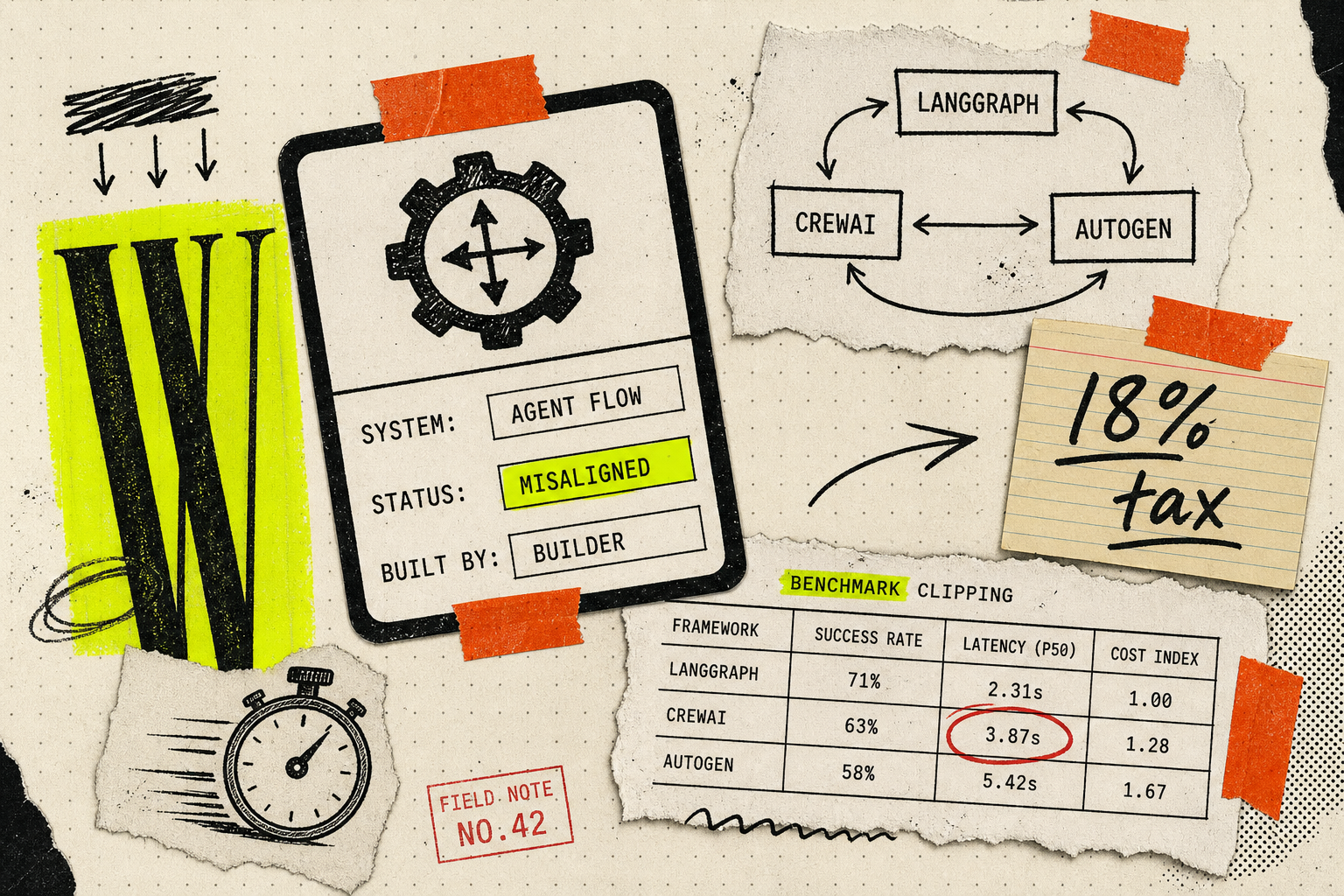
You Picked The Wrong Agent Framework. Benchmarks Say So.
You picked the framework off a listicle instead of a benchmark. Here's how LangGraph, CrewAI, AutoGen actually stack up — and the picking rule I use.
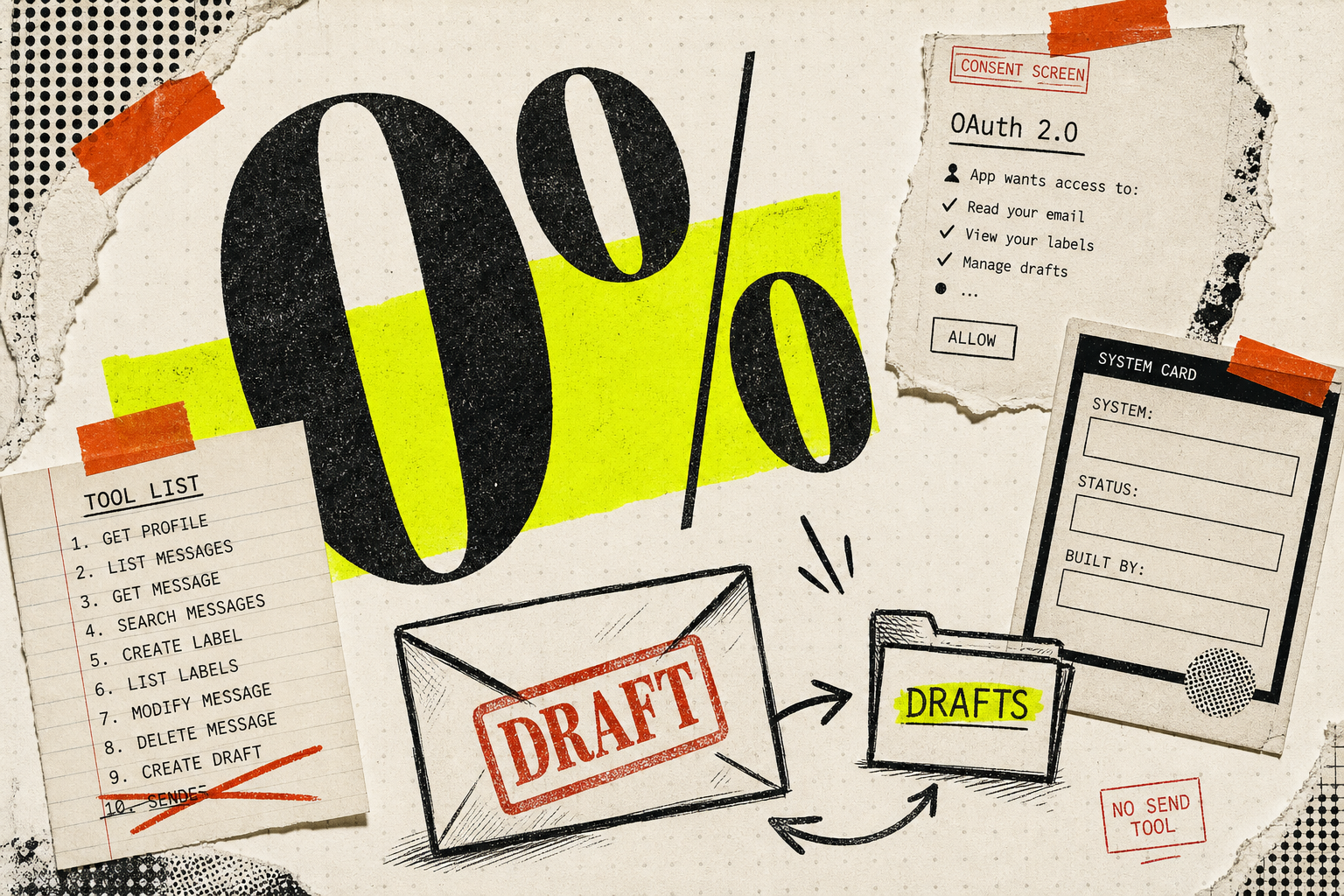
Your AI Agent Can't Send That Email. Blame OAuth.
Google's Gmail MCP server has 10 tools. Not one of them can send an email. Here's the OAuth gap breaking most AI email agent builds this month — and the fix.