You Picked The Wrong Agent Framework. Benchmarks Say So.
You picked the framework off a listicle instead of a benchmark. Here's how LangGraph, CrewAI, AutoGen actually stack up — and the picking rule I use.
The AI agent you're paying $8,000 a month to run is probably slower and more expensive than it needs to be — because someone picked the framework off a "top 10" listicle instead of a benchmark.
Gartner says 40% of enterprise applications will ship with a task-specific AI agent by the end of 2026, up from less than 5% a year ago[1]. That's an 8x jump. Most of those agents will be built on one of four frameworks: LangGraph, CrewAI, AutoGen, or the OpenAI Agents SDK. And most of them will be built on the wrong one.
I keep seeing the same mistake with operators. Someone reads a blog post that calls CrewAI "the easiest way to get started" and ships a role-based crew into production. Six months later they're burning tokens on manager-agent chatter, latency's crawling, and nobody can debug it. The framework wasn't wrong for the prototype. It was wrong for the job it grew into.
Here's how the benchmarks actually shake out — and how I'd pick if I were starting one today.
The state of production, in one number
79% of US companies are experimenting with AI agents right now[2]. Only 23–25% have actually scaled one into production[3]. Another way to say that: ~70% of the money spent on agent projects this year will produce a demo, not a shipped system.
This isn't a talent problem. It's a stack problem. The prototype framework that gets you to a working demo in an afternoon is often the same one that makes production a nightmare.
The four frameworks that matter
The 10-framework listicles are noise. In practice, the production market is four names.
LangGraph is the graph-based orchestrator from the LangChain team. State machine at the core, checkpointing, streaming, human-in-the-loop as a first-class primitive. Currently at ~32,600 GitHub stars[4], used in production at Klarna and Replit[4].
CrewAI is role-based. You define "agents" as characters with a title, a goal, and a backstory. They talk to each other through a manager. 44,600+ GitHub stars, adoption reported at ~60% of the Fortune 500[5], 2 billion agent executions in the trailing 12 months[6]. It's the fastest thing on the market to a working prototype — 2 to 4 hours from empty repo to demo.
AutoGen is Microsoft Research's multi-agent framework. Conversation-first, strong in research settings, weaker in the "how do I debug what my agents just did in production" story.
OpenAI Agents SDK is the one that ships with the GPT stack. Best when you're already all-in on OpenAI models and don't need portability. Thin abstraction, minimal surprises.
What the benchmarks actually say
Two benchmarks worth reading came out this summer.
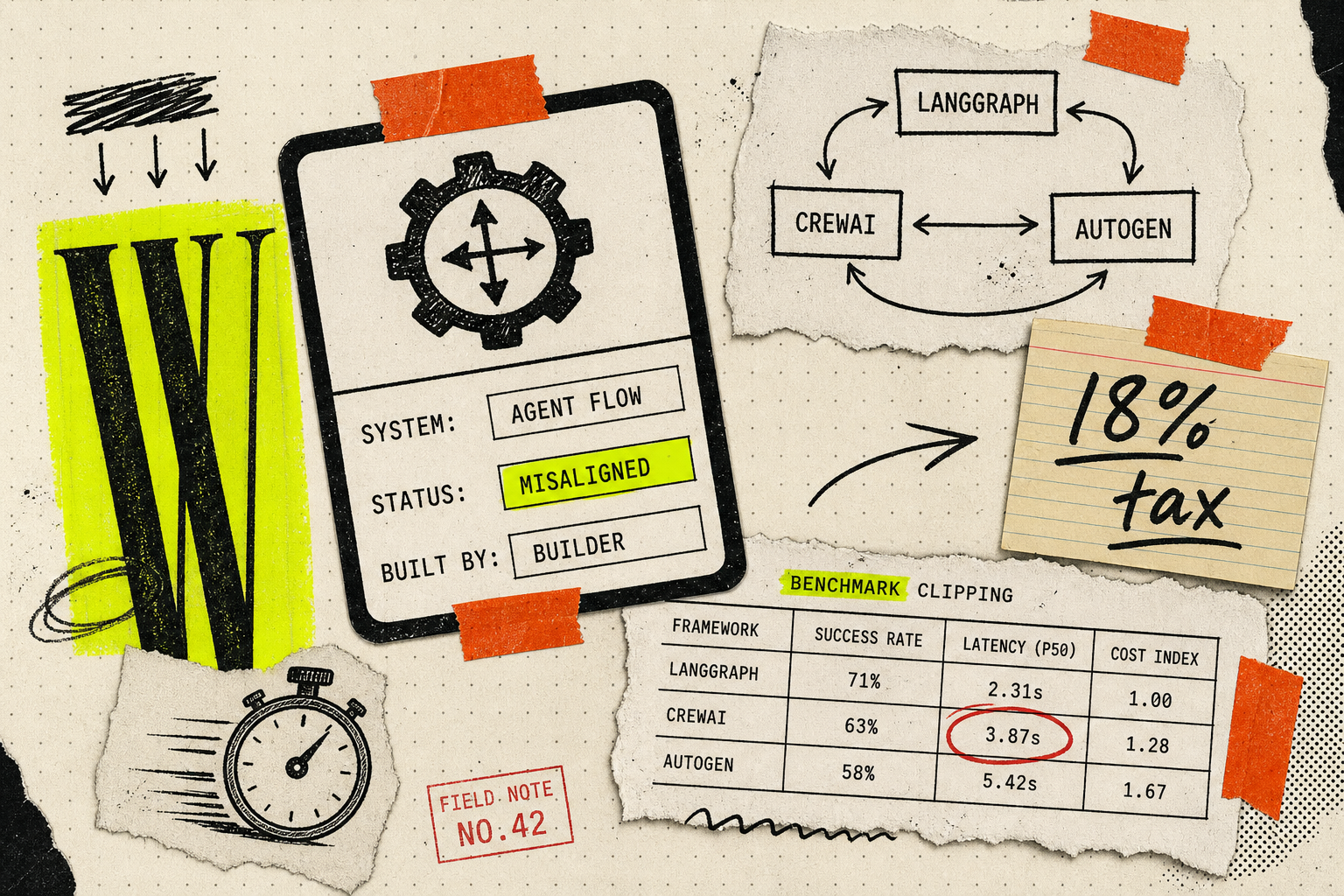
The Agent Report ran the same production workload across all four frameworks in July[7]. The headline finding: LangGraph and Hermes Agent operate at near-raw-cost efficiency because their orchestration layers add minimal token overhead. CrewAI's role-based system adds ~18% overhead on every turn, because role descriptions get injected into every call. That 18% is what a $10K/month agent costs you as a $1,800/month tax for the "easy" abstraction.
AImultiple's independent test — 5 tasks, 2,000 runs — found LangGraph the fastest framework with the lowest latency across all tasks, and LangChain (the wrapper) the most token-efficient overall[8]. Different angle, same conclusion: the orchestration abstraction has a cost, and CrewAI's is the highest of the mainstream four.
Markaicode ran a 3-parallel-agent test on GPT-4o[9]. CrewAI adds a manager-agent call before each parallel task starts. LangGraph has no equivalent overhead. On a 3-task workload that's 3 extra LLM calls per run. At production volume — say 10,000 runs a day — that's 30,000 wasted calls a day. Do that math on your invoice.
The picking rule I actually use
Ignore the star counts. Ignore the "which one's easiest" content. Pick based on three questions.
Q1: Is your workflow linear, branching, or truly parallel?
- Linear (input → step → step → output): use anything. Pick for tooling and team fit.
- Branching with conditions or loops: LangGraph. It's the only mainstream one with a clean state-machine model.
- Truly parallel with independent subtasks: LangGraph or a plain async orchestrator. CrewAI's manager pattern taxes you 18% per turn.
Q2: Do you need human-in-the-loop review? If yes, LangGraph. Checkpointing and interrupt patterns are first-class. Everyone else bolts it on. This matters when auditors show up — and if you're regulated at all, they will.
Q3: How long does the agent need to run? Under 30 seconds: doesn't matter, pick for developer speed. Over 30 seconds with retries and state: LangGraph's checkpointing means you resume from where you failed instead of paying to re-run from scratch. On a workflow that costs $2 in tokens per full run, restarting mid-flow instead of from step 1 pays for the migration in weeks.
The one exception
CrewAI's not a bad tool. It's a great prototyping tool. If your job is "prove this workflow works in 3 hours so we can pitch the exec team on funding it," CrewAI is the right pick. Ship the demo, get the budget, then port to LangGraph before you scale it.
The mistake is treating the prototype framework as the production framework. It's a Toyota Corolla vs. a Freightliner. Both drive. Only one is designed to haul.
What to do this week
If you're already running an agent in production and it feels expensive:
- Log 100 turns of raw token usage.
- Compare against the raw-model cost for the same task (skip the framework, hit the API directly).
- Everything above raw cost is your framework tax. If it's over 15%, you're paying too much.
If you haven't picked yet:
- Prototype in whatever's fastest — CrewAI, or straight-up OpenAI Agents SDK.
- Before you cross ~1,000 runs/day in production, port to LangGraph if the workflow has any branching, retries, or human review.
- If it's linear input-output, stay put.
The 88% pilot failure rate on agent projects[10] isn't because the models are bad. It's because someone shipped the prototype and hoped it'd scale.
If you want this built
I build agent systems for operators running $1M–$20M businesses — the ones for whom "the AI bill quadrupled last month" is a real problem, not a hypothetical. Book a 30-minute audit call and I'll tell you which framework your workflow should be on, and what it'd cost to migrate.
-
Gartner: 40% of Enterprise Apps Will Feature Task-Specific AI Agents by 2026↩
Gartner: 40% of enterprise apps integrated with task-specific AI agents by end of 2026, up from <5%.
-
AI Agent Adoption Statistics 2026↩
79% of companies adopting AI agents; 40%+ of projects may be cancelled.
-
State of Agentic AI Adoption in US Startups (2026 Report)↩
~23-25% of US organizations have successfully scaled agents into production.
-
Claude Agent SDK vs LangGraph vs CrewAI 2026 Benchmark↩
LangGraph ~32,619 stars, fastest in latency, cheapest tokens; used by Klarna and Replit.
-
Agentic AI Frameworks 2026: Production Comparison↩
CrewAI adopted at ~60% of Fortune 500; 44,600+ GitHub stars; 2-to-4-hour setup.
-
LangGraph vs CrewAI vs AutoGen: Best AI Agent Framework 2026↩
CrewAI reports 2B agent executions in trailing 12 months, 150+ enterprise customers.
-
CrewAI to LangGraph Migration Guide: Save 18% Tokens (2026)↩
CrewAI role-based system adds ~18% token overhead per turn from injected role descriptions.
-
Top 5 Open-Source Agentic AI Frameworks↩
5 tasks, 2000 runs — LangGraph fastest across all tasks, lowest latency.
-
LangGraph vs CrewAI: Let's Learn About the Differences↩
CrewAI hierarchical process adds an extra manager LLM call per delegation; LangGraph has no equivalent overhead.
-
Enterprise AI Agents Adoption Statistics 2026↩
80% of enterprise apps embed an AI agent but only 31% run one in production; 88% of pilots never ship.
Ready to build your own AI system?
Book a Free Audit Call →Keep Reading
Never Put An AI Agent In Front Of An Upset Customer
AI-handled support hits 4.10/5 CSAT vs 4.30 for humans — and the gap is entirely emotional tickets. Here's the four-gate escalation design that closes it.
DHH Just Drew The Line Between Vibe Coding And Your Agent
DHH split vibe coding from agentic engineering on Lex Fridman. The same wedge is coming for every operator running AI agents in 2026.
Your AI Agent Can't Send That Email. Blame OAuth.
Google's Gmail MCP server has 10 tools. Not one of them can send an email. Here's the OAuth gap breaking most AI email agent builds this month — and the fix.