Your AI Agent Costs More Than The Employee It Replaced. Here's Why.
Uber blew its full 2026 AI budget in four months. MIT says 95% of AI pilots fail. Here's why AI is now costing more than the workers it replaced — and what to do.
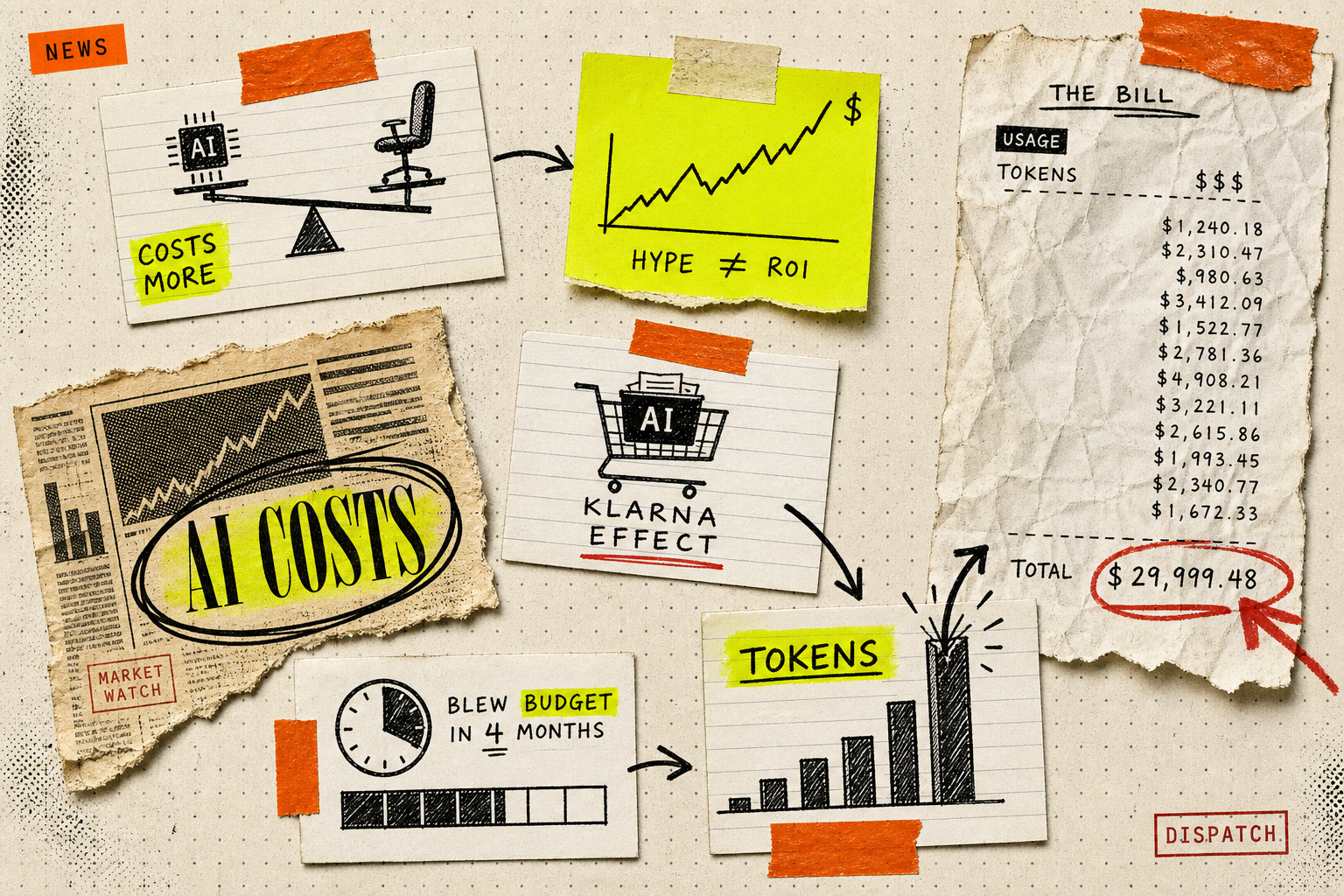
Uber burned through its entire 2026 AI coding budget in four months[1]. Some Uber engineers were racking up $500 to $2,000 per person per month in API costs[2]. That's not a hobby line-item — that's a full-time salary in a lot of the world, spent on tokens.
This is the story every VC deck skipped. The tools that were supposed to make labor obsolete are quietly becoming more expensive than the labor they were supposed to replace. I'm going to explain why that keeps happening, why the "just wait for models to get cheaper" answer is wrong for anyone running a real business today, and what I do differently when I build agents for a $2M–$20M operation.
The receipt-based version of the story
Forget vibes for a second. Look at the receipts.
- Uber's CTO admitted the company blew its full-year AI budget in Q1 after gamifying internal Claude Code usage with a leaderboard[1]. His literal words: "we're coming to the end of the so-called tokenmaxxing era."[3]
- Fortune's May write-up on Microsoft's own findings: employees who use Copilot the most are the most expensive employees to have. Total cost per active user can outrun what those employees produce[4].
- Forbes' July piece was blunter: "the technology that was supposed to make human labor obsolete is, at this moment, more expensive than the humans it was meant to replace."[5]
- Inc.'s Joe Procopio, June 2026: "The bill for AI as labor replacement is coming due, and it's an actual, big bill with many zeroes."[6]
- MIT's NANDA study on enterprise AI pilots: 95% deliver no measurable P&L return[7]. RAND put general AI project failure north of 80%[8].
That's five separate outlets, five separate framings, one conclusion: the ROI math a lot of businesses used to justify their 2026 AI spend was wrong.
Why this happens (and it's not "prices will drop")
The default answer from the boosters is: models are getting cheaper every quarter, just wait. Per-token prices are dropping. But per-token is the wrong unit to look at. Here's what actually happens:
1. Agents use 10x–100x more tokens than a chat. A chat is one round-trip. An agent is a loop — plan, call a tool, read the result, plan again, call another tool. A modestly complex agentic workflow chews through a few million tokens before it finishes what a human would do in five minutes. Per-agent-task token consumption is growing faster than per-token cost is dropping.
2. The "leaderboard trap." Uber's mistake wasn't rolling out Claude Code. It was rolling it out with a gamified adoption metric attached. The moment you pay for tokens and reward volume, engineers optimize for volume. The bill balloons before the productivity gain shows up in shipped code[1].
3. Nobody accounts for the whole stack. Sticker price on Copilot is $30/user/month[9]. Real cost when you actually integrate it — the E3 or E5 license underneath it, the M365 admin work, the training, the governance review — is closer to $66–$90/user/month, all-in[9]. That's before anyone actually uses a token.
4. Retrofits, not rebuilds. Most "AI transformation" projects bolt an LLM onto a workflow that was already broken. The MIT NANDA paper is explicit — the 5% of pilots that work almost all rebuild the workflow around the AI, not the other way around[7]. The other 95% are paying premium prices to make a bad process slightly faster.
The Klarna Effect
The pattern is now common enough that cognitive scientist Gary Marcus gave it a name: the Klarna Effect[10].
Klarna very publicly announced its AI chatbot was doing the work of 700 customer service agents. A year later they were quietly rehiring, with the CEO admitting "I had to pay a lot for saying AI can do all our jobs" and that "cost unfortunately seems to have been a too predominant evaluation factor."[10] Customer satisfaction had dropped hard enough that acquiring replacement customers cost multiples of what they saved on payroll[11].
Every couple of weeks I see a Klarna Effect story on the timeline. Big company announces layoffs "thanks to AI." Some quarters later, quiet rehire under a gig-worker contract. The score is roughly: AI won round one on cost narrative, human labor won round two on retention math.
What I actually build instead
I run ZEROCAM Studio solo. I don't have a token budget I can burn through in four months. That constraint has forced a completely different way of scoping agents.
One narrow job, not a general assistant. The wins I've delivered aren't "an AI that does marketing." They're "an agent that categorizes bank transactions for tax prep" or "an agent that pulls last-week ad-spend data into a Slack message every Monday at 9am." Narrow scope → predictable token cost → obvious ROI check.
Cache aggressively; don't call the model twice for the same thing. Most agent bills are lit on fire by re-generating the same summary of the same document ten times a day. A simple cache layer cuts real bills by 40–70% in my experience.
Track cost per outcome, not cost per token. If your dashboard says "we spent $412 on Anthropic this week" and doesn't say "…which produced these 18 completed jobs at $22.90 each" — you don't have a dashboard, you have a graveyard for data. Set outcome-tied budgets before you turn the agent on. Cut the agent if the unit economics don't clear the cost of a virtual assistant doing the same task.
Rebuild the workflow around the agent, or don't ship the agent. The MIT number sits in the back of my head every project. If the AI is bolted onto a broken process, save yourself the token bill and fix the process first.
Keep a human in the loop for anything customer-facing. The Klarna math is not going to reverse next quarter. Support and sales conversations are still worth the salary of a decent human running them, with AI in the wings for drafting, retrieval, and QA. Full replacement is the trap.
What to actually do this week
If you're running a $2M–$20M business and you signed up for a bunch of AI subscriptions this year:
- Pull your last three months of AI invoices. Anthropic, OpenAI, Copilot, whatever you're using. Add them up.
- Identify what a virtual assistant in Manila or Cape Town would cost to do the same jobs. Rough numbers, back-of-napkin.
- If AI is more expensive than the VA equivalent and the quality isn't dramatically better, cut it. Not everything. Just the pieces where the math is upside-down.
- For the pieces you keep, wire in per-outcome cost tracking. Not per-token. Per-completed-job.
You'll probably discover two or three subscriptions that were making a vendor rich and doing nothing for your P&L.
The AI-labor arbitrage is real for narrow, well-scoped, well-instrumented agents. It is not real for "let's slap Claude on everything and see what sticks." The bill will find you either way — the only question is whether you saw it coming.
If you want a second set of eyes on your stack — what to keep, what to kill, what to rebuild before you scale it — that's what the free audit call is for. Thirty minutes, no pitch, we look at the receipts.
-
Uber burned through its entire 2026 AI budget in four months. Now its COO is questioning whether it's worth it↩
Uber exhausted its 2026 AI coding budget in four months on Claude Code.
-
Uber Spends Full 2026 AI Budget in 4 Months↩
Uber engineers reported $500–$2,000/month in API costs per person.
-
Uber CTO: We're coming to the end of the so-called tokenmaxxing era↩
Uber CTO's direct quote acknowledging the token cost problem.
-
Microsoft reports are exposing AI's real cost problem: Using the tech is more expensive than paying human employees↩
Copilot's heaviest users become the company's most expensive employees.
-
AI Costs More Than The People It Replaced↩
Framing that AI is currently more expensive than the labor it was meant to replace.
-
Bosses Are Blowing More Money on AI Agents Than It'd Cost Them to Just Pay Human Workers↩
AI agent request volume can cost more than paying the human workers they were meant to replace.
-
MIT report: 95% of generative AI pilots at companies are failing↩
95% of enterprise GenAI pilots deliver no P&L return.
-
AI Project Failure Rate 2026: 80% Fail↩
RAND puts general AI project failure over 80%.
-
Microsoft Copilot Pricing Explained: Plans, Cost & Licensing (2026 Guide)↩
Real all-in enterprise Copilot cost is $66–$90/user/month.
-
Klarna Walks Back AI Overhaul: Rehires Staff After Customer Service Backlash↩
Klarna reversed its full AI-replacement push and began rehiring humans.
-
Klarna Claimed AI Was Doing the Work of 700 People. Now It's Rehiring↩
Klarna's chatbot-driven support backlash led to human rehiring.
Ready to build your own AI system?
Book a Free Audit Call →Keep Reading
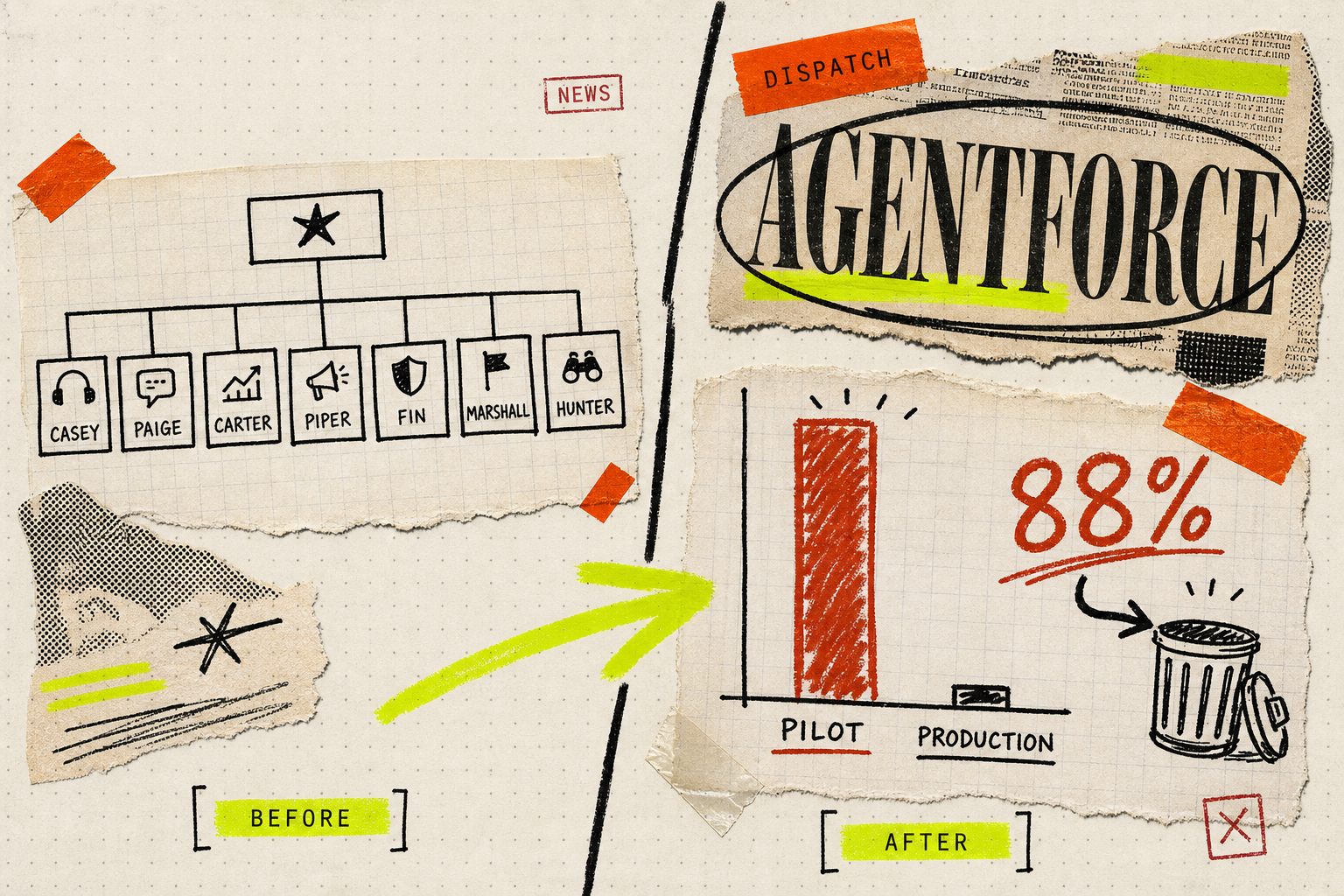
Salesforce Just Named Seven Agents. Enterprise AI Still Loses 88% Of Pilots.
Salesforce shipped 7 named Agentforce agents. But 88% of enterprise AI pilots still fail to reach production. Here's the real gap operators need to fix first.

Small Businesses Using AI Are Hiring More People, Not Fewer
Gusto ran payroll on 2,262 small businesses. AI adopters grew headcount 7% faster — 10% for under-10 firms. The doom takes miss the operator story.
WhatsApp Just Made Every Reply Billable. Your Bot Bill Starts October 1.
On October 1, Meta starts charging for every WhatsApp reply — human, third-party AI, or its own. The sticker price is the boring part. Here's what it actually breaks.