Why Your AI Agent Pilot Won't Survive Production
74% of enterprises have rolled back a live AI agent after launch. The model isn't why. Here's the operations layer most vendors don't sell — and the 5-step playbook I'd actually run.
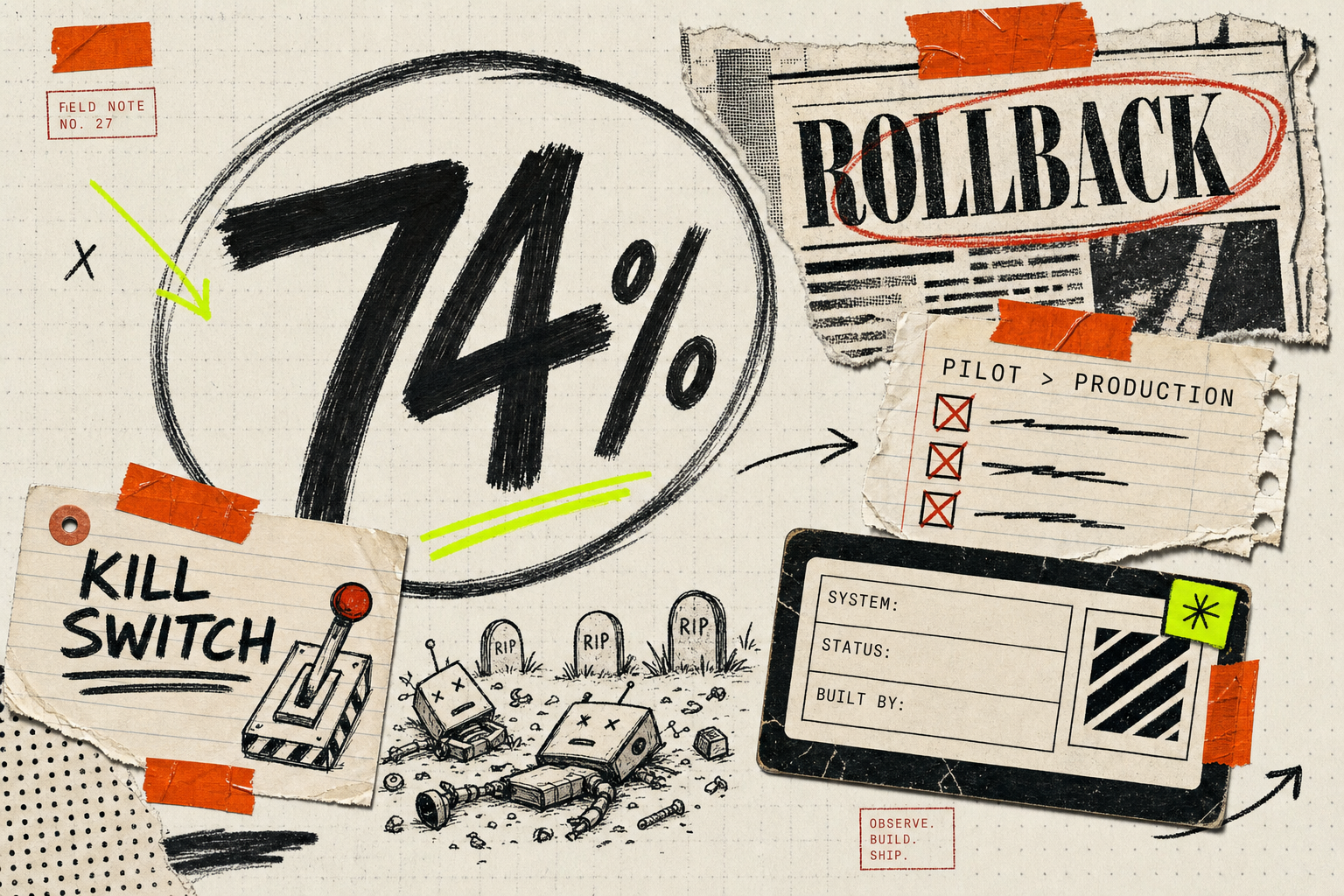
74% of enterprises that put an AI customer agent into production have already rolled it back or shut it down[1]. Not in a pilot. After it went live, in front of real customers. That's the part nobody is talking about while every vendor on LinkedIn is selling you "your first AI employee."
If you're running a $1M–$20M business and a sales rep just pitched you an AI voice agent, an AI sales SDR, or an AI support bot, this is the post I'd want you to read before you sign anything.
The pilot is the easy part
Build an agent that works for a demo? Easy. There's a stack of seven tools that get you to a working pilot in a weekend.
Build one that survives 30 days of real customers, real edge cases, and one boardroom-level mistake? Almost nobody is doing that. IDC's number is that 88% of AI agent pilots never make it to production[2]. The ones that do — the 12% — then face Sinch's 74% rollback rate after launch.
Do the math. You start with 100 pilots. 12 reach production. 9 of those get pulled. You're left with 3 surviving deployments out of 100 attempts. That's not "AI is broken." That's "the layer around the model is missing."
What actually breaks
The model isn't the problem. The model rarely is. Fiddler AI tracked failure modes across 70–95% of production AI agents and the top causes were governance, monitoring, and integration — not hallucination rates[3]. IBM puts it more bluntly: 70% of executives say the AI governance they have today is not fit for purpose[4].
Here's what actually breaks once an agent is in front of customers:
- It promises something it can't deliver — and the customer holds the company to it
- It loops on a stuck ticket for $40 of token cost before anyone notices
- It hands off to a human with no context, doubling the support load instead of cutting it
- It writes one wrong number to the CRM and the sales team works off bad data for a week
- It can't tell you why it made a decision when legal asks
None of those are model failures. All of them are operations failures. They get caught in production because the pilot didn't simulate the messy real-world inputs that production sees every hour.
"But the vendor said it works"
Of course they did. Their demo runs on three curated inputs in a controlled environment. Your production runs on 4,000 inputs a day from people who are tired, confused, or actively trying to game the system.
Gartner is now predicting that 40% of enterprises will demote or decommission autonomous AI agents by 2027 specifically because of governance gaps identified only after production incidents occur[5]. Read that again. The governance problem isn't visible in the pilot. It only shows up after the agent has already done damage.
This is the part the vendor doesn't put on the slide.
The five things that have to exist before you go live
If I'm building or auditing an AI agent for an operator, these five things have to exist before the agent ever touches a real customer. None of them are "the model." All of them are the layer around it.
1. A bounded scope you can write on one page. What can this agent do? What can't it? What's escalation criteria? If you can't write the scope in 200 words, the agent is too ambitious for v1. The single best predictor of an agent surviving production is a narrow, dull, replaceable v1 — not an "AI employee" that does everything.
2. A real eval set, not vibe checks. 50–200 actual past conversations, replayed against the agent, with pass/fail criteria a human reviewer agreed on first. Every prompt change re-runs the eval. If the eval gets worse, the change doesn't ship. Most vendors will say "we tested it" and have no eval set you can inspect. That's a red flag.
3. Observability you can actually read. Every agent run logged: the user input, the tool calls, the model output, the cost, the latency, the resolution. Not "logs are available in our dashboard." Logs that a non-technical person on your team can scan in 10 minutes a day and spot drift. Without this, you find out the agent is broken when the customer churns — not before.
4. A kill switch and a fallback. One config toggle that turns the agent off and routes traffic back to humans (or a simpler agent). Tested monthly. The number of teams I've seen that don't have a working kill switch for their flagship AI feature is genuinely scary. The 88% of AI pilots never reaching production[2] is partly because nobody planned for "what if we have to turn this off in 30 seconds."
5. A human review loop on the first 30 days of decisions. Not "spot checks." A defined percentage (10–25%) of agent outputs reviewed by a human, with feedback fed back into prompts and the eval set. You burn this hour-budget for the first month, then taper. Skip this and you're flying blind on day 31.
If a vendor or builder can't show you these five, they haven't built you an AI agent. They've built you a demo and handed you a production problem.
What I'd actually do
If you have $30K–$100K to spend on AI agent work this year, this is the order I'd run it:
- Pick one boring, repetitive, well-bounded task. Not "AI customer support." Specifically: "categorize and route incoming tickets to the right queue." One job. One input. One output. One escalation path. Boring wins.
- Run it shadow-mode for 2 weeks. The agent sees real inputs and proposes outputs. Humans still execute. Compare its proposals against what the humans actually did. This is your real eval — free, with no customer risk.
- Promote only when shadow-mode agreement is >85% on the metric you care about. Not "it looks good." A number you'd defend to your CFO.
- Launch with 10% traffic, a kill switch, and a daily review of the first 200 runs. Scale to 100% only after two clean weeks.
- Budget 20% of the build cost for ongoing observability and governance. Most teams budget 100% to build and 0% to operate. That's the rollback pattern Sinch found[1].
This is the boring, unsexy version. It's also why the agents I build for operators actually stay running.
The take
Most "AI agent" deployments aren't failing because the AI is bad. They're failing because nobody built the operations layer that turns a working demo into a system you can trust at 2 a.m. on a Saturday. The vendors don't sell that layer because it isn't a SaaS feature — it's a discipline.
If you're about to spend real money on an AI agent for your business, the question isn't "is the model good enough?" It's "does the team building this have a plan for the 74% rollback risk?" If they don't have an answer, the answer is no.
If you're sizing up an AI agent for your business and want a real audit of the build plan — not the sales pitch — book a 30-minute call. I'll tell you exactly which of the five gaps above is going to bite you and what to do about it. No pitch.
-
Sinch research reveals 74% of enterprises have rolled back live AI customer communications agents↩
74% of enterprises have rolled back or shut down a live AI customer communications agent after deployment due to a governance failure.
-
IBM Says Enterprises Will Run 1,600 AI Agents by Year End — 70% Cant Govern the Ones They Have↩
IDC research shows 88% of AI agent pilots never make it to production; IBM data shows 70% of enterprises lack agent governance.
-
AI Agent Failure Rate: Why 70-95% Fail in Production↩
Top production failure causes for AI agents are governance, monitoring, and integration — not model quality.
-
Shaping the next era of agentic AI at Think 2026↩
7 in 10 executives believe the AI governance they have in place is not fit for purpose.
-
Many autonomous agents doomed by governance failures↩
Gartner predicts 40% of enterprises will demote or decommission autonomous AI agents by 2027 due to governance gaps identified only after production incidents.
Ready to build your own AI system?
Book a Free Audit Call →Keep Reading
Never Put An AI Agent In Front Of An Upset Customer
AI-handled support hits 4.10/5 CSAT vs 4.30 for humans — and the gap is entirely emotional tickets. Here's the four-gate escalation design that closes it.
DHH Just Drew The Line Between Vibe Coding And Your Agent
DHH split vibe coding from agentic engineering on Lex Fridman. The same wedge is coming for every operator running AI agents in 2026.
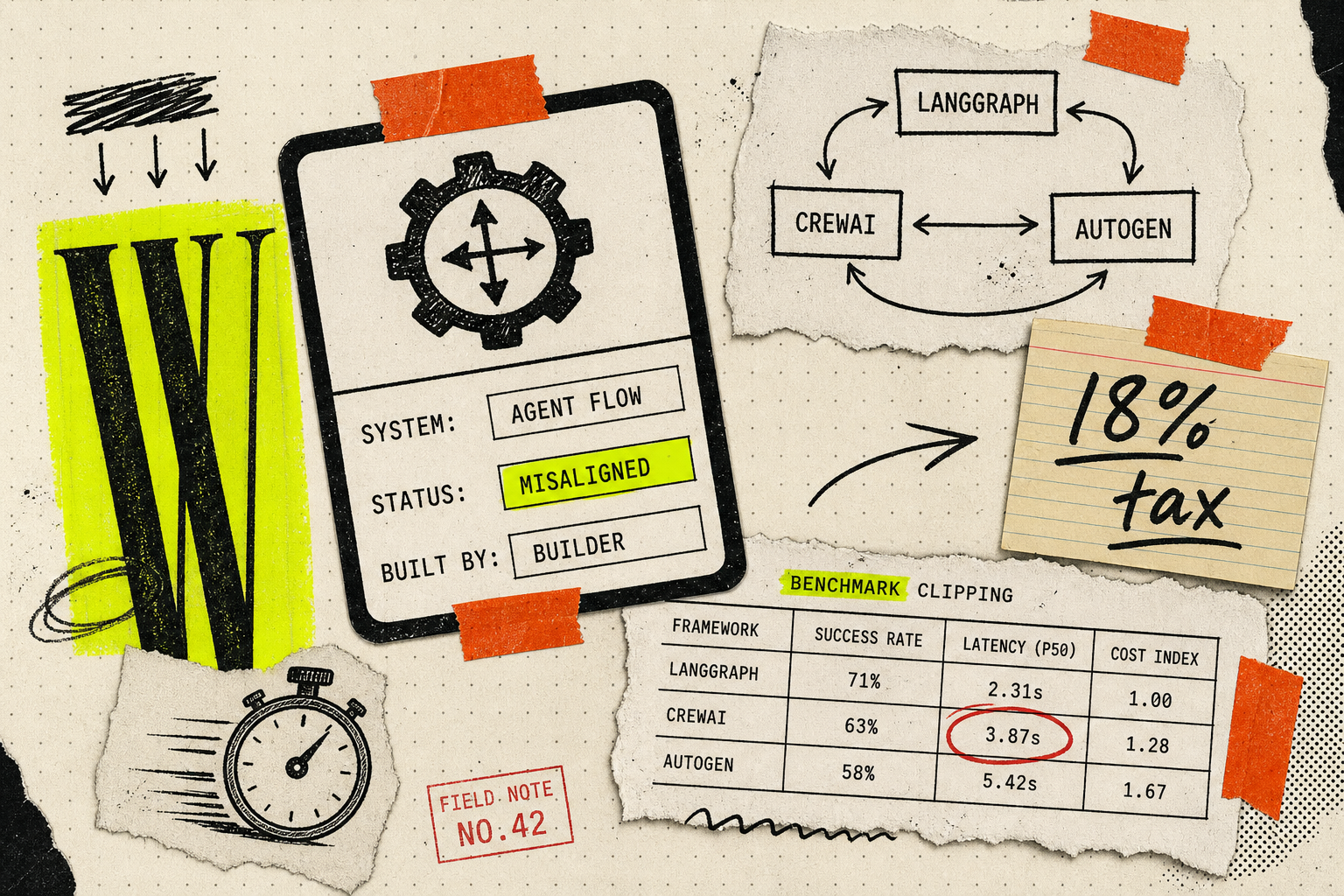
You Picked The Wrong Agent Framework. Benchmarks Say So.
You picked the framework off a listicle instead of a benchmark. Here's how LangGraph, CrewAI, AutoGen actually stack up — and the picking rule I use.