AI Voice Agents Book Meetings 3x Better Than SDRs. Klarna's Trap Isn't Yours.
AI voice agents book meetings 3x better than human SDRs. Klarna proved the tech works — and where it breaks. Here's the four-part stack to build one that lasts.
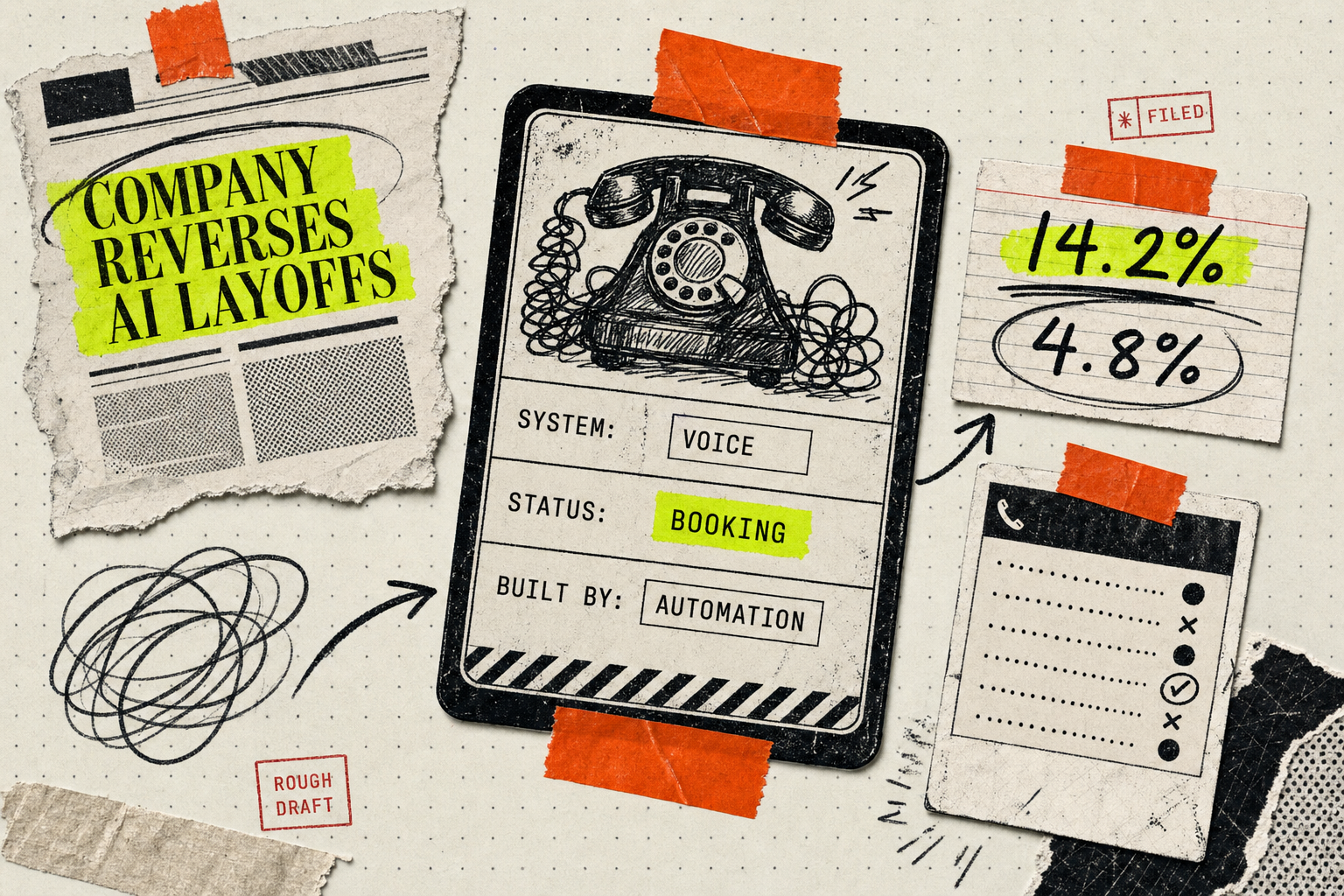
The math on AI voice agents finally works. Data from 10,000+ outbound sales campaigns shows AI voice agents hitting a 14.2% connect-to-meeting-booked rate — the industry average for human SDRs is 4.8%[1]. That's not a 20% lift. That's a 3x delta.
And Gartner expects 30% of all inbound customer service calls to be handled by AI voice agents by 2027[2].
So the pitch decks are right — the technology is real. But every operator I talk to who's tried to actually deploy one has the same story: it worked in the demo. It fell apart in production. And Klarna — the company held up as the poster child for AI-replacing-humans — just spent 2025 quietly reversing course[3].
Here's what the demo doesn't show, and what to build instead.
The Klarna reversal is the whole story
Klarna's original claim, February 2024: their OpenAI-powered assistant was doing the work of 700 full-time customer service agents in its first month, handling 2.3 million conversations and automating 67% of them[4]. CEO Sebastian Siemiatkowski went on every podcast to say they'd frozen human hiring because AI could match human quality.
18 months later, the same CEO admitted the strategy went too far. Klarna is hiring humans back. In his own words: overemphasis on cost-cutting led to "poorer service" and the company "reduced its employee base from 7,400 to 3,000" during the AI push before recalibrating[5].
The rollback isn't because AI voice tech got worse. It's because Klarna optimized for one variable — cost per interaction — and let quality, escalation paths, and the last-mile human handoff rot. The AI handled the easy 67%. But when a customer had a real problem, they got stuck.
That's the trap. And it's a design trap, not a technology trap.
What the numbers actually say
Two datasets to hold in your head before you build anything.
Outbound cold calling
Outreach's 2025 dataset found AI-personalized calls achieved a 36% higher meeting conversion rate compared to generic outbound[6]. The 14.2% booked rate above only holds when the AI is doing real personalization off enriched data — not blasting the same script. Average industry cold call conversion in 2025 is still 2.3%[7]. If your AI agent isn't outperforming that by at least 3x, it's not personalized enough.
Inbound follow-up
AI calling for inbound lead response — calling back a form-fill within 5 minutes — hits 18-27% conversion to conversation, roughly 3x the outbound rate[8]. This is the highest-payoff voice AI use case nobody talks about because it's boring. It's not "AI cold calling 100 plumbers." It's "the form-fill just landed at 11pm and the AI called them at 11:01."
Customer service
The retention play: AI voice agents cut average handle time meaningfully but only when paired with clean handoff paths. First call resolution benchmarks sit at 70-85% for well-run centers[9]. If your AI hits 60% and dumps the other 40% into a queue with no context, your CSAT tanks. Ask Klarna.
The four-part stack (the actual build)
Every voice AI deployment that works has these four pieces. Every one that fails is missing one.
1. The voice layer
You don't build this. You rent it. As of mid-2026, the working platforms sit in a narrow band on latency and price:
- Retell AI: ~620ms latency, $0.07/min, HIPAA on standard tier[10].
- Bland AI: ~800ms latency, $0.09/min, better for high-volume ($299–$499/mo platform fee amortizes above ~5,000 mins/mo)[11].
- ElevenLabs / Vapi: lower latency, higher voice quality, more expensive per minute.
The one number that matters is latency. Below 700ms, humans don't notice they're on with an AI. Above 900ms, they hang up. Everything else is a preference — pick one and stop shopping.
2. The context layer
This is where 90% of deployments die. The voice agent needs to know who it's calling and why, before it dials. That means:
- Lead enrichment (Clearbit, Apollo, or ZoomInfo API) firing on trigger.
- CRM state (last touch, deal stage, past objections) piped in as system prompt.
- Product/pricing docs loaded as retrieval — not baked into the prompt.
Skip this and you get exactly what Klarna got: an agent that can handle the top 3 FAQs and fails on anything else.
3. The handoff layer
The single most-skipped piece. Every AI voice agent needs a clear rule: when to shut up and route to a human.
Concrete triggers I use:
- Two failed intent-classification cycles in a row.
- Customer says any variant of "let me talk to a person."
- High-value account (define this in advance).
- Any legal, refund, or compliance question — no exceptions.
The Air Canada precedent isn't going away. In February 2024, the British Columbia Civil Resolution Tribunal ruled that Air Canada was legally liable when its chatbot invented a bereavement fare policy that didn't exist — Air Canada's defense that the chatbot was a "separate legal entity" was rejected outright[12]. Every AI deployment since is a direct liability exposure. If your agent hallucinates a refund policy, that's on you.
4. The measurement layer
Not "we deployed AI." Actual per-call metrics:
- Connect rate (dials → picked up)
- Qualification rate (picked up → qualified conversation)
- Booked rate (qualified → calendar event)
- Escalation rate (AI → human handoff)
- CSAT on completed calls (send a 2-question SMS after)
If you can't pull these four numbers weekly, you don't have an AI voice agent. You have a demo running in production.
What I'd build first if I were you
Not outbound. Inbound follow-up.
Reason: it converts 3x better, the customer already opted in (so no cold-call resistance), and the "call within 5 minutes" behavior is unteachable to a human SDR. This is the one place voice AI has a structural advantage humans literally can't match.
The build:
- Form fill on your site → webhook to a queue.
- Enrichment API fires (30 seconds).
- Voice agent dials with enriched context in system prompt.
- Agent's job is one sentence: "Qualify and book a 15-minute call with a real person." No selling. No pitching. Just booking.
- Escalation trigger: "let me talk to a person" or two intent-classifier misses → warm-transfer to on-call human.
- Post-call: fire a summary into CRM + a 2-question SMS for CSAT.
That's a 2-week build for a competent operator. It'll convert 18-27% of your form fills to booked calls[8], versus the 2-6% most companies get from an SDR calling back within 24 hours[7].
The one-line lesson from Klarna
Don't build an AI voice agent to save money on people. Build it to do the thing humans literally cannot do — respond in 60 seconds, at 11pm, on a Sunday, with the customer's full context in memory. That's the moat. The moment you use it to replace your existing team, you're on the Klarna timeline: 18 months to a public reversal.
If you want this built for your business — same architecture, your CRM, your call flow, your handoff rules — book a 30-minute audit. I'll tell you exactly what the version for your ops looks like, what platforms fit your volume, and where your current handoff will break. No pitch, just the map.
-
What is the Success Rate of AI Cold Calling? (2026 Statistics)↩
AI voice agents achieve 14.2% connect-to-meeting rate vs 4.8% human SDR average
-
11 Top Voice AI Platforms for Modern Call Centers [2026 Enterprise Guide]↩
Gartner estimates 30% of inbound customer service calls will be handled by AI voice agents by 2027
-
Klarna CEO Reverses Course By Hiring More Humans, Not AI↩
Klarna CEO reversed AI-induced hiring freeze to bring back human staff
-
Klarna AI assistant handles two-thirds of customer service chats in its first month↩
Klarna AI handled 2.3M conversations equivalent to 700 agents
-
AI enabled Klarna to halve its workforce↩
Klarna reduced employee base from 7,400 to 3,000 during AI push
-
70+ Cold Calling Statistics for 2026↩
AI-personalized cold calls hit 36% higher meeting conversion than generic outbound
-
Cold Call Conversion Rates: Top Success Rates for 2026↩
Average cold call conversion rate is 2.3% in 2025
-
47 AI Calling Statistics Every Sales Leader Needs to Know in 2026↩
AI calling for inbound follow-up hits 18-27% conversion to conversation
-
45 call center statistics you need to know in 2026↩
First call resolution benchmark is 70-85% for well-run centers
-
Bland AI vs Air AI: Which Voice Agent Platform Wins in 2026↩
Retell AI runs ~620ms latency at $0.07/min with HIPAA on standard tier
-
Retell vs Bland AI: Voice Platform Comparison 2026↩
Bland AI platform fees amortize above 5,000 minutes/month
-
What Air Canada Lost In 'Remarkable' Lying AI Chatbot Case↩
Tribunal ruled Air Canada liable for chatbot hallucinating bereavement fare policy
Ready to build your own AI system?
Book a Free Audit Call →Keep Reading
Never Put An AI Agent In Front Of An Upset Customer
AI-handled support hits 4.10/5 CSAT vs 4.30 for humans — and the gap is entirely emotional tickets. Here's the four-gate escalation design that closes it.
DHH Just Drew The Line Between Vibe Coding And Your Agent
DHH split vibe coding from agentic engineering on Lex Fridman. The same wedge is coming for every operator running AI agents in 2026.
You Picked The Wrong Agent Framework. Benchmarks Say So.
You picked the framework off a listicle instead of a benchmark. Here's how LangGraph, CrewAI, AutoGen actually stack up — and the picking rule I use.