Two In Three Support Teams Just Shipped An AI Agent. Median Resolution: 41%.
Salesforce says 66% of support teams shipped an AI agent this year. The median resolution rate is 41%. Here's why the handoff is where the money actually leaks.
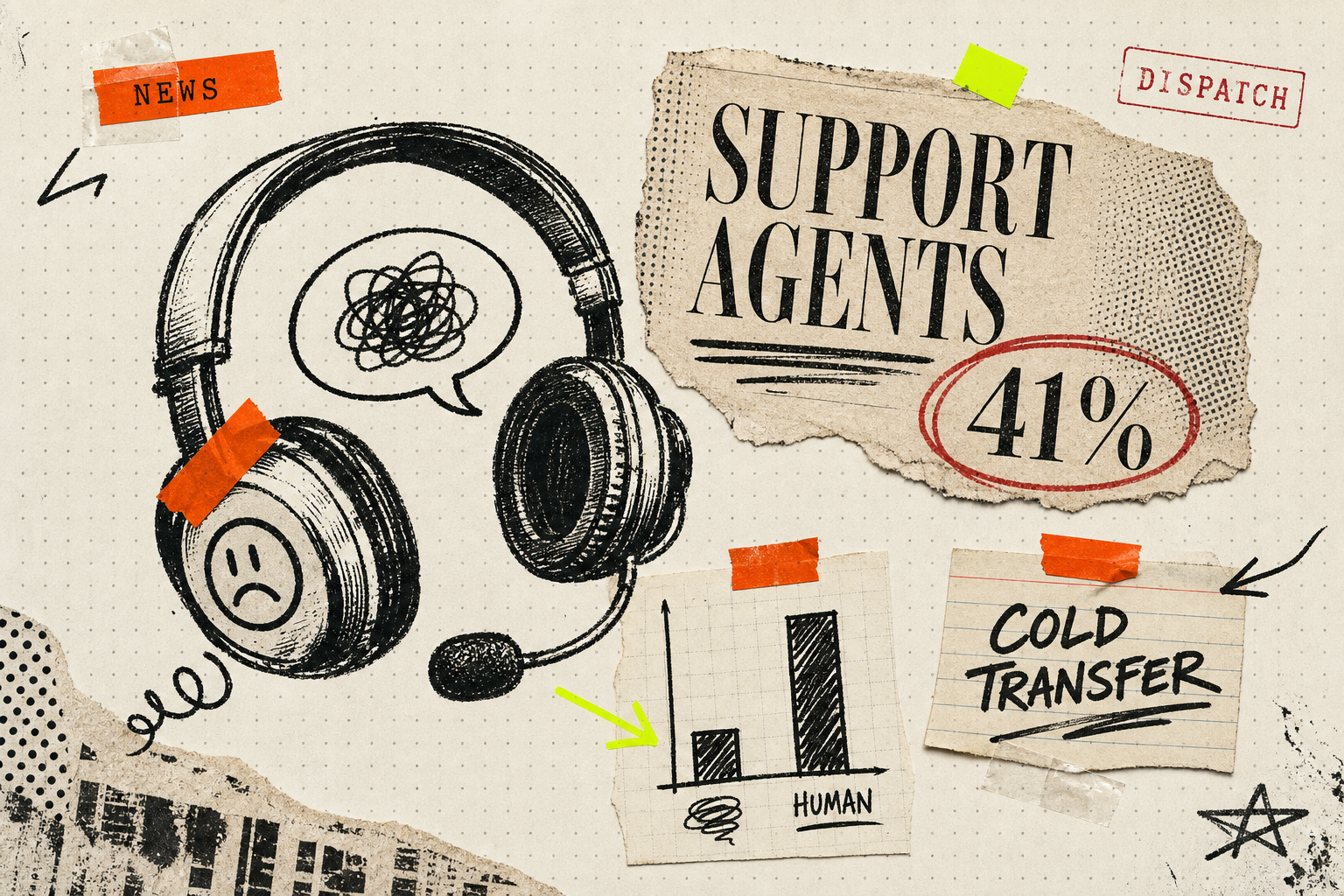
Salesforce says 66% of customer service organizations now run at least one AI agent. Last year it was 39%. The vendors are on stage taking a victory lap[1].
Then you look at the resolution numbers.
The enterprise median for tier-1 AI deflection in 2026 is 41.2%, per Zendesk CX Trends and Salesforce State of Service data aggregated by ClarityArc[2]. Bottom quartile: 22.4%. That means the typical operator who spun up an "AI customer service agent" this year is deflecting fewer than half the tickets it touches — and a big chunk of them are shipping systems that barely clear 1 in 5.
Six in ten conversations still route to a human. And when they do, the handoff is usually broken.
That's the story nobody in the launch keynotes is telling.
The pitch vs. the math
Every big vendor released a customer-service agent product this year. Salesforce is pushing Agentforce. Zendesk shipped its AI Agents platform. Pylon launched an "Agentic Support Platform" on YouTube to 3.5M views[3]. monday.com's "welcome your AI agents to the team" spot crossed 12M[4].
The pitch is the same on every stage: cut cost per contact, replace tier-1 headcount, give customers 24/7 answers.
The math is more honest than the pitch.
- Live-channel cost per contact (phone, chat, email) averages $8.01 according to Gartner benchmarks[5].
- Self-service cost per contact is about $0.10.
- On paper, the cost delta is 80x.
- In practice, IBM measured a 23.5% average reduction in cost per contact from conversational AI deployments[6].
- Real operators with clean back-end integrations report 20–40% cost-per-contact reductions over 2–3 years[7].
Nobody's getting the 80x. Because 41% deflection means 59% of contacts still land on a human — and the humans now spend more time per ticket, not less, because the ones that escalate are the hard ones.
The Lorikeet CX team put realistic ranges on it: 30–50% resolution for early deployments, 50–70% as workflows mature, and 70–85% for deeply integrated, action-taking agents on well-scoped use cases[8]. If your team is at 41%, you're average. If you're at 22%, you're paying vendor fees for something worse than a good FAQ page.
The Klarna number everyone quotes wrong
Klarna is the canonical case study, and it's getting misremembered in two directions[9].
The pro-AI crowd cites the peak: 2.3M chats handled, work of ~700 agents, 25% shorter resolution times, $40M in projected profit improvement in year one.
The anti-AI crowd cites the reversal: mid-2025, CEO Sebastian Siemiatkowski admitted quality had slipped and Klarna started rehiring humans.
Both are true. Both miss the point.
The Klarna story isn't "AI failed." It's that peak deflection ≠ sustained CX quality. They hit the deflection numbers. What they lost was the ability to catch edge-case rage cases before those customers churned. That's not a model problem. That's an escalation-design problem.
If you're building an AI service agent for a $5M–$20M business right now, that's the number you need to be modeling — not deflection, not cost savings. The recovery curve on escalated tickets.
The handoff is where the money leaks
Here's the metric nobody puts in the deck: cold-transfer handoffs drop CSAT by 12%[10]. That's not a small hit. That's the difference between a repeat customer and a chargeback.
There are three ways handoffs fail. All three are common in the systems shipping right now:
- The cold-context dump. The AI escalates. The human gets no summary — sometimes not even the transcript in a usable place. The customer repeats their whole problem for the third time.
- The escalation black hole. The AI says "I'm connecting you to a specialist," and… nothing. No SLA. No queue position. The customer bounces to a competitor.
- The undisclosed-AI trap. The customer never knew they were talking to a bot until it messes up. Now trust is gone before the human even joins.
Chatbot CSAT typically runs 10–15 points below live-agent CSAT[11]. Which is fine — for tier-1 volume — as long as escalated conversations recover to a healthy score. They only do that when context travels with the ticket.
Most of what I see in the wild? Context doesn't travel. The AI sits inside one vendor's platform. The humans work in a different tool. The handoff is a URL, not a warm transfer with a summary.
What "well-scoped" actually means
The 70–85% resolution rate is real. It just requires design that most operators skip.
- Scope narrow. Order status. Refund initiation. Subscription pause. Password reset. Not "answer anything." An agent that can act on 6 workflows will beat an agent that can talk about 60.
- Wire the back end first. If your agent can't hit your OMS, your billing system, and your CRM with write access, it's a decision tree, not an agent. Read-only agents defer. Write-capable agents resolve.
- Permission-scope every action. Refunds under $50 auto-execute. Above $50, agent proposes and a human clicks. This is the guardrail every real deployment has and every demo skips.
- Design the escalation, not just the deflection. When the agent hands off, it should deliver: a one-line summary of the issue, what it already tried, the customer's mood signal, and the recommended next action. That's the difference between recovering CSAT and torching it.
- Measure the four numbers. Resolved deflection rate. Cost per contact before and after. Handle time on escalated tickets. Total platform + maintenance cost. If you can't produce all four this quarter, you don't have a program, you have a purchase.
Those four numbers come straight from Tommaso Maria Ricci's 2026 CX guide, and they're the right ones[12]. Everything else is vanity.
The uncomfortable pattern I keep seeing
Two in three service teams shipped an agent this year. Salesforce is calling it success. Most of those deployments are running at median 41% resolution, sitting on top of broken escalation paths, without a real cost-per-contact baseline to prove ROI against.
That's not a broken product category. It's operators buying the deflection number and forgetting to fund the plumbing that makes deflection worth having.
If your ticket volume is going up quarter-over-quarter and your team is quietly hiring back the humans you thought you'd replace — you're not alone. Klarna did the same thing, publicly. Most companies are doing it privately.
The good news: the fix is not another platform. It's narrower scope, real back-end integration, and an escalation path that doesn't burn customer trust when the agent inevitably tags out.
If your support stack is showing this pattern — deflection numbers you can't defend, CSAT slipping on escalated tickets, and no honest cost-per-contact math — that's exactly what my audit call is for. Thirty minutes. I'll tell you which of the four numbers is missing and what your version would look like if it were designed to resolve, not just deflect.
-
Two in Every Three Customer Service Teams Now Use AI Agents↩
AI agent adoption in customer service organizations jumped from 39% (2025) to 66% (2026), citing Salesforce research.
-
Customer Service AI Agent Statistics 2026: 120+ Data Points↩
Enterprise median tier-1 deflection is 41.2%; bottom quartile 22.4%.
-
Introducing the Agentic Support Platform↩
Pylon launched an 'Agentic Support Platform' - 3.5M views.
-
Welcome your AI agents to the team by monday.com↩
monday.com's AI agents launch spot crossed 12M views on YouTube.
-
Reduce Cost per Contact: What AI Really Saves↩
Gartner benchmark: live-channel contact ~$8.01, self-service ~$0.10.
-
75 AI Customer Service Statistics 2026↩
IBM measured 23.5% average cost-per-contact reduction from conversational AI.
-
AI in Contact Center: Proven Ways to Lower Costs and Improve Efficiency↩
Real operators report 20-40% cost-per-contact reduction over 2-3 years.
-
What Resolution Rate Can AI Customer Support Achieve (2026 Benchmarks)↩
Realistic ranges: 30-50% early, 50-70% mature, 70-85% action-taking.
-
Klarna's AI Reversal: Why It Rehired Human Agents↩
Klarna AI handled 2.3M chats, work of ~700 agents; later rehired humans.
-
AI-to-Human Handoff in Ecommerce: 7-Step Context Transfer↩
Cold-transfer handoffs drop CSAT by 12%; three handoff failure modes catalogued.
-
Human Handoff in AI Customer Support: How Escalation Works (2026)↩
Chatbot CSAT typically runs 10-15 points below live-agent CSAT.
-
AI Customer Service 2026: Cut Cost 45%, Up CSAT 30%↩
Four-number measurement framework for AI customer service programs.
Ready to build your own AI system?
Book a Free Audit Call →Keep Reading
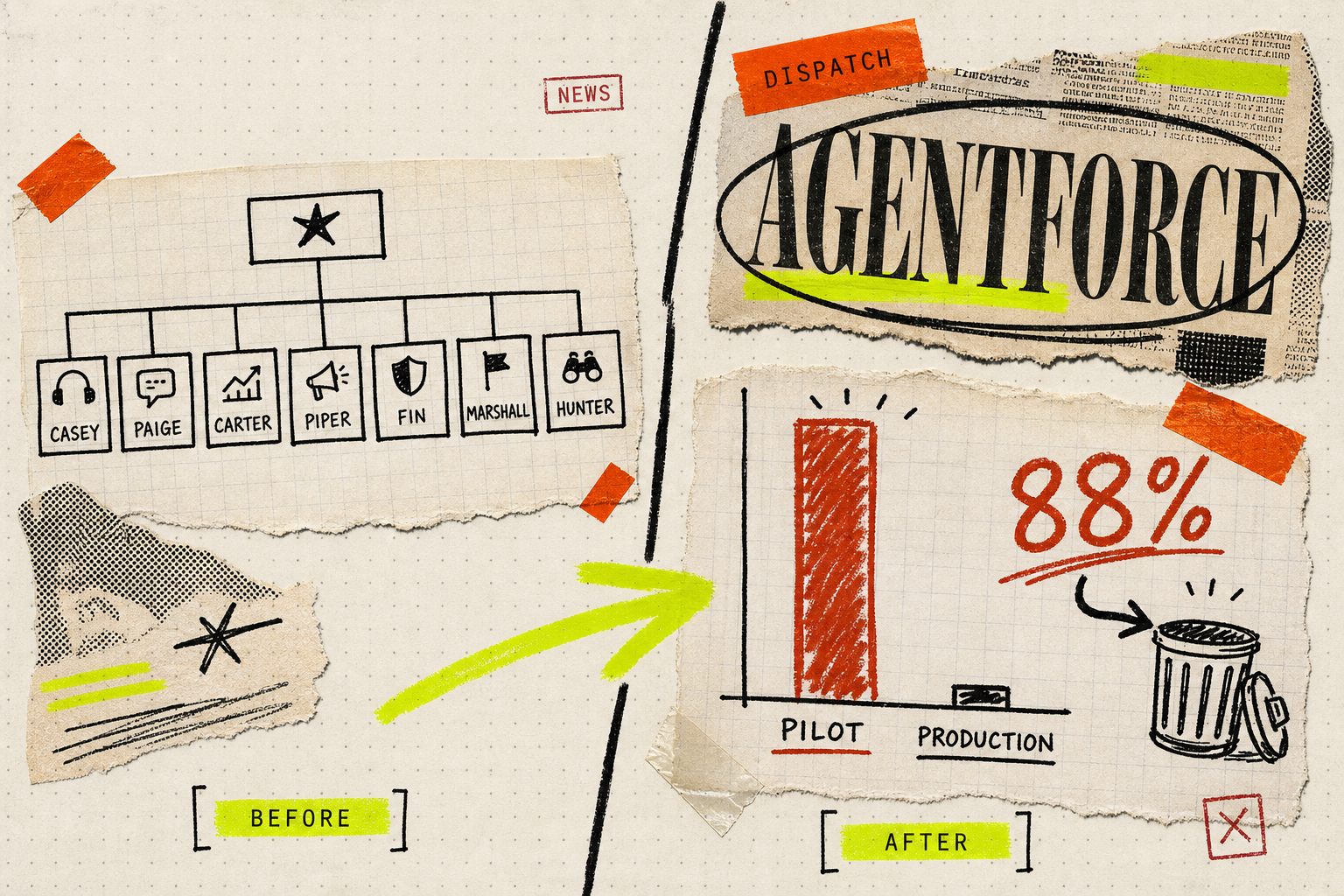
Salesforce Just Named Seven Agents. Enterprise AI Still Loses 88% Of Pilots.
Salesforce shipped 7 named Agentforce agents. But 88% of enterprise AI pilots still fail to reach production. Here's the real gap operators need to fix first.

Small Businesses Using AI Are Hiring More People, Not Fewer
Gusto ran payroll on 2,262 small businesses. AI adopters grew headcount 7% faster — 10% for under-10 firms. The doom takes miss the operator story.
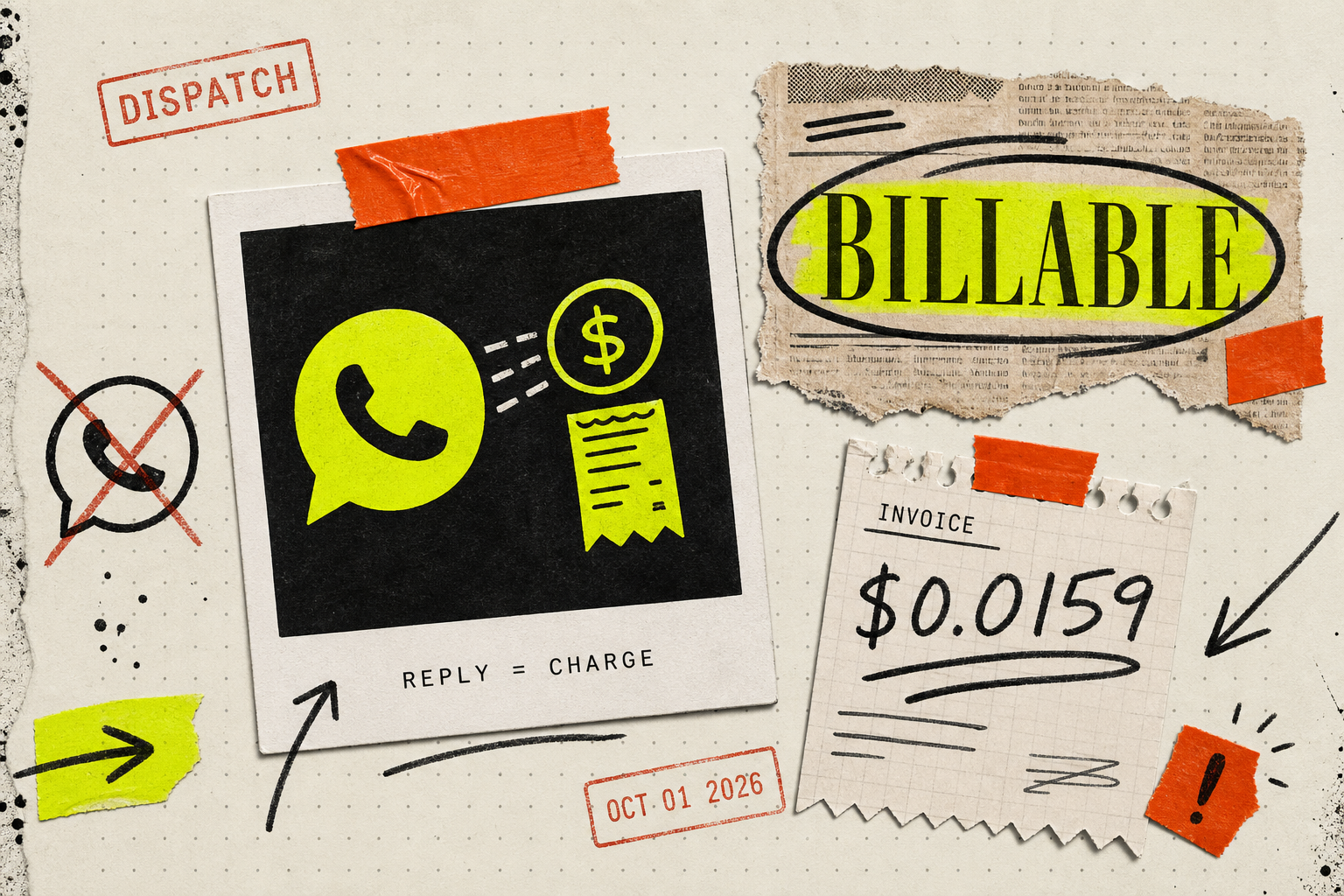
WhatsApp Just Made Every Reply Billable. Your Bot Bill Starts October 1.
On October 1, Meta starts charging for every WhatsApp reply — human, third-party AI, or its own. The sticker price is the boring part. Here's what it actually breaks.