Ed Zitron Says AI Is A Con. The Numbers Say He's Half Right.
Ed Zitron says AI is a con. The receipts show 95% of pilots fail — but the 6% who win follow a boring, narrow playbook. Here's what to actually build.
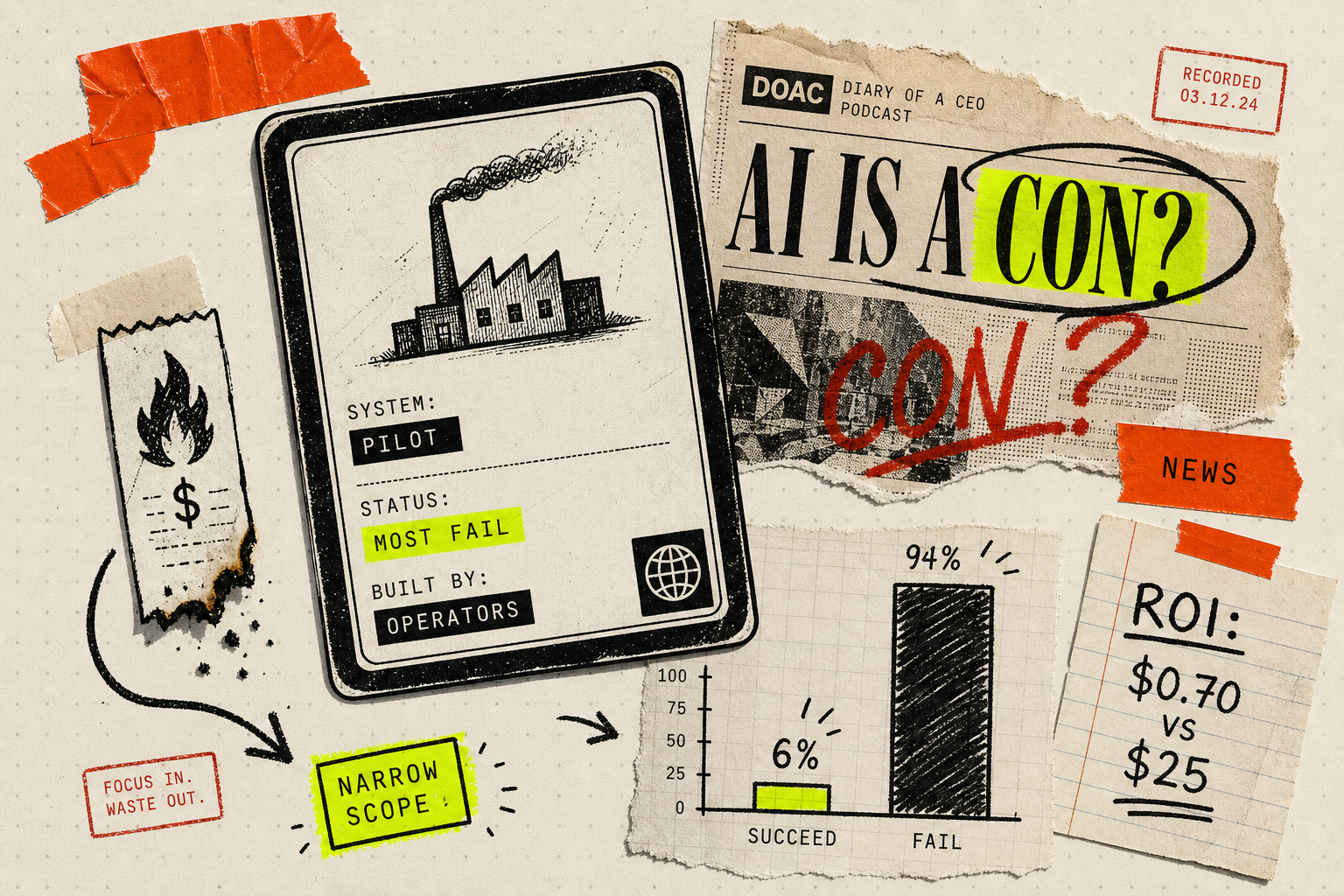
Ed Zitron went on Diary of a CEO last week and told 6.6 million people that generative AI is "a con," that OpenAI will run out of cash by 2027, and that the whole thing is going to take the tech economy down with it[1][2]. It's the most extreme version of the "AI bubble" argument that's been building for a year.
If you run a $2M-to-$20M business and you're trying to decide what to actually build with AI this quarter, you're now getting two messages that can't both be true. LinkedIn tells you every operator who isn't shipping agents right now is finished. Zitron tells you you're a mark in the world's biggest scam. Neither is right. Both are useful.
Here's what I think is actually going on — and what I'd do about it if I were you.
Zitron is right about the money. He's wrong about your bill.
Start with the part that's not debatable. OpenAI is losing enormous amounts of money. Yahoo Finance, citing internal projections reported by The Information, pegs OpenAI's 2026 loss at $14B[3], and analysts confirm $3.7B was burned in Q1 2026 — a 65% burn rate against revenue[4]. Anthropic, meanwhile, quietly did the opposite — passed $11.5B in Q2 2026 revenue and turned adjusted operating income positive while OpenAI reportedly lost around $39B in 2025[5].
This matters for a specific reason. The frontier-lab economics have almost nothing to do with your economics.
The lab burn is a race for training scale and a bet on future paid usage. The operator's economics are per-query costs on already-trained models. Value Add VC pulled the recent numbers: a human agent handling a routine support query costs roughly $20-25, versus $0.50-0.70 for an AI agent handling the same query — a 30-40x cost differential when it's actually working[6]. That gap doesn't evaporate if OpenAI restructures or if Anthropic swallows half its enterprise market. Inference prices have been dropping for three years and the open-weights floor keeps sinking underneath the closed models.
So if Zitron is right that the lab economics are broken — and the receipts say he mostly is — the actual downside for you isn't "AI stops working." It's "the vendor mix changes and prices reshuffle." Different problem, different bet.
He's dead right about the hit rate. Almost nobody talks about this honestly.
The uncomfortable part of Zitron's argument is the ROI data. Terminal X's April 2026 research puts the failure rate at 95% of enterprise AI pilots delivering no measurable return[7]. Unico Connect's June 2026 aggregate says 80–95% of AI projects fail to deliver ROI, and blames poor data plus weak integration, not model quality[8]. BCG and Forrester's own 2026 numbers say 22% of agent deployments show negative ROI at the 12-month mark — almost always tied to scope creep, missing evals, or trying to make one agent do five jobs[9]. Only about 6% of organizations qualify as "high performers" capturing significant value from AI[10].
Those numbers are inconvenient for both sides of the debate. They break the LinkedIn narrative that every business is quietly winning with AI. And they break Zitron's frame too — because they're not the shape of a con. They're the shape of a hard technology adoption cycle where a small minority is separating from a large majority.
The interesting question isn't "is AI real." The interesting question is: what does the 6% do that the 94% doesn't?
What the 6% is doing
Every 2026 report I read for this piece said basically the same thing. Not one of them said "picked the best model." Not one said "hired the biggest consultancy." They all said some version of this:
- Narrow scope. One job. One workflow. Not "AI transformation." Algolia's May 2026 write-up put it bluntly: customer service, e-commerce search, and internal knowledge access are the mature areas with real ROI benchmarks — the bottleneck is data quality and integration, not the model[11]. AI hive's June breakdown showed a single narrowly-scoped internal-comms agent produce enterprise-wide time savings without touching any other department[12].
- A cost baseline they already understood. The 30-40x gap only shows up when you knew what the manual version cost per unit. Nobody who couldn't answer "what does one ticket cost us today" saw payback.
- Evals before scale. BCG's negative-ROI cohort skipped evals. The positive-payback cohort didn't[9].
- Six-to-twelve month timelines, not six weeks. 41% of positive-payback agent deployments hit within 12 months. 18% within 6[9]. Nobody serious is shipping "AI transformation" in a sprint.
That's it. That's the whole 6% playbook. It's not glamorous, which is why the LinkedIn version doesn't sell it.
What I'd do if I were you this quarter
Zitron's bearish take does one useful thing: it gives operators permission to stop panicking. You are not behind. There is no invisible competitor quietly running a fully-agentic $10M business next door. If they existed, they'd be in the 6% and you'd hear about them from actual customers, not from Twitter.
Here's what the data says the actual move is:
- Pick one workflow where you already know the unit cost. Support tickets, invoice processing, appointment booking, lead qualification. If you can't answer "what does one of these cost us today," don't automate it yet — measure it.
- Build the narrowest possible agent for that one job. Not a platform. Not a copilot. One workflow, in production, with a rollback path.
- Set up evals from day one. Not vibes. Real accept/reject criteria you can score. If you can't score it, you can't improve it — and you're guaranteed to land in the 22% negative-ROI bucket.
- Give it two quarters. Not two weeks. The 6% didn't rush.
- Assume the vendor market will move under you. Multi-model. Portable prompts. Don't hard-code your business to one API.
If OpenAI's math really does snap in 2027, the operators who followed that playbook will barely notice — their agents will get moved to whichever lab still ships and prices drop. The ones who bought a $50K "AI transformation" package will notice a lot.
Zitron's not wrong that the frontier is overheated. He's just wrong that this makes the boring, narrow, well-instrumented use of these tools a con. That version of AI has always been quiet. It's still quiet. It's the only version I've ever seen actually work.
If you want an outside read on which single workflow in your business would actually clear the bar — narrow, measurable, ROI-shaped — that's the audit call. 30 minutes. No pitch. I'll tell you honestly whether the AI version is worth building this quarter or whether you're better off waiting for the vendor shuffle to settle.
The 6% aren't smarter than the 94%. They're just more patient about what they call "AI."
-
The Man Who Calls BS On AI | Ed Zitron on The Diary of a CEO↩
Zitron argues generative AI is a con, OpenAI runs out of cash by 2027.
-
Ed Zitron: OpenAI Will Run Out of Cash by 2027 and Trigger a Tech Depression↩
Summary of Zitron's thesis on the AI-bubble mechanics.
-
OpenAI's own forecast predicts $14 billion loss in 2026 but Nvidia-style $100 billion revenues by 2029↩
OpenAI internal projections show $14B loss for 2026, per The Information.
-
OpenAI Burns 65% of Revenue: $3.7B Loss in Q1 Alone↩
OpenAI burned $3.7B in Q1 2026, a 65% burn rate against revenue.
-
Anthropic Turns Profitable While OpenAI Struggles: The AI Industry's Dramatic Reversal↩
Anthropic $11.5B Q2 2026 revenue, adjusted operating income positive; OpenAI ~$39B loss in 2025.
-
Enterprise AI ROI Measurement in 2026: Only 5-8% of Companies See Real Returns↩
Human agent $20-25 per routine support query vs $0.50-0.70 for AI agent — 30-40x cost differential.
-
AI ROI in 2026: Why Most Enterprise AI Fails and What Actually Works↩
95% of enterprise AI pilots fail to deliver ROI.
-
AI Statistics 2026, Adoption, ROI & Impact↩
80-95% of AI projects fail to deliver ROI, driven by data and integration weaknesses.
-
AI Agent Adoption 2026: 120+ Enterprise Data Points↩
41% positive payback within 12 months, 18% within 6; 22% negative ROI at 12 months per BCG/Forrester 2026 data.
-
60+ AI Agent Statistics for 2026: Adoption, ROI & Market Growth↩
88% of companies use AI in at least one part of business; only ~6% are true high performers.
-
AI agent use cases: where enterprises are deploying agents today↩
Customer service, e-commerce search, internal knowledge access are the mature ROI areas; bottleneck is data quality and integration.
-
Enterprise AI Agent Use Cases: Real Examples and ROI (2026)↩
Narrowly scoped agent (internal comms) delivered enterprise-wide time savings without touching other departments.
Ready to build your own AI system?
Book a Free Audit Call →Keep Reading
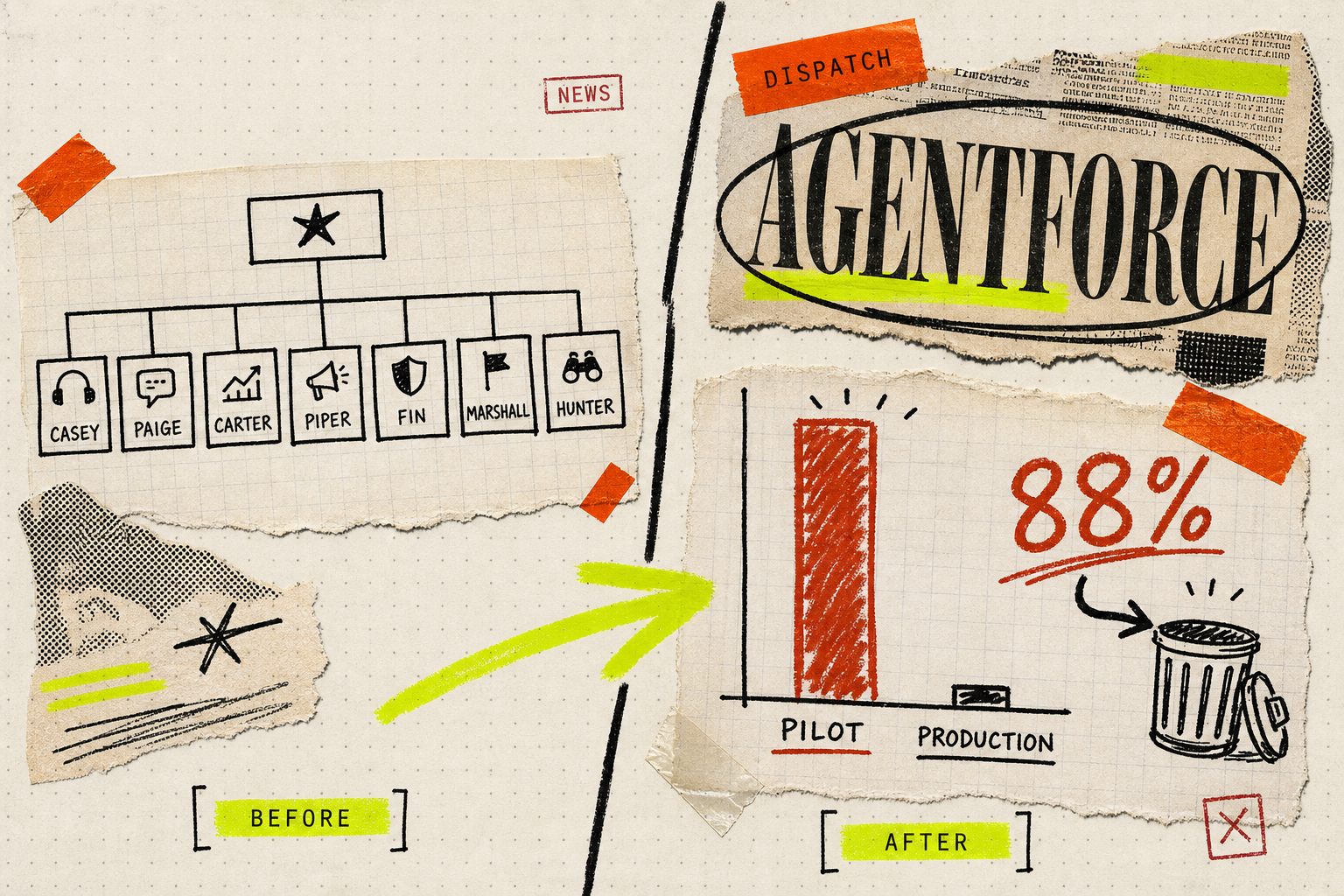
Salesforce Just Named Seven Agents. Enterprise AI Still Loses 88% Of Pilots.
Salesforce shipped 7 named Agentforce agents. But 88% of enterprise AI pilots still fail to reach production. Here's the real gap operators need to fix first.

Small Businesses Using AI Are Hiring More People, Not Fewer
Gusto ran payroll on 2,262 small businesses. AI adopters grew headcount 7% faster — 10% for under-10 firms. The doom takes miss the operator story.
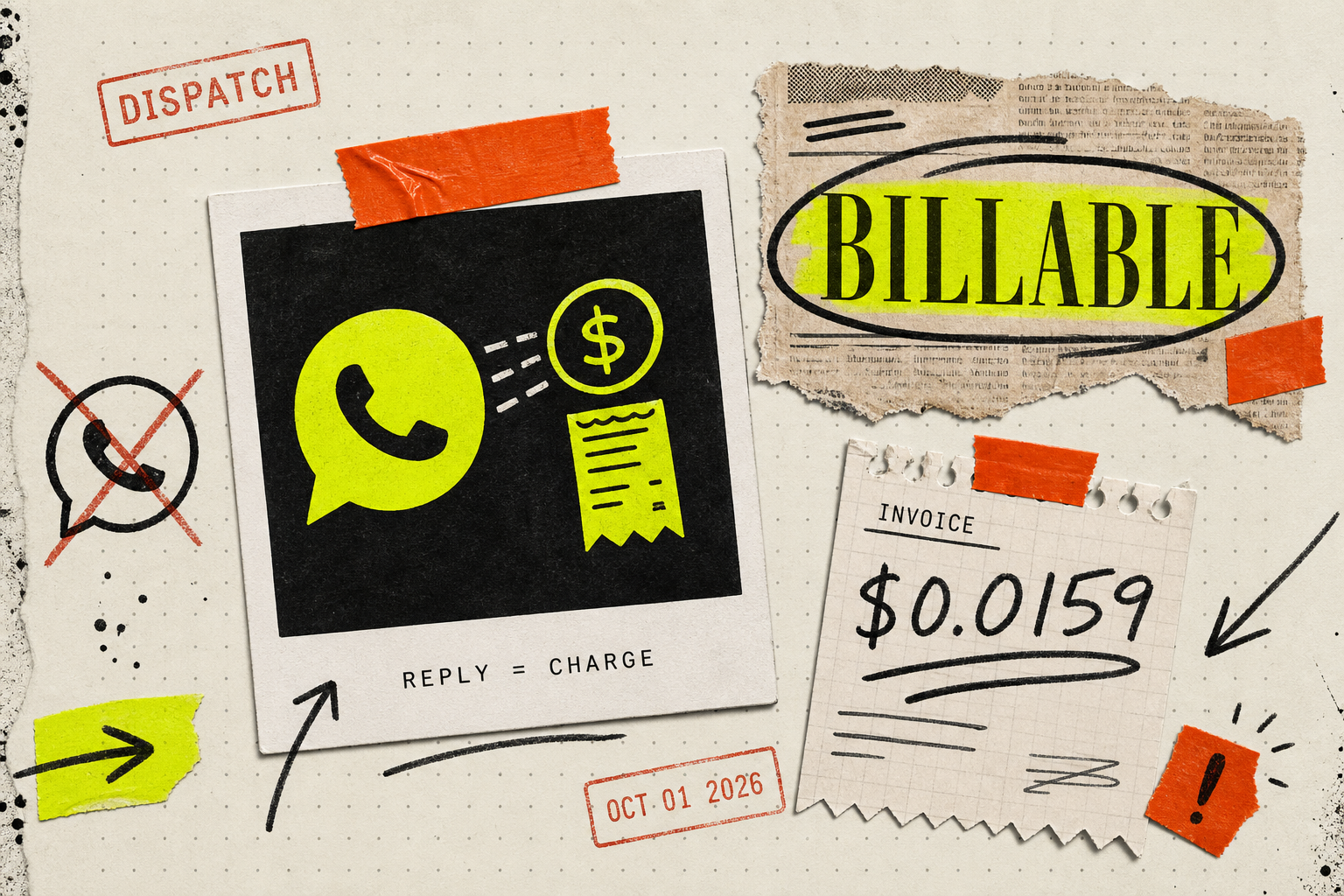
WhatsApp Just Made Every Reply Billable. Your Bot Bill Starts October 1.
On October 1, Meta starts charging for every WhatsApp reply — human, third-party AI, or its own. The sticker price is the boring part. Here's what it actually breaks.