Gartner Says AI Agents Will Outnumber Your Sellers 10 To 1. Most Won't Help.
Gartner says AI agents will outnumber sellers 10 to 1 by 2028 — and under 40% of sellers will say they helped. The real problem isn't the models.
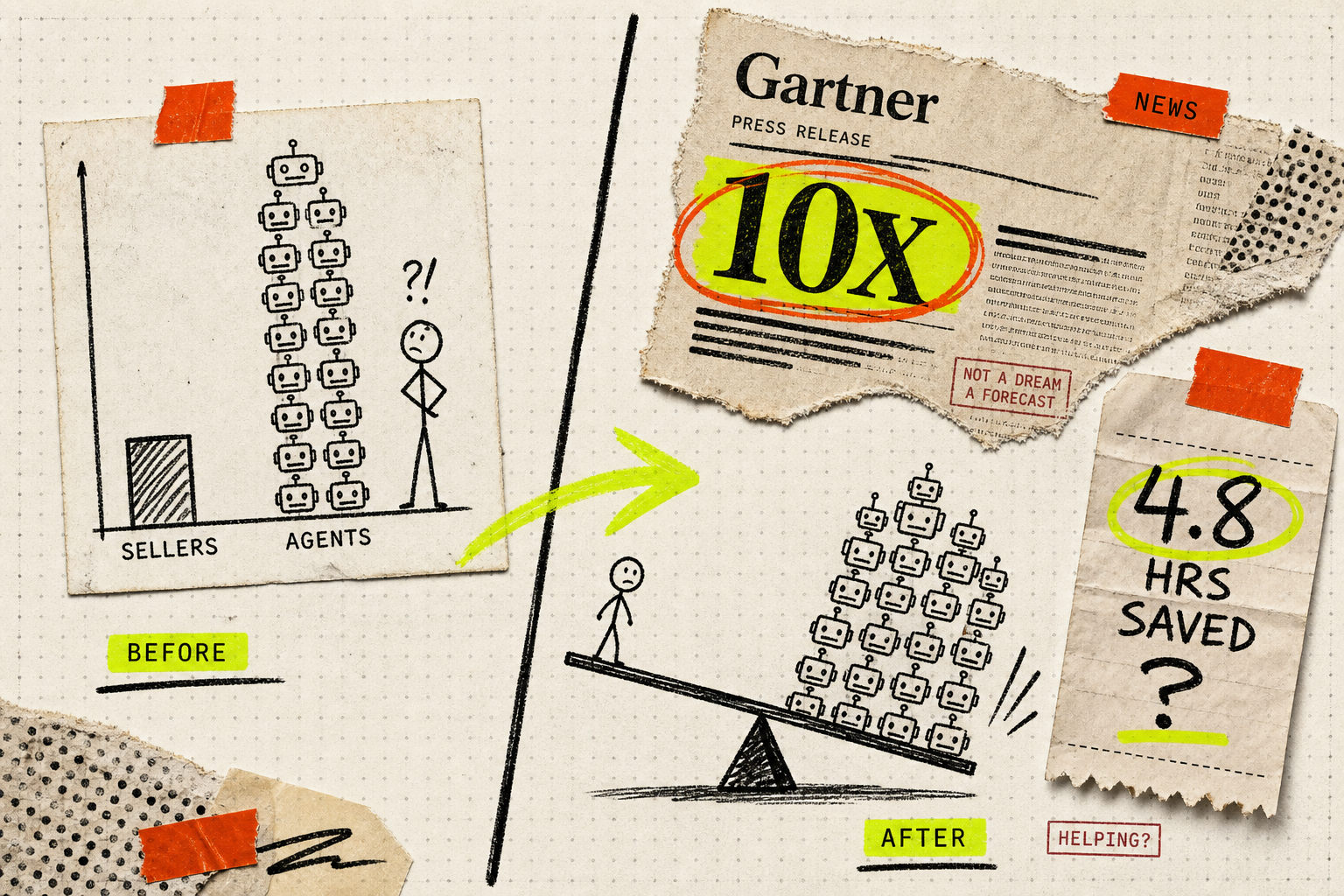
By 2028, AI agents will outnumber human sellers by 10 to 1[1]. And fewer than 40% of those sellers will say the agents actually made them more productive[1]. Both numbers come from the same Gartner press release. Everyone is quoting the first one. Almost no one is quoting the second.
That gap is the story. Not the robot arms race — the fact that the arms race is quietly failing the people it's supposed to help.
I've watched small business owners spend six months stacking AI agents onto their stack the way they stacked SaaS tools in 2020 — one for lead scoring, one for cold email, one for CRM cleanup, one for meeting notes, one for support triage. Six agents, six vendor bills, and somehow the team is still forwarding the same three emails to each other by hand. If you're running a $2M–$20M business and this sounds familiar, the Gartner numbers explain why.
The two numbers everyone is missing
Let's pin the headline data down before the takes get slippery.
Gartner's July 2026 forecast: AI agents will outnumber human sellers by 10x by 2028, but fewer than 40% of sellers will report agents improved their productivity[1]. That's not a fringe prediction. It's the same firm forecasting that 40% of enterprise applications will embed task-specific agents by end of 2026, up from less than 5% in 2025[2].
Two months earlier, Gartner ran the numbers on where the time actually goes. AI tools save sellers 4.8 hours per week. And 72% of sales organizations fail to reinvest that time in high-value activities[3].
Put those together and you get the actual state of AI in sales in 2026: agents save time, most orgs let that time evaporate, and most sellers can't tell you what the agent changed. This is not a tooling problem. It's a systems problem.
Agent sprawl is the new SaaS sprawl — and it's worse
Here's what the enterprise reports call "agent sprawl," translated for a business owner:
- 98% of companies have deployed AI agents or plan to[4]. Less than half have visibility into an inventory of what they've deployed[4].
- 96% of organizations use AI agents in some capacity. Only 12% have a centralized platform to manage them[5].
- Only 13% of orgs believe they have the right AI agent governance in place. By 2028 the average Fortune 500 will run over 150,000 agents[6].
- IBM's own writeup calls out the small-business flavor of this: firms with tight budgets spending thousands per month on redundant AI writing tools alone[6].
This mirrors what happened with SaaS a decade ago — every team bought its own tools, IT lost the map, and by year three the finance team was cutting checks to 47 apps nobody remembered signing up for. Except this time the "app" has API keys, spends real compute, touches customer data, and can send an email on its own initiative. The failure mode is a lot uglier than a forgotten Zoom seat.
Why most takes on this are wrong
The dominant take right now: "the models will get better, the agents will orchestrate themselves, patience." I disagree.
The problem is not model capability. GPT-5 and Claude 4.6 are more than smart enough for the tasks small businesses hand them. The problem is that nobody owns the system-level view. A cold-outreach agent that generates 200 emails a day is worthless if your CRM enrichment agent is filling the same records with garbage the same afternoon. A support-triage agent is worse than nothing if it duplicates tickets your Zendesk automation already handled. When each tool is scoped to its own vendor and its own dashboard, the seams between them are where all the value leaks out.
The second common take: "just consolidate on one platform." Also wrong, for a different reason. The all-in-one AI platforms selling into SMB right now are, mostly, thin GPT wrappers with a shared login. You trade six vendor bills for one, and you trade six mediocre agents for six mediocre agents that happen to share a UI. That is a procurement win, not a productivity win.
What actually works for a $2M–$20M business in 2026
Three things, in this order.
1. Inventory before you add
Every agent, bot, and automation currently touching your business. Vendor, monthly cost, what it does, what data it touches, who owns it. If you can't fit it on a whiteboard, you're already in sprawl territory. Ness Digital's 2026 survey found 99% of companies plan to put agents in production; only 9–14% have actually done so at scale[7]. That gap is 100% governance, not tech.
2. Pick two jobs and build the system around them
For most $2M–$20M shops those two jobs are (a) inbound lead qualification + booked-call handoff and (b) post-sale support triage. Both are measurable. Both cost real payroll dollars today. Pick vendors that plug into your existing CRM and support desk, not vendors that ask you to migrate. Kill the standalone tools that overlap.
3. Design for the reinvested hour
If your AI stack saves your sales rep five hours a week, you need a written answer to "what do those five hours become?" before you spend a dollar on the stack. Gartner's 72% failure rate on this[3] is the entire ballgame. AI that gives you time you don't spend well is a cost, not a savings.
The blunt version
By 2028 you will be surrounded by AI agents whether you deployed them or not — your CRM will ship them, your ad platform will ship them, your accounting software will ship them. The question is whether they add up to a system or a mess.
The businesses that will win the next 18 months aren't the ones that adopt the most agents. They're the ones with the cleanest map of what's already running, the smallest number of agents doing the most consequential jobs, and a real plan for what the reinvested time becomes.
Most operators are on the wrong side of that. That's the actual news buried under the 10-to-1 headline.
If you want a straight read on which agents in your current stack are actually earning their bill — and which two jobs you should be handing to systems built for your business, not shrink-wrapped SaaS — that's what the 30-minute audit call is for. No pitch, just the map.
-
The Future of AI Sales: Best Practices to Adopt (citing Gartner's 10-to-1 forecast)↩
Cites Gartner: by 2028 AI agents outnumber human sellers 10 to 1; <40% of sellers report agent productivity gain.
-
Agent Sprawl Is the New Shadow IT And You Probably Can't Count Yours↩
Gartner forecast: 40% of enterprise apps embed task-specific agents by end of 2026, up from <5% in 2025.
-
Gartner: As AI Saves Time, Sales Organizations Fail to Reinvest Time in High-Value Activities↩
Gartner: AI saves sellers 4.8 hrs/week; 72% of sales orgs fail to reinvest the time.
-
AI Agent Sprawl: Why AI Governance Is Now a Board-Level Issue↩
98% of companies deployed or plan to deploy AI agents; less than half have inventory visibility.
-
AI Agent Sprawl 2026: Why 94% of Enterprises Lose Control↩
96% of orgs use AI agents; only 12% have a centralized management platform (OutSystems 2026 survey).
-
What is AI Agent Sprawl?↩
Only 13% of orgs believe they have the right AI agent governance; F500 avg 150K+ agents by 2028; SMB overspending on redundant AI tools.
-
Agent Sprawl Is a Board Issue: Enterprises Cannot Count Their Agents↩
Ness Digital Aug 2026: ~99% of companies plan agent production; only 9–14% have done so at scale.
Ready to build your own AI system?
Book a Free Audit Call →Keep Reading
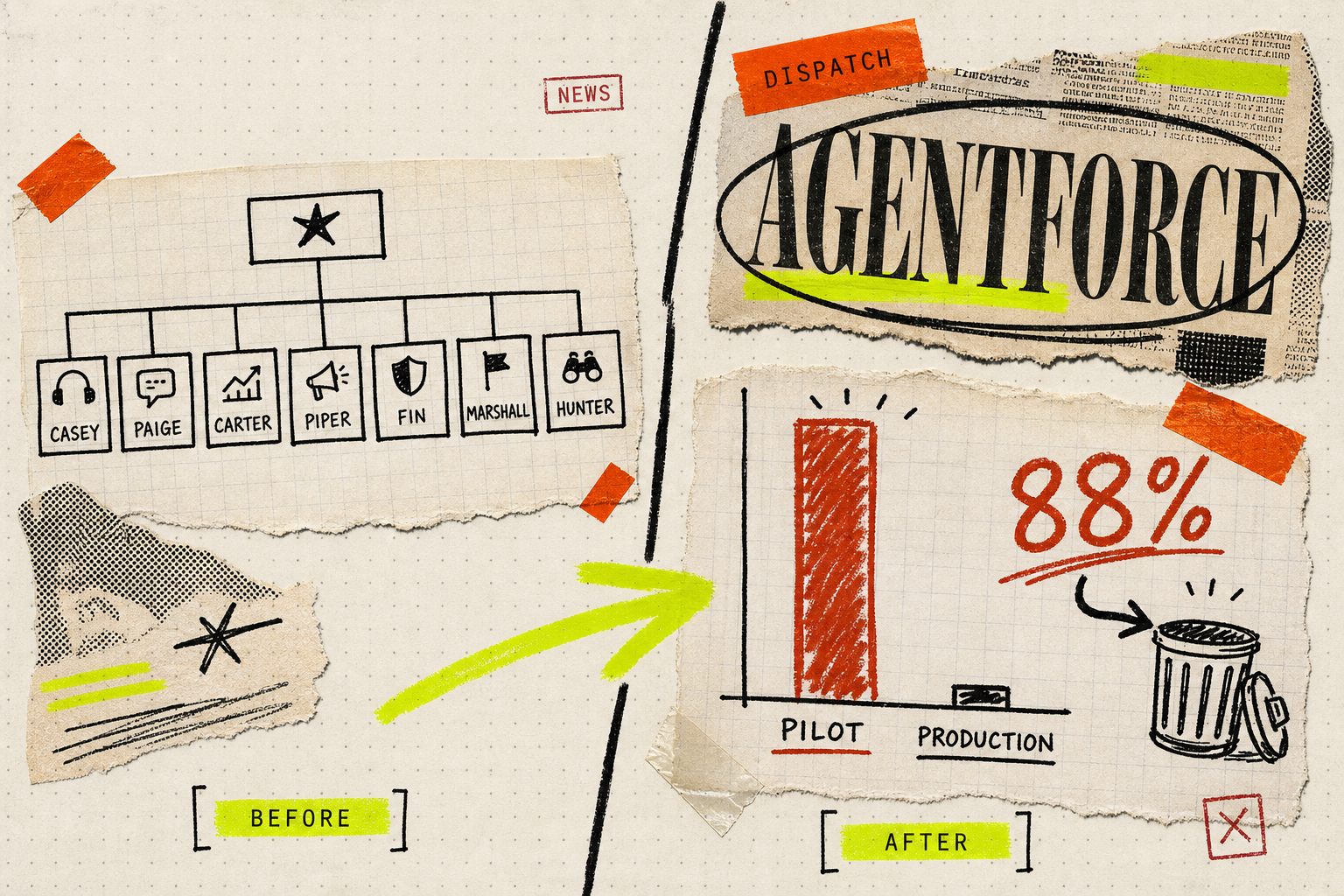
Salesforce Just Named Seven Agents. Enterprise AI Still Loses 88% Of Pilots.
Salesforce shipped 7 named Agentforce agents. But 88% of enterprise AI pilots still fail to reach production. Here's the real gap operators need to fix first.

Small Businesses Using AI Are Hiring More People, Not Fewer
Gusto ran payroll on 2,262 small businesses. AI adopters grew headcount 7% faster — 10% for under-10 firms. The doom takes miss the operator story.
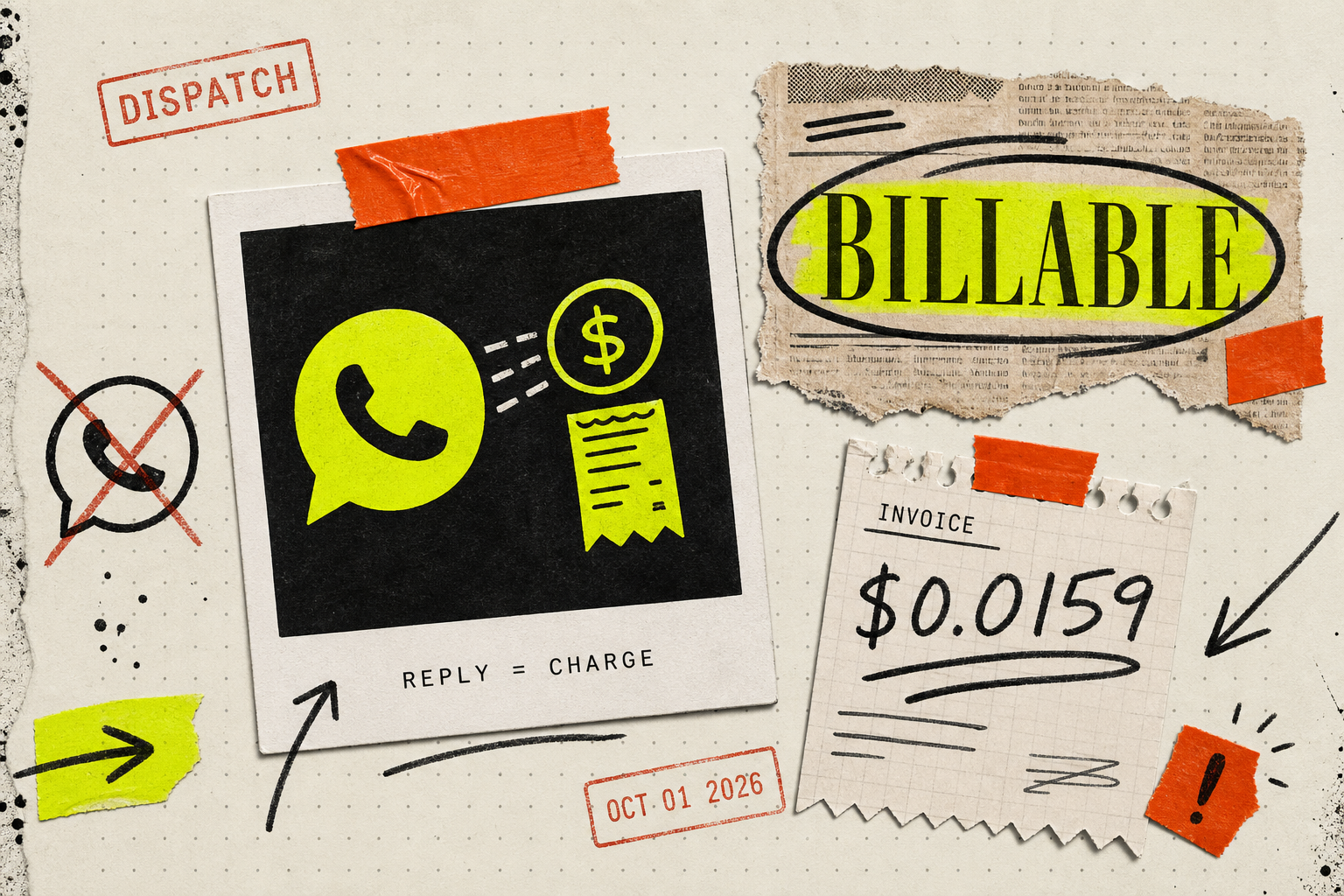
WhatsApp Just Made Every Reply Billable. Your Bot Bill Starts October 1.
On October 1, Meta starts charging for every WhatsApp reply — human, third-party AI, or its own. The sticker price is the boring part. Here's what it actually breaks.