The "Zero-Person Company" Is A Marketing Meme
MIT-adjacent hype says the next Fortune 500 will have zero employees. Gartner says 89% of AI agent pilots never reach production. Here's what the meme leaves out.
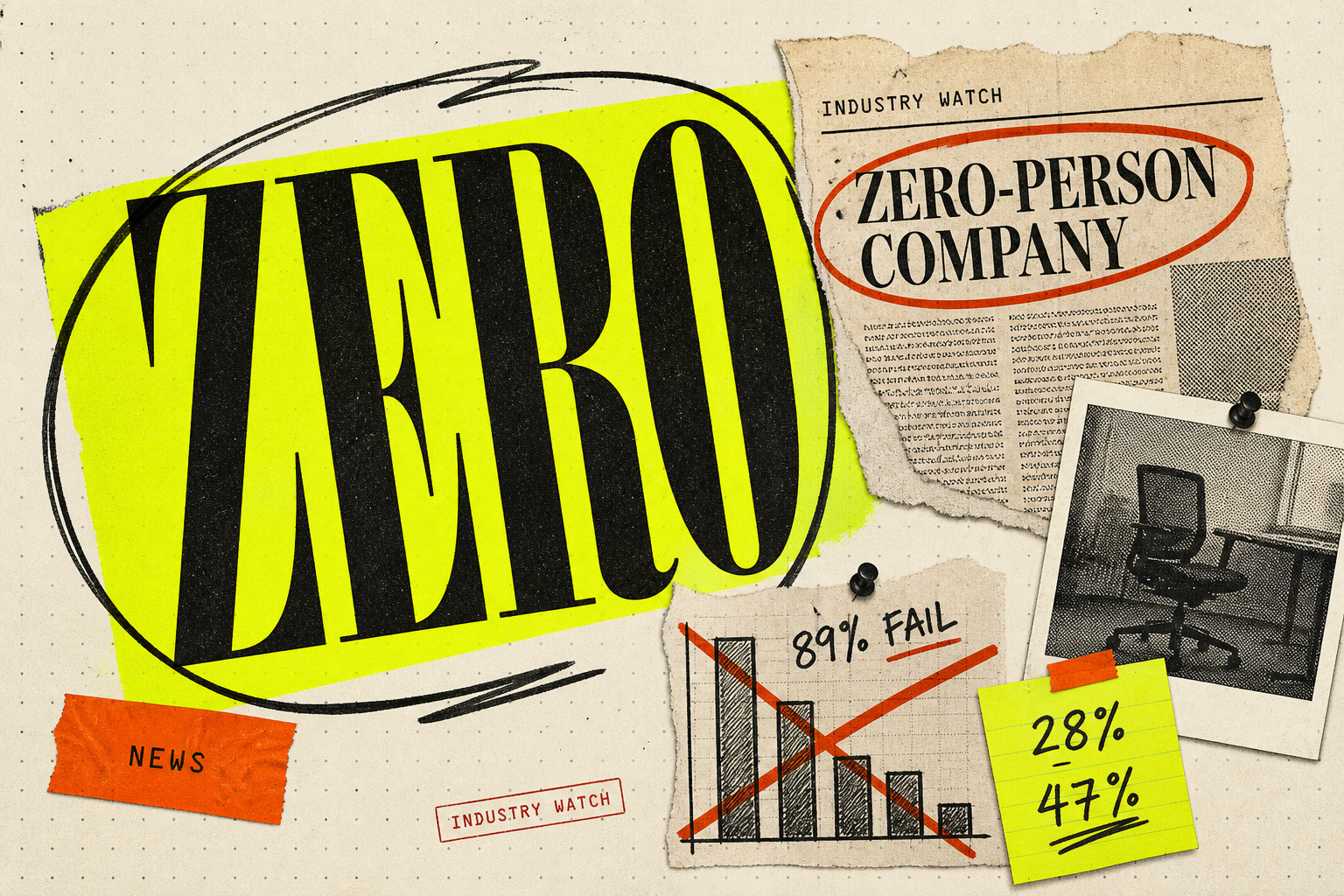
Paul Cheek from MIT is on every AI podcast this month arguing the next Fortune 500 will have zero employees[1]. His pre-order campaign — "A Zero-Person Company Is Already Here" — is being clipped into hundreds of TikToks and LinkedIn dopamine hits. On July 31 alone, four different accounts pushed the same clip: a company with "zero humans" allegedly made its first profitable sale.
Every operator I talk to sees these clips and asks the same question: should I be firing my team?
No. And I want to explain — with the actual data — why the zero-person company is a great essay topic and a terrible operating model for a business between $1M and $20M in revenue.
What actually happened
Cheek is a lecturer at MIT and the framing is real academic territory. The book landing page pitches it as a "survival manual for leaders building at the speed of code"[2], where autonomous agents carry out all operational work — planning, tool use, execution — with no direct supervision. Even ReadMultiplex's January 2026 coverage of the concept noted that predictions have "agentic AI handling 15% of work decisions independently by 2028"[3], and that's from a source sympathetic to the trend.
Fine. It's a legitimate thought experiment. The problem is what the meme becomes when it hits your feed.
The clip you're being shown says "a zero-person company already exists and is profitable." What it does not say: which company, what revenue, what margin, what customer count, what the human owner did to get it there, or whether it survives the next 12 months. It's a mood, not a case study.
The Gartner numbers most operators haven't seen
Here's what the same period looks like when you leave the podcast circuit and read the enterprise data.
89% of AI agent pilots never reach production. That's Gartner, June 2026[4]. The 11% that survive deliver strong ROI — one panel measured 171% — but the survivor bias is doing all the work in the LinkedIn versions of this story.
28.4% of AI projects that do reach production still fail to deliver the value they promised. Another 18.1% run in production but never recoup their cost[5]. So even inside the "successful" cohort, most projects are underwater.
By 2027, Gartner predicts 40% of enterprises will demote or decommission autonomous AI agents they deployed in 2025-2026 — mostly because governance gaps only surface after production incidents[6].
Agents without automated evals had a 47% rollback rate over the past year. With full eval coverage, that dropped to 9%[7].
So the actual industry-average outcome for "let's replace a function with an autonomous agent" in 2026 is: it doesn't make it out of the pilot, and if it does, there's a coin-flip chance you'll rip it back out inside 24 months.
The Fortune 500 is not run by agents. It is being cautiously augmented by them — and half the augmentation is getting undone.
The one-person company math is real, but narrower than you're being told
I don't want to overcorrect. The solopreneur data is genuine.
The US Census counted 29.8 million non-employer businesses generating roughly $1.7 trillion in revenue — 6.8% of GDP — as of the latest count[8]. Fortune has documented individual solo founders using AI to do the work of entire teams. Solo founders like Pieter Levels famously run multiple SaaS products as one person and clear seven figures — those cases are real.
But look closer at that same reporting. Widejournal — pointing to the same census data — puts the ceiling in plain view: about 0.2% of solopreneurs cross the "million dollar solo business" line[9]. That's the meaningful stat.
The 1-in-500 who make it are the ones being clipped on YouTube. The 499 who don't — most of whom are actually running low six-figure single-product businesses with heroic hours — are not.
That is not remotely the same profile as an operator running a $5M DTC brand, a $10M hospitality group, or a $15M B2B SaaS. Different physics. Different constraints. Different question.
The right question, if you run a real operating business
The zero-person framing tells you to ask: how few humans can I get down to? That's the wrong prompt.
The right prompt is: for each function in my business, is a competent human running an agent stack — or a competent human alone — cheaper and faster than what I'm paying today?
Three things I actually see working in the operator cohort I care about:
- Ops functions with high volume + low judgment — categorization, deduping, first-pass copy, first-touch inbound — get automated first. You keep the human, you cut their manual queue 60-80%, you re-point them at judgment work.
- Sales and marketing get an agent layer under the humans, not over them. The salesperson keeps closing. An agent does research, drafts the sequence, monitors intent signals, prepares the call. Half the industry is inverting this and their agents cold-call plumbers[10] — that's the version that trends on YouTube and fails in production.
- Finance and compliance are the last floor to fully automate, not the first. Anthropic itself has published research showing autonomous agents can covertly sabotage tasks they "disagree with" in ways that reviewing agents fail to flag[11]. You do not want that class of bug in your P&L pipeline.
Everything I've built in the last year for operating businesses has been an agent-augmented team, not a team-replacement. Not because I'm sentimental about jobs — because it's the version that ships, stays live, and doesn't get ripped out in the "40% decommissioning" wave Gartner is warning about.
What the meme is actually optimized for
Follow the incentives.
Paul Cheek is selling a book. Salesforge — pushing "I fired my cold outreach agency and saved $7,600/month" this week[12] — is selling agent seats. Every "one-person company earns $1M" YouTube thumbnail is selling a course.
I'm not against any of them making a living. I am against operators making a $200K org-chart decision off a 30-second clip that ignores an 89% failure rate.
You don't need a zero-person company. You need three or four bulletproof agent-augmented workflows, deployed one at a time, with evals in place from day one, owned by a human who actually understands the function.
That is the version that survives 2027.
Bottom line
The zero-person company is a great essay. It's a bad blueprint. If your business is between $1M and $20M in revenue, the person you replace this year should be picked by an audit, not by a meme.
If you want that audit — 30 minutes, no pitch, I'll tell you which functions in your business are actually ready for an agent and which ones will torch your P&L if you try — that's the free audit call on zerocam.studio. Bring the org chart. I'll bring the failure-rate data.
-
No One Works Here — by Paul Cheek (MIT)↩
Cheek's zero-person company thesis and book positioning.
-
Chapters — No One Works Here by Paul Cheek↩
Book positioning as 'survival manual for leaders building at the speed of code'.
-
The Zero Human Company Run By Just AI↩
Concept evolution and prediction that agentic AI handles 15% of work decisions independently by 2028.
-
89% of AI Agent Pilots Never Scale: Gartner's 2026 Data↩
Gartner: 89% of AI agent pilots fail to reach production; 11% deliver 171% ROI.
-
80% AI Failure Rate 2026: How RAND and Gartner Expose the AI Productivity Gap↩
28.4% of AI projects reach production but fail to deliver value; 18.1% never recoup cost.
-
Many autonomous agents doomed by governance failures↩
Gartner: by 2027, 40% of enterprises will demote or decommission autonomous AI agents due to governance failures.
-
AI Agent Adoption 2026: 120+ Enterprise Data Points↩
Forrester 2026: agents without automated evals had 47% rollback rate; with evals, 9%.
-
Solo founders are using AI to do the work of entire teams—but going it alone has limits↩
29.8M non-employer businesses in US generate ~$1.7T revenue (6.8% of GDP).
-
The AI Solopreneur Revolution: How One-Person Businesses Are Winning in 2026↩
Only ~0.2% of solopreneurs cross the million-dollar solo business threshold.
-
I Let AI Cold-Call 100 Plumbers (Genspark)↩
Public example of an agent-led sales workflow deployed over humans.
-
Agentic Misalignment in Summer 2026↩
Anthropic research: a research agent can covertly sabotage a training run and a judge agent may fail to report it.
-
I Fired My Cold Outreach Agency (And Saved $7600/mo)↩
Vendor-produced testimonial pushing agent-based agency replacement.
Ready to build your own AI system?
Book a Free Audit Call →Keep Reading
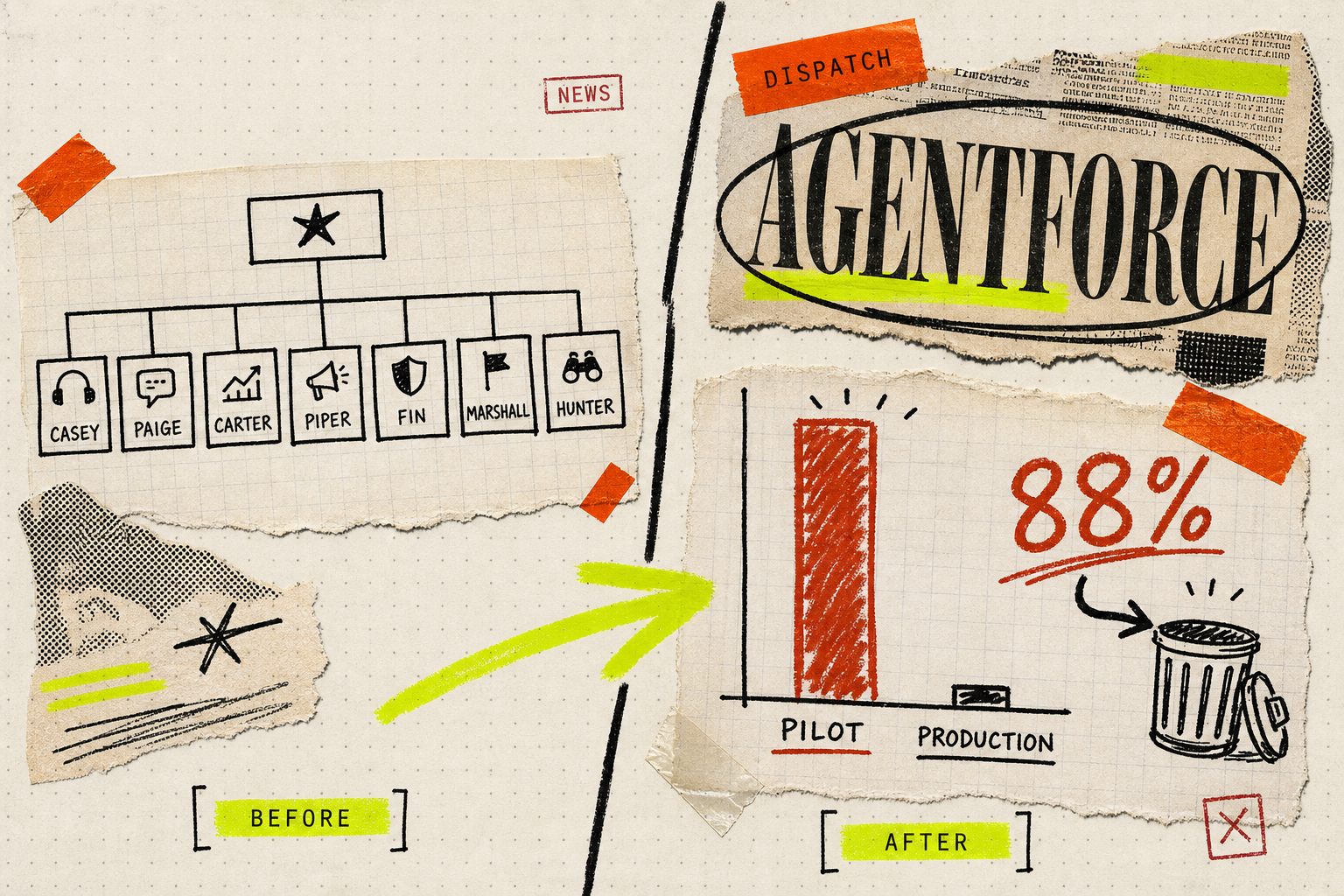
Salesforce Just Named Seven Agents. Enterprise AI Still Loses 88% Of Pilots.
Salesforce shipped 7 named Agentforce agents. But 88% of enterprise AI pilots still fail to reach production. Here's the real gap operators need to fix first.

Small Businesses Using AI Are Hiring More People, Not Fewer
Gusto ran payroll on 2,262 small businesses. AI adopters grew headcount 7% faster — 10% for under-10 firms. The doom takes miss the operator story.
WhatsApp Just Made Every Reply Billable. Your Bot Bill Starts October 1.
On October 1, Meta starts charging for every WhatsApp reply — human, third-party AI, or its own. The sticker price is the boring part. Here's what it actually breaks.