The Agentic AI Divide Is Real. And You're On The Wrong Side Of It.
PwC says 20% of companies capture 74% of AI's economic value. If you run a $2M-$20M business and you're still 'testing' agents, you're the 80%.
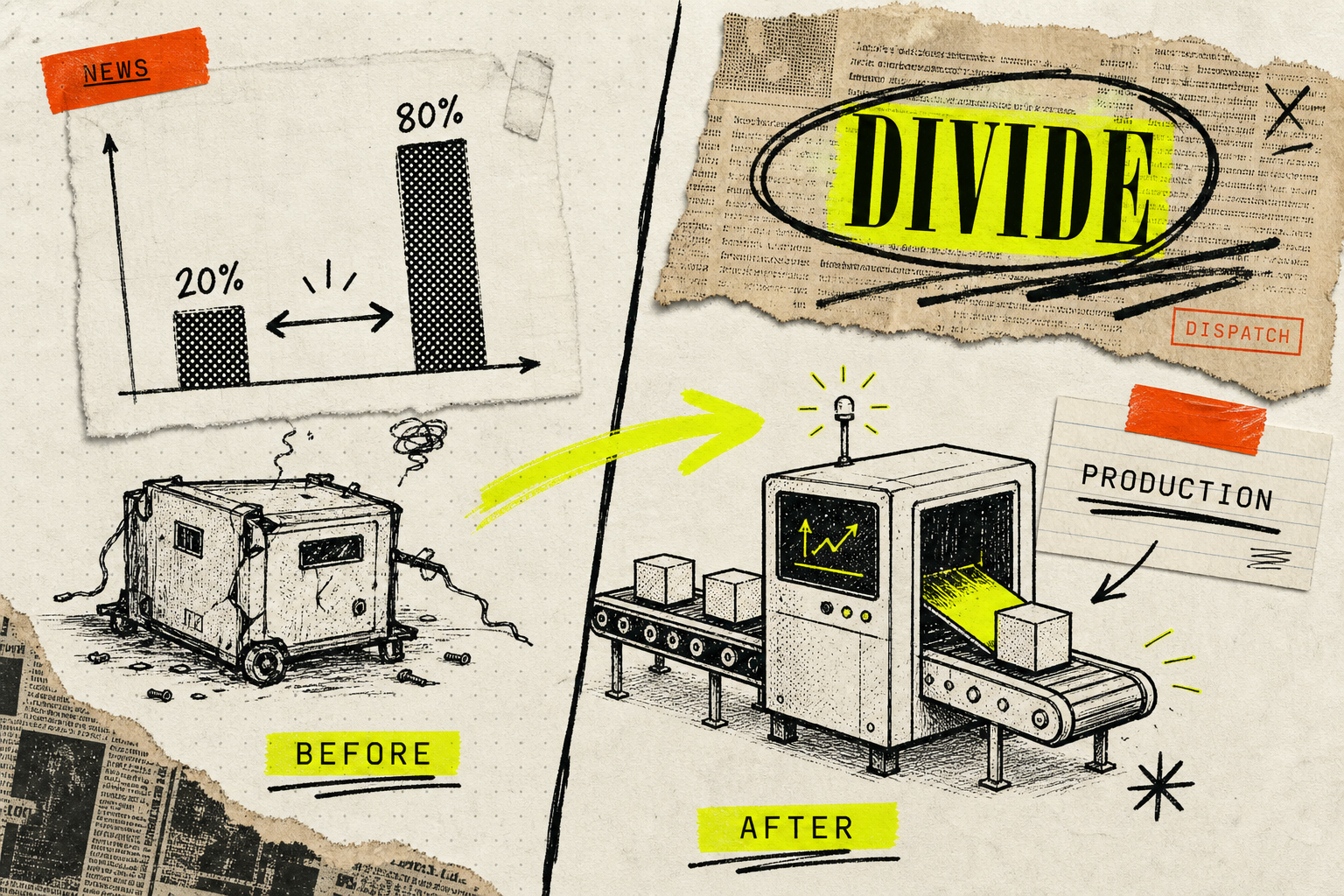
PwC's 2026 study says 20% of companies are capturing 74% of AI's economic value.[1] MIT Sloan spent last month calling it "the agentic AI divide nobody's talking about."[2] The talking heads read this as an enterprise story — big banks, Fortune 500, the usual. It isn't. It's a story about you.
If you run a $2M–$20M business and you've been "playing with ChatGPT," "trying Claude Skills," or "testing an n8n workflow" for six months, you are the 80% falling behind. Not the 20% pulling away. The divide isn't between big and small. It's between operators who ship agents and operators who talk about them.
The numbers, cold
Read them once and hold them.
- McKinsey's 2026 State of AI: 88% of organizations use AI in at least one function. Only 23% have scaled a single agentic system anywhere in the business. Actual scaled use inside any one function stays under 10%.[3]
- Forbes summary of the same data: 10% of enterprise functions use AI agents. Ten. Percent.[4]
- PwC: 74% of AI's measured economic value in 2026 flowed to just 20% of organizations. The gap is widening, not closing.[1]
- 86% of enterprise AI agent pilots never reach production.[5] MIT's GenAI Divide report puts the ROI failure rate at 95%.[6]
- First Page Sage: enterprise adoption of agentic AI sits at 25%. Mid-market and SMB adoption is "reporting rapid growth" from a base near zero.[7]
Put those together and the shape of the divide gets ugly. A minority of companies — mostly enterprise, mostly tech-forward — are running agents in production and pocketing three-quarters of the returns. Everyone else has a pilot deck and a "we're exploring AI" slide.
Why most takes on this are wrong
Every consultant hot take on the divide says the same three things: "invest in AI literacy," "build a governance framework," "align agentic AI to strategic outcomes." That's what a PwC deck says because PwC sells AI transformation consulting.
Here's what's actually causing the divide, based on the same data the consultants are quoting.
Reason 1: Enterprises have engineering budgets. You don't. Gartner projects that more than 40% of agentic AI projects will get canceled by 2027 — the reasons cited include escalating costs, unclear business value, and inadequate risk controls.[8] Enterprises have compliance, legal, and infra teams to build guardrails. A $5M business doesn't. So a $5M business tries to run agents without guardrails, one hallucinates a customer refund, and now the founder swears off agents for a year.
Reason 2: Pilots are cheap. Production is brutal. The pilot connects two clean data sources. Production connects ten enterprise systems with different schemas, auth models, and rate limits.[9] A 3% failure rate in pilot means 6 broken cases. At scale it means 300 broken cases a week. Enterprises absorb this. A 30-person company can't.
Reason 3: The 20% winners aren't smarter — they're more disciplined. They picked one process, wired one agent, measured it, and let it run for six months before touching another. Everyone else is jumping between Claude Skills, n8n templates, and whatever showed up in their YouTube feed this week.
The consultants won't tell you this because "pick one thing and ship it" doesn't sell a $400K engagement. But it's what separates the operators making agents work from the ones making agent decks.
What the divide actually costs a $5M business
Let's price this. Assume you run a $5M business at 15% net margin — $750K a year. Two peers of yours in the same industry are on opposite sides of the divide.
Peer A (the 20%): Has one agent in production. It handles inbound support triage or lead qualification or invoice reconciliation. Saves maybe $60K in labor, adds maybe $80K in revenue by not letting leads rot in an inbox. Net: ~$140K/year, and the compounding starts.
Peer B (the 80% — probably you): Has a Claude account, an n8n instance nobody logs into, and three half-built automations. Net: some vibes and a subscription bill.
Two years of that compounding and Peer A has a $300K/year advantage on the same top line. That's not "AI transformation." That's one operator picking one problem and finishing.
What to actually do this quarter
If you're on the wrong side of the divide today, you don't need a strategy deck. You need one shipped agent. Here's the shape of it — same shape the 20% actually use.
- Pick one process that costs you at least $50K a year in salary or lost revenue. Support triage, lead qualification, invoice categorization, quote generation, review response. Not "AI content strategy." Something you can measure in dollars this month.
- Write down the current human workflow in bullets. If you can't, the agent will fail — you don't understand your own process well enough to hand it off.
- Wire the minimum viable agent — n8n, Claude API, one integration. Not a swarm of agents. Not multi-model orchestration. One agent, one job, in production.
- Instrument it. Log every call, every decision, every error. If you can't see what it did yesterday, it doesn't count as production.
- Run it for 30 days before touching anything else. Not building the next thing. Not adding a second agent. Making this one boring and reliable.
That's it. That's the entire delta between the 20% and the 80% in this data. Discipline, not intelligence.
The uncomfortable part
The gap is compounding monthly. Enterprises are adding agents faster than SMBs are catching up. PwC's leaders are focused on growth-through-AI while the laggards are still asking whether ChatGPT will replace their marketing coordinator.[1] IBM says 75% of enterprises will let agentic AI significantly redefine their service delivery by the end of this year.[10]
Whichever side of the divide your business sits on in eighteen months will be decided by what you do in the next ninety days. Not by which model you pick. Not by which framework you use. By whether you shipped one boring agent that actually works.
If you want help closing the gap
This is the whole reason ZEROCAM exists — I build one working agent for one operator at a time, in the specific stack their business already runs on. No transformation deck, no AI literacy training, no seventeen-agent org chart. One agent, one job, live in production before the invoice clears.
If your business is between $1M and $20M and you're tired of being on the wrong side of a widening gap, book a free audit call. Thirty minutes. I'll tell you exactly which process to agent-ify first, roughly what it'd cost to build, and what you'd save in year one. If the numbers don't work, I'll tell you that too.
You don't need a strategy. You need one shipped agent. Let's pick which one.
-
PwC 2026 AI Performance Study: Three-quarters of AI's economic gains captured by 20% of companies↩
20% of companies capture 74% of AI's measured economic value in 2026
-
Agentic AI: What Leaders Wish They Knew Sooner↩
MIT Sloan frames the current adoption gap as 'the agentic AI divide'
-
McKinsey's State Of AI: The Scaling Gap Is Now CX's Problem↩
McKinsey State of AI 2026: 88% adoption across functions but only ~23% scaling agentic AI; scaled use inside any function stays under 10%
-
Roughly 10% Of Enterprise Functions Use AI Agents, McKinsey Finds↩
Forbes summary of McKinsey data: ~10% of enterprise functions use AI agents
-
Why 86% of Enterprise AI Agent Pilots Never Reach Production↩
86% of enterprise AI agent pilots never reach production (McKinsey/Gartner/AI Governance Institute)
-
Why 88% of Agentic AI Pilots Never Reach Production↩
Cites MIT GenAI Divide report showing 95% of generative AI pilots fail to deliver expected ROI
-
Agentic AI Adoption Statistics for 2026↩
Enterprise agentic AI adoption at 25%; mid-market and SMB adoption growing from a near-zero base
-
AI Agent Adoption Statistics 2026 (Gartner + McKinsey + PwC compilation)↩
Gartner: more than 40% of agentic AI projects will be canceled by 2027 due to escalating costs, unclear value, and inadequate risk controls
-
Scaling AI Agents: Pilot to Enterprise in 2026↩
A 3% failure rate in pilot becomes hundreds of failures per week at production scale
-
Agentic AI statistics 2026: Market size, adoption, and growth data↩
IBM: 75% of enterprises will let agentic AI significantly redefine their global service delivery by end of 2026
Ready to build your own AI system?
Book a Free Audit Call →Keep Reading
Salesforce Just Named Seven Agents. Enterprise AI Still Loses 88% Of Pilots.
Salesforce shipped 7 named Agentforce agents. But 88% of enterprise AI pilots still fail to reach production. Here's the real gap operators need to fix first.

Small Businesses Using AI Are Hiring More People, Not Fewer
Gusto ran payroll on 2,262 small businesses. AI adopters grew headcount 7% faster — 10% for under-10 firms. The doom takes miss the operator story.
WhatsApp Just Made Every Reply Billable. Your Bot Bill Starts October 1.
On October 1, Meta starts charging for every WhatsApp reply — human, third-party AI, or its own. The sticker price is the boring part. Here's what it actually breaks.