OpenAI Just Made Half The AI Marketing Agencies Redundant
OpenAI just shipped free training and native Shopify, Intuit, and Slack connectors for small businesses. Here's what actually breaks about the AI-agency middle tier.
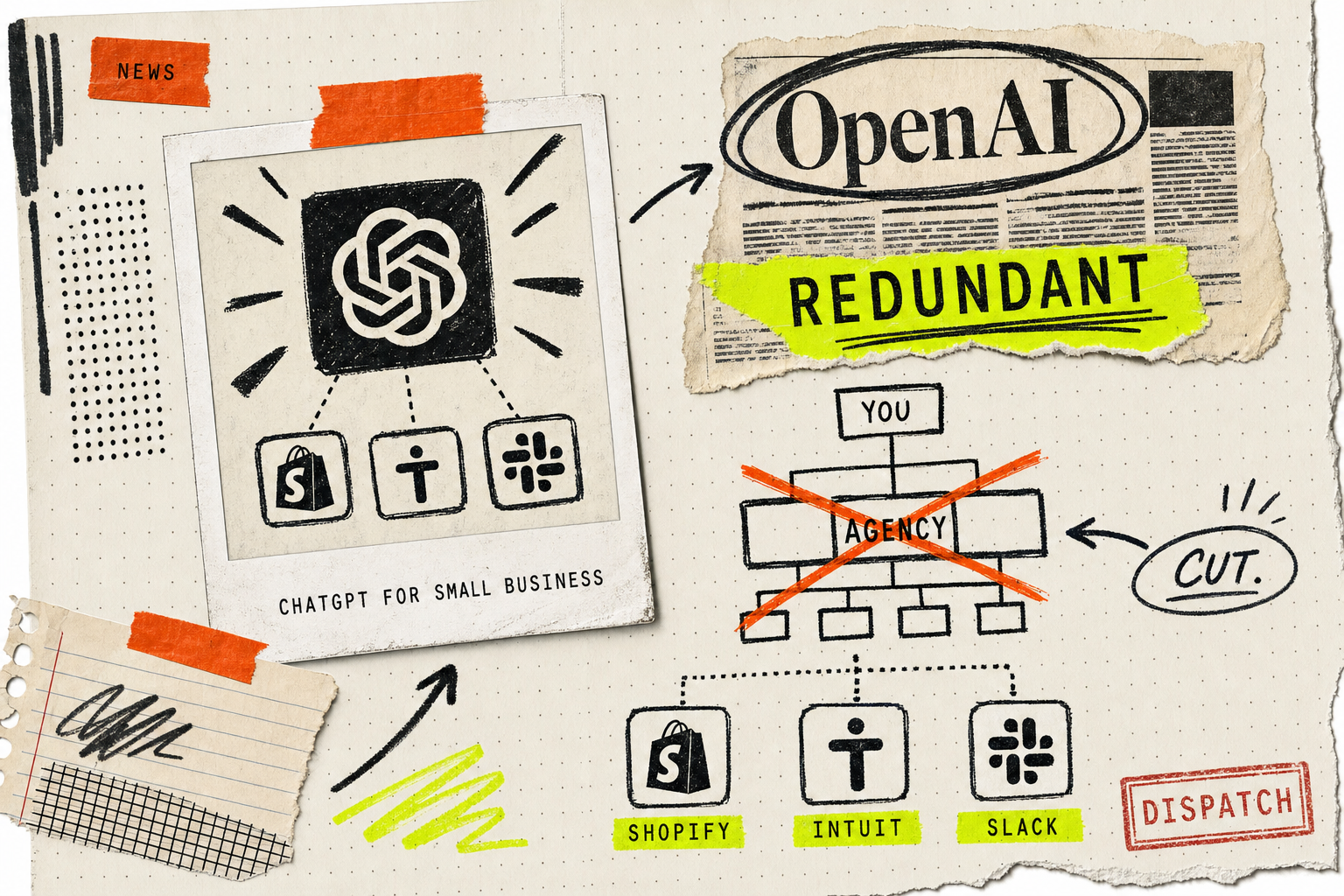
OpenAI shipped the "ChatGPT for Small Business" program on July 21st[1]. Free training, an in-person academy tour, and — the part nobody's talking about — direct native integrations with Shopify, Intuit, Slack, Dropbox, Atlassian, and Wix[2]. In one press release, they cut about six months of work out of every "AI marketing agency" pitch deck in the country. I don't think most of that industry has noticed yet.
Here's what actually changed, and what it means if you run a $1M–$20M business and someone is trying to sell you an "AI transformation."
The number nobody is engaging with
Codex plus ChatGPT Work hit 10 million weekly users on the day of the announcement[3]. That's roughly double the count from two weeks earlier, when ChatGPT Work debuted on July 9[4]. Sam Altman said combined usage rose 2.5x in a single week[5].
Two things about that number matter more than the number itself.
First: it's weekly active, not "signed up and never returned." OpenAI would love to inflate this, and 10M weekly is still what they reported. That means the base of business users who now have a general-purpose agent inside their workflow is bigger than the entire installed base of most vertical AI SaaS tools combined.
Second: it doubled in two weeks. Whatever ChatGPT Work is doing for the median user, it's sticky enough that word-of-mouth is compounding faster than any B2B software launch I've watched in the last five years. That includes Slack.
Why the partner list is the story
The launch coverage focused on the training and the academies. That's marketing. The real move is the partner integrations.
Look at who signed up: Intuit, Shopify, Dropbox, Slack, Wix, Atlassian[2]. Now look at what a $2M–$10M business actually runs on. Shopify or a similar cart. QuickBooks (Intuit) for books. Slack for team comms. Dropbox for files. Wix or Squarespace for the site. You just described 80% of the software stack of every operator I've ever done a call with.
Intuit isn't a casual partner here either — they signed a $100M+ multiyear deal in late 2025 to embed ChatGPT directly into TurboTax and QuickBooks[6]. Shopify has been quietly building "commerce in ChatGPT" since September 2025, letting merchants sell inside a ChatGPT conversation with no redirect[7].
That's not a demo. That's a distribution channel most operators haven't priced in yet.
The "AI adoption" numbers are lying to you (both ways)
The U.S. Chamber of Commerce says 89% of small businesses now use AI in some form, up from 36% in 2023[8]. The U.S. Census Bureau's Business Trends survey puts it at 8.8%[9]. Both are real numbers. They're measuring different things.
- The Chamber counts "any employee ever uses ChatGPT to write an email."
- Census counts "the business itself uses AI to produce goods or services."
Goldman Sachs' 10,000 Small Businesses panel found the honest middle: 76% of small businesses "report using AI" — but only 14% say AI is fully embedded in their core operations[10].
That 14% is the number that matters. Because the OpenAI program is a bet on moving the other 62% from "we tried ChatGPT once" to "we run ops on it." Free training and native Shopify/QuickBooks connectors are exactly the friction points that were keeping them stuck.
If OpenAI moves that 14% number to 30% in 12 months, half the "AI implementation" agencies pitching a $6K/month retainer to install Zapier and rename it are done.
What most takes get wrong
The takes I've seen from the AI-marketing-agency world break into two camps, both wrong.
Camp 1: "Big opportunity — we can help small businesses navigate this."
No, you can't. Not the way you're pitching it. If OpenAI is running free in-person academies and shipping native Shopify/Intuit integrations, the marginal value of a generalist agency "helping you set up ChatGPT" is close to zero. You are now competing with a free program run by the company that makes the product.
Camp 2: "This is just marketing — real AI work still needs experts."
Partially true. Custom agents, evals, integrations against non-standard stacks — that work is real. But it's not what most "AI marketing agencies" sell. Most of them sell prompt libraries, ChatGPT training decks, and a Notion template. That specific product just got commoditized by OpenAI itself.
The real opportunity — and the actual danger — is one level up.
What actually changes for an operator
Three things, in order:
1. Your baseline just moved. If you're running a Shopify + QuickBooks + Slack stack (and most operators are), you're about to get native ChatGPT connectors dropped into all three. Your job is not to build those connectors. It's to make sure your data is clean enough that they work when they arrive. A messy Shopify product catalog and a QuickBooks with 40% of transactions in "Uncategorized" makes the ChatGPT integration useless. Fix the data. Now.
2. The vendors between you and OpenAI are going to consolidate — fast. Anyone selling "AI-powered X" where X is a wrapper on top of the OpenAI API is on borrowed time when OpenAI ships X natively. HubSpot's stock is already down about 70% from its 2024 peak as it repriced to survive an AI-native world[11]. This is not going to stop with HubSpot. If you're paying $500/mo for an "AI email tool," that's the exact category OpenAI is about to disintermediate.
3. Your competitive advantage is now systems, not tools. Everyone gets the same tools. The moat is: (a) whether your data is in good enough shape to actually feed those tools, and (b) whether you have a workflow disciplined enough for an agent to run repeatably. Those two things are boring. They're also the whole game now.
What I'd do if I ran a $5M business this week
- Audit the software stack. Circle every tool where the primary value is "it's got AI in it." Those are candidates to cut in the next 6 months.
- Clean the two most important datasets — usually product catalog and customer records. Everything downstream depends on them.
- Sign one person up for the free ChatGPT for Small Business program[1] and give them 4 hours a week to actually work through it. Not because the program is amazing — because it's free and it gets you a baseline.
- Stop paying anyone $6K/month to "implement AI." Pay someone once — a builder, not an agency — to build one real, running system tied to a real business outcome.
The next 12 months are going to be brutal for AI middlemen and quietly great for operators who own their data and their systems. OpenAI just made that gap wider.
If you want to figure out which category you're in and what your version of "build one real system" looks like, that's what the audit call is for. 30 minutes, no pitch — I'll tell you what I'd cut, what I'd keep, and what I'd build.
-
OpenAI launches small business program as it touts 10M ChatGPT Work and Codex users↩
OpenAI announced the ChatGPT for Small Business program on July 21, 2026, alongside the 10M users milestone.
-
OpenAI unveils small business initiative, adds integrations with Shopify, Slack, Intuit↩
Names the launch partners: Dropbox, Shopify, Intuit, Slack, Wix, Atlassian.
-
OpenAI's agents hit 10 million users as ChatGPT Work push accelerates↩
Codex and ChatGPT Work passed 10 million weekly users on the day of the small business program announcement.
-
OpenAI Says Codex and ChatGPT Work Hit 10 Million Users↩
Confirms user count roughly doubled from two weeks earlier when ChatGPT Work launched.
-
OpenAI's Codex and ChatGPT Work agents reach 10M users↩
Sam Altman said combined usage of Codex and ChatGPT Work rose 2.5x in a single week.
-
Intuit Pays OpenAI $100M+ to Embed ChatGPT in TurboTax↩
Intuit signed a $100M+ multiyear partnership to embed ChatGPT into TurboTax and QuickBooks.
-
Shopify and OpenAI bring commerce to ChatGPT↩
Shopify merchants can sell directly through ChatGPT conversations with no redirects.
-
AI Statistics for Small Business 2026 — Key Data & Research↩
U.S. Chamber of Commerce reports 89% of small businesses use AI in some form, up from 36% in 2023.
-
Small business AI adoption statistics for 2026↩
U.S. Census Bureau BTOS survey puts small business AI adoption at 8.8%, reflecting a stricter definition.
-
AI Statistics 2026: Small Business, Ecommerce & Productivity Data↩
Goldman Sachs 10,000 Small Businesses: 76% use AI, only 14% have it embedded in core operations.
-
OpenAI Launches Program to Accelerate Small Business AI Adoption↩
Coverage of the AI-native repricing wave hitting incumbents including HubSpot.
Ready to build your own AI system?
Book a Free Audit Call →Keep Reading
Salesforce Just Named Seven Agents. Enterprise AI Still Loses 88% Of Pilots.
Salesforce shipped 7 named Agentforce agents. But 88% of enterprise AI pilots still fail to reach production. Here's the real gap operators need to fix first.

Small Businesses Using AI Are Hiring More People, Not Fewer
Gusto ran payroll on 2,262 small businesses. AI adopters grew headcount 7% faster — 10% for under-10 firms. The doom takes miss the operator story.
WhatsApp Just Made Every Reply Billable. Your Bot Bill Starts October 1.
On October 1, Meta starts charging for every WhatsApp reply — human, third-party AI, or its own. The sticker price is the boring part. Here's what it actually breaks.