LinkedIn Says 81% Of Long-Form Posts Are AI. Your Outreach Is Getting Buried.
Reply rates crashed from 5.1% to 3.43%. LinkedIn flagged 81% of posts as AI. The 2024 outreach playbook broke. Here's what actually works now.
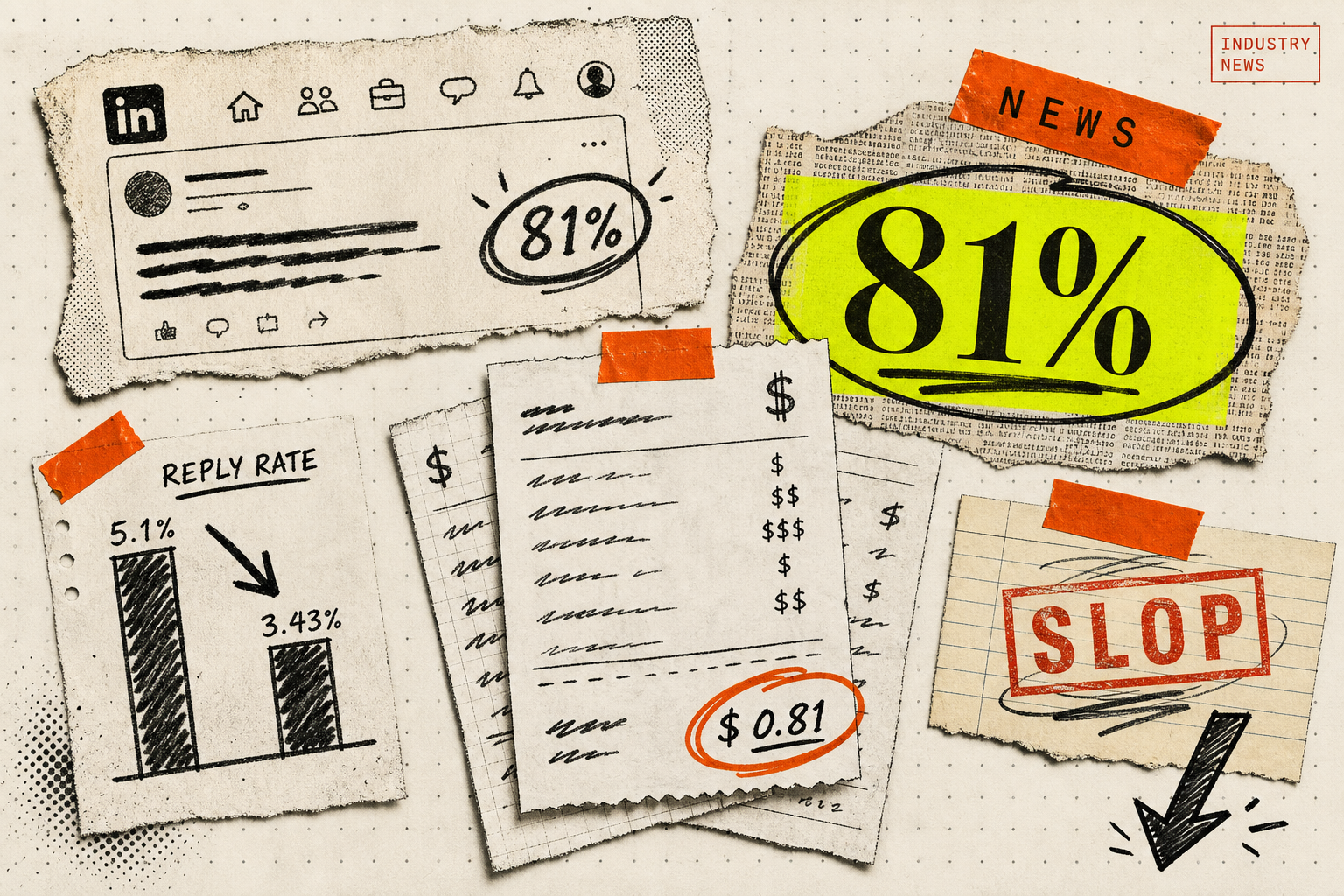
Four out of five long-form posts on LinkedIn are now flagged as likely AI-generated. Cold email reply rates dropped from 5.1% in 2024 to 3.43% in 2026. LinkedIn shipped a "Seems like AI slop" button on July 30. Forbes ran a piece four days ago on invisible watermarks now traveling with every AI-drafted email. The AI outreach playbook that worked in 2024 doesn't work anymore. If you're running it, you're not being ignored — you're being suppressed, spam-flagged, and in some cases, watermarked as a bot.
This isn't a "quality problem." It's a distribution problem. And the platforms are doing exactly what any operator should have predicted they'd do the moment inbox volume 6x'd.
What actually happened this summer
Three things collided:
One. Originality.ai ran a study across a million LinkedIn feeds and found 81.2% of long-form posts are likely AI-written[1]. LinkedIn's own thought-leadership category was the worst — the sample of 99 influential voices came back over 50% AI[2].
Two. LinkedIn announced algorithm changes on May 20, 2026 targeting low-quality AI content, then on July 30 shipped a native "Seems like AI slop" report button[3]. Flagged content isn't removed — it's suppressed beyond your immediate network[4]. Which is worse. You post, you get 20 impressions from your team, the algorithm decides it's slop, the reach dies quietly.
Three. Cold email reply rates cratered. Koka Sexton's data (published yesterday) puts the industry average at 3.43%, down from 5.1% two years ago[5]. Kwanzoo's teardown of first-gen AI SDRs shows outbound touches went up 6.4x while positive reply rates fell to 1.3% — below the human baseline of 2.1%[6]. Roughly half of AI SDR pilots shut down within 90 days.
That's not a market correction. That's a market rejection.
Why most takes on this are wrong
The dominant take on LinkedIn right now goes: "just add more personalization" or "use a humanizer tool." Both miss it.
Personalization at scale is exactly what caused the collapse. When every SDR pipeline can pull the prospect's last tweet and reference it in a "personalized" opener, the pattern becomes the tell. The reader spots the shape — hook, one-line "I saw you posted about X," soft ask — because they've read it 40 times this week. Personalization stopped being a signal in Q4 2024. Everyone has it. Nobody notices it.
Humanizer tools are worse. They add typos, break rhythm, and route your output through a "make this sound human" model. What comes out the other side is text that's harder to read and still gets flagged. The Forbes piece on watermarking made this specific point four days ago — the major LLMs are now embedding statistical fingerprints that survive light editing[7]. You can't paraphrase them off.
The real correction: the market has learned to read tone at scale. It knows what an AI-drafted opener looks like because it's seen 500 of them this quarter. The fix isn't better hiding. The fix is different work.
What actually still works — and it's not what LinkedIn influencers are selling
I've watched the numbers on this closely because it's the exact stack we build for operators. Here's what still moves the needle in 2026.
Hybrid drafting, not AI drafting. Saleshandy's data shows a hybrid arm — where AI handles research and first draft, and a human does final refinement — hit a 14.7% reply rate against 4.1% for AI-only and 10.4% for pure human[8]. Spam flags dropped from AI-only's 7.8% to 3.1% — nearly the human baseline. The ratio matters. You want AI doing 70% of the mechanical work and a human doing 100% of the last 30%. Not the other way around.
Signals over volume. Kwanzoo's follow-up work argues the fix is a "signal-first" outbound motion: instead of sending 70,000 emails to a semi-warm list, send 700 to prospects who tripped a specific trigger — hired a role, changed vendors, launched a product[6]. Reply rates on signal-triggered outbound at the operators I've seen stay in the 8–12% range. Because the message actually belongs.
Sender reputation, not send volume. Fuzzy AI's 2026 analysis frames it bluntly — AI-generated volume has wrecked cold email deliverability across the board[9]. If your domain sent 12,000 emails last month with a 40% open rate, Gmail already de-prioritized you. Warming, verified lists, and staying under 200 sends per mailbox per day is now table stakes, not optimization.
Publish less on LinkedIn, but publish yourself. LinkedIn's slop suppression is downstream of the platform's own economics — engagement per session dropped once the feed got saturated with AI posts, so they're culling. If you're a founder or operator, the winning move is fewer posts written entirely by you, with real receipts. One post a week that reads like a person outperforms five posts a week that read like a template. This isn't a hot take — it's just what the algorithm is now optimizing for.
What this means for a $5M operator right now
If you're running a $1M–$20M business and you bought an AI outbound tool in the last 18 months, you're looking at a portfolio decision, not a tool decision. The instinct is to ask "which tool is better." That's the wrong question. The right questions:
- What percentage of your pipeline is coming from cold? If it's under 20%, the outbound cratering barely touches you. Fix your inbound instead.
- What's your reply rate versus 12 months ago? If it dropped more than 30%, the AI SDR isn't broken — the whole channel is compressed. Cut volume, add signal.
- How much of your LinkedIn content is going through an AI drafter? If it's over 50%, the reach data you're seeing is post-suppression. You have no idea what your actual organic reach looks like right now.
The operators winning at this in Q3 2026 aren't the ones with the fanciest stack. They're the ones who quietly went back to sending 40 hand-written emails a week, warmed their domains properly, and posted twice a month with something real to say. It's not sexy. But it's what the market rewards after a saturation event.
The one thing to change this week
Pick one of your outbound campaigns. Pull the last 500 sends. If the reply rate is under 3%, kill it. Not tune it. Kill it. Then rebuild the campaign around a specific trigger — a job change, a funding event, a product launch — and cap the send volume at 50/day per mailbox with a human writing every third email from scratch.
You'll send 90% fewer emails and reply rate will double. I've seen it consistently across the studio's operator engagements this year. The math only breaks when volume was doing the work in the first place.
If you want this rebuilt
The full outbound stack that survives the 2026 correction — hybrid drafting, signal triggers, sender reputation, LinkedIn distribution — is 3-4 tools glued together with real logic between them, not a single all-in-one AI SDR platform. Most operators don't need to build it themselves. They need someone who's already seen the numbers on 20 versions of it.
If you're staring at a declining outbound funnel and can't tell whether the tool broke or the market shifted, that's what the audit call is for. Book a 30-minute audit at zerocam.studio — I'll pull the last 90 days of your outbound data with you, tell you which lever is actually moving, and what your rebuilt version would look like. No pitch. If your stack is fine, I'll tell you that too.
The playbook changed in July. The operators who ship the new one in Q3 own Q4.
-
LinkedIn AI Content Study: 81% of Long-Form Posts Are Likely AI↩
81.2% of LinkedIn long-form posts classified as likely AI-generated
-
LinkedIn Leads All Platforms in AI-Written Posts, Study of a Million Feeds Confirms↩
Independent analysis found over 50% of thought-leadership posts likely AI
-
LinkedIn adds a button to report AI-generated 'slop'↩
LinkedIn shipped Seems like AI slop reporting on July 30, 2026
-
LinkedIn Is Suppressing AI Slop: What That Means for You↩
AI-slop content is suppressed beyond immediate network, not removed
-
AI SDRs Are Destroying Outbound↩
Cold email reply rates fell from 5.1% (2024) to 3.43% (2026)
-
AI SDRs Failed: Why First-Gen Tools Broke↩
Outbound touches rose 6.4x while positive reply rates fell to 1.3%; ~half of pilots shut down in 90 days
-
AI Wrote Your Cold Email. Now It Carries An Invisible Watermark↩
Major LLMs embed statistical fingerprints in output that survive light editing
-
AI vs Human Cold Emails: Who's Winning in 2026?↩
Saleshandy hybrid arm hit 14.7% reply vs 4.1% AI-only and 10.4% human-only; spam flags 3.1% vs 7.8%
-
Cold Email Deliverability 2026: AI Volume Kills Reputation↩
AI-generated volume has wrecked cold email deliverability and sender reputation industry-wide
Ready to build your own AI system?
Book a Free Audit Call →Keep Reading
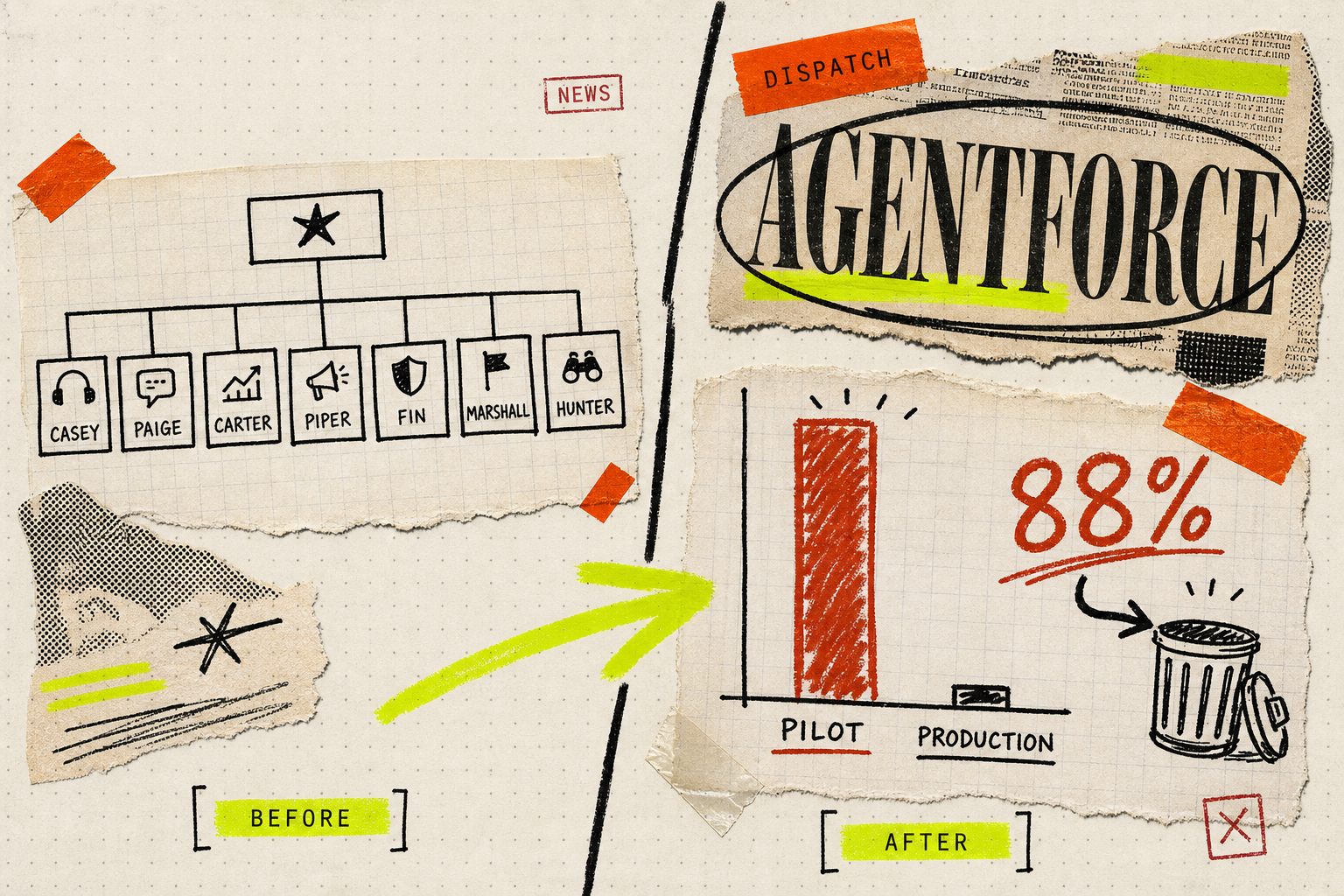
Salesforce Just Named Seven Agents. Enterprise AI Still Loses 88% Of Pilots.
Salesforce shipped 7 named Agentforce agents. But 88% of enterprise AI pilots still fail to reach production. Here's the real gap operators need to fix first.

Small Businesses Using AI Are Hiring More People, Not Fewer
Gusto ran payroll on 2,262 small businesses. AI adopters grew headcount 7% faster — 10% for under-10 firms. The doom takes miss the operator story.
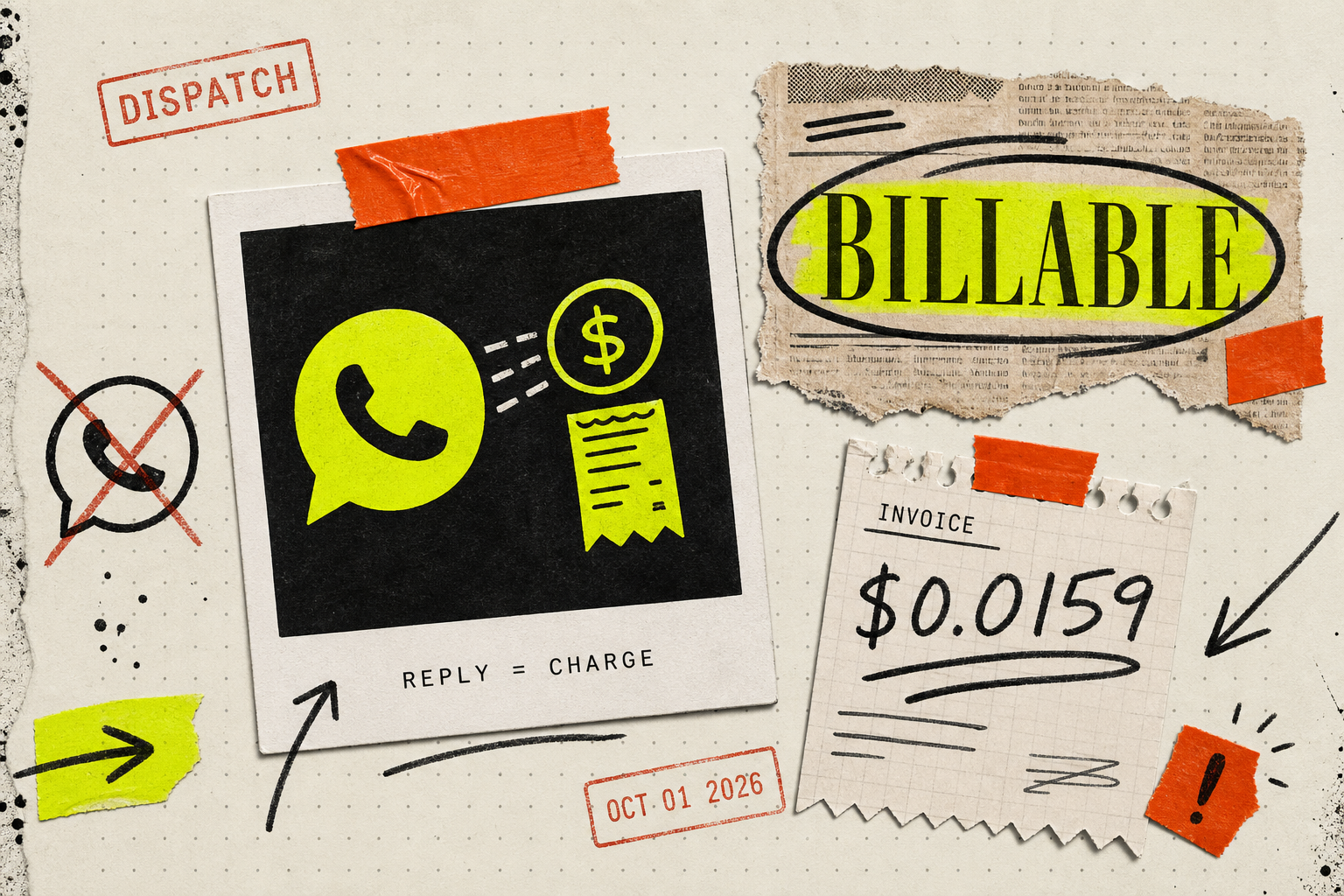
WhatsApp Just Made Every Reply Billable. Your Bot Bill Starts October 1.
On October 1, Meta starts charging for every WhatsApp reply — human, third-party AI, or its own. The sticker price is the boring part. Here's what it actually breaks.