Half The Fortune 500 Just Killed Their AI Agents. Do Not Copy Them.
KPMG says 49% of enterprises cut back AI agent rollouts because costs outran value. The tech isn't the problem — the buying model is. What smaller operators should do instead.
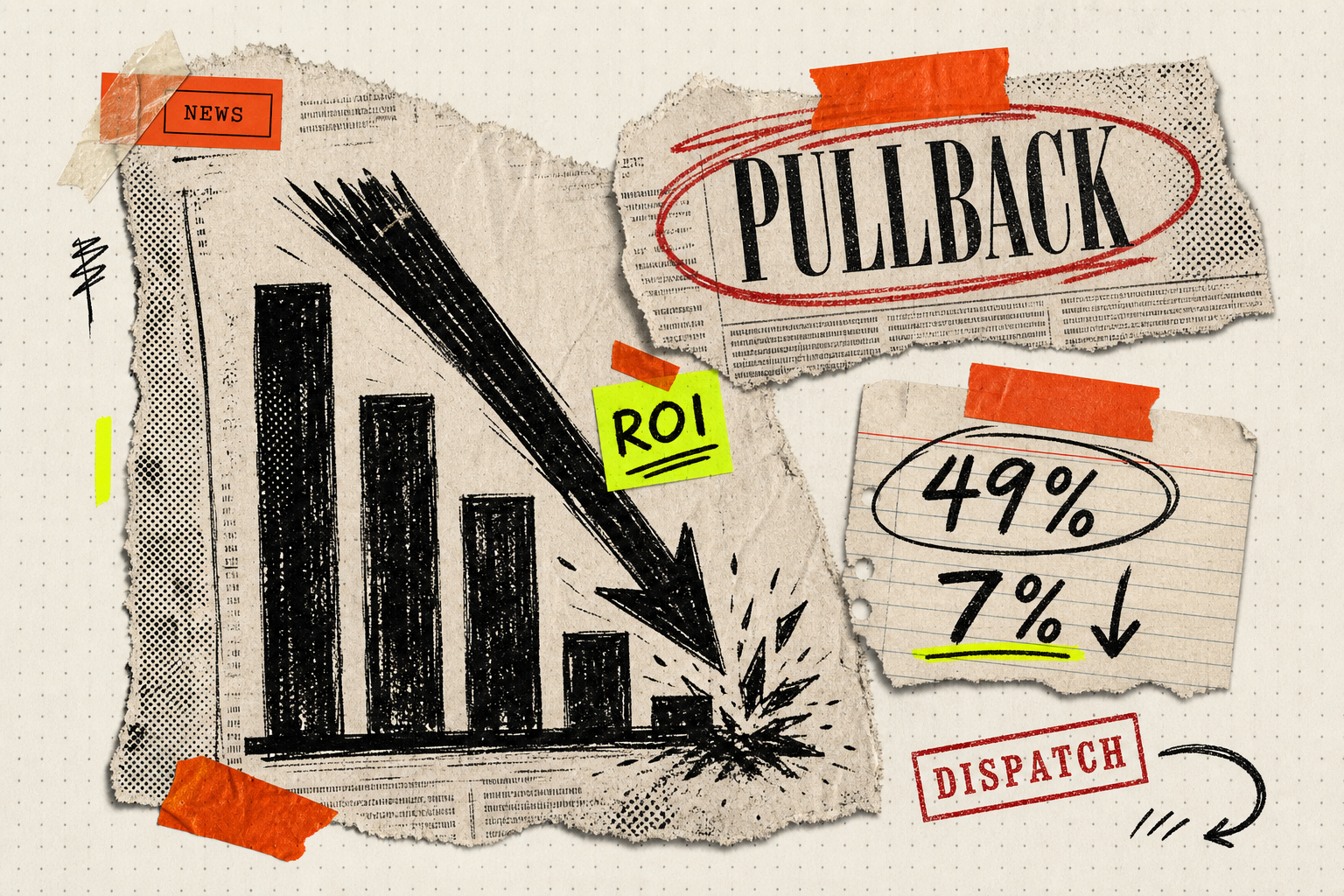
Nearly half of the world's biggest companies just scaled back their AI agent rollouts. Not because the tech failed. Because the bill did.
KPMG's Q2 2026 Global AI Pulse — 2,100 senior leaders across 20 countries — landed last week with the number every AI vendor is trying to bury: 49% of organizations have scaled back, narrowed, delayed, or paused AI agent deployments after costs began to outweigh value[1]. Only 7% report established ROI[1]. Forbes called it the "viral statistic" of Q3 2026[2].
Every LinkedIn take I've seen this week says the same thing: agents are overhyped, wait it out, stick with copilots. Most of them are wrong.
The story isn't that agents don't work. The story is that the enterprise playbook for buying them was broken from day one — and if you run a $5M-$20M business, you're about to inherit the same mistakes if you're not careful.
Here's what the pullback actually means, and what to do differently.
The four numbers behind the retreat
The KPMG report isn't the only one. Four separate 2026 surveys hit the same wall in the same quarter:
- KPMG (2,100 execs, Q2 2026): 49% cut, delayed, or paused agent deployments over cost. 7% have established ROI. Only 26% report real-time visibility into what their AI systems cost to operate[1][3].
- Mavvrik (State of AI Cost Governance, July 2026): 81% of enterprises report moderate-to-high gross margin erosion from AI costs — two years running. 40% escalated surprise AI bills to the board. 1 in 4 canceled a program[4][5].
- WitnessAI (300 execs, July 2026): 68% of U.S. companies saw AI initiatives run over budget. 33% report overruns "mostly or always"[6][7].
- Gartner: 89% of enterprise AI agent pilots fail to reach production. The 11% that survive deliver 171% ROI[8].
Put those together and the pattern is clear. The problem isn't the model. It isn't the framework. It's the operating model — enterprises bought agents the way they buy SaaS, and agents don't behave like SaaS.
Why the enterprise math breaks
Enterprise procurement expects three things: a fixed seat price, a predictable monthly bill, and a vendor to blame when something breaks. Agents give you none of that.
The unit isn't a seat. It's a token — and tokens are consumed by the agent, not the user. A single "smart" agent can burn 50-200x more tokens than a chat session on the same task, because it's calling tools, retrying, reasoning through steps, and pulling context on every hop[9]. When Mavvrik says forecast accuracy got worse in 2026 than it was in 2025, that's why[10].
The bill is variable by design. A well-behaved agent doing the same job twice can cost 3x more the second time because a document was longer or a tool call failed and retried. Finance teams built to approve $12/seat/month don't have a framework for "this workflow cost us $847 to run yesterday and $2,100 today."
And there's nobody clean to blame. When your Salesforce breaks, you call Salesforce. When your Zapier flow breaks, you call Zapier. When your custom-agent-that-uses-Claude-with-a-Perplexity-tool-orchestrated-by-LangGraph-running-on-AWS breaks, you call five vendors and eat the outage yourself.
That's what actually killed those 49% of rollouts. The tech worked well enough. The purchasing model didn't.
What the 11% who won are doing differently
Gartner's 171% ROI number for the surviving 11% isn't a mystery. Read past the headline and the pattern is boring:
- They started with one workflow, not a platform. Not "agents for the company." One measurable process — inbound lead qualification, refund triage, invoice categorization — with a known baseline cost and a known target.
- They metered spend at the workflow level. Not "AI budget." Cost-per-run. Cost-per-outcome. So when a workflow drifted from $0.40/run to $2.30/run overnight, someone saw it that day, not that quarter.
- They wrote the fail case first. What does the agent do when it doesn't know? What does it escalate? Who owns the escalation queue? The 89% that die skip this and discover the answer is "hallucinate and email the customer confidently."
- They didn't buy a platform. They bought a system. The winners treat the LLM as a component, not the product. The value lives in the workflow around it — data hygiene, permissions, evals, cost caps, fallbacks. The LLM is the cheapest, most swappable part of the stack.
That's not enterprise strategy. That's how a $5M business runs anything. Which is exactly why smaller operators are about to have a moment.
The window for smaller operators
Here's the part nobody's saying out loud: the enterprise pullback is a green light for operators running $1M-$20M businesses.
You have three structural advantages the Fortune 500 doesn't:
- You don't need a cross-functional AI steering committee. You need a decision from one person — probably you — and a Friday afternoon.
- Your workflows are already small enough to meter. A 12-person hospitality operation has maybe 40 recurring workflows total. An enterprise has 40,000. Metering yours is a spreadsheet, not a platform purchase.
- You can pick the boring, high-ROI stuff. The agent that categorizes 200 transactions/day, drafts 30 supplier reply emails, or triages 50 inbound leads is worth $2K-$6K/month to a $5M business — and costs $80-$200/month in tokens to run. The math is trivially good when you're not paying a $400K/year "Head of AI" to shepherd it.
The KPMG report isn't a warning to stay out. It's proof that the market is quietly getting cheaper and less crowded for the operators who move now — because the enterprise buyers who were going to bid up the tooling, the talent, and the model rates just took the year off.
What I'd do this quarter
If I ran a $5M-$20M business and read the same reports this week, my quarter looks like this:
- Pick one workflow. The one you'd fire a $60K/year employee to run better. Not the flashiest — the most repetitive.
- Instrument the current cost per run (headcount time + tooling + errors). Get an honest baseline. Most of my audit calls end here because nobody has this number.
- Build the agent version of exactly that workflow — nothing else. Use the cheapest model that clears your quality bar. Cap the token spend per run with a hard limit.
- Run both in parallel for 30 days. If the agent version is 30%+ cheaper and 90%+ as accurate, retire the manual version. If it isn't, you learned what your data actually looks like — worth more than the tokens you spent.
- Repeat with the next workflow. Do not build a platform. Do not hire a Head of AI. Do not call your stack "agentic."
That's the whole play. It's not sexy. It's not what the 49% did. And it's why the 11% are making money while everyone else is writing postmortems.
The enterprise pullback isn't the end of the agent wave. It's the end of the first bad version of it. The second version — smaller, metered, boring, profitable — is what the operators who ignore this week's headlines are quietly building right now.
If you want to figure out which one workflow at your business is the highest-ROI agent candidate — and whether it's actually cheaper to build than to keep doing manually — that's what the free 30-minute audit call is for. No pitch. I'll tell you where I'd start and, honestly, where I wouldn't.
-
Global AI Pulse Q2 2026↩
49% of organizations scaled back, delayed, or paused AI agent deployments; only 7% report established ROI.
-
KPMG Says Nearly Half Of Executives Pulled Back AI Agents Over Cost↩
The 49% pullback statistic went viral in Q3 2026 as the defining number of enterprise AI adoption.
-
AI Investment and Agent Deployment Hold Steady Amid Growing Focus on Pragmatism↩
Only 26% of enterprises report full, real-time visibility into what their AI systems cost to operate.
-
2026 State of AI Cost Governance Report↩
81% of enterprises report moderate-to-high gross margin erosion from AI costs, second consecutive year.
-
AI Bill Shock Hits the Boardroom: 40% of Companies Escalated Surprise AI Costs↩
40% of companies escalated surprise AI cost overruns to the board; 1 in 4 canceled a program.
-
New WitnessAI Report Reveals the Financial Cost and Risk Factors of Enterprise AI Adoption↩
33% of respondents report AI projects were always or mostly over budget in the past 12 months.
-
Nearly 7 in 10 firms report AI cost overruns↩
68% of US companies say at least some AI initiatives ran over budget in the past year.
-
89% of AI Agent Pilots Never Scale: Gartner's 2026 Data↩
Gartner: 89% of enterprise AI agent pilots never reach production; the 11% that survive deliver 171% ROI.
-
AI Agent Failure Rate: Why 70-95% Fail in Production↩
AI agents consume many multiples of the tokens of a single chat session due to tool calls, retries, and multi-step reasoning.
-
Enterprises Can See Their AI Bill, But They Still Can't Predict It↩
Accuracy of enterprise AI spending forecasts worsened in 2026 compared with 2025.
Ready to build your own AI system?
Book a Free Audit Call →Keep Reading
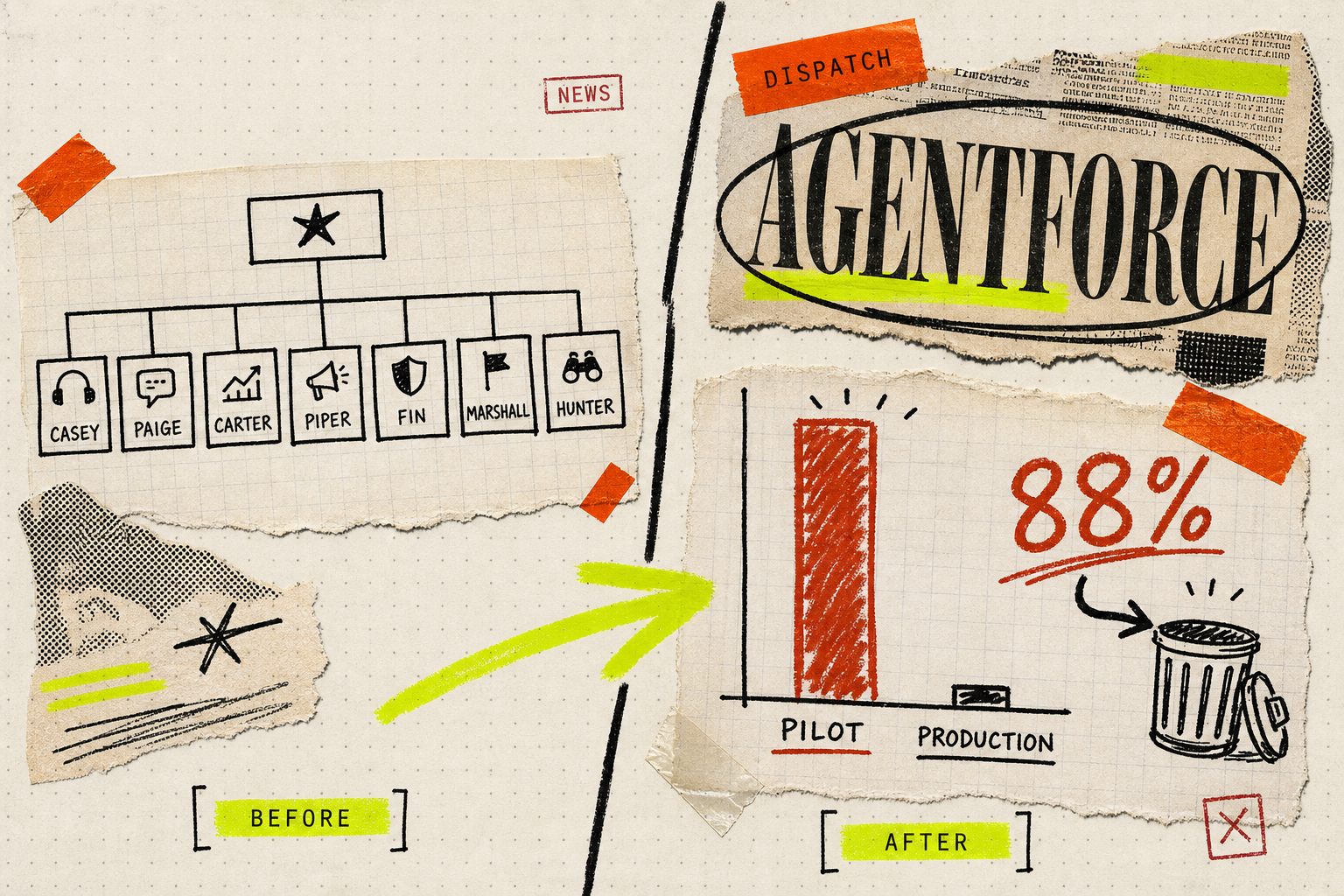
Salesforce Just Named Seven Agents. Enterprise AI Still Loses 88% Of Pilots.
Salesforce shipped 7 named Agentforce agents. But 88% of enterprise AI pilots still fail to reach production. Here's the real gap operators need to fix first.

Small Businesses Using AI Are Hiring More People, Not Fewer
Gusto ran payroll on 2,262 small businesses. AI adopters grew headcount 7% faster — 10% for under-10 firms. The doom takes miss the operator story.
WhatsApp Just Made Every Reply Billable. Your Bot Bill Starts October 1.
On October 1, Meta starts charging for every WhatsApp reply — human, third-party AI, or its own. The sticker price is the boring part. Here's what it actually breaks.