Cloudflare Just Deleted The Chromium Tax On Your AI Agents
Cloudflare shipped Kitesurf, an agent-first browser that uses 3-7x less CPU than Chromium. Every AI agent product just got a hidden price cut.
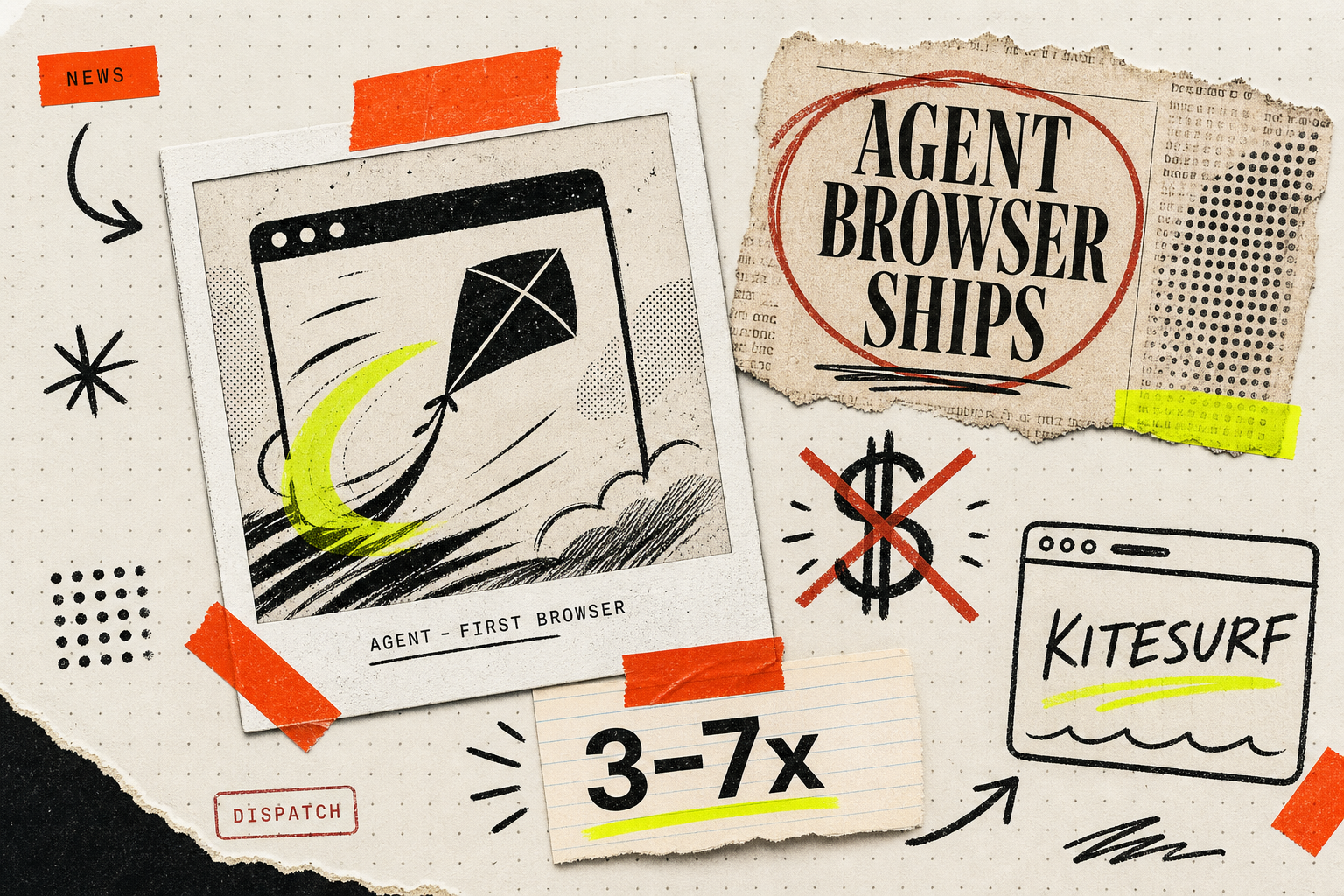
Cloudflare shipped a new browser on August 6th. Not for humans — for AI agents. It's called Kitesurf, it runs entirely on Cloudflare Workers, and it uses 3 to 7× less CPU and memory than Chromium for the tasks agents actually do — screenshots and HTML extraction[1]. Every "AI agent" tool you're paying for right now — the ones that book meetings, scrape competitors, fill forms, click checkout buttons — is quietly running Chrome in a data center somewhere. That's the bill you never see. Kitesurf is Cloudflare's argument that the bill was always too high.
I want to unpack what that actually means for anyone running an agent in production, because most of the takes I've seen so far are missing the operator angle.
The bill you didn't know you were paying
When you buy an "AI SDR" or an "AI research assistant" or a workflow that touches the web, you're not just paying for tokens. You're paying for a headless Chrome instance to be spun up, kept warm, and then thrown away. Every scrape. Every login. Every screenshot.
Browserless — one of the largest managed-headless-browser providers — advertises this exact number on its landing page: each headless Chrome instance devours 500MB+ of RAM[2]. Their cloud plans range from $25/mo on the entry tier to $350/mo on Scale, and costs climb fast when you need more concurrency or longer sessions[3]. That's the price of one tool. Now multiply by the 5–10 agents most operators are already running.
The Chromium tax isn't a line item. It's baked into the sticker price of every agent product on the market. You just don't see it because the vendor is eating it — until they can't, and then your bill goes up "for infrastructure reasons."
What Cloudflare actually built
Kitesurf isn't Chrome-lite. It's a from-scratch browser assembled out of Rust and WebAssembly parts: the Blitz rendering engine, Firefox's Stylo CSS parser, Boa JS for JavaScript, all glued together inside Cloudflare Workers[4]. Twelve weeks of work. It already passes 215,000+ Web Platform Tests[4] — the same conformance suite Chrome and Firefox get graded on.
The pitch, in Cloudflare's own words: "AI doesn't care about tabs, themes, browser extensions, or synchronization across devices. It cares about token count, context windows, scalability, performance, and costs"[1]. So Kitesurf drops the parts of Chromium that were built for humans — smooth scrolling, extension APIs, tab management, pixel-perfect font rendering — and keeps the parts an LLM needs to read a page and click a button.
It's free while in beta, and it's exposed through Browser Run, Cloudflare's headless-browser API[5]. If you already use Playwright or Puppeteer against Browser Run, Kitesurf is a runtime flip, not a rewrite.
Why the take on LinkedIn is wrong
The dominant take today is "Cloudflare is joining the AI browser war." That's the same lazy framing that got applied to Perplexity Comet, OpenAI Atlas, and Claude for Chrome — all of which are consumer AI browsers where a human sits in front of the tab[6]. Kitesurf is not that. There's no UI. No user. It's an infrastructure product aimed at the developers and studios who ship the products the consumer browsers compete with.
The actual fight is one layer down: the compute layer under every agent. Browserbase, Browserless, Steel, Firecrawl's Browser Sandbox, plus the DIY teams running their own headless Chrome fleets on AWS — that's Kitesurf's real competitive set[7]. And unlike the consumer AI browser space, where the numbers are muddy, the pitch here is concrete and testable: 3–7× lower resource usage on the same workload[1].
If those numbers hold in production — and Cloudflare shipped a benchmarking harness that runs Puppeteer tests on real sites against both Chromium and Kitesurf, comparing assertions and visual output[1] — then the economics of running a web-touching agent get rewritten this quarter. Not because agents get smarter. Because the substrate gets cheaper.
What actually changes for a $1M–$20M operator
Three things, in order of how fast they'll hit your P&L:
1. Your existing vendors' margins go up. Then yours should. If your AI SDR platform is running Chromium on Browserbase today and switches to Kitesurf next month, their cost per session drops by roughly 5×. Watch whether that lands in their pocket or gets passed to you as lower pricing. If it doesn't get passed within two quarters, you have bargaining room at renewal. Ask them, on the record, what their compute cost per session is.
2. Home-grown agents get economical. For teams (including studios like mine) that were quietly deferring internal agent builds because $300/mo of headless-browser cost per agent × 8 agents = an infrastructure line nobody wants to defend — that math changes. A study-scale system that used to cost ~$2,400/mo in browser compute drops toward $400/mo if the 5-6× number holds[1][2]. That's the difference between "we'll revisit next year" and "we'll ship it this month."
3. The wrapper economy gets uglier. A lot of the "AI agent" products on Product Hunt are three prompts, a Playwright script, and a $99/mo Stripe button. Their moat was infrastructure friction — you didn't want to run 50 concurrent headless browsers yourself. When that friction drops 5×, the ceiling on how much they can charge before customers build in-house drops too. Expect more consolidation, more free tiers, and more "our unique agent framework" pivots in the next two quarters.
None of this is speculative. It's the same shape as the 2015 shift when serverless made "spin up a container for one request" cheap, and it collapsed a bunch of businesses whose entire value prop was "we run infrastructure so you don't."
The catch
Kitesurf is not a Chromium clone. It correctly renders TodoMVC, Wikipedia, Hacker News, and much of the Cloudflare dashboard[4] — the kinds of pages agents actually operate on. It will not correctly render a highly interactive React SPA with WebGL and custom Web Components. It's a beta. There will be sites your agent needs that break.
Also worth naming: this hands more of the agent stack to Cloudflare. If your DNS, your Workers, your Durable Objects, and now your headless browser all live in one vendor, "multi-vendor" is a phrase you're using while pointing at a single dashboard. That's a governance conversation, not a technical one, but it's the one your CFO will eventually have with someone.
What I'd actually do this week
If I ran a $5M ops-heavy business today, I'd do exactly three things:
- Ask every agent vendor I pay: what browser engine do you run, and what's your compute cost per session? The good ones will answer. The ones who dodge are the ones you can push at renewal.
- Take one internal automation I'd deferred because of infrastructure cost — competitor price scraping, KYC document intake, weekly report screenshotting — and prototype it against Browser Run + Kitesurf while the beta is free. One prototype. One week.
- Add "browser-engine cost per session" to whatever agent scorecard I already track. If I don't track one, that's the actual problem to fix first.
None of this requires a strategic offsite. It's a Tuesday.
The AI browser story you'll read on LinkedIn this week is "Cloudflare enters the browser war." The story that matters for anyone actually shipping is quieter: the price floor on running an agent at scale just dropped, and the vendors above that floor haven't updated their pricing yet.
That gap is the arbitrage. It closes fast.
If you're trying to figure out which of the agents you already pay for are about to get dramatically cheaper — or which ones you should build in-house now that they can — that's what the free audit call is for. 30 minutes, your stack, no pitch.
-
Introducing Kitesurf: The agent-first browser that runs in V8 isolates on Cloudflare Workers↩
Cloudflare announces Kitesurf; 3-7x less CPU/memory than Chromium; runs on Workers; built in 12 weeks; passes 215K+ Web Platform Tests.
-
AI Agent Browser Automation API↩
Each headless Chrome instance devours 500MB+ of RAM — the compute overhead under every agent.
-
5 Awesome Browserless Alternatives in 2026↩
Browserless cloud plans $25/mo entry to $350/mo Scale — pricing context for the Chromium-tax argument.
-
Cloudflare launches Kitesurf, a browser built for AI agents↩
News coverage confirming Kitesurf details: built on Blitz, Stylo, Boa JS, 215,000+ WPT tests, renders TodoMVC/Wikipedia/HN correctly.
-
Introducing Kitesurf, an agent-first browser on Browser Run↩
Official product changelog: Kitesurf available in Browser Run, free while in beta.
-
Best AI Browser Agents in 2026, Compared↩
The consumer AI browser landscape — Atlas, Comet, Claude for Chrome — the wrong comparison set for Kitesurf.
-
11 Best AI Browser Agents in 2026↩
The three buckets of browser agents (consumer, framework, managed infra) — Kitesurf's real competitive set.
Ready to build your own AI system?
Book a Free Audit Call →Keep Reading
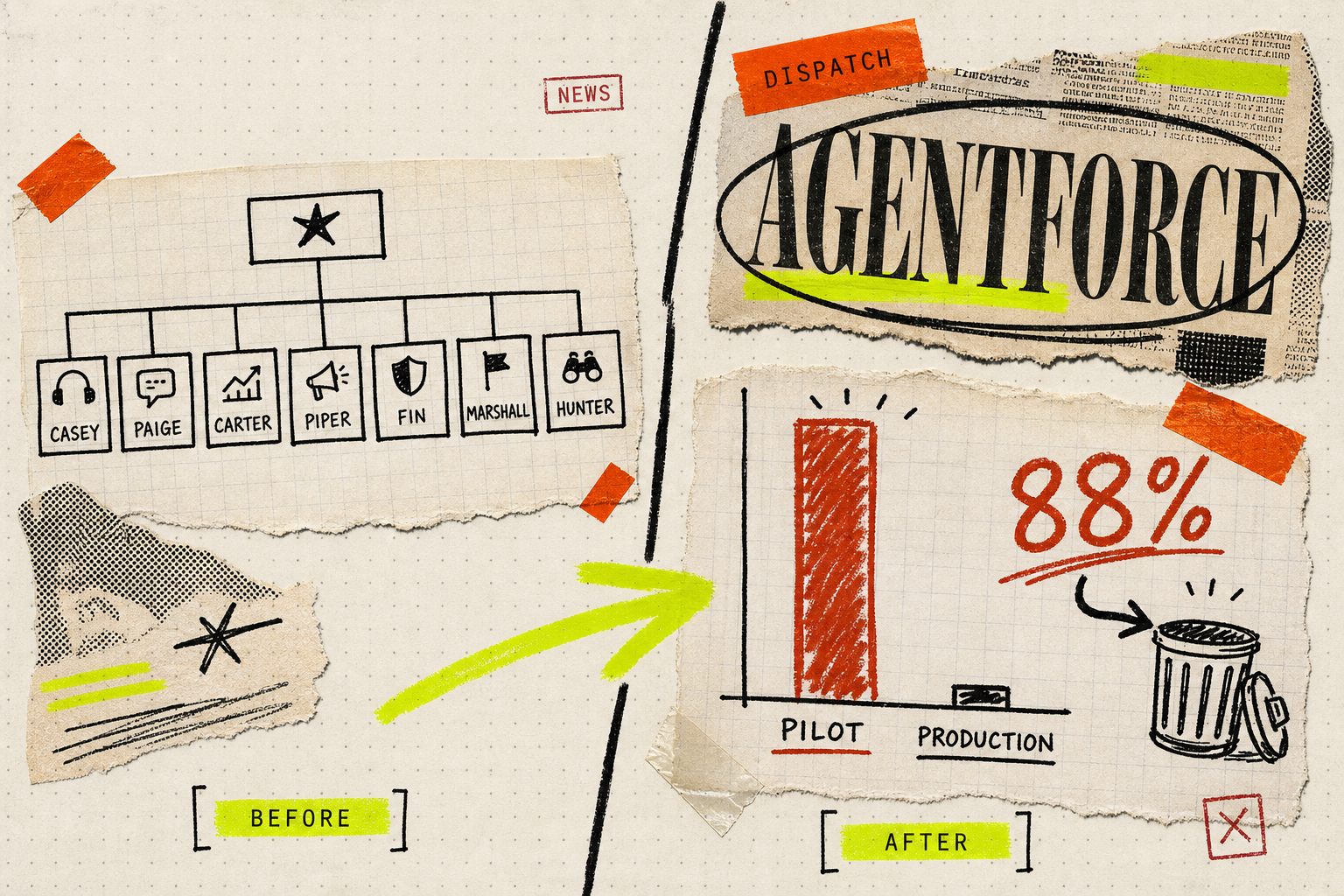
Salesforce Just Named Seven Agents. Enterprise AI Still Loses 88% Of Pilots.
Salesforce shipped 7 named Agentforce agents. But 88% of enterprise AI pilots still fail to reach production. Here's the real gap operators need to fix first.

Small Businesses Using AI Are Hiring More People, Not Fewer
Gusto ran payroll on 2,262 small businesses. AI adopters grew headcount 7% faster — 10% for under-10 firms. The doom takes miss the operator story.

WhatsApp Just Made Every Reply Billable. Your Bot Bill Starts October 1.
On October 1, Meta starts charging for every WhatsApp reply — human, third-party AI, or its own. The sticker price is the boring part. Here's what it actually breaks.