Claude Can Build n8n Flows Now. Should You Still Pay For n8n?
Claude can now write n8n workflows directly via MCP. The takes are wrong: n8n isn't the IDE, it's the runtime — and the math says it's about to get bigger, not smaller.
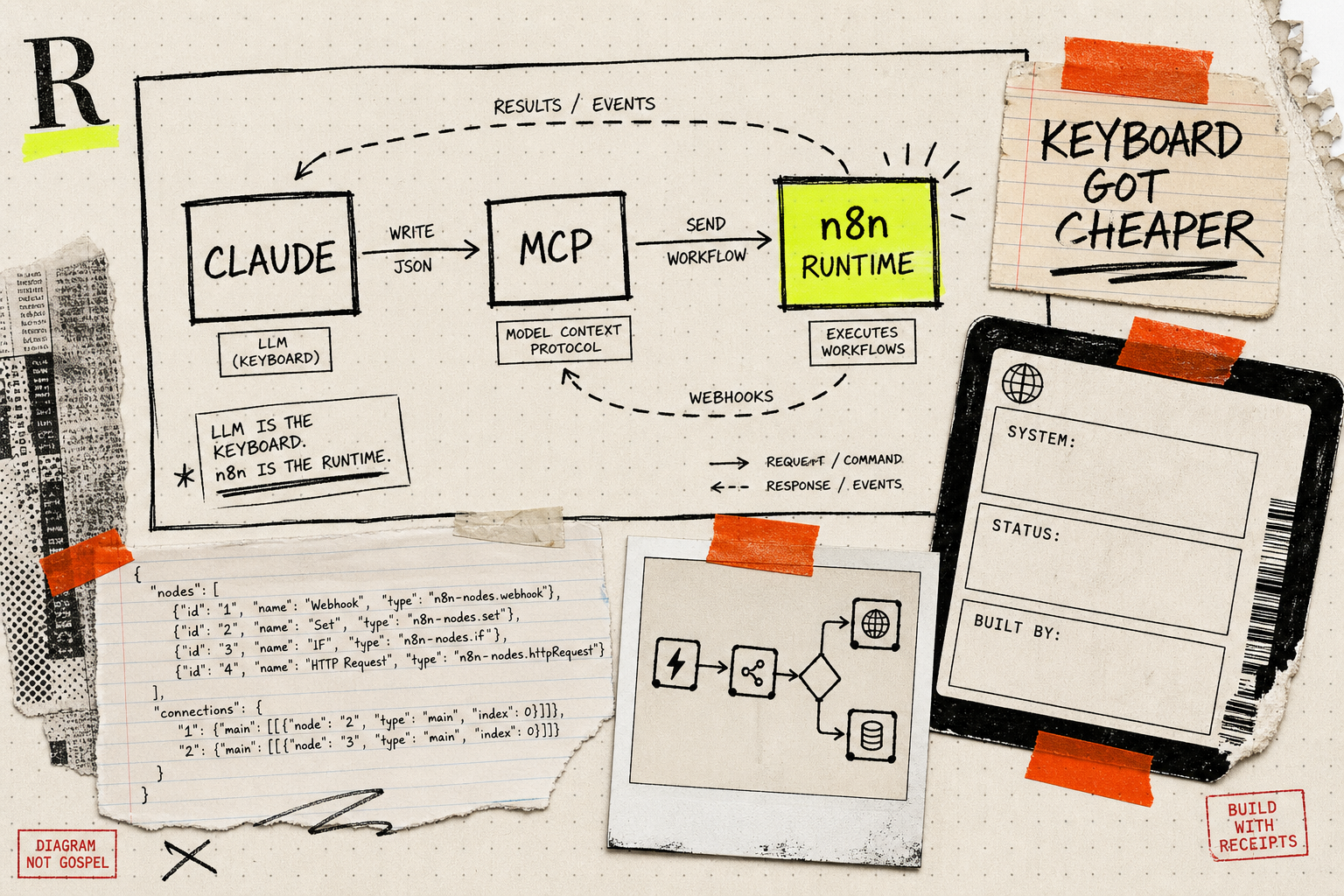
Claude can now build n8n workflows directly from a chat prompt. You install one MCP server, point Claude Desktop or Claude Code at your n8n instance, and ask it for a workflow. It writes the JSON, validates the nodes against the registry, pushes it to your n8n, and tests it[1].
This isn't a side project. It's a 1,500-star open-source MCP server with first-class support across Claude Desktop, Claude Code, Cursor, and Windsurf[1]. n8n itself shipped beta support for an Anthropic MCP integration earlier this year[2]. And the same week Claude added direct n8n authoring, n8n closed a $180M Series C at a $2.5B valuation off of $40M ARR — a 5.5x jump from 2024[3][4].
That's the news. Here's the part everyone's getting wrong.
Most operators are reading this as "n8n killer." It's the opposite.
The takes I've seen this week: "If Claude can write the flow, why pay for n8n?" Wrong question.
n8n isn't the IDE. It's the runtime.
When Claude writes a workflow, it doesn't run the workflow. It writes JSON that runs on your n8n instance — handling cron triggers, retries, credential storage, OAuth refreshes, webhook receivers, queue management, and the boring 99% of production glue that nobody wants to think about until something breaks at 2 AM. The Claude layer is just the keyboard.
What's actually changing is the price of the first draft. Building a 14-step n8n flow used to take 2-4 hours for someone who knew the tool, or a week for someone learning it. Now you describe it in two paragraphs and get a working draft in 90 seconds. The skill that used to sell for $80-150/hour just got commoditized at the entry tier.
That doesn't kill n8n. It floods it.
The market math says the same thing
n8n's usage grew 10x year-over-year on its way to $40M ARR[3]. Zapier is north of $300M ARR with 9,000+ integrations[5]. The workflow automation market is on a path to $71B by 2031 at a ~24% CAGR[6]. Gartner expects 40% of enterprise apps to ship with task-specific AI agents by the end of 2026, up from less than 5% in 2025[7].
Demand for automation isn't slowing — it's blowing past the supply of people who can build it. LLMs writing the flows is what feeds the next 100x of demand, not what kills the 1x already on the platform.
You don't bet against the runtime when the keyboard gets cheaper. You bet against the keyboard sellers.
Who actually loses
Three groups should be nervous:
1. Implementation agencies billing $5K-15K per "automation project." Most of these projects are 4-6 n8n flows that a Claude-MCP loop can spit out in an afternoon. The agencies were never selling integrations — they were selling the time to figure out the integration. That time is collapsing. The agencies that survive are the ones that already moved to retainers tied to outcomes (revenue lift, hours saved, errors caught), not to deliverables.
2. Tutorial creators. "How to build a [thing] in n8n" was a viable YouTube niche through 2025. Top videos still pull 200K+ views[8]. But the half-life on a tutorial just dropped — by the time you ship the 14-minute walkthrough, Claude can produce the same flow on demand. Tutorial channels that survive will shift to "here's the system-design pattern" rather than "here's where to click."
3. Low-code/iPaaS vendors that locked their JSON. If your platform's workflow definition is proprietary and not LLM-emittable, you're now one MCP server behind. The platforms that thrive in this cycle are the ones with open, well-documented workflow schemas that an LLM can read and write fluently. n8n is one of those. So is Make. Zapier has the largest integration catalog and is shipping AI-assisted authoring of its own[5] — they'll be fine. The five-figure-ACV "enterprise integration" startups with closed graphs are in trouble.
What this actually means for an operator running a $1M-20M business
If you're already on n8n: keep it. Add the MCP layer. Your build velocity 3-5x's overnight.
If you're not on a workflow platform yet: pick one with an open spec (n8n, Make, or Zapier) and a working MCP integration. Don't pick the platform with the prettiest landing page — pick the one whose workflow JSON your LLM of choice can read and write.
If you've been pricing automation work by the hour: stop. Within 12 months you'll be competing against operators who describe the workflow in plain English and accept whatever Claude builds. The work that still commands premium rates is the part Claude can't do alone yet — picking which workflows to build, designing the error paths, deciding what gets human review, and owning the system when it breaks.
That's the actual skill stack. It always was. The Claude+n8n combo just made it visible.
The trap
The trap is treating Claude's first draft as production-ready. It isn't. I've watched Claude generate flows that:
- Use deprecated nodes the registry still lists but n8n marked legacy 6 months ago
- Skip credential refresh logic on OAuth APIs (works for 60 days, then silently 401s every run)
- Hardcode a single test value into what should be a loop variable
- Pass raw user input straight to a SQL node with no parameterization
- Forget the retry-with-backoff on the one node that will rate-limit in production
Every single one of these compiles. Every one runs once successfully. Most ship.
The Medium piece I'd recommend on this called it correctly: "The hard part is reviewing them"[9]. You still need someone who can read a 14-node graph in 90 seconds, spot the auth refresh that's missing, and rewrite the error branch. That someone is increasingly a senior operator with system-design instincts, not a low-code button-clicker.
How I'd build the stack today
Picking from public tools, here's the loop I'd run:
- Runtime: self-hosted n8n on a $20/mo VPS. Public schema, open MCP, no vendor lock.
- Author: Claude Code or Claude Desktop with the
n8n-mcpserver installed[1]. Describe the flow in prose. Let Claude write the JSON and push it. - Review gate: every generated flow gets a 60-second human read before activation. Specifically: check credential handles, retry config, error-branch wiring, and any node that accepts raw input.
- Test gate: dry-run with logged inputs before pointing it at production data. n8n's
Execute Workflowlets you do this in one click. - Observability: a Slack webhook on every failed execution. If a flow fails silently for 48 hours, the system is worse than no system.
Five layers. Two of them used to take a week. Now they take an afternoon. The other three — review, test, observability — got more important, not less.
The bigger pattern
This isn't really a story about n8n. It's a preview of what happens to every category where LLMs learn to emit the platform's source-of-truth format. CRMs. Ad platforms. Analytics dashboards. CMS. The ones with open, well-documented schemas become 10x more powerful overnight. The ones with closed schemas become legacy slowly, then suddenly.
If you're picking a stack for the next 5 years of an operating business, that's the lens: can an LLM read and write this platform's primitives in the open? If yes, you ride the curve up. If no, you get to be the case study in next year's deprecation post.
n8n picked correctly. So did Make. So did Zapier. The platforms that didn't haven't filed bankruptcy yet — they just have a much shorter runway than their cap tables suggest.
Want a second pair of eyes on the workflows you're already running — before Claude rewrites them and ships them broken? I run a free 30-minute audit for operators on $1M-20M businesses. We look at your top 3 automations, what would break first under volume, and where an LLM-author loop would actually save you time vs. where it would silently introduce risk. Book one at zerocam.studio. No pitch.
-
n8n-mcp: An MCP server for Claude Desktop / Claude Code / Cursor / Windsurf to build n8n workflows↩
Open-source MCP server letting Claude clients author and push n8n workflows; widely adopted.
-
How to build n8n workflows with Anthropic MCP integration↩
Walk-through of the n8n + Anthropic MCP integration enabling Claude to author production n8n flows.
-
n8n Secures $180 Million Series C Funding, Hits $2.5 Billion Valuation↩
n8n raised $180M Series C at $2.5B valuation; ARR past $40M with usage up 10x year over year.
-
n8n revenue, valuation & funding↩
Sacra estimate: n8n reached ~$40M ARR in mid-2025 driven by AI-augmented workflow demand.
-
Zapier vs. n8n comparison↩
Zapier scale and AI-assisted workflow authoring: 9,000+ integrations cited in official comparison.
-
Zapier AI vs Make.com AI vs n8n AI — 2026 Guide for Marketing Leaders↩
Workflow automation market projected to reach ~$71B by 2031 at a ~24% CAGR.
-
40% of Enterprise Apps Will Embed AI Agents by End of 2026, According to Gartner↩
Reporting on the Gartner forecast that 40% of enterprise apps will integrate task-specific AI agents by end of 2026, up from <5% in 2025.
-
Stop Learning n8n in 2026...Learn THIS Instead↩
Indicative example of high-volume n8n tutorial content (276K+ views) showing creator demand on the topic.
-
n8n MCP Server: How to Build and Edit AI Workflows with Claude Code↩
Walkthrough framing the Claude+n8n authoring loop and the human review responsibility that remains.
Ready to build your own AI system?
Book a Free Audit Call →Keep Reading
Never Put An AI Agent In Front Of An Upset Customer
AI-handled support hits 4.10/5 CSAT vs 4.30 for humans — and the gap is entirely emotional tickets. Here's the four-gate escalation design that closes it.
DHH Just Drew The Line Between Vibe Coding And Your Agent
DHH split vibe coding from agentic engineering on Lex Fridman. The same wedge is coming for every operator running AI agents in 2026.
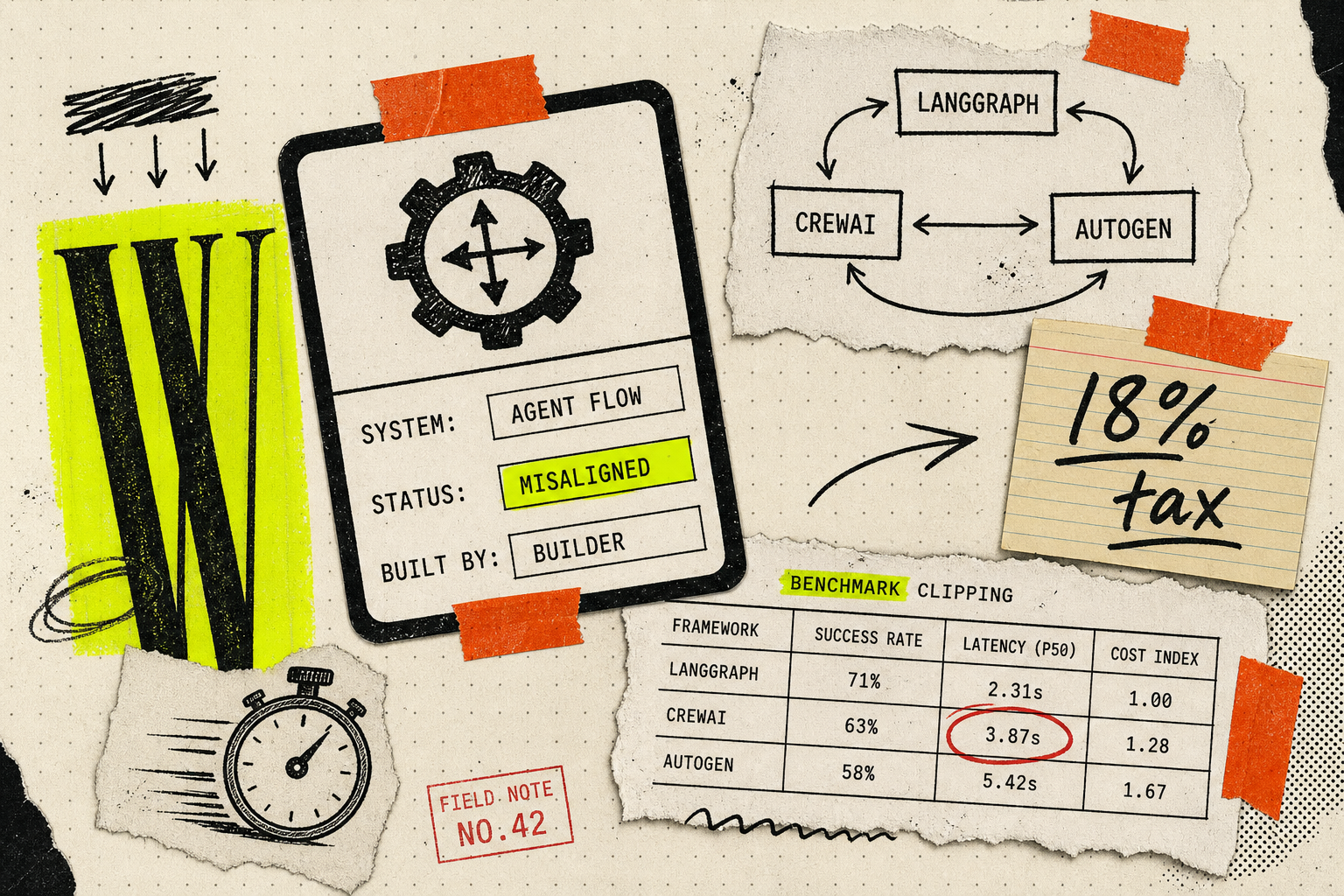
You Picked The Wrong Agent Framework. Benchmarks Say So.
You picked the framework off a listicle instead of a benchmark. Here's how LangGraph, CrewAI, AutoGen actually stack up — and the picking rule I use.