Anthropic Just Killed The Mega-Prompt. Your Agent Bill Is About To Drop.
Anthropic's Skills API just went GA. If you're paying real money for AI agents, it's a token-bill event — and most stacks are bleeding cash.
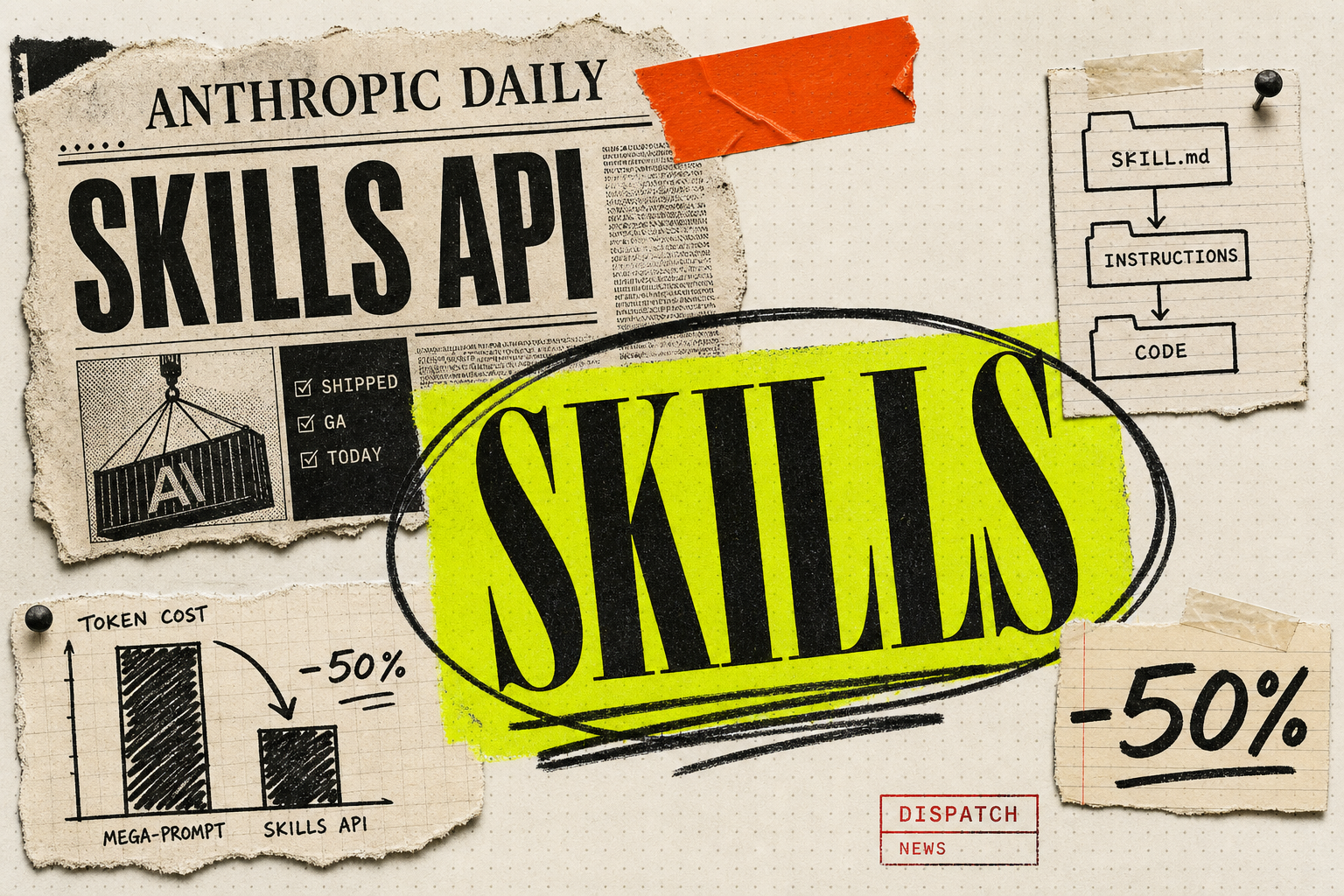
Anthropic pushed computer use, the Skills API, and the Files API to general availability last week[1]. Every AI Twitter thread I read called it a developer story. Most of them missed the actual thing.
If you run a business that pays a real API bill for AI agents — even a small one — this is a token-bill event, not a developer story. And it exposes a design mistake most agent stacks in production right now are quietly bleeding money on: the mega system prompt.
Here's what actually changed, why it matters, and what I'd tear out of an agent stack this week if I were running one.
What Skills actually are
Skills are folders. Each folder has a small SKILL.md file that describes what the skill does in a few sentences, plus any code, templates, or docs the agent might need. The model reads only the description by default. When it decides a task needs a specific skill, it pulls in the rest on demand[2].
That's it. That's the whole idea.
It sounds boring until you look at what most production agents are doing today: shoving every workflow, every rule, every example, every tool schema into one giant system prompt that gets sent on every single call. A single 800-token system prompt hit 100,000 times a month burns 80 million input tokens before the agent processes a single user request[3]. Real prompts in production are 3,000–8,000 tokens, not 800.
Skills let the model load context in tiers — description first, instructions when needed, code only when it runs. Anthropic calls it progressive disclosure. Early adopters running Skills instead of classic tool-loaded prompts are reporting roughly 50% lower token usage and faster execution[4]. One community writeup pegged the token cut at up to 40% for typical workflows[5].
For a business running an AI agent that handles inbound support at 30,000 tickets/mo — say a $5M DTC brand — that's the difference between a $3,200 monthly bill and a $1,600 one. Same output. Same latency ceiling. Different architecture.
Why the mega-prompt was always broken
If you built anything on top of GPT-4 in 2023 or Claude in early 2024, you know the pattern. You started with a clean system prompt. Then support asked for a new tone. Add a paragraph. Then legal said don't quote prices. Add another paragraph. Then someone found a hallucination. Add three edge-case rules. Six months later your system prompt is 4,000 tokens, half of it is stale, nobody remembers why line 47 exists, and every user message pays for the whole novel.
Redis, which built infrastructure specifically for this problem, calls it prompt bloat: every step of the conversation gets appended, so by turn ten the agent is sending the original question, every tool result so far, and its own running commentary on every inference[6]. Cost scales linearly with prompt length. Latency scales linearly with prompt length. Hallucination rates go up as the useful signal gets buried[7].
The mega-prompt worked when agents were toys. It doesn't work when agents are infrastructure.
Skills vs MCP — not the same thing
A quick clarifier because the takes on X are already confused. Skills and MCP are not competitors. They live on different layers.
MCP is the plumbing — how your agent connects to Slack, your database, your CRM[8]. Skills are the knowledge — how the agent knows what "process a refund" means at your company, in your voice, using your escalation rules.
Anthropic's own framing[2]: MCP answers "what can I access." Skills answer "how do I do this." Most production agents need both.
The relevant point: if you already invested in an MCP setup, you don't rip it out. You start extracting knowledge that's currently trapped in system prompts and putting it into skill files. Same tools. Cleaner brain.
What I'd do this week if I ran an AI-heavy stack
Three moves. Not theoretical — this is what I'd do Monday morning if I were spending five figures a month on Anthropic or OpenAI API calls.
1. Audit your system prompts as an inventory problem, not a text problem.
Print your longest system prompt. Highlight every section that's a workflow ("if X, do Y, then Z"). That's a skill candidate. Highlight every section that's a data schema ("orders have these fields"). That's a skill candidate too. What's left — tone, persona, safety rules — that's your real system prompt. It should be short. If it's more than 300 tokens after this pass, you're still hoarding.
2. Move workflows to skill files with clear trigger conditions.
Anthropic's docs are clear that the description in each SKILL.md is what the model uses to decide when to load it[9]. If your descriptions are vague, the model loads the wrong skill or loads too many. Write the descriptions like a librarian, not a marketer — "Use this skill when the customer asks about return status for orders older than 30 days" beats "Handles returns."
3. Measure token spend per workflow, not per API call.
Most teams look at their monthly Anthropic bill as one number. That's useless. What you want is: refund workflow costs 12,400 tokens per invocation, running 6,000 times/mo = 74M tokens/mo = $110 with Sonnet 4.6. Now you have a target to attack. If moving that refund workflow to a skill drops it to 6,800 tokens per invocation, you just saved $50/mo per workflow — and you probably have 15 workflows.
The bigger shift
Every model provider is now pushing the same architectural pattern: keep the base model general, load specialization on demand, don't pay for context you're not using. Anthropic shipped Skills. OpenAI shipped structured outputs and their assistants file system. MindStudio's writeup calls it a "token cost crisis"[3] — that's marketing language, but the underlying trend is real.
Two years ago, buying "an AI agent" meant buying prompt engineering. In 2027 it means buying context architecture. The people who understand the difference are going to build the same features at half the cost, with fewer hallucinations, and ship faster. The people who don't are going to blame the model when it's their design.
If you're running an agent in production and you don't know what your per-workflow token cost is, that's the first thing to fix this week — before you touch anything else.
If you want that number for your specific stack and don't have someone in-house who can pull it, that's what the free audit call is for. 30 minutes, I look at your agent architecture, tell you where the tokens are going, and what would move to a skill file first. No pitch.
-
Build production agents with computer use, the Skills API, and the Files API↩
Anthropic pushed computer use, Skills API, and Files API to general availability in August 2026.
-
Skills explained: How Skills compares to prompts, Projects, MCP, and subagents↩
Anthropic's framing: MCP answers 'what can I access', Skills answer 'how do I do this'. Model reads only the SKILL.md description by default; loads the rest on demand.
-
What Is the AI Token Cost Crisis? Why Enterprise AI Bills Are Exploding↩
An 800-token system prompt hit 100,000 times/mo burns 80 million input tokens before processing a single user request.
-
The Skills vs MCP Debate: Understanding Two Layers of the Same Stack↩
Early adopters running Skills report ~50% lower token usage and faster execution vs classic tool-loaded prompts.
-
Claude Skills and Subagents Reduce Prompt Bloat↩
Skills act as reusable, lightweight components that load only when needed, cutting token overhead by up to 40% in typical workflows.
-
Prompt Bloat: Causes, Costs & Fixes for LLM Apps↩
Every step of the conversation gets appended: by turn ten the agent is sending the original question, every tool result, and its own commentary on every inference.
-
Prompt Bloat vs Skill Systems: Why Giant System Prompts Make AI Agents Worse↩
Long system prompts multiplied by many steps make agentic workflows expensive to run; latency increases and context window gets crowded.
-
Agent Skills vs MCP: Architecture and Decision Guide 2026↩
Nine independent sources converge on the same read: Skills answer how, MCP answers access, most production agents need both.
-
Agent Skills — Claude Platform Docs↩
The description in each SKILL.md is what the model uses to decide when to load the skill; unlike prompts, Skills load on demand so guidance isn't repeated across conversations.
Ready to build your own AI system?
Book a Free Audit Call →Keep Reading
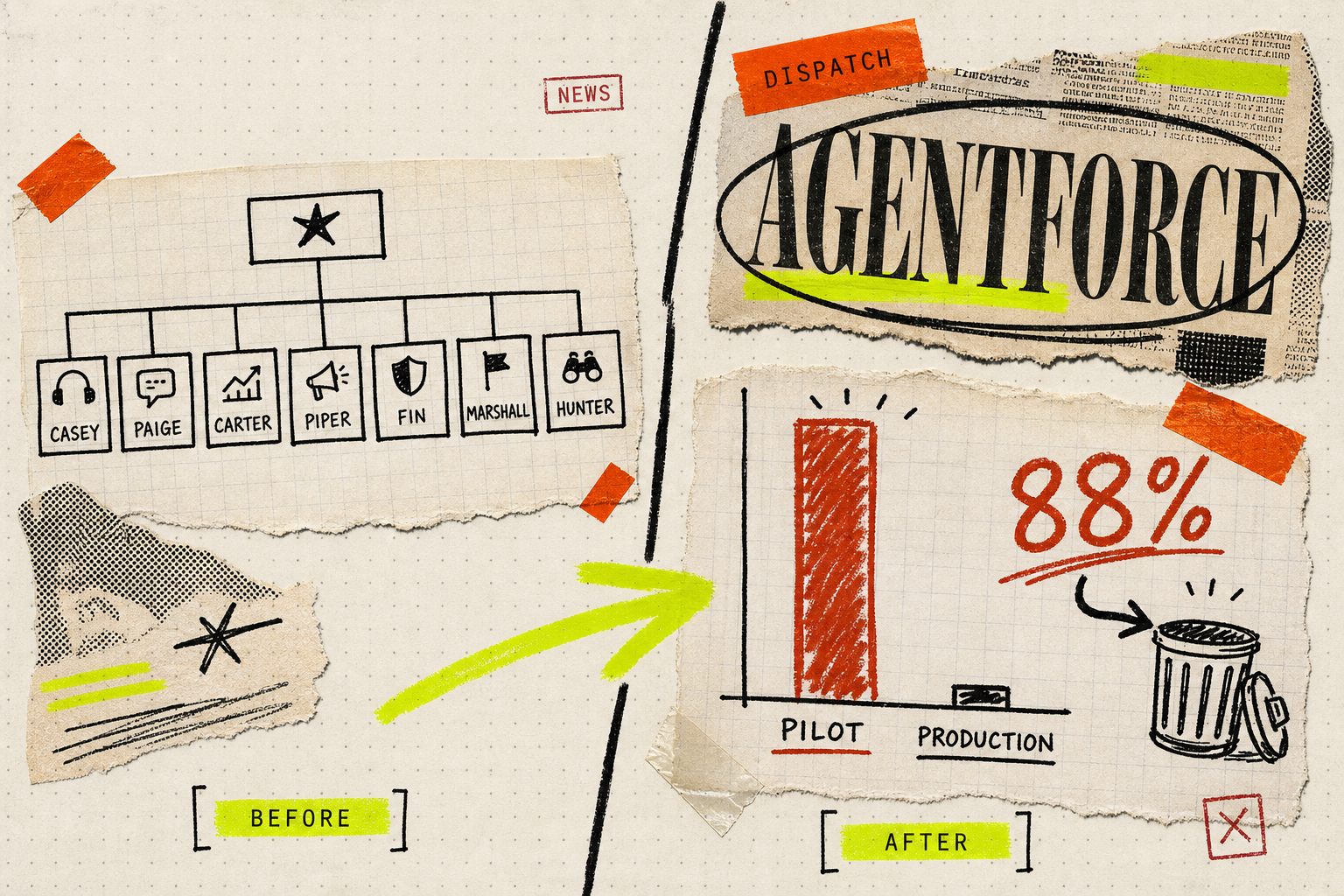
Salesforce Just Named Seven Agents. Enterprise AI Still Loses 88% Of Pilots.
Salesforce shipped 7 named Agentforce agents. But 88% of enterprise AI pilots still fail to reach production. Here's the real gap operators need to fix first.

Small Businesses Using AI Are Hiring More People, Not Fewer
Gusto ran payroll on 2,262 small businesses. AI adopters grew headcount 7% faster — 10% for under-10 firms. The doom takes miss the operator story.

WhatsApp Just Made Every Reply Billable. Your Bot Bill Starts October 1.
On October 1, Meta starts charging for every WhatsApp reply — human, third-party AI, or its own. The sticker price is the boring part. Here's what it actually breaks.