AI Costs More Than The Workers It Replaced. Don't Be That Company.
Uber burned its 2026 AI budget in four months. Klarna reversed course on 700 replaced agents. Here's the operating model that gets 5-10x ROI instead.
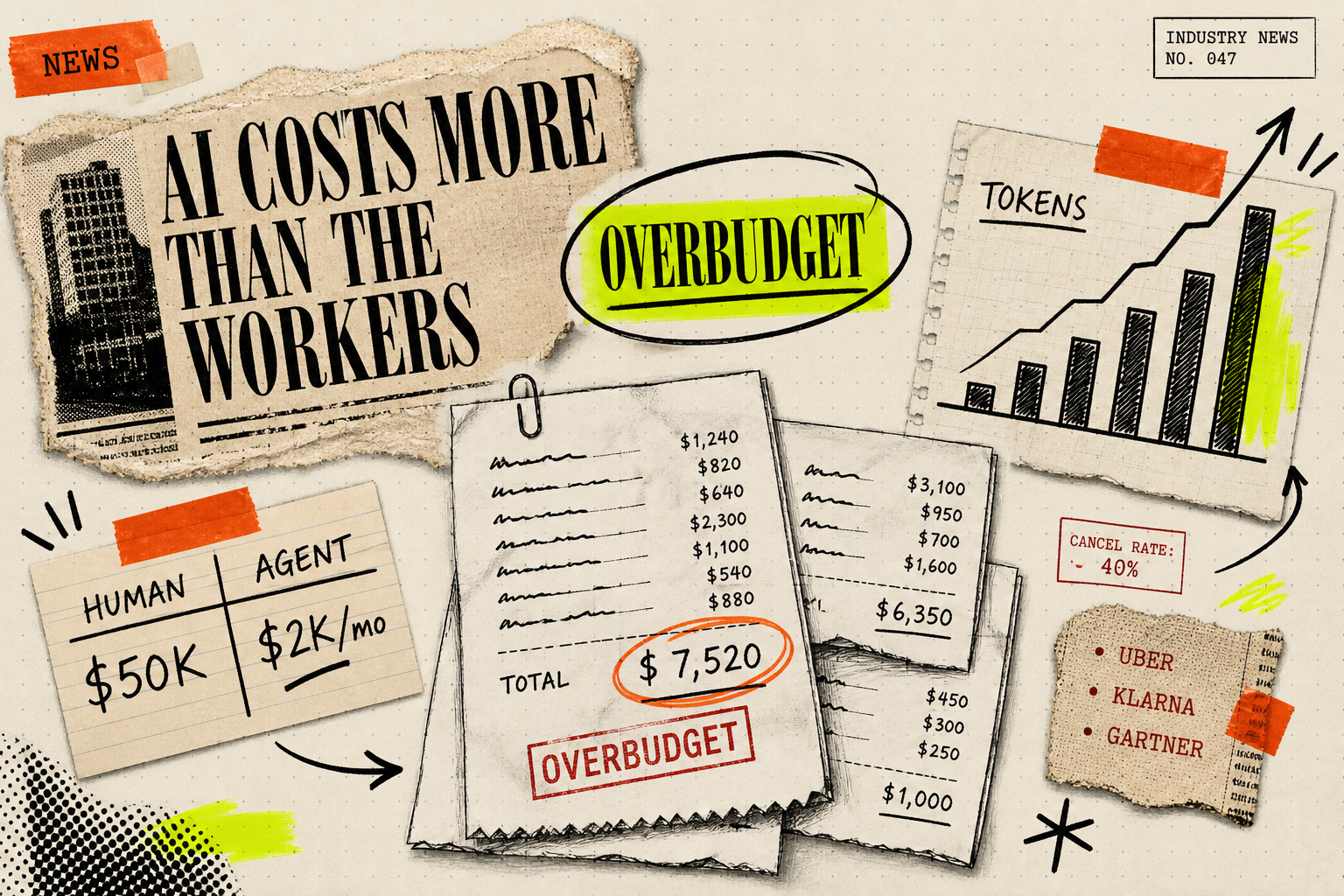
Uber burned through its entire 2026 AI budget in four months[1]. Klarna replaced 700 support agents with AI, watched quality collapse, and started quietly hiring humans back[2]. Gartner says 40% of agentic AI projects will be canceled by 2027[3]. And a Goldman Sachs breakdown from May pegged a coding-agent's raw API cost at $13.39 per day versus $300 for a human engineer[4].
So which is it? Is AI cheaper than a human, or more expensive?
Both. And if you don't know which side you're on right now, you're on the losing side. Here's what most operators are getting wrong.
The viral thesis is half right
The Forbes headline "AI Costs More Than The People It Replaced"[5] is a real thing that's happening. Fortune ran the same story in May pointing at Microsoft's own internal numbers[6]. The Economy Media explainer making the rounds on YouTube has 2.2M views.
The pattern is consistent enough to name: companies swap out a $50-70K loaded-cost human for an AI agent, then watch token spend outpace what they were paying the person.
Uber is the poster child. About 5,000 engineers got access to Claude Code in December 2025. By April, the entire 2026 AI budget was gone[7]. Per-engineer spend was running $500-$2,000 per month[8]. Uber's own COO started publicly asking whether the productivity gain justified the burn[9].
That's real. But here's what the viral takes miss: AI is 10-50x cheaper per task on almost every routine workflow that gets measured properly. Teneo's 2026 analysis of customer service put AI at $0.25-$0.50 per contact versus $3-$6 for a human — an 85-92% cost reduction that holds at scale[10]. Two things are true at once. The tech is cheaper. And it's blowing up budgets.
Why both are true
There are three failure modes stacked on top of each other, and most operators walk into all three.
Failure mode 1: Agentic workloads use radically more tokens than chatbots. A one-shot chatbot answer is a few thousand tokens. An agent that reads context, calls tools, checks its work, and iterates can burn 40-100x that per task. Gartner explicitly warned that cheaper token prices won't rescue enterprise AI budgets because agent consumption is growing faster than unit costs are falling[6]. This is why Uber's numbers exploded — engineers weren't asking Claude questions, they were letting it run.
Failure mode 2: No usage cap, no per-task budget, no unit economics. Most "AI adoption" I see at $1M-$20M operators looks like: buy licenses, hand them out, hope for the best. There's no line-item measuring cost per resolved ticket, cost per generated draft, cost per closed lead. You cannot manage what you don't measure — and if the only metric is monthly bill, you find out in the wrong direction.
Failure mode 3: Replacing the human before the system works. This is the Klarna trap. In 2024 they announced AI was doing "the work of 700 employees" and projected $60M in savings. By 2025, quality had degraded enough that the CEO publicly reversed and started re-hiring[2]. A more honest 2026 post-mortem shows it wasn't a clean flip — Klarna kept the AI for high-volume routine queries and layered humans back on top for anything complex[11]. The lesson isn't "AI failed." The lesson is: they fired the humans on Day 1, before the AI had earned any autonomy.
How to not be that company
I'll be blunt: if you're a $1M-$20M operator and you're deploying AI the way Uber and Klarna did — top down, no budget guardrails, replace humans first — you'll get the worst of both worlds. Higher bills, worse output, angry customers. Here's the operating model I actually build for:
1. Pick tasks with clean cost-per-unit math. Customer service tickets, cold email drafts, invoice categorization, review responses — anything where you can compute "what did that cost us to answer before, what does it cost now, is it better." If you can't write both numbers on a napkin, you're not ready to automate it. Aim for tasks where the Teneo-style $0.25-vs-$6 delta actually shows up in the P&L.
2. Set a hard per-workflow budget cap. Not "monthly AI spend" — that's how Uber got surprised. A per-run, per-user, per-agent cap that kills the workflow if it exceeds N cents. This is trivial to build with any modern LLM gateway. The reason most stacks don't have it: nobody's asked. Ask.
3. Instrument before you scale. Per-tool failure rates, retry counts, cost-per-completion, human-override rates. Reddit builders working on real production agents keep saying the same thing: tool-level metrics are what save the project, not model-level ones[12]. If your dashboard can only tell you "this month's OpenAI bill was $X," you don't have a dashboard, you have an invoice.
4. Earn autonomy in stages. Klarna's real mistake wasn't the AI — it was the "700 employees replaced" press release. Any workflow worth automating should ship in three stages: human does the work + AI drafts (parallel), AI does the work + human approves each output (review), AI runs solo on cases it's proven itself on (autonomous). Skipping to stage three because "AI can do the work of 700 people" is how you end up on Forbes.
5. Report cost-per-outcome to leadership monthly. Not "we spent $12K on AI." That's meaningless. "We closed 340 support tickets for $850, versus $2,040 the old way." That number lands. That number defends the budget when the CFO comes hunting.
The uncomfortable middle
The honest read on the last twelve months of enterprise AI is that the market is bimodal. On one side: operators using AI for well-scoped, well-measured, well-capped workflows and getting 5-10x unit economics. On the other side: operators throwing licenses at engineers with no framework, then getting Forbes-featured for the wrong reasons.
The 40% of agentic AI projects Gartner expects to die by 2027 aren't dying because the models don't work. They're dying because the operating model doesn't work[3]. Nobody set a budget cap. Nobody defined the unit economics. Nobody staged the autonomy. So when the bill came in higher than the salary of the person who used to do the job, the project got killed.
Don't be that company. The models are cheap enough now. The operating discipline is what's expensive — and it's the only thing that separates the 5-10x-ROI stack from the "why is our AI bill higher than payroll" stack.
Book an audit
If you're already three months into an AI rollout that feels expensive and you can't confidently answer "what does one completed task cost us?" — that's what the audit call is for. Thirty minutes, no pitch. I'll tell you exactly where your unit economics broke and what to fix first.
-
Uber Burns Its 2026 AI Budget In Four Months On Claude Code↩
Uber exhausted its 2026 AI budget in four months on Claude Code.
-
Klarna Reverses AI Push, Says Customers Prefer Human Support↩
Klarna reversed AI-only support and began rehiring humans after quality dropped.
-
Gartner: 40%+ of Agentic AI Projects Will Be Canceled by 2027↩
Analysis of Gartner's forecast: 40%+ of enterprise agentic AI projects will be canceled by end of 2027 due to escalating costs, unclear business value, and inadequate risk controls.
-
AI Is More Expensive Than Humans: What the Data Shows↩
Goldman Sachs May 2026 analysis: coding agent raw API cost $13.39/day vs $300/day for a human engineer.
-
AI Costs More Than The People It Replaced↩
Companies laying off workers to fund AI that costs more than the workers replaced.
-
Microsoft reports are exposing AI's real cost problem↩
Cheaper tokens won't translate to cheaper enterprise AI because agentic models use far more tokens per task.
-
Uber Exhausts AI Budget as Claude Code Hits 84%↩
Uber internal leaderboard drove Claude Code adoption to 84% of ~5,000 engineers; per-engineer spend hit $500-$2,000/month.
-
Uber Spends Full 2026 AI Budget in 4 Months↩
Uber burned its entire 2026 AI budget on Claude Code and Cursor by April; per-engineer API costs $500-$2,000/month.
-
Uber burned through its entire 2026 AI budget in four months. Now its COO is questioning whether it's worth it↩
Uber COO publicly questions whether AI spend justifies productivity gains.
-
AI agents can now cost more than the humans they were supposed to replace↩
Teneo.ai 2026 CS workflow analysis: AI $0.25-$0.50/contact vs $3-$6 human, 85-92% reduction.
-
Klarna's AI customer service deployment - AI Autopsy 002↩
Klarna's reversal was hybrid, not a clean flip - $60M projected savings and 853 employee equivalent remained partially in play.
-
Uber Caps Usage of AI Tools Like Claude Code to Manage Costs↩
Uber later capped employees to $1,500/month per AI coding tool - the exact 'per-workflow budget cap' fix the article recommends.
Ready to build your own AI system?
Book a Free Audit Call →Keep Reading
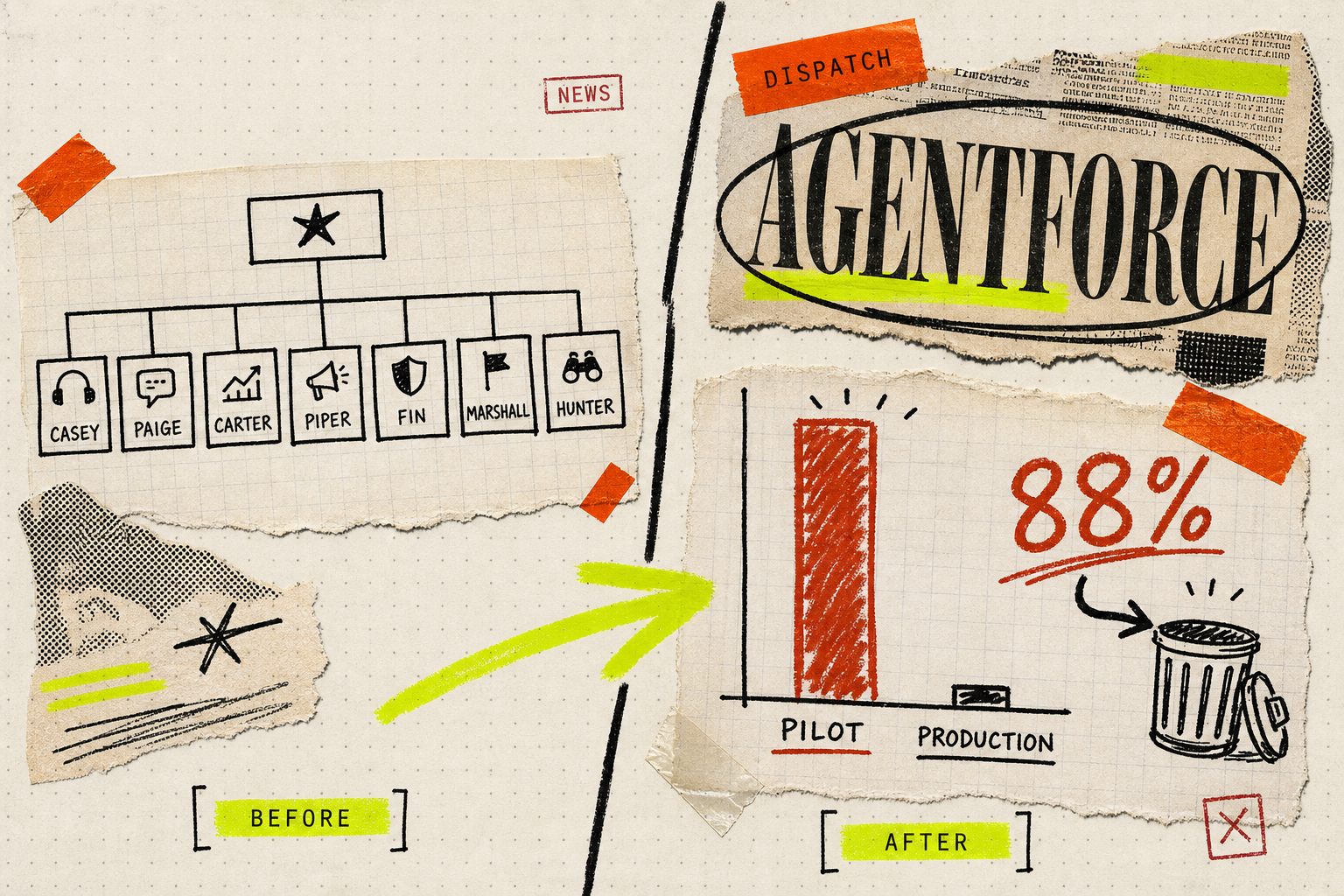
Salesforce Just Named Seven Agents. Enterprise AI Still Loses 88% Of Pilots.
Salesforce shipped 7 named Agentforce agents. But 88% of enterprise AI pilots still fail to reach production. Here's the real gap operators need to fix first.

Small Businesses Using AI Are Hiring More People, Not Fewer
Gusto ran payroll on 2,262 small businesses. AI adopters grew headcount 7% faster — 10% for under-10 firms. The doom takes miss the operator story.
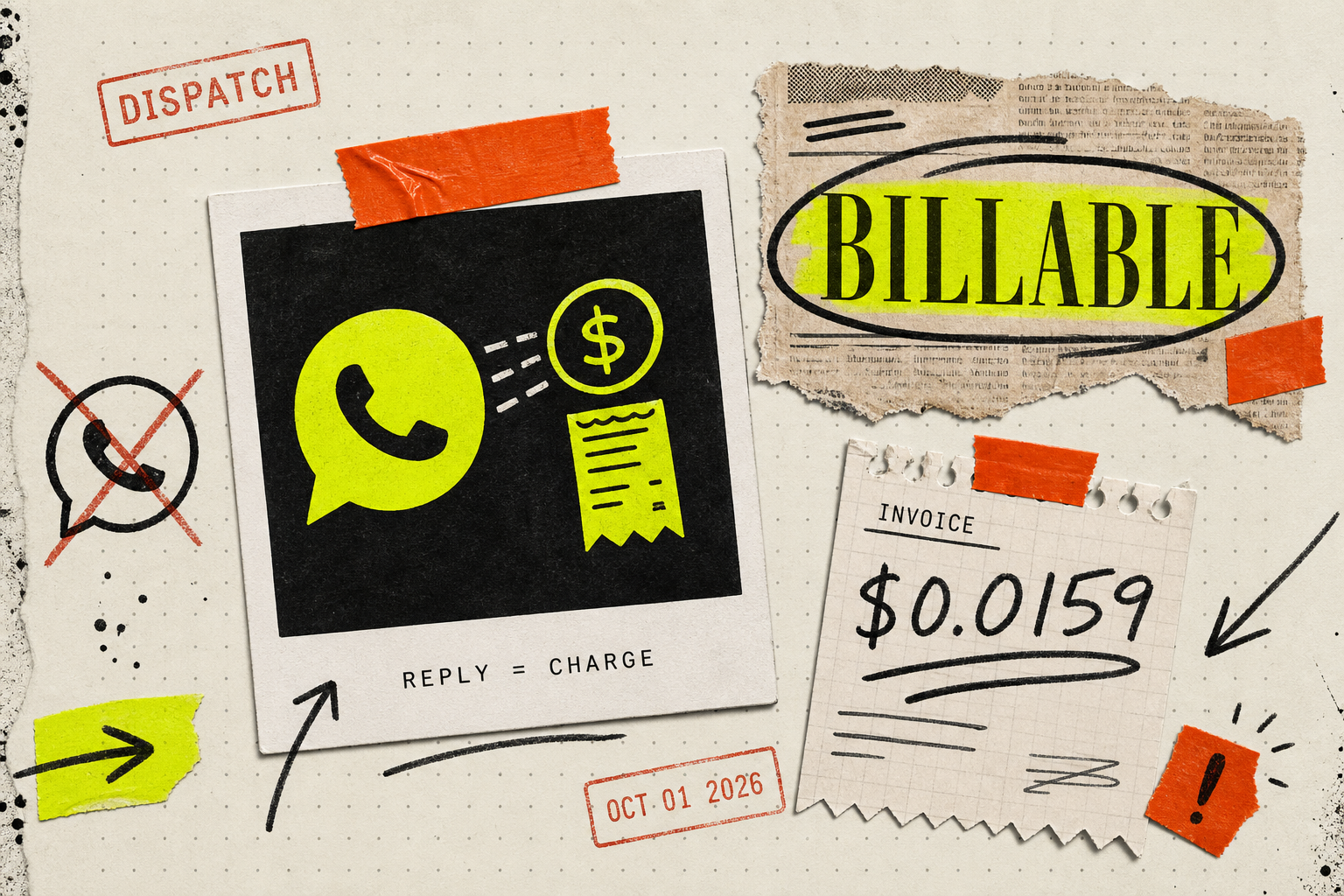
WhatsApp Just Made Every Reply Billable. Your Bot Bill Starts October 1.
On October 1, Meta starts charging for every WhatsApp reply — human, third-party AI, or its own. The sticker price is the boring part. Here's what it actually breaks.