AI Agents Just Got Permission To Spend. Your Checkout Isn't Ready.
Visa and Mastercard just plugged AI agents into checkout. Most merchants don't have the fraud guardrails, refund policy, or tokenization coverage to absorb it.
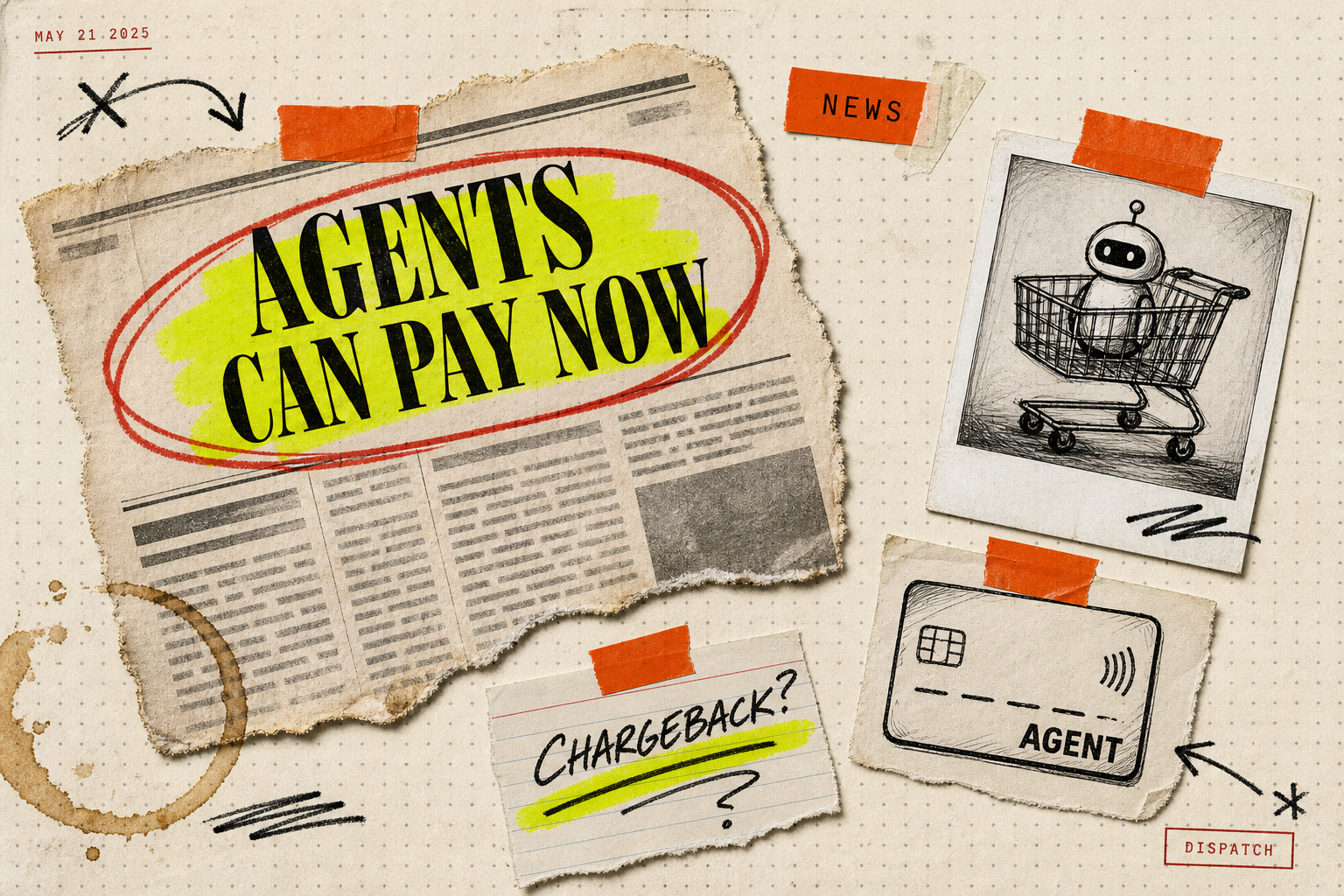
Visa plugged its payment network into ChatGPT five days ago.[1] Mastercard shipped Agent Pay for Machines the same week.[2] And Adyen's 2026 fraud report says AI agents will move 5–20% of all payment volume in the next five years.[3]
If you sell anything online, your checkout is about to get hit by traffic that doesn't behave like a human, doesn't authenticate like a human, and — when it goes wrong — files chargebacks that look nothing like the ones you're used to. Most operators I talk to think this is a 2027 problem. It's already in production.
Here's what's actually shifting, what the breathless takes are missing, and the three things I'd fix in your stack this quarter if you sell anything north of $50 a unit.
What just happened
Three things landed in roughly thirty days.
June 12, 2026 — Visa + ChatGPT. Visa now lets ChatGPT initiate purchases on a cardholder's behalf. Spending limits, approval steps, and a list of approved merchants act as the guardrails.[1]
June 11, 2026 — Mastercard Agent Pay for Machines. Mastercard extended its risk, fraud, and compliance network to agent-initiated transactions, with merchant-side acceptance tooling.[2]
May 20, 2026 — US Payments Forum Spring snapshot. Industry consensus: authentication is entering a new fraud era because the existing system was never designed for delegated commerce.[4]
And the part nobody's talking about: OpenAI quietly pulled its first attempt at Instant Checkout. Walmart, an initial retail partner, walked. Fortune's reporting points at unresolved fights over fraud, refunds, and returns.[5] The infrastructure is being built in public, mid-flight, while merchants get told it's all sorted.
It's not sorted.
Why most takes are wrong
The dominant LinkedIn narrative is that AI shopping is a frictionless win — agents pre-filter products, customers convert faster, everyone wins. Reasonable on paper. Wrong in three places.
Wrong #1: Consumers don't actually want this yet. Forrester's April 2026 survey found four recurring objections: loss of control, errors and liability, distrust of agentic decision-making, and data security.[6] When PYMNTS dug into the same question, the verdict was that consumers are interested in research but not in delegating the spend.[7] Translation: agents will show up in your funnel before customers fully trust them, which means your fraud signals are about to get noisier — not cleaner.
Wrong #2: The card networks aren't ready for the volume profile. Visa's network had issued over 12.6 billion payment tokens by early 2025; tokenized transactions show roughly 40% less fraud, and Mastercard's data says tokenization lifts authorization rates 3–6%.[8] Tokenization is the right pipe — but most mid-market merchants still route a meaningful share of traffic through non-tokenized checkout pages. When an agent loops on a flaky checkout, it doesn't give up like a person. It retries. Repeatedly. And those retries get scored as fraud.
Wrong #3: The chargeback math gets worse, not better. Sift's 2026 benchmark put the average general chargeback rate at 0.26% in Q3 2025, with card-not-present ecommerce sitting between 0.6% and 1%.[9] Visa's monitoring threshold is 0.65%.[10] You don't have a lot of headroom. If first-party fraud — already Adyen's number one enterprise threat in 2026 — gets a multiplier from "my agent bought something I didn't authorize," you can blow through your monitoring threshold in a single quarter without doing anything wrong on the front end.[11]
The optimistic story is real. The risk story is just as real. Both can be true at the same time. The mistake is shipping one and ignoring the other.
What this actually changes for operators
If you run a $1M–$20M ecommerce or hospitality business, three concrete things change in the next 90 days.
1. Your fraud model needs an "agent provenance" signal. Adyen's data shows 30% of merchants already say AI-platform trust scoring is the most critical new signal they need.[3] You probably can't build it yourself — but you can prepare by capturing which checkout sessions originated from agent traffic (User-Agent strings, OpenAI Atlas headers, partner integrations) and flagging them for separate review until you can score them. Don't treat agent traffic as human traffic. It's a different beast and your processor needs to know.
2. Your refund and return policy needs an agent clause. Right now, your terms probably assume a human authorized the purchase. When an agent acts on a delegated mandate and the customer disputes the charge later, who wins the chargeback fight? The honest answer is: nobody's tested it. Accenture's writeup on agentic commerce names liability handling as one of the unresolved infrastructure layers.[12] Get ahead of it with a one-paragraph addition: "If a purchase is initiated by an AI agent on your behalf, return windows and dispute eligibility may be affected." Boring legal hygiene, but it's free, and it documents your intent if a network arbitrator ever looks.
3. Your checkout needs to handle the false-decline problem before agents make it bigger. Agentic commerce shifts the weight of approval precision; false declines become more expensive because the agent retries and the customer never sees the friction it took.[7] If your decline rate is sitting above 8–10% — common in mid-market — fixing that this quarter buys you headroom for when agent traffic ramps. The order of operations: tokenize whatever isn't tokenized, push your 3DS implementation to 3DS 2.x with frictionless flows, and pull a 30-day decline report from your gateway and walk it with your processor.
None of those three is exciting. All three close the gap before the gap gets you.
How I'd build the agent-readiness check
If I were auditing a mid-market checkout today, the 30-minute version looks like this:
- Signal capture. Are agent-flagged sessions tagged in your analytics and your fraud tool? If no, that's the first ticket. Even a crude rule (HTTP_USER_AGENT contains "GPTBot" or "ChatGPT-User") is better than nothing.
- Tokenization coverage. What share of your transactions are network-tokenized? If you don't know the number, ask your gateway. Anything under ~70% on card transactions is a liability when agent volume hits.
- 3DS posture. Are you on 3DS 2.x with frictionless flow enabled, or still defaulting to 3DS 1.0 challenges that send buyers into a bank app? Frictionless flows are what agents actually traverse without breaking.
- Chargeback baseline. Pull the last six months and chart the trend by week. If you're north of 0.4%, you have a problem regardless of agents.
- Policy review. Add the agent-mandate clause to your ToS and your refund policy. One paragraph. Done.
Most of this is 20 hours of work with your current team. None of it requires "an AI strategy." All of it positions you to actually capture agent-driven revenue when it shows up instead of paying for it in fraud losses and false declines.
The honest bottom line
Agentic commerce is happening. The card networks have committed; the platforms have shipped; the volume curve is starting now. The numbers say it'll be somewhere between modest (5% of payment volume) and large (20%) within five years.[3] You don't have to bet on which end of that range. You just have to not get caught with infrastructure that assumes every checkout came from a human in 2024.
If your checkout still assumes that — and most do — you have a quarter, maybe two, to fix it before it costs you.
If you want a 30-minute look at where your checkout sits on the agent-readiness curve — tokenization coverage, false-decline rate, fraud-signal posture, the policy gaps — that's exactly the kind of audit I run. Book one at zerocam.studio. No pitch deck. Just the gaps and the fix order.
-
Visa lets ChatGPT shop for you, but with guardrails for AI chatbots↩
Visa launched payment integration with ChatGPT on June 12, 2026 with spending limits and approval guardrails
-
Fiserv Integrates Mastercard Agent Pay Into Merchant Platform↩
Mastercard launched Agent Pay Acceptance Framework; Fiserv integrating to support AI agent-initiated transactions
-
2026 Fraud Report: Fraud's Identity Crisis↩
AI agents projected to influence 5-20% of payment volume within five years; 30% of merchants name AI-platform trust scoring as most critical new signal
-
US Payments Forum Spring Market Snapshot: Authentication Enters New Fraud Era↩
US Payments Forum May 2026 snapshot: authentication entering new fraud era for delegated commerce
-
AI shopping agents are coming. No one is ready for them↩
OpenAI pulled Instant Checkout; Walmart withdrew as launch partner; no industry agreement on fraud/refunds/returns
-
Consumers Reject Delegating Payments To AI Agents↩
Forrester April 2026 survey identifies four consumer objections to agentic payments
-
Agentic Commerce May Force New Focus on False Declines↩
Agentic commerce shifts weight to approval precision; false declines more expensive when agents retry silently
-
Ecommerce Fraud and Chargeback Prevention: 2026 Playbook↩
Visa issued 12.6 billion payment tokens by early 2025; tokenized transactions see ~40% less fraud
-
Chargeback Statistics 2026: 25+ Facts on Fraud, Costs and Trends↩
Sift 2026 benchmark: average general chargeback rate reached 0.26% in Q3 2025; CNP ecommerce sits 0.6-1%
-
Average Ecommerce Chargeback Rate vs Visa's 0.65% Threshold↩
Visa's chargeback monitoring threshold is 0.65%
-
Adyen Report: First-Party Fraud Emerges as Top Enterprise Threat↩
First-party fraud is now the top enterprise threat per Adyen 2026 report
-
Agentic Commerce and the Future of Payments↩
Liability handling remains an unresolved infrastructure layer for agentic commerce
Ready to build your own AI system?
Book a Free Audit Call →Keep Reading
Salesforce Just Named Seven Agents. Enterprise AI Still Loses 88% Of Pilots.
Salesforce shipped 7 named Agentforce agents. But 88% of enterprise AI pilots still fail to reach production. Here's the real gap operators need to fix first.

Small Businesses Using AI Are Hiring More People, Not Fewer
Gusto ran payroll on 2,262 small businesses. AI adopters grew headcount 7% faster — 10% for under-10 firms. The doom takes miss the operator story.
WhatsApp Just Made Every Reply Billable. Your Bot Bill Starts October 1.
On October 1, Meta starts charging for every WhatsApp reply — human, third-party AI, or its own. The sticker price is the boring part. Here's what it actually breaks.