Shopify Just Opted 5.6M Stores Into AI Shopping. Most Don't Even Know.
Shopify auto-enrolled 5.6M stores into ChatGPT, Copilot, and Google AI Mode on March 24. AI traffic now converts 42% better. Most operators have no idea.
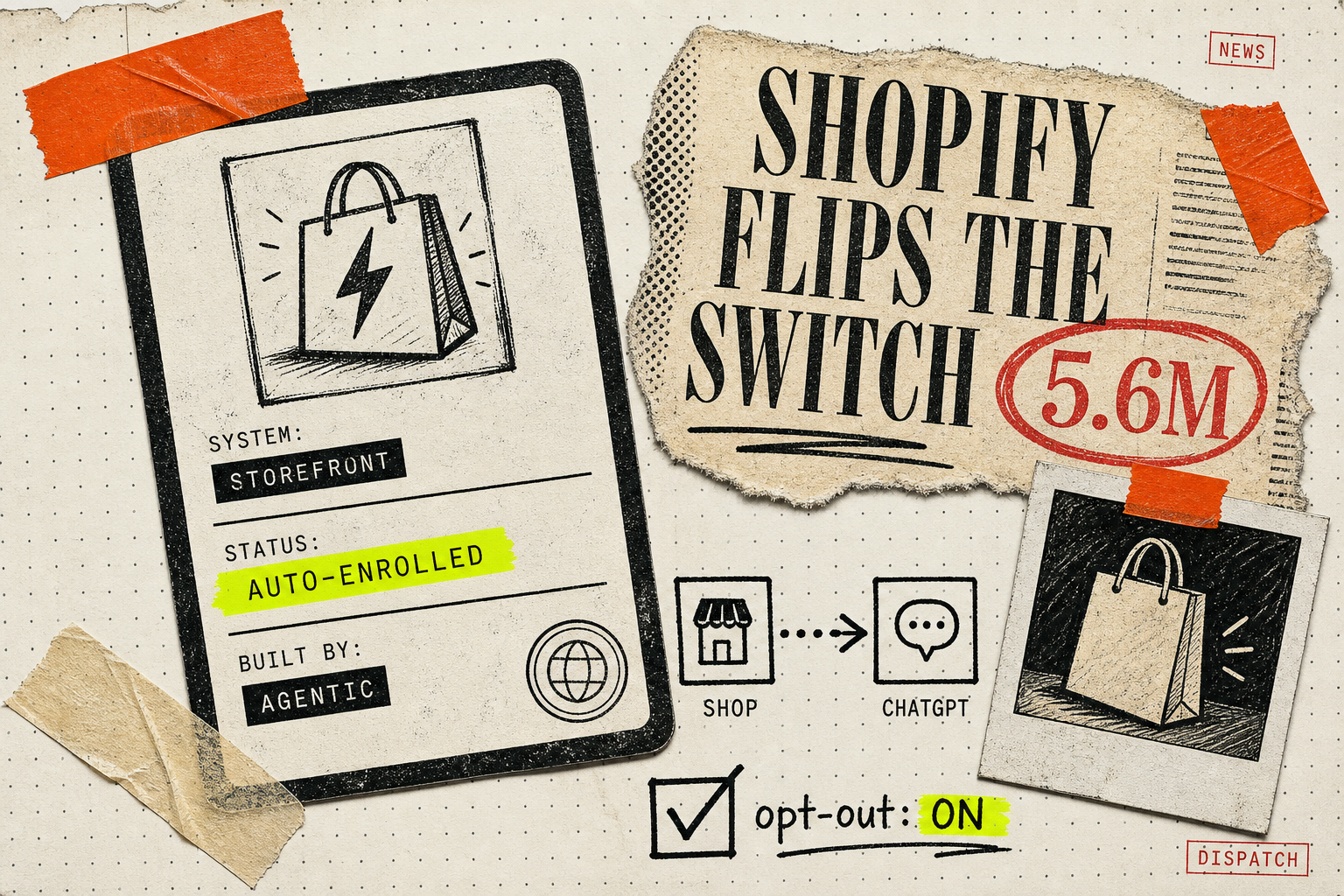
On March 24, 2026, Shopify flipped a switch. Roughly 5.6 million stores were enrolled into Agentic Storefronts overnight — no opt-in, no setup wizard, no email asking permission[1]. If you run a Shopify store in the US, your products are now sitting inside ChatGPT, Microsoft Copilot, Google AI Mode, and the Gemini app, getting recommended to shoppers in conversations you'll never see.
This is the biggest distribution change in DTC since paid social got expensive. And almost every operator I talk to has no idea it happened.
What Shopify actually did
The mechanic is simple. Shopify co-developed the Universal Commerce Protocol with Google — an open standard that lets AI agents discover products, build carts, and check out across any platform and any payment processor[2]. On the ChatGPT side, Shopify wired into the Agentic Commerce Protocol so its merchants transact directly in chat alongside OpenAI's instant-checkout flow[3]. The result: your catalog becomes a feed that AI agents can read and transact against, without sending the shopper to your website.
The default is opt-out. Inside Shopify Admin, there's now an "Agentic" panel with a toggle that reads "Allow Shopify to manage for me." It's on by default[4]. That setting auto-enrolls you in every AI channel Shopify integrates with — current and future. If you've never logged into that panel, you're already live.
Worth saying clearly: this isn't a beta. It's the new front door.
Why most takes are wrong
The LinkedIn thread version of this story is "AI is the future of commerce, get on board." That's the kind of analysis that drives operators to install a chatbot and call it a strategy. It misses what's actually different.
Two things changed in March that didn't change before:
One — the distribution is real. Shopify's president Harley Finkelstein has been openly framing agentic apps as "personal shoppers" that become a new front door for e-commerce[5]. The numbers are catching up to the talk: AI traffic to US retail sites was up 393% year-over-year in Q1 2026, according to Adobe[6]. That's not a curiosity number. That's a channel that didn't exist 18 months ago becoming material.
Two — the conversion math is upside down. Adobe's data: AI-referred traffic converted 42% better than non-AI traffic in March 2026, and revenue per visit ran 37% higher[6]. Shopify's own internal numbers: AI-referred shoppers convert at nearly 50% higher rates with 14% higher average order values than organic search[7]. Whatever you believe about the long-run, the short-run data says agentic traffic is already your best converting channel by a wide margin.
The takes I'm reading don't grapple with what that means. If your highest-converting channel is one where your brand, photography, copy, and PDP design are invisible — and the agent picks based on machine-readable data alone — your entire conversion strategy needs to be rebuilt.
What it actually changes for operators
I'd think about this in three buckets.
Your product feed is the storefront now. When a shopper asks ChatGPT "best running shoes for flat feet under $150," the agent reads your product data, your policies, your reviews, your inventory state, and your shipping options. It doesn't look at your hero image. It doesn't read your About page. Your title, description, category, attributes, variant data, and return policy ARE the conversion surface. Stores that have spent the last decade optimizing PDPs for humans need to spend the next quarter optimizing feeds for agents — or get outranked by a competitor whose copywriter happened to write better structured data.
Your moat is shifting from brand to availability. When the agent decides what to surface, the inputs are price, availability, fulfillment speed, returns terms, and reviews. Brand loyalty still matters — shoppers will sometimes name the brand they want. But the discovery query "best X for Y under $Z" is now a real-time auction where having a clean SKU feed and 2-day shipping beats having a beautiful Shopify theme. Operators who built their advantage on storytelling above the fold should be nervous.
The opt-out question is harder than it looks. I've heard founders say "I'll opt out — I'm not letting AI sell my product without my consent." Fine in principle. In practice, you're opting out of the channel that's growing 393% a year and converting 42% better than the rest of your stack. The honest move isn't "opt out" or "opt in and forget" — it's spend a weekend cleaning your product data and policies so when the agent reads you, you win the comparison.
The risk that nobody talks about: the agent is increasingly the buyer's interface, but the merchant of record is still you. Returns, support tickets, chargebacks, fraud — all yours. If the agent misreads your sizing data and recommends the wrong product to 10,000 people, your return rate explodes and the agent doesn't pay the restocking fee. The economics work right now because conversion is so high. They'll tighten when volume grows.
What I'd build first
If I were running a $5M Shopify brand today, I'd do three things this month, in order.
- Audit the Agentic panel. Log in, see what's already enabled, decide what stays on. Most operators have never opened it. If the panel is empty, your policies, shipping, and returns pages are probably incomplete — the agent reads those to answer "Does this store offer free returns?" If your policy page is blank, you don't show up in that conversation.
- Rebuild your product feed for agents. Title structure, attribute coverage, variant detail, structured shipping data, return windows, image alt text, FAQ blocks tied to specific SKUs. The same way SEO teams spent a decade learning what Google's crawler cared about — you have 12 months to figure out what the agent's retrieval layer cares about. The brands that move first will compound for years.
- Build a measurement layer for agent traffic. Most Shopify analytics setups can't separate AI-referred sessions from organic search yet. Set up referral tagging, monitor the new "agentic" channel in your reports, and figure out which products are winning agent recommendations vs. which are getting skipped. If you can't see it, you can't optimize it.
The brands that will lose the next two years aren't the ones who don't have an AI strategy. They're the ones who have one for ads and not for distribution. Agentic commerce isn't a feature you bolt onto your store. It's the new layer between your catalog and your buyer — and Shopify just installed it for you whether you asked or not.
If you're running a Shopify store at $1M–$20M and you want a hard look at what your store looks like to an AI agent right now — what's machine-readable, what's missing, where you're getting outranked — that's exactly what the audit call is for. 30 minutes, no pitch. I'll show you what I see and what I'd fix first.
-
Shopify Agentic Storefronts Went Live for All Merchants on March 24 — What That Actually Means for Your Store↩
5.6M Shopify stores became part of ChatGPT's shopping experience on March 24, 2026 without merchants doing anything.
-
Building the Universal Commerce Protocol (2026)↩
UCP is the open standard Shopify co-developed for how AI agents transact with merchants.
-
Introducing Shopify Agentic Storefronts: Sell your products everywhere AI conversations happen↩
Shopify wired both the OpenAI/Stripe ACP and the Shopify/Google UCP so merchant catalogs transact across ChatGPT and other AI agents.
-
Shopify Agentic Storefronts: Complete 2026 Guide↩
Inside Shopify Admin, the Agentic panel defaults to 'Allow Shopify to manage for me' — auto-opt-in to all channels.
-
Shopify is preparing for AI shopping agents to change everything, exec says↩
Shopify president Harley Finkelstein on the agentic commerce rollout as the new front door for e-commerce.
-
AI traffic to US retailers rose 393% in Q1, and it's boosting their revenue too↩
Adobe Q1 2026: AI traffic to US retailers up 393% YoY; converting 42% better than non-AI traffic with 37% higher revenue per visit.
-
AI-referred shoppers convert better and spend more (2026)↩
AI-referred shoppers convert at nearly 50% higher rates with 14% higher AOV than organic search.
Ready to build your own AI system?
Book a Free Audit Call →Keep Reading
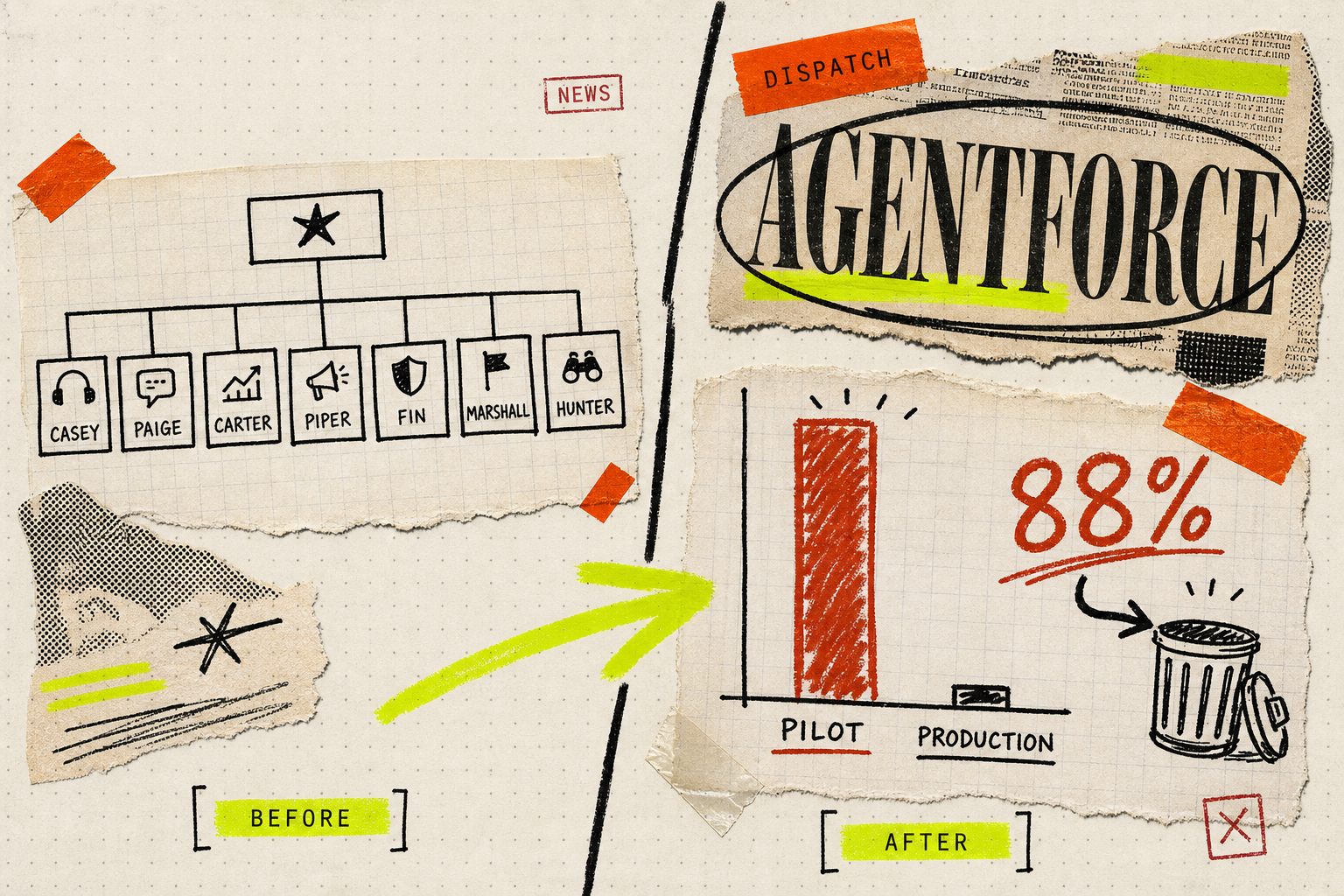
Salesforce Just Named Seven Agents. Enterprise AI Still Loses 88% Of Pilots.
Salesforce shipped 7 named Agentforce agents. But 88% of enterprise AI pilots still fail to reach production. Here's the real gap operators need to fix first.

Small Businesses Using AI Are Hiring More People, Not Fewer
Gusto ran payroll on 2,262 small businesses. AI adopters grew headcount 7% faster — 10% for under-10 firms. The doom takes miss the operator story.
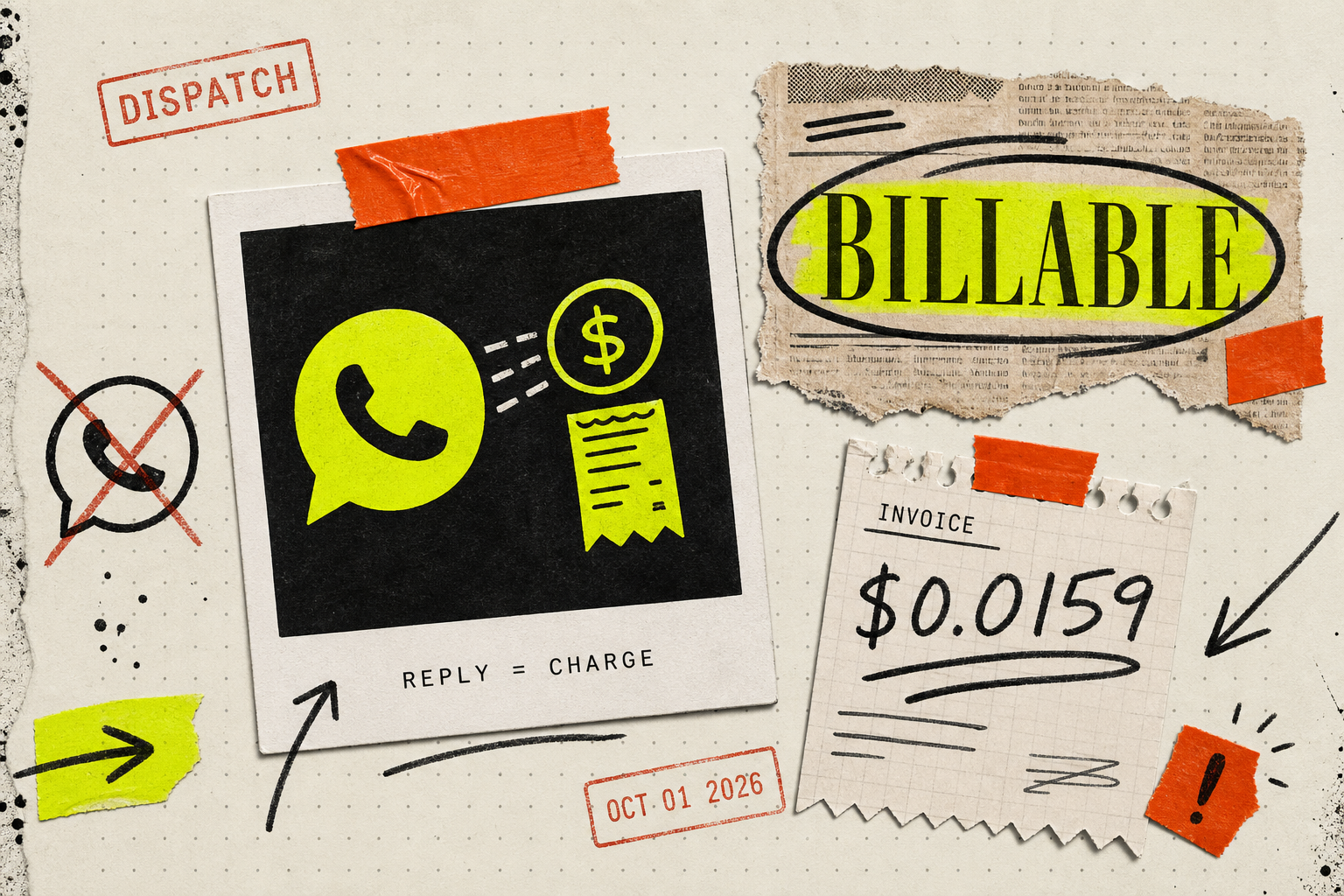
WhatsApp Just Made Every Reply Billable. Your Bot Bill Starts October 1.
On October 1, Meta starts charging for every WhatsApp reply — human, third-party AI, or its own. The sticker price is the boring part. Here's what it actually breaks.