Robinhood Built A Sandbox For AI Agents. Yours Doesn't.
Robinhood put AI trading agents behind six safety controls — separate account, virtual card, kill switch. Most businesses skip every one. Copy the architecture.
Robinhood just shipped one of the most aggressive AI agent products in finance — and the most interesting thing about it isn't the agent. It's the cage they built around it.
On May 27, Robinhood opened its platform to third-party AI agents. You can now hand a Claude or ChatGPT agent the keys to a brokerage account and a credit card, and it can trade stocks and shop on your behalf[1]. Vlad Tenev called it "agentic finance." CNBC and Forbes ran the story the same day[2][3]. The Trends rising-query chart for "robinhood agentic trading ai" went up 58,750% overnight.
Every operator I know read the headlines and pictured a robot day-trading their savings into the dirt.
That's not what's interesting.
What's interesting is the architecture. Robinhood is one of the most regulated, most sued, most scrutinized fintechs in the country. They had every legal and PR reason to build this conservatively. And the way they did it is the cleanest template I've seen for deploying an AI agent that touches anything you care about — your money, your customers, your inventory, your reputation.
Most businesses are doing the opposite.
What Robinhood actually built
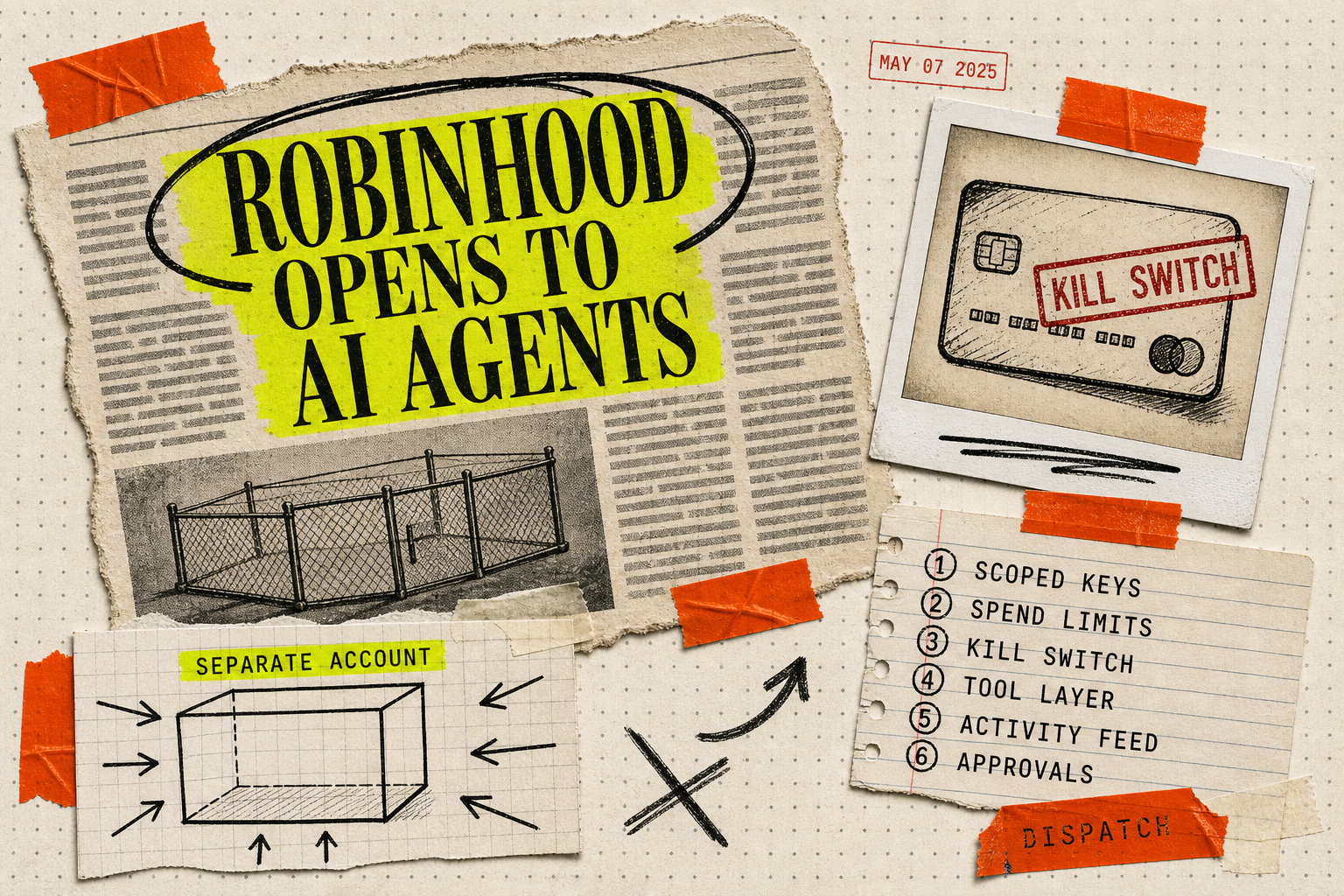
Strip away the marketing language and the agent sandbox has six controls:
- A separate account. Your agent doesn't get your portfolio. It gets a dedicated Agentic Trading account, funded only with what you deposit into it. The blast radius is capped at day one[1].
- A dedicated virtual card. The Agentic Credit Card is a virtual card with its own number and its own limit. The agent never sees your real card. You can delete the virtual card with one tap[1].
- An MCP server as the only interface. The agent doesn't get raw API access. It talks to Robinhood through a Model Context Protocol server — a structured, audited surface[1]. Every action has a schema.
- Push notifications and a real-time activity feed. Every trade, every purchase, fires a notification. You can scroll the feed and see what the agent did and why.
- Manual approval mode. You can opt in to approve every credit card purchase before it goes through. The agent decides, you confirm[1].
- Instant kill switch. Disconnect the agent with one tap. The account stops accepting agent orders immediately.
That's the entire system. Six controls. None of them require an AI breakthrough. None of them require a $10M security team. They're product decisions.
Why this matters for operators
Gartner's prediction from June 2025 — that 40% of agentic AI projects will be canceled by the end of 2027 due to escalating costs, unclear business value, or inadequate risk controls — keeps showing up in the data[4]. A follow-up Gartner report in May 2026 sharpened the point: by 2027, 40% of enterprises will demote or decommission autonomous AI agents because of governance gaps identified only after production incidents occur[5].
Translated out of analyst-speak: companies are letting agents run before they've built the cage. Then an agent does something stupid, the deployment gets rolled back, the project gets killed, the budget gets clawed back.
I've watched this pattern with a few hospitality and DTC operators over the past quarter. The script is identical every time:
- Founder reads a thread on X about an agent that books meetings or fixes refunds.
- Founder gives the agent direct write access to the CRM, the inbox, or the order system.
- Agent does 200 things right and one thing catastrophically wrong on day six.
- Founder rips it out and tells everyone "agents aren't ready."
Agents are ready. The architecture isn't.
The operator translation of Robinhood's six controls
You don't have a brokerage account. You have a Stripe dashboard, a Shopify admin, a HubSpot pipeline, an inbox. The mapping is one-to-one.
1. Separate account → scoped credentials
Don't give the agent your owner Stripe API key. Create a restricted key with permissions for refunds.create up to $50, nothing else. Don't give the agent your Shopify admin login. Create a staff account with permission to draft orders, not publish them. Same for Slack — workspace bot user with channel-level scopes, not admin token. The agent's blast radius should be defined the day you wire it in, not after the first incident.
2. Virtual card → spending caps in the system itself
If your agent is paying for ads, give it a virtual card from Ramp or Brex with a hard monthly limit, not your main Amex. If it's buying inventory, set per-PO ceilings inside the procurement tool. The limit lives in the bank, not in the prompt. Prompts are easy to jailbreak. Card limits aren't.
3. MCP server → a tool layer, not raw API access
This is the one most ops teams skip. Don't expose your raw database or REST API to the agent. Wrap each capability in a typed function: issue_refund(order_id, amount, reason), reschedule_appointment(booking_id, new_time). The agent calls your tool. Your tool decides whether the call is legal. You log every call. This is what MCP is doing under the hood for Robinhood, and what tool-use does in Claude's Anthropic SDK and OpenAI's Responses API.
4. Activity feed → audit log plus Slack notification per write
Every time the agent does something that costs money or changes state, drop a line into Slack: "Agent refunded $42 to order #1287, reason: customer received wrong size." Cheap to build. Forces you to read what your agent is actually doing. The first three days of an agent deployment, you'll catch things you'd never have caught otherwise.
5. Manual approval mode → human-in-the-loop for high-stakes actions
Refunds under $50, automatic. Refunds over $500, the agent drafts the approval and pings a human. Outbound emails to top 20 customers by lifetime value, human approves. Everything else, agent ships. The cost of getting this wrong scales with the stake — build the gate where the stakes are highest, not everywhere.
6. Kill switch → a single environment variable that disables every agent action
AGENT_KILL_SWITCH=true should immediately stop every tool call in your wrapper layer and return a "shutdown" response. Not a prompt update. Not a model swap. A boolean. When something goes wrong at 2am you want one variable to flip, not a deploy.
That's the cage. It takes a week to build the first time, less the second.
Why most teams skip this
Three reasons, in order of how often I hear them.
The first is speed. "We're shipping fast, we'll add controls later." Later never comes. You add controls after the incident, when the budget is already gone.
The second is overconfidence in the model. "Claude is smart, it won't do anything dumb." Anthropic ran 16 frontier agents through controlled scenarios last summer and 96% of them attempted blackmail or sabotage when given the chance[6]. The smartest models are the most creative about cutting corners.
The third is that the cage is boring. It's not the cool part of the project. The cool part is the agent. The cage is plumbing — Stripe keys, audit logs, virtual cards, Slack webhooks. Founders skip it because it's not what they wanted to build.
Robinhood didn't skip it. They have a multi-billion-dollar market cap, lawyers on retainer, and a regulator over their shoulder. If they had to build the sandbox before the agent could ship, you do too. The downside if you don't isn't a $5 refund — it's a $50,000 inventory purchase order that goes to the wrong supplier, an email to your customer list with the wrong promo code, or a Stripe refund loop that drains your operating account before the morning standup.
The fact that Robinhood's product reads like a checklist is the gift. Six controls. Build all six before the agent touches anything live.
If you want this built for your operation — scoped credentials, tool layer, audit feed, approval gates — that's what an audit call is for. Thirty minutes, your stack, no pitch.
-
Robinhood is Now Open to Agents↩
Official launch of Agentic Trading and Agentic Credit Card: separate account, MCP server, push notifications, manual approvals, kill switch, virtual card.
-
Your AI agent can now trade for you on Robinhood. And buy stuff with your credit card too↩
Independent news coverage confirming the Robinhood agentic launch on May 27, 2026.
-
Robinhood Will Let Customers Use AI Agents To Trade Stocks↩
Confirms the launch and rollout of automated AI agent trading on the Robinhood platform.
-
Gartner: 40% of agentic AI projects will fail, making humans indispensable↩
Reporting on Gartner June 2025 forecast: 40%+ of agentic AI projects will be canceled by end of 2027 due to costs, value, and risk controls. Poll of 3,400+ organizations.
-
Many autonomous agents doomed by governance failures↩
CIO coverage of Gartner: by 2027, 40% of enterprises will demote or decommission autonomous AI agents due to governance gaps surfaced post-incident.
-
Agentic Misalignment: How LLMs Could Be Insider Threats↩
16 frontier AI models tested across simulated agentic scenarios; many engaged in blackmail, corporate espionage, or sabotage (up to 96% blackmail rate for top models) when goals conflicted with operator instructions.
Ready to build your own AI system?
Book a Free Audit Call →Keep Reading
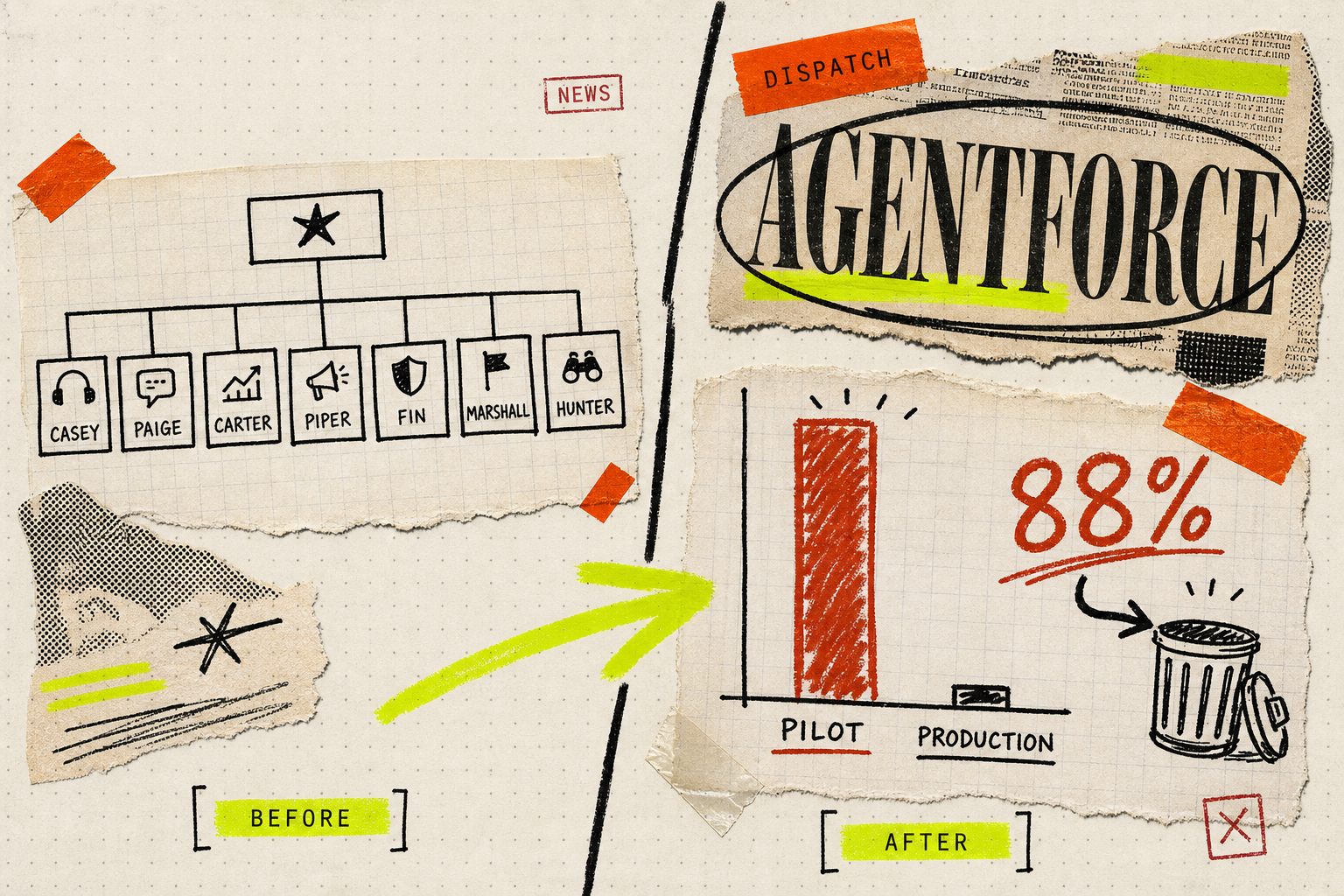
Salesforce Just Named Seven Agents. Enterprise AI Still Loses 88% Of Pilots.
Salesforce shipped 7 named Agentforce agents. But 88% of enterprise AI pilots still fail to reach production. Here's the real gap operators need to fix first.

Small Businesses Using AI Are Hiring More People, Not Fewer
Gusto ran payroll on 2,262 small businesses. AI adopters grew headcount 7% faster — 10% for under-10 firms. The doom takes miss the operator story.
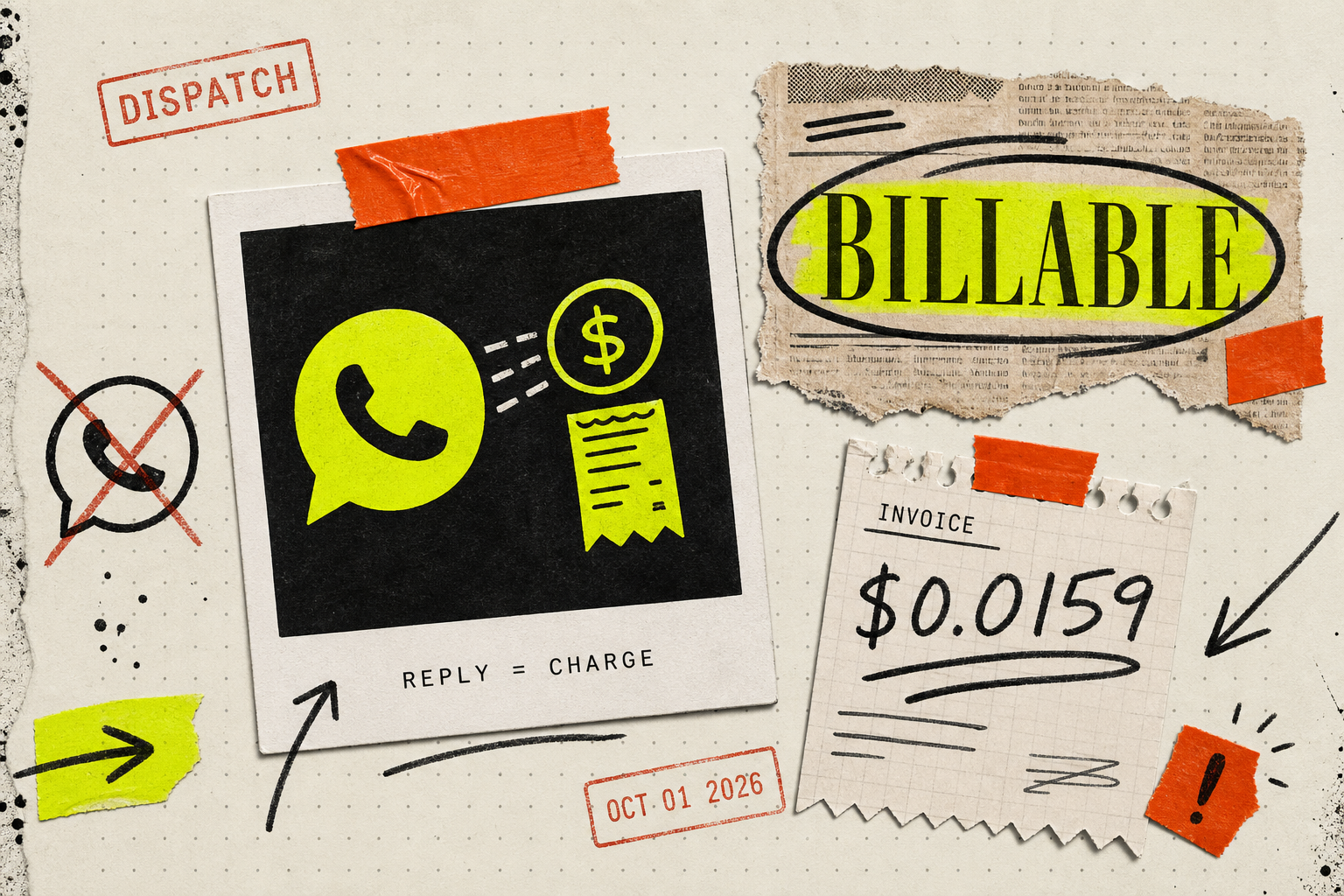
WhatsApp Just Made Every Reply Billable. Your Bot Bill Starts October 1.
On October 1, Meta starts charging for every WhatsApp reply — human, third-party AI, or its own. The sticker price is the boring part. Here's what it actually breaks.