Meta Just Turned On AI Ads By Default. Ask REI About The Bike.
Meta shipped Brand Memory at Cannes on an opt-out default. Ask REI, who spent a week running an AI-mutated two-handlebar bicycle ad they never approved.
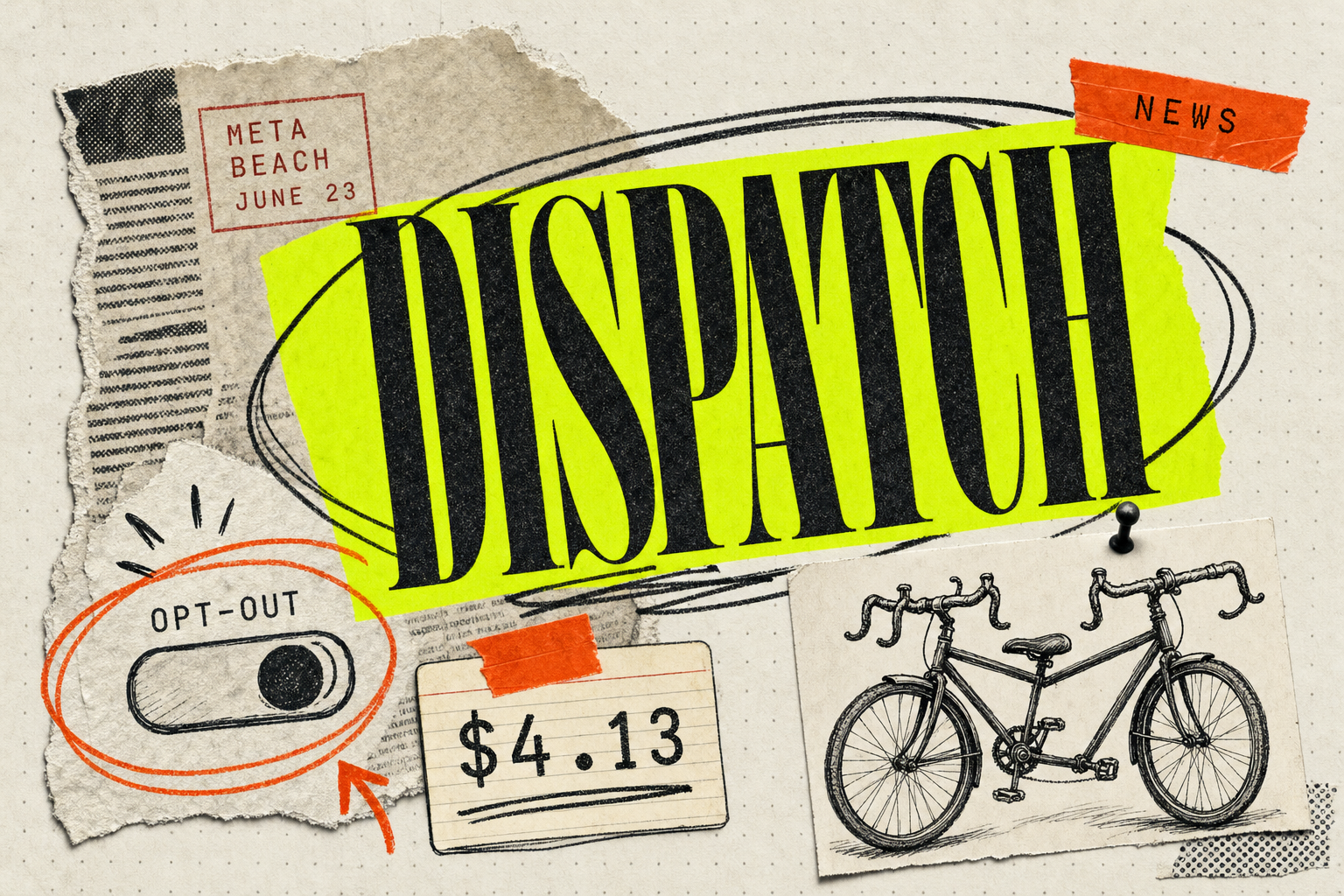
On June 23 at Cannes Lions, Meta's global business chief Nicola Mendelsohn walked on stage at Meta Beach and announced Brand Memory[1] — an AI creative system that learns your brand from your past ads and generates new ones for you. The pitch was clean: every dollar spent on Meta ads now returns $4.13 in revenue on average, up 25% since 2022, based on a study of over one million campaigns[1].
Every marketer on LinkedIn spent the week calling it the future of advertising. Most of them missed the actual story.
The actual story is that eight days before that keynote, REI's Meta account posted an ad featuring a bicycle with two sets of handlebars welded onto the same frame. It ran on Instagram for about a week before anyone noticed[2]. REI didn't ask Meta's AI to touch that image. Meta had auto-enrolled the retailer into an AI personalization tool that modified a vendor-supplied product photo without telling anyone[3].
That's the shipping default of Meta's new AI creative stack. Opt-out. On by default. Silent when it edits your work.
What Meta actually shipped (and what's just a roadmap)
Cut through the Cannes press-release noise. Three things were announced, one is real today, two are "coming months"[4]:
- In limited testing today: Brand Memory + the end-to-end creative workspace, with select advertisers.
- In testing inside Ads Manager: a creative-approval workflow so teams can review AI-generated modifications before they go live.
- Live and expanding: language translation for text overlays (adds Portuguese, French, German, Italian, Indonesian) and video voiceover translation (now 11+ languages including Hindi, Arabic, Chinese, Turkish)[1].
Everything else is roadmap. If your rep is telling you Brand Memory is switch-on ready across your accounts, they're selling you next year's product with this year's confidence.
The one number I'd actually anchor on: Meta raised its 2026 capex guidance to $125–145 billion[4]. That's the scale of the bet driving all of this. The $4.13 figure isn't a lie — it's an average across a million campaigns from a Meta-commissioned study using a Berkeley randomized-controlled framework[1]. It's also an average that hides an enormous range. Your account is somewhere on that distribution, not standing on the mean.
Why "opt-out" is the whole story
Meta's AI creative ecosystem does something interesting: it learns from what performed. Brand Memory ingests roughly 18 months of your ad library, extracts tone and format, and generates new creative that echoes your past winners[4].
Read that again. It learns what performed. Not what you stand for.
If you had a lousy 2024 — off-brand offers, bargain-bin creative, a positioning you're actively moving away from — Brand Memory will scale that at velocity, with conviction, before you notice. It's an execution accelerant, not a strategy engine. It compounds whatever direction you were already pointed in.
Then layer on the enrollment default. REI's own statement to Business Insider: "Meta auto-enrolled us in an AI personalization tool that produced an inaccurate and inappropriate alteration of a vendor-provided image in some of our ads."[2] REI didn't opt in. It took a week for anyone to notice a bicycle with a duplicate steering column. The retailer has since unenrolled and apologized[5].
If a $3.7B revenue co-op with a real marketing team missed it for a week, so will your $8M DTC brand.
The three questions to answer this week
Not next quarter. This week. Before your next campaign spins up:
1. Which AI personalization toggles is Meta already running on your account? Log into Business Manager → Ads Manager → Account Settings → Advantage+ Creative controls. Anything set to "on" that you didn't consciously turn on is on because of the opt-out default. Audit every account you touch. Screenshot the current state before you change anything so you know what you started with.
2. What's the last 18 months of creative you'd actually want Brand Memory to learn from? This is the harder question. If Brand Memory ships broadly this fall and you enroll, you're feeding the model a body of work. Pull your top 30 ads by ROAS from the last 18 months. Then ask: does this represent where the brand is going, or where it's been? If it's "where it's been," Brand Memory will lock you into that. Either curate the training set aggressively or hold off on enrollment.
3. Who owns the "human in the loop" on your account? Meta is testing a Creative Approval Flow, but it's not shipped everywhere yet, and even when it is, someone has to actually approve[4]. Name that person. Give them 15 minutes a day. If nobody owns it, the answer to "who is checking Meta's AI edits before they hit our audience?" is "nobody" — and that's how you end up with a two-handlebar bike in your feed.
What this actually changes for a $5M–$20M operator
Three things, in order:
The generation layer stops being the moat. If Meta is now producing headline variants, image variants, and 11-language voiceovers inside Ads Manager, the days of paying $8K/mo for a creative agency to spin up variations are numbered. Not gone — but the price ceiling drops. The moat moves upstream to strategy, positioning, and offer, and downstream to measurement.
Governance becomes a real line item. Someone on your team, or your fractional CMO, has to own AI-ad-review as a standing responsibility. Not "we'll deal with it when something goes wrong." Standing. Meta's opt-out defaults are not going away — this is the new normal across every ad platform. TikTok announced its own agentic creative AI at the same Cannes[6]. Google is right behind them.
Creative fatigue math accelerates. The industry benchmark right now is that a Meta ad's creative lifespan averages about 21 days before fatigue sets in[7]. When AI generation drops the cost of a new variant to near-zero, the winning play isn't running the same ad longer — it's shipping more variants, faster, with tighter human review on each one. The bottleneck moves from production to judgment.
None of this is a game to sit out. If you're spending north of $50K/month on Meta and you're not planning around AI-generated creative in Q3, your CPMs are going to get worse before they get better, because everyone else is planning around it.
But planning around it is different from letting Meta drive.
Where I'd start
If I were running a $10M DTC brand's paid media next Monday, I'd do three things in this order:
- Audit the toggles. One hour with the account. Document what's on, turn off anything you didn't consciously enable, screenshot everything.
- Curate the training library. Pick the 20-30 ads that represent where you're going, not where you've been. Archive the rest before enrollment.
- Assign the reviewer. One human, 15 minutes a day, checking what Meta shipped in the last 24 hours to your account. Weekly report to the founder.
Do that and you get the upside of Meta's AI stack — cheaper variants, faster localization, tighter feedback loops — without the two-handlebar bike.
If you want this built for your account — the audit, the training curation, the review workflow — that's what a free 30-minute audit call is for. No pitch, no deck. Just a look at what's live in your account and what needs to change this week.
-
Meta ad spend returns $4.13 per dollar as AI creative tools roll out at Cannes↩
Meta's Cannes announcement + the $4.13 return-per-dollar study methodology and 25% lift since 2022
-
REI gets roasted for a nonsensical Instagram ad featuring a bike with 2 sets of handlebars — and blames a Meta AI tool↩
REI ran a Meta-AI-modified two-handlebar bicycle ad; REI's spokesperson statement about auto-enrollment
-
REI's AI bike ad fiasco reveals a Meta auto-enrollment setting brands missed↩
Meta auto-enrolled REI into an AI personalization tool without consent; confirmed to Fast Company June 22 2026
-
Meta AI Creative Ads at Cannes Lions 2026: A Playbook↩
What shipped vs roadmap; Brand Memory ingests ~18 months of ads; Meta 2026 capex guidance $125-145B; approval flow in Ads Manager testing
-
AI Slop Ad: Meta's AI Turned a Real Bike Into a Two-Handlebar Monstrosity↩
REI unenrolled from Meta's generative AI program and apologized
-
Meta's AI push at Cannes Lions highlights social's automation race↩
TikTok introduced agentic AI creative tools at the same Cannes Lions event
-
Meta Advantage+ Creative Best Practices for 2026↩
Meta creative lifespan averages ~21 days before fatigue sets in
Ready to build your own AI system?
Book a Free Audit Call →Keep Reading
Salesforce Just Named Seven Agents. Enterprise AI Still Loses 88% Of Pilots.
Salesforce shipped 7 named Agentforce agents. But 88% of enterprise AI pilots still fail to reach production. Here's the real gap operators need to fix first.

Small Businesses Using AI Are Hiring More People, Not Fewer
Gusto ran payroll on 2,262 small businesses. AI adopters grew headcount 7% faster — 10% for under-10 firms. The doom takes miss the operator story.
WhatsApp Just Made Every Reply Billable. Your Bot Bill Starts October 1.
On October 1, Meta starts charging for every WhatsApp reply — human, third-party AI, or its own. The sticker price is the boring part. Here's what it actually breaks.