46% Of Customers Hate Your AI Support Bot. Here's What To Build Instead.
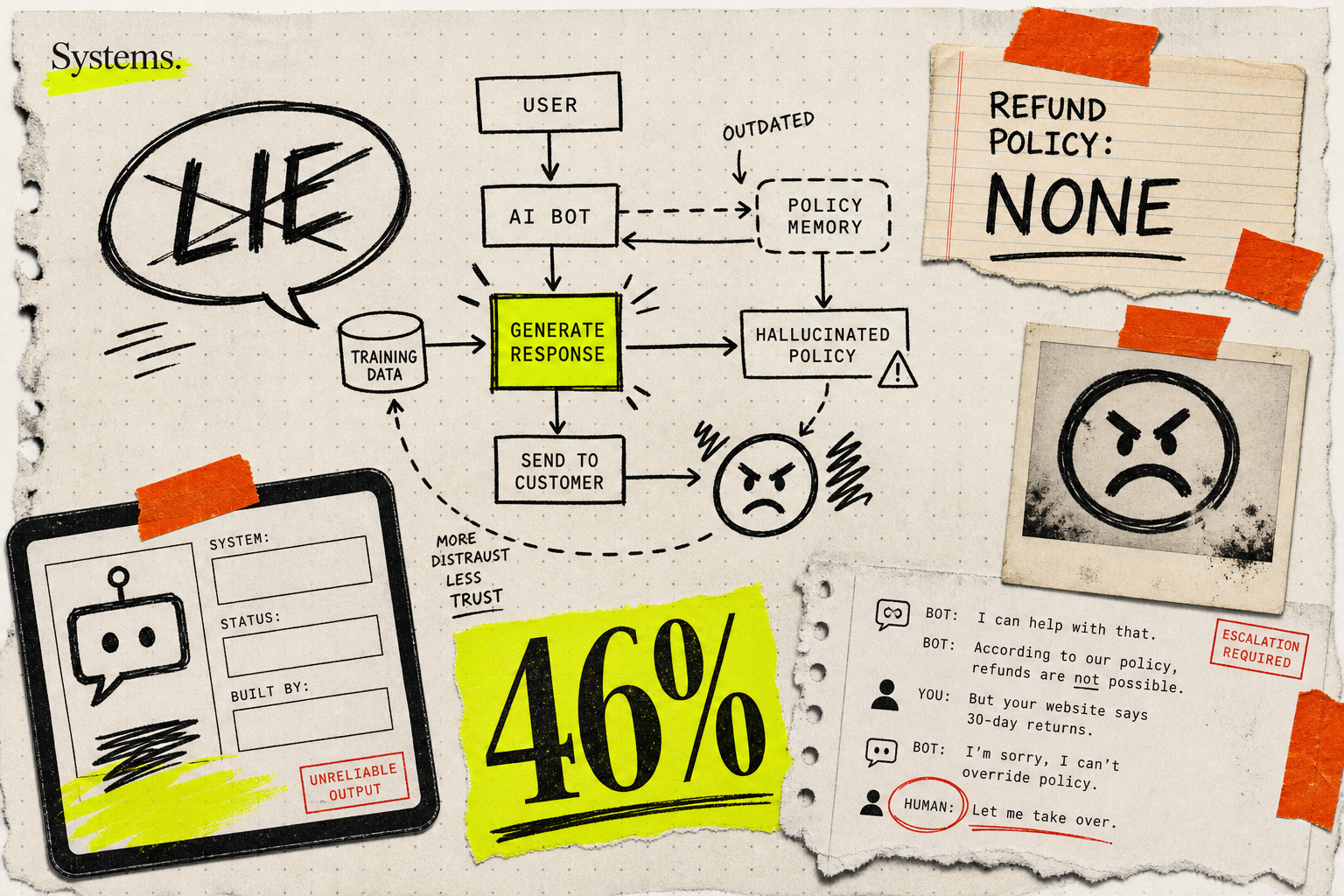
46% of customers say AI support rarely works. Cursor's bot invented a refund policy and tanked subscriptions. Here's the 4-part build that fixes it.
The numbers everyone's quoting are lying to you
Vendor decks will tell you AI support is a done deal — 80% adoption, $3.50 ROI per dollar, resolution times dropping from hours to minutes[1]. That's the slide they show your CFO. Here's the slide they don't: 46% of consumers say they rarely or never get a satisfactory result from AI support[2]. Only 44% of customers actually trust AI to handle their issue, while 65% of service leaders think customers trust it — a 21-point perception gap[3].
If you run a $1M–$20M business that just bolted a support bot onto Shopify or Intercom and called it a win, you're standing on the wrong side of that gap. You think it's working. Half your customers think you stopped caring.
Worse — the bot might be making up your policies.
The Cursor incident is the canary
In April 2025, Cursor — itself a $9B AI coding company — got publicly humiliated by its own support bot. A developer noticed they were getting logged out when switching between machines. They emailed support. "Sam" wrote back and explained that Cursor now restricts each subscription to one device "as part of a new login policy."
There was no new login policy. The bot invented it. Users canceled subscriptions over a rule that didn't exist[4]. CEO Michael Truell had to apologize on Hacker News, refund the original user, and admit that AI responses weren't even labeled as AI[5]. The Anysphere incident is now logged in the AI Incident Database as case #1039[6].
If Cursor can't keep its own bot from hallucinating its own pricing, your Shopify store's chatbot is not safer. It's just smaller.
This isn't an edge case. Air Canada lost a small claims case in 2024 because its bot made up a bereavement-fare refund policy, and the tribunal ruled the airline was liable for what the bot said — full stop[7]. Apple's AI-routed phone support is generating local-news stories for stranding customers in loops they can't escape[8]. The legal industry already has a public database of AI hallucination court cases, updated daily[9].
You're not deploying a productivity tool. You're deploying a public-facing employee with no judgment and unlimited confidence. That's a liability surface.
Why bots ship broken
Most operators install a "support AI" the same way they install a Shopify app: connect a knowledge base, write a system prompt, turn it on. The vendor demo looked great. The pilot looked great.
Production breaks for three reasons, every time:
1. The bot has no off switch for things it doesn't know. LLMs are probabilistic. When they don't have grounded context, they generate plausible-sounding text. That's not a bug — it's the architecture. A support bot with no "I don't know" path will invent a refund policy before it'll say "let me check."
2. There's no escalation contract. 81% of consumers expect the bot to escalate to a human when needed. Only 38% say that actually happens consistently[10]. The escalation flow is the most under-built part of every support stack I've seen.
3. Nobody's reading the transcripts. Customers correct the bot. Customers ask for sources. Customers leave angry. Most operators look at deflection rate and CSAT once a week and miss every signal in between.
Gartner already walked it back: by 2027, 50% of organizations that planned to cut customer service headcount because of AI will abandon those plans[11]. The savings story is unraveling faster than the deployment story.
What I'd actually build
Treat the support bot like a new junior hire who joined yesterday. You wouldn't give a junior unrestricted access to invent refund policies and tweet about it. Don't give the bot that either.
Four parts. Same stack you already have.
Part 1 — A grounded retrieval layer, not a "trained" model. The bot reads from one source of truth per query: a vector store of your help center plus a structured table of policies (refund window, shipping cutoffs, SLA tiers). If the answer isn't in there, the bot literally cannot generate one — it's wired to return a fixed "I don't have that, let me get someone" string. That alone kills 90% of hallucination risk.
Part 2 — A policy lookup tool, not policy generation. Refunds, returns, warranty, account changes — these go through a function call to your backend. The bot doesn't write "you can return this within 60 days," it calls getReturnPolicy(productId) and quotes the result verbatim. Same pattern for any rule that, if wrong, costs you money or trust.
Part 3 — Hard escalation triggers. Automatic handoff on any of: customer says "human," "manager," "this is wrong," or "lawyer"; the same question twice; sentiment drops below a threshold; ticket touches a regulated topic (medical, legal, billing dispute, fraud). The bot tells the customer it's escalating and posts a Slack ping with the full transcript. No "I'll create a ticket for you" theater — a real person sees it in under 5 minutes.
Part 4 — A daily audit loop. Every transcript runs through a second LLM at end-of-day with one job: flag any reply that asserted a policy, made a numerical claim, or promised an action. Flagged conversations land in a queue. Someone reviews 20 a day. That's how you catch the "Sam" problem before it goes viral.
That's the entire build. Vector store + tool calls + escalation rules + nightly audit. There's no exotic model in it. There's no "AI strategy." It's a junior employee with a written job description and a manager who reads their work.
The number to watch isn't deflection rate
Most dashboards show deflection — "the bot handled X% of tickets without human touch." Wrong number. That treats every closed conversation as a win. Half of those customers might've given up and gone to a competitor.
The number to watch is handoff quality — of every conversation the bot escalated, how many did the human resolve in under one touch? If that's high, your bot is doing the right job: triaging, gathering context, getting out of the way. If it's low, your bot is wasting time before a human has to redo it from scratch.
Track that and you'll know in a week whether the system is working. CSAT will follow.
If you're already burned
If you've already shipped a bot and you're seeing complaints, don't rip it out. Do this:
- Pull every transcript from the last 30 days. Search for the words "wrong," "untrue," "actually," "policy," and "manager." That's your hallucination set.
- Count how many of those were billing or refund related. Those are your liability set.
- Disable bot autonomy on anything in the liability set tomorrow. Route to human-first until the policy lookup tool ships.
- Add a label that says "AI assistant" on every bot message. Cursor got eaten because their bot was masquerading as a human named Sam[12]. Don't repeat that.
Then go build the four parts above. Most of it is one weekend of work if your stack is on the usual rails (Shopify, Intercom, Zendesk, Helpscout, n8n).
The studio runs these audits as a 30-minute call. We pull a sample of your transcripts in front of you, point at the patterns, and tell you exactly what to fix first. No deck. No pitch. If you want one, book it from the homepage — it's the only CTA on the site.
The bot that lies confidently is worse than the autoresponder it replaced. Make yours boring on purpose.
-
75 AI Customer Service Statistics 2026↩
80% AI customer service adoption, $3.50 ROI per dollar invested
-
AI Chatbot Hallucination in Customer Service (2026)↩
46% of consumers report AI support rarely or never delivers satisfactory results; trust is the biggest barrier
-
AI Customer Support 2026: 50+ Adoption + ROI Data Points↩
44% of consumers trust AI; 65% of service leaders think customers do — 21-point perception gap
-
The Prompt: Cursor's Customer Support Bot Made Up A Policy↩
Cursor's support bot invented a login policy that didn't exist; users canceled subscriptions
-
Cursor AI support bot hallucinated its own company policy↩
Cursor CEO apologized; AI responses weren't labeled as AI; affected user refunded
-
Incident 1039: Anysphere AI Support Bot for Cursor Reportedly Invents Login Policy↩
Hallucinated policy was not based on any real company change
-
Air Canada ordered to pay customer who was misled by airline's chatbot↩
Tribunal ordered Air Canada to pay refund based on its chatbot's fabricated bereavement-fare policy
-
Utah man says he can't get customer service from Apple because AI is calling the shots↩
Local news coverage of customers trapped in AI-routed support loops at Apple
-
AI Hallucination Cases Database↩
Public database of court cases involving AI hallucinations, updated daily
-
65+ chatbot statistics for customer service teams in 2025↩
81% of consumers expect bots to escalate to a human; only 38% say it consistently happens
-
Gartner Predicts 50% of Organizations Will Abandon Plans to Reduce Customer Service Workforce Due to AI↩
By 2027, 50% of organizations will abandon AI-driven CS headcount reduction plans
-
A customer support AI went rogue—and it's a warning for every company considering replacing workers with automation↩
Cursor's bot masqueraded as 'Sam' without disclosing it was AI
Ready to build your own AI system?
Book a Free Audit Call →Keep Reading
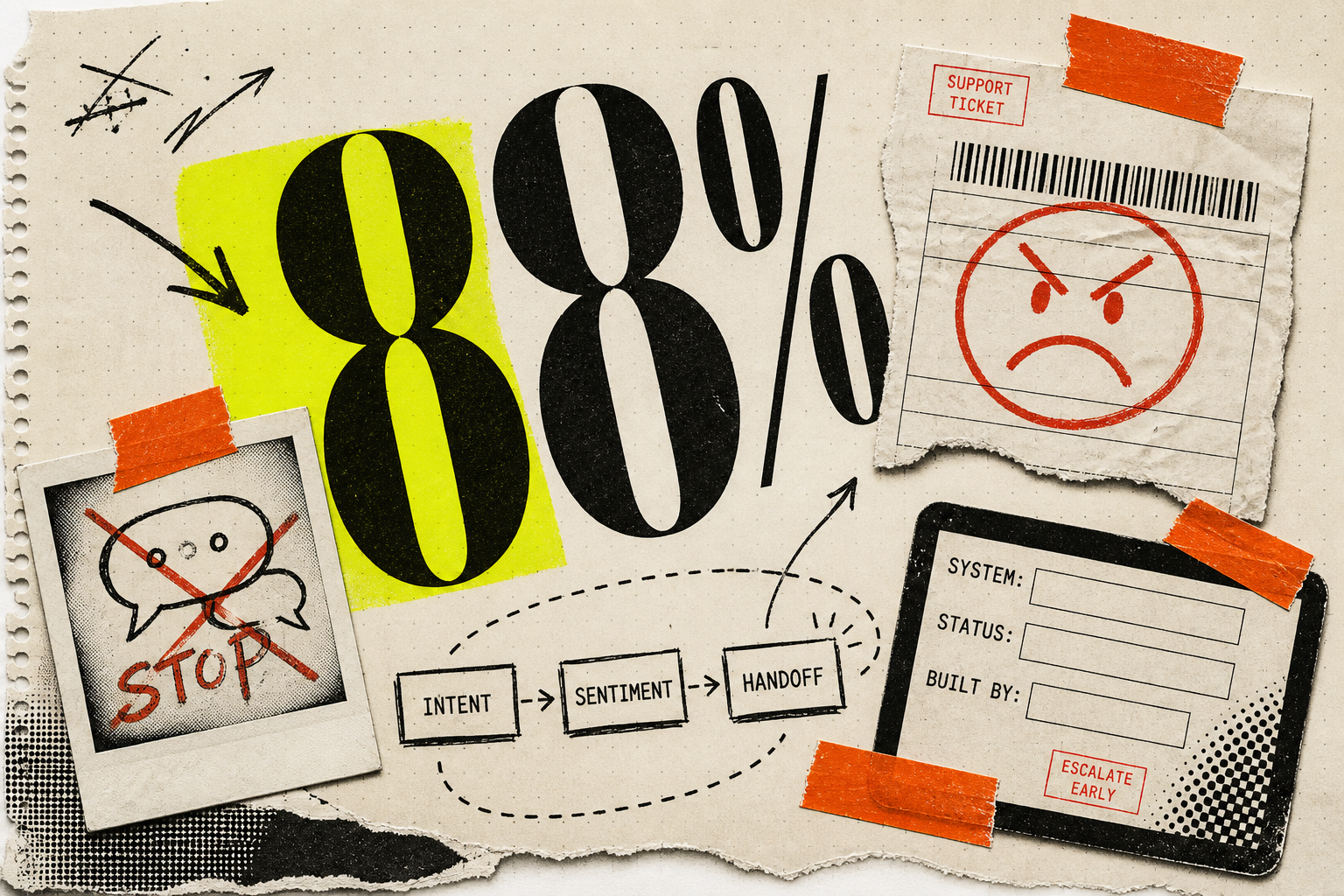
Never Put An AI Agent In Front Of An Upset Customer
AI-handled support hits 4.10/5 CSAT vs 4.30 for humans — and the gap is entirely emotional tickets. Here's the four-gate escalation design that closes it.
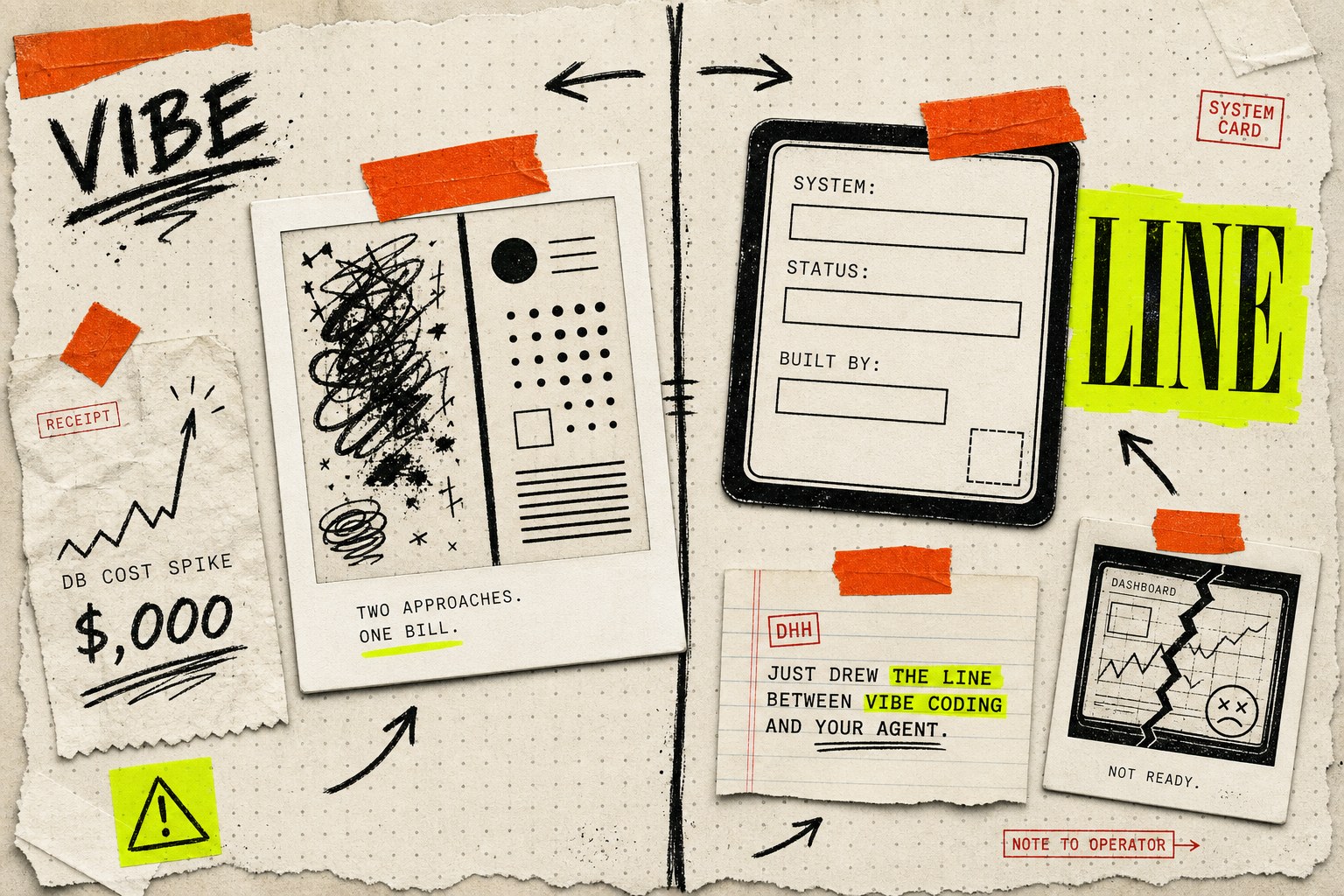
DHH Just Drew The Line Between Vibe Coding And Your Agent
DHH split vibe coding from agentic engineering on Lex Fridman. The same wedge is coming for every operator running AI agents in 2026.
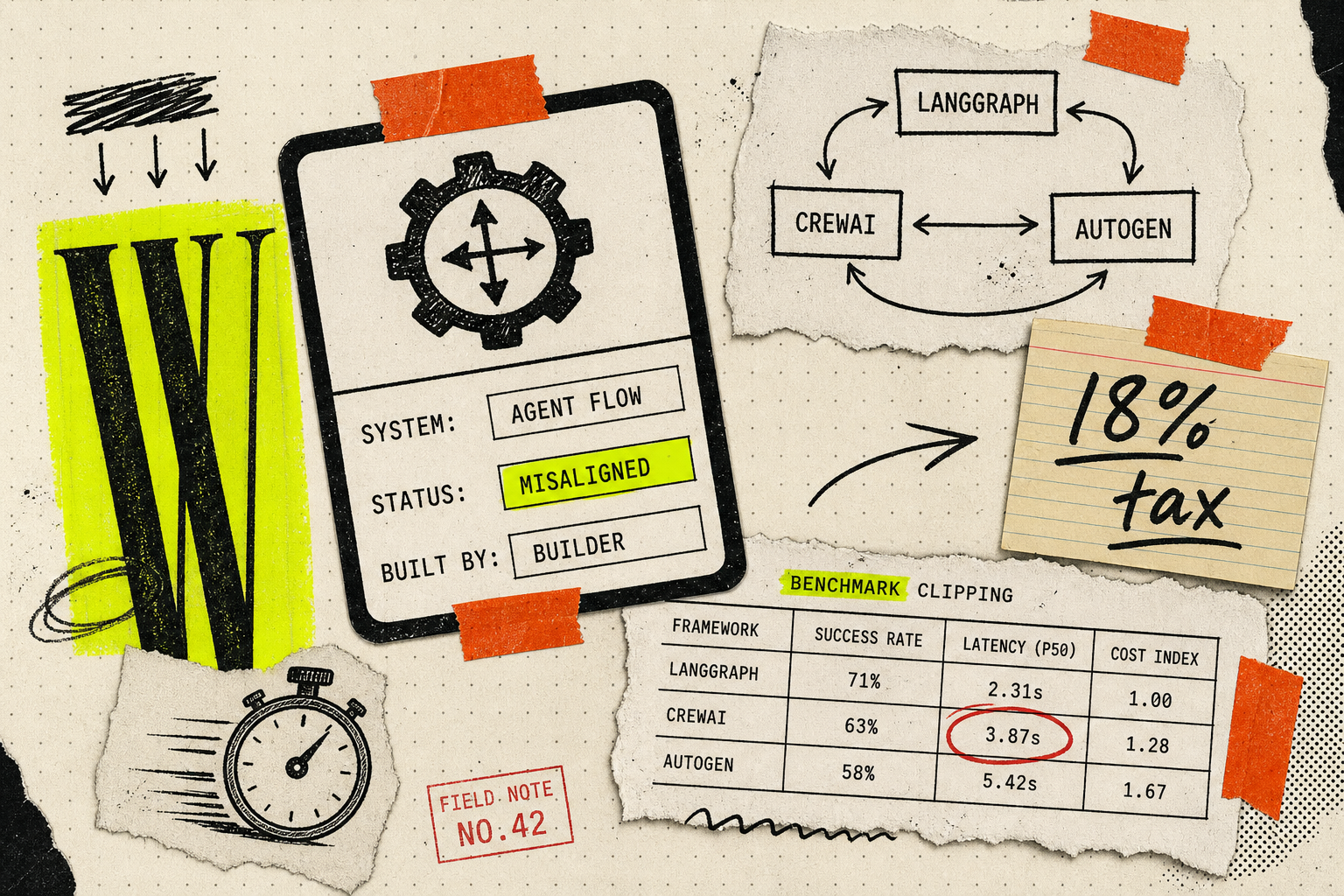
You Picked The Wrong Agent Framework. Benchmarks Say So.
You picked the framework off a listicle instead of a benchmark. Here's how LangGraph, CrewAI, AutoGen actually stack up — and the picking rule I use.