Shopify's AI Website Builder Isn't Your Problem. Your Data Is.
Shopify's Spring '26 shipped 150+ updates and everyone's staring at the AI store builder demo. Here's the layer underneath — and the audit I'd run before touching any of it.
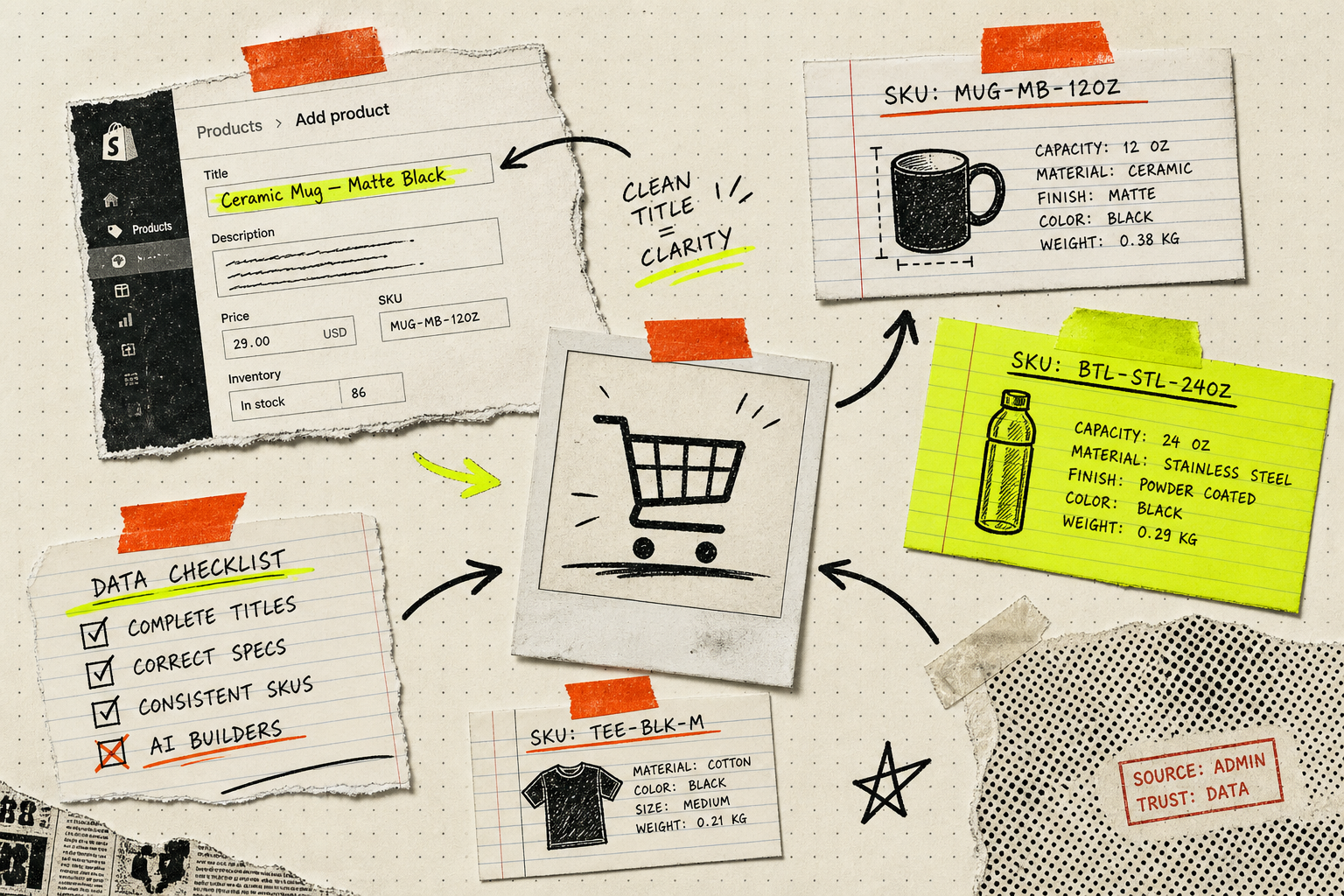
Shopify shipped 150+ updates in its Spring '26 Edition on June 17, and the "build a store from a prompt" demo is what everyone posted about[1]. That's the wrong thing to look at.
The prompt-to-store demo is a launch reel. The real story sits three layers down. Shopify quietly turned its admin into an agent, opened its Catalog and Cart to any AI assistant, and shifted the game so your storefront isn't where shoppers find you anymore. If your product data is messy, none of it works. Fudge interviewed 27 founders in the week after the launch. 22 of them said their product data isn't clean enough to win in AI channels yet[1]. That's the number that should scare you — not the fact that Shopify can now build a starter site in 60 seconds.
I'll walk through what Shopify actually shipped, what the AI store builder can and cannot do, and where I'd spend the next two weeks if I ran a store today.
What Shopify actually launched
Spring '26 has three moving parts that matter for a $1M–$20M store.
Sidekick, the admin agent. It writes copy, edits product images, segments customers, and now creates records when you describe them in English. Shopify's Q1 2026 earnings put weekly active shops using Sidekick up 385% year over year, with more than 12,000 custom apps built through it in a single quarter[2]. Merchant surveys peg the time savings at 5–10 hours per week for solo operators[3].
The AI Store Builder. Type a prompt, get a working starter storefront. It's included on any Shopify plan. It's genuinely fast, and for a first-time seller it clears the "blank admin" wall. It also has a ceiling — the site it hands you converts like a template with placeholder copy, because that's what it is.
The Universal Commerce Protocol and public MCP servers. This is the part almost no launch recap explains. Shopify co-developed a protocol with Google, Amazon, Meta, Microsoft, Stripe, and others that lets AI assistants read your catalog, add to cart, and check out — natively, no scraping[1]. Shopify's VP of Product called it "the agentic commerce infrastructure for the internet." Any developer can hit the Catalog, Cart, and Checkout MCP servers today, no approval committee.
Layer three is a new admin section called Agentic Storefronts that shows what AI-driven traffic and orders are doing to your store[4]. That's the one you should open first thing tomorrow morning.
Why the store builder is a distraction
I've watched enough sellers chase the next builder to know how this goes. You'll spin up an AI-generated storefront, publish it, wait a month, get 400 sessions, convert at 0.6%, and blame the AI. The problem isn't the AI. It's that a prompt-generated store solves the wrong bottleneck.
Your bottleneck isn't "getting a site up." It's whether people who see your product actually buy it — and now, whether AI assistants pick your product to recommend at all. Shopify's own numbers claim that AI searches powered by the Catalog convert at twice the rate of searches built on scraped data, and AI-driven traffic to Shopify stores grew 8x year over year[1]. That growth is real. But the sellers winning that traffic have clean product data. The ones losing it have messy titles, missing attributes, and product descriptions that don't tell an AI what the product actually is.
A dropshipper I know tested this. Same store, same products, one week apart. He rewrote 40 SKUs — proper titles, structured attributes, real specifications, no marketing fluff — and the impressions in Google's AI Overviews for those SKUs went from single digits to consistent daily surfacing. He didn't change his theme. He didn't touch his ads. He fixed the data.
The honest read on Sidekick
There's a scorecard I keep coming back to. One agency measured Sidekick against the typical scope of work a Shopify Plus merchant sends them and called it "genuinely transformative on about 70% of the work"[5]. That's a big number, and probably right for the boring 70%: copy drafts, image edits, customer segments, bulk updates, one-off admin questions.
The 30% Sidekick struggles with is the 30% that matters: complex multi-step actions, deep integrations with your email platform or analytics, custom code, and anything that spans multiple systems. Merchants report Sidekick giving "imprecise answers on complex tasks"[6]. It works well inside Shopify's native features but can't manage configurations in your email platform, analytics tools, or fulfillment providers[3].
There's a broader signal here worth taking seriously. Stack Overflow's 2026 developer survey found 84% of developers use AI tools, but trust in their accuracy dropped to 29%. The top complaint: output that's almost right but not quite[7]. Sidekick sits inside that same "almost right" band. The approve-before-save model exists precisely because Shopify knows this.
Treat Sidekick like a fast junior. You still review the work.
The autonomous checkout question
OpenAI pulled back ChatGPT Instant Checkout in March 2026 after early rollout issues[1]. That's a real datapoint against the "agentic commerce is here now" narrative. Discovery inside AI assistants is working — orders are landing. Fully autonomous, no-human-in-the-loop checkout is not solved. Anyone selling you a $200/month "rank in ChatGPT" tool is selling you a shortcut into an ecosystem that's still forming[8].
The fundamentals still win. Clean product data, real specs, structured attributes, and schema markup are enough to compete in AI channels today[8]. Everything else is speculation.
Where I'd spend the next two weeks
If I ran a store today, I'd ignore the AI store builder entirely and do these four things, in this order:
- Audit product data on the top 25 SKUs. Every field. Title, description, attributes, dimensions, materials, use cases. Rewrite for a machine reader, not a hero image. AI assistants recommend the product they can describe accurately.
- Turn on the Agentic Storefronts admin section. Read what AI channels are already doing to your store. You need a baseline before you optimize anything.
- Use Sidekick for bulk work — with a review pass. Product copy drafts, image cleanups, customer segments. Save the 5–10 hours a week. Don't let it publish without a human sign-off.
- Run one A/B test this month. Shopify shipped native A/B testing with Spring '26 — no paid app needed. Test one thing. Get one clean answer.
Ignore the tooling churn under this. The prompt-to-store demo will get better. So will Sidekick. So will agentic checkout. None of that changes the input variable: a machine can't sell a product it can't describe.
Clean the data. Everything else follows.
-
Shopify Spring '26 Edition: The Updates That Matter (2026)↩
Spring '26 shipped 150+ updates on June 17, 27 founders interviewed with 22 flagging unclean product data; OpenAI pulled back ChatGPT Instant Checkout in March 2026.
-
AI sidekick for Shopify: what it is, what it isn't↩
Q1 2026: weekly active shops using Sidekick up 385% YoY; 12,000+ custom apps built through it in one quarter (per PYMNTS via Shopify earnings).
-
Sidekick AI Agents: Activate Agentic Commerce on Shopify in 2026↩
For lean teams, Sidekick shaves 5–10 hours per week off repetitive admin work; Sidekick can't reach outside Shopify into email, analytics, or fulfillment platforms.
-
Shopify AI in 2026: Every Feature, Tool & Agent You Need to Know↩
Shopify AI is a three-layer stack (native, agent/commerce, third-party) — the new Agentic Storefronts admin section is where AI-driven traffic and orders are tracked.
-
Shopify Sidekick vs Your Agency: The Honest 2026 Scorecard↩
One agency scorecard: Sidekick is 'genuinely transformative on about 70% of the work' a typical Shopify Plus merchant sends to an agency.
-
Shopify Sidekick Review: What It Can (and Can't) Do for Your Store (2026)↩
Merchants report Sidekick giving 'imprecise answers on complex tasks' — the approve-before-save model exists precisely because of this.
-
State of Shopify AI 2026: What's Real vs Hype↩
84% of developers use AI tools but trust in accuracy dropped to 29% — 'almost right but not quite' is the top complaint.
-
AI for Shopify in 2026: Tools and Workflow↩
The 'agentic AI optimization tool' market is too young for proven recipes — clean product data, clear titles, and schema markup are the fundamentals that win in 2026.